Invitation to Participate – Study to understand the use of international commercial arbitration

The Commonwealth Secretariat is conducting a Study on challenges to accessing international commercial arbitration across the Commonwealth, and potential solutions (http://thecommonwealth.org/arbitration-study). The Secretariat was requested to conduct the study by Senior Officials of Commonwealth Law Ministries at their meeting in London in October 2018.

The aim of the study is to understand the use of international commercial arbitration in addressing commercial disputes across the Commonwealth, as well as ways in which member countries may strengthen the accessibility and effectiveness of international commercial arbitration. The study will be authored by a group of distinguished arbitration experts, advised by a task force representing arbitration expertise from every region of the Commonwealth.
As part of the study stakeholders are asked to fill out relevant questionnaires:
arbitrator, counsel, business, academic (closed).

The Study is expected to be completed for consideration at the meeting of Commonwealth Law Ministers in late 2019 and will be publicly available on the Commonwealth Secretariat website.

Teaching Mediation through Video and Peer Discussion

Legal education in Australia increasingly acknowledges the need to teach about technology and law schools have included elective and core curriculum dealing with such issues (Judy Gutman and M Riddle, ‘ADR in Legal Education: Learning by Doing’ (2012) 23 Australasian Dispute Resolution Journal194; Kathy Douglas, Josephine Lang and Meg Colasante, ‘The Challenges of Blended Learning Using a Media Annotation Tool’ (2014) 11(2) Journal of University Teaching and Learning Practice 1, 3-4). There are now subjects that provide the opportunity to build computer apps (applications) to solve legal problems and core courses include information on issues such as smart contracts and blockchain. For example, FineFixer, an application devised to help the public implement strategies to deal with fines, was initially developed by RMIT University students in an elective course and was later made available through the Moonee Valley Legal Service, funded by a grant from the Victoria Law Foundation.  Higher education is evolving with faculty increasingly engaged ‘with options and technologies, including collaboration tools, video and media’ where video, as a visualisation media, taps into ‘the brain’s inherent ability to rapidly process visual information, identify patterns, and sense order in complex situations.’ (New Media Consortium and EDUCAUSE, NMC Horizon Report: 2018 Higher Education Edition (2018) 11 March 2019, 35)  ADR teaching also needs to adopt the latest technology in teaching about areas such as negotiation, mediation, arbitration and collaborative law.

Teachers of mediation have often relied on videos to demonstrate mediation skills to prepare for role-plays. However, merely watching a video may not be as effective as also engaging with peers. The watching of video, combined with a subsequent online discussion of mediation skills, can enhance student learning as students become active rather than passive learners. After watching videos and discussing the legal skills online, students can later be asked to demonstrate these skills in role plays. Our article in the latest edition of the Australasian Dispute Resolution Journal discusses an example of the use of video and online discussion to scaffold learning about mediation (Kathy Douglas, Tina Popa and Christina Platz, ‘Teaching Mediation Using Video and Peer Discussion: An Engaged Video Learning Model’ (2019) 29(3) Australasian Dispute Resolution Journal 182). Students watch a video of a mediation, discuss the mediator interventions online and then undertake role plays at an intensive weekend seminar. The scaffolding of student learning through watching the video and subsequent online discussion prepares students to demonstrate the mediation skills. The article concludes with a model of ADR learning with video that serves as a useful guide to implementing active video learning activities. This model can be used to make further videos such as specific contexts of mediation that is family, workplace or community mediations. The model could be used to develop videos on other ADR options such as conciliation, arbitration and collaborative law. We hope this model might assist the ADR community to use technology effectively in their teaching of ADR skills and theory.

webinar-3199164_1920

[pixabay, free image, mohamed_hassan]

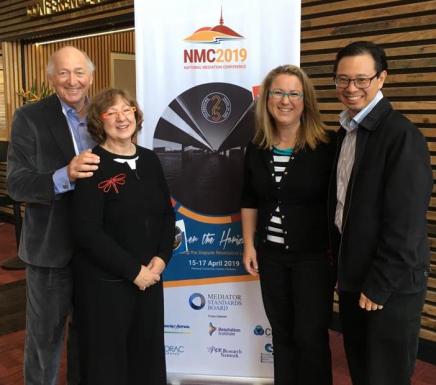
NMC2019

NMC2019-banner

OMG       YOU’RE NOT REGISTERED YET???

This will be a remarkable event.  Not only 11 national and international Plenary Speakers.  Not only more than 130 national and international presentations.  Not only more than 500 delegates to catch up with, or to lose yourself among.

But also a Welcome Function with views to die for.  A cocktail party with the Australian Government Solicitor.  An informal dinner at a smokehouse that just happens to be a winery, too.  A (competitive) poetry slam.  And a farewell function to wrap it all up.

Pre-conference workshops to refresh your practical skills.  Not only traditional presentations, but opportunities to contribute and to take part: mini-workshops, collaborative conversations, interactive panels.  Child-inclusive FDR; ethical complexities in Elder Mediation; perspectives on leadership; unexpected applications for restorative practice; what’s happening in conciliation; research and you; younger people, older people, and everyone else.  And illuminations from other countries, other cultures, other societies.

And three journals calling for papers from the conference: the ADRJ, The University of Newcastle Law Review, and the Bond Law Review.

And the ADRRN NMC2019 Blogfest.

Phew!  Thank goodness the Easter break is so close – you’ll have earned a rest.

Pickle_Puppy_cropped

[© A. Boyle 2018]

Get on to it, before it’s too late:

http://nmc2019.com.au/

Please do contribute to our Indigenous Delegate Support Fund while you’re registering.

Understanding the Brexit dilemma – How negotiation games provide analytical tools

Brexit

Picture Credit – Wikimedia Commons

When Professor Roger Fisher of Harvard Law School’s Program on Negotiation published ‘Getting to Yes’  in 1981, Game Theory was well developed.

It was firmly in the grasp of mathematicians and economists – not lawyers.

First advanced by mathematicians  in1944, more mathematicians followed, developing a game model of co-operation and conflict. This was later enhanced–  given a prison-sentence scenario and named The Prisoners Dilemma.

Nobel Prize – winning John Nash made further enhancements, giving us the Nash equilibrium – a model of problem solving to analyse and resolve the prisoner’s dilemma game.

By the time ‘Getting to Yes’ was published, game theory was a strong part of economic theory and analysis. Business schools had wrested it from the mathematicians and installed it in mainstream business programs.

Researcher followed researcher – developing and enhancing what has become known as the field of distributive negotiation.

Fisher’s ideas about interest-based negotiation (called integrative negotiation) were influenced by but separate from the distributive work of the business schools.

Fisher embraced The Prisoners Dilemma and other games in his teaching.

He often used the famous Negotiation Auction game, demonstrating how emotion and ego can override rational behaviour in negotiation. In this game, players bid for, say, a $10 note. Bids start low and then move surprisingly close to $10 as the competitive emotions kick in. The rules require that the top two bidders must pay their final bid although only the highest wins. Consistently the last two bidders pay more than the face value of the note, trapped in an ego-driven battle in which emotion overrides reason.

Edward’s Game

Using case studies, Fisher refined this game into something he named ‘Edward’s Game’ – although sadly he did not explain who Edward was nor publish his analysis.  Playing it in class with Fisher, we experienced an addictive game where the proponent has something desired increasingly fiercely by other competing negotiators. The proponent’s pitch is ‘I won’t tell you what I want – you just keep putting offers on the table and I will tell you when it is enough’.

The seductive quality of the game increases with the negotiator’s desire for what is at stake. In the domestic setting we often observe Edward’s Game when one party anxiously seeks forgiveness from another who refuses to indicate what forgiveness will require.

Edward’s Game is the gift that goes on giving.

It provides a terrific frame to test and analyse international dilemmas that appear completely irrational.

Brexit through the lens of Edward’s Game.

Brexit is playing out in the House of Commons, while the world watches in dismay. It is evident that no-one, except the economists who are commenting, the EU and the horrified public, is behaving in a way that can be explained  by the rational, analytical tools of game theory.

Edward’s game has been playing for quite a while.

May clearly has a powerful interest in being seen to honour her promise of being the Prime Minister who implements the public vote to leave. To complicate matters, there is more than one Edward’s game being played out. This makes her negotiation task so much more difficult because the different interests she has to satisfy in order to ‘win’ are in conflict. Some interests use Brexit blocking as a tool to pursue a more devious agenda of self-promotion and derailing of May’s leadership. Some interests relate to overturning the ‘leave’ decision and some interests relate to being unwilling to do anything which might be seen to be ‘giving in’ to the Europe that Brexiteers had vowed never to be seen to agree with again.

May keeps putting more on the table.

She went back to the EU to negotiate an extension. The warring parties would not agree and more of her own party defected to a new independent group with different interests again.

Receiving intelligence that a uniting interest of key decision-makers was her demise, she offered a new solution. She would resign if the proposal negotiated with the EU were approved. No luck.

She is now talking of a further extension which shows no signs of meeting sufficient approval yet for a motion to be passed in the house – but watch this space.

Negotiating Edward’s game successfully

Fisher constantly demonstrated to us willing participants in his game how difficult it was to ‘win’ without giving away more than the value on offer. This is what is happening with Brexit also.

Fisher proposed 3 tools for ‘winning’ Edward’s game. How might they work in this scenario?

  1. Go to yourBATNA– but, leaving it so late, what could have been May’s BATNA has deteriorated into a WATNAand would end in lose/lose – a very bad outcome.
  2. Change the players– May has signalled willingness to resign as the price for approval of her deal but it is too late. Divisions are so entrenched it would be near impossible to find an acceptable leader with the numbers to get May’s deal through. She has been experimenting with another version this week – collaborating with Labour leader Jeremy Corbyn. A good outcome seems very unlikely.
  3. Change the game– May has already been cycling through Fisher’s seven elements. She has tried ‘relationships’ but her antagonists are prepared to risk all key relationships in their bid to block her. She has tried to brainstorm ‘options’ but masterful Edward’s Game players won’t play. She has tried ‘standards’ but apparently the regulatory pain of a hard Brexit is bearable if it will block her deal. Seems hard to see where to go from here.

Edward’s Game provides a great opportunity for using negotiation tools to explain the apparently irrational. As world leaders in many places showcase their Edward-like skills, commentators and analysts need to name the game early so that constituencies can be encouraged to find common interests quickly and avoid discovering that both the battle and the war have been lost.

The ethics of 21st century ‘family justice’ research: Invitation to Workshop

The Australian Chapter of Family and Conciliation Courts is hosting its conference in Sydney between 15 to 17 August 2019. ADRRN members are welcome to register to attend the conference. Chapter secretary Jenni Neoh has alerted us to a workshop of particular interest to researchers in family law and family dispute resolution.

AFCC-LogoThe ethics of 21st century ‘family justice’ research, and its application to professional practice

Associate Professor Nicola Taylor, Alexander McMillan Chair in Childhood Studies, Director, Children’s Issues Centre University of Otago, Dunedin, New Zealand, Professor Judith Cashmore, University of Sydney, Sydney NSW.

This full day workshop draws together the combined expertise of three leading international researchers who have undertaken numerous studies on a diverse range of family law issues including post-separation residence and contact arrangements, relocation, international child abduction, children and young people’s views/participation, child protection, out-of-home care, child witnesses and family dispute resolution processes. The researchers will provide a unique perspective on the nuances of ethical research with families, particularly separated parents and their children, and with the family justice professionals who work with them. The workshop explores key ethical issues and complexities that have arisen for them in the research context, but which also have relevance for working with, or representing, children more generally in the family justice context. The benefits and limitations of social science research evidence in family law practice and dispute resolution will also be addressed.

Participating in this workshop is critical for all family law professionals, researchers and academics who want to better understand and discuss the role of research in the family justice field and how it applies to their practice or field. Opportunity will be given to workshop participants to raise ‘ethical’ issues they have grappled with too.

Call for Papers: 8th ADR Research Network Round Table

We are delighted to announce our Call for Papers (click here for Word version) for the 8th Australasian Dispute Resolution Research Network Roundtable, to be held at Latrobe University Law School in Melbourne on 9th and 10th December 2019. Please note that this post is the only way that we advertise the Roundtable, so please disseminate to any researchers who may be interested.

ADR Network logo

Call for Paper Proposals

The 8thAnnual Research Roundtable of the Australasian Dispute Resolution Research Network (ADRRN) will be held in Melbourne, 9-10 December 2019.

ADRRN roundtables provide a collaborative and supportive research environment for work-shopping papers-in-progress. Draft papers are distributed ahead of time to participants, to enable thoughtful and constructive quality feedback. Time allocated for a presentation is usually 30 minutes for presentation, and 30 minutes for feedback and discussion. Two primary commentators are appointed for each paper.

The ADRRN is now calling for papers for the 2019 roundtable to be held at the La Trobe Law School, La Trobe University Melbourne, City Campus. Paper proposals of no more than 300 words should be submitted via email to adrresearchnetwork@gmail.comby 31 July 2019. Presenters will be required to submit, in addition to draft papers, a short blog post of no more than 1000 words prior to the roundtable. Blog posts will be published here on the ADRRN’s webpage:  https://adrresearch.net/.

Paper proposals that consider dispute resolution from a scholarly, critical and/or empirical perspective are welcome. We particularly encourage submissions from postgraduate students and early career researchers. All proposals will be considered. Papers must not have been published or submitted for publication, as the focus is work in progress.

A selection panel will select round table papers from abstracts submitted. The following selection criteria will be applied:

  • Papers take a scholarly, critical and/or empirical perspective on an area of dispute resolution;
  • The round table will include a spread of participants across stages of career; and
  • A well-balanced range of work will be presented at the round table to provide diversity, to develop the field and to enable cohesive discussion.

Participation is on a self-funded basis.

Attendance at the Round Table is only open to individuals who are contributing to the scholarly discussions by presenting a paper, or commentating and/or chairing a session.

Deadline for paper proposals: 31 July 2019

(300 word maximum plus short bio, to adrresearchnetwork@gmail.com)

Date for notification: 16 August 2019

Draft (full) papers + blog post due: 31 October 2019 (to send to participants early Nov.)

For further information, please contact:

2019 Network President: Lola Akin Ojelabi via adrresearchnetwork@gmail.com

2019 Roundtable Conveners: Lola Akin Ojelabi and Jacqueline Weinberg

About the Australasian Dispute Resolution Research Network

The Australasian Dispute Resolution Research Network brings together leading dispute resolution scholars and provides a collaborative environment to foster, nurture and enrich high quality research and scholarship. The Network is inclusive and forward-looking and seeks to bring together emerging, mid-career and established scholars to build excellence in the field and provide peer support. Network activities are expressly designed to provide a supportive and collegial presentation environment in which meaningful discussion and constructive feedback is provided to the presenter.

Network activities include maintaining the ADR Research Network blog at www.adrresearch.net on Twitterand conducting annual scholarly round tables of work in progress since 2012.

Guest blog post proposals are always welcome. Contact blog editor Olivia Rundle, at Olivia.Rundle@utas.edu.au.

Membership of Australasian Dispute Resolution Research Network

We don’t like hierarchies or unnecessary administration, so we don’t have any membership list or legal organisational framework.

The way to become a member of the ADR Research Network is to subscribe to the blog. This is our primary means of communication.

Subscription will mean that every time a post is made on the blog you will receive a notification alert to your email address. Other ways to follow blog activity is through Facebook “ADR Research Network” and Twitter@ADRResearch, but engagement on these platforms is not necessary to keep track of blog activity.

Conflict about Climate Change

Screen Shot 2019-03-15 at 10.51.42 amSchool students are protesting today about the failure of politicians to take serious action in response to climate change. They are calling for action. The Global Strike for Future grew from 16 year old Swedish student Greta Thunberg‘s decision to strike on Fridays outside the Swedish parliament. She has been joined regularly for Friday protests by students in Germany, Belgium, Britain and France. Today’s global protest is happening in 112 countries including Australia. “Pupils from hundreds of schools in over 55 cities and towns across Australia are using the action to call on all politicians to stop Adani’s coal mine, say no to all new fossil fuels and power Australia with 100 per cent renewable energy by 2030.

A protest is obviously evidence of a dispute, in this case between politicians and young people, most of whom are not yet allowed to vote. It is hard for people without a right to vote to persuade democratically elected politicians. The power imbalance between the primary parties to this dispute is obvious. However, if there is, as is expected, a significant turn out in numbers, a strong message will be sent to politicians about what future voters think about their performance on climate change. The dispute has already sparked reaction from politicians in Australia, with the Prime Minister, Deputy Prime Minister, Commonwealth Education Minister and NSW Education Minister all making public statements calling for students to stay in school and not participate in the strike. The Deputy Prime Minister said in parliamentary question time that “the children should be staying in school to learn about Australian history, to learn about Australia geography“. Prime Minister Scott Morrison has called for less activism and more learning in schools. Essentially, none of these responses address the substantive concerns of the protestors, instead concentrating on the right to protest where it conflicts with the policy of compulsory school attendance. Other politicians have supported the children’s right to protest, including the ACT Education Minister.

Another argument raised against the protest is that because the people protesting are children, they are essentially being “politicised” and used by adults to push a political agenda. Students have responded assertively against such claims, reinforcing that they are expressing their own concerns. This argument plays upon the power imbalance between the parties, because the people protesting are being told that their message is less persuasive because they lack capacity to form a truly independent opinion in the way that an adult can.

The dispute has spread well beyond the two groups of politicians and school students who wish to protest. Schools have been divided in their support or non-support of their students attending, media coverage reveals a range of views for and against, and parents and children have been negotiating their way around whether or not they are allowed to or supported to participate.

The opportunities for the application of conflict management and resolution processes in this context are infinite.

  • Within families, the opportunity to engage in meaningful, respectful discussions about the issues of climate change action and protesting about it in school time has been taken in many families. There has potentially been enormous growth in the skills that both children and parents have chosen and developed in these dialogues.
  • Similarly, students, teachers, parents, and school principals have all had the opportunity to discuss the issues, negotiate possibilities, and communicate boundaries within school communities. Thinking about ways to enable different points of view to be expressed, and to manage conflicting opinions, power imbalance, and mass protest must have been an enormous challenge within schools. There is always the choice to use power to say “no”, but the civil disobedience on a mass scale that might follow then also has to be dealt with. It will be interesting to see whether schools take the opportunity for a “teachable moment” to discuss protest, school attendance and climate change action by politicians and ordinary people, and effective ways to manage conflicting points of view.
  • Politicians have an opportunity to decide how to engage with the message that the people they govern are sending them. They could decide to open a conversation, to think critically about how people under the age of 18 can meaningfully participate in political life, and to take a more collaborative approach to the conversation rather than the adversarial “for or against” approach that appears to have been adopted so far.


Celebrating Women in Dispute Resolution

Happy International Women’s Day 2019. You may like to flashback to our 2017 International Women’s Day post about gender issues in dispute resolution. This year, I want to celebrate the community building contributions of women dispute resolution practitioners and researchers.

Our Australian Dispute Resolution Research Network is filled with wonderful women, who strive to maintain a mutually supportive, inclusive and friendly community. Women are very well represented among our membership. Many of the prominent scholars in the dispute resolution field are women – we read their work, they supervise(d) our research training, they inspire us. (NB I thought about making a list and decided it would be way too long and could never be inclusive of all the wonderful women DR researchers!). Most of the people who have supported me in my research so far are women. I am forever indebted to them for their welcome, genuine interest, time, care, kindly communicated rigour, and fabulous company. Community is best when everyone makes an effort, and in my own experience, women are particularly adept at building and maintaining community – giving and receiving so much in the process.

In some areas of dispute resolution women appear to face substantial barriers. There is a ‘persistent and severe under-representation of women in the highest levels of international mediation, particularly at the United Nations.‘ By “highest levels” I am guessing the author is referring to the most prestigious and best remunerated international mediation opportunities. The United Nations has recognised that there needs to be equal representation of women as compared to men in international peace building processes. Under-representation of women in international dispute resolution has been given scholarly attention. Attempts to support women’s participation in international level dispute resolution processes include the Women Mediators Across the Commonwealth, a ‘platform for the peer-to-peer exchange and learning of women mediators from across Commonwealth countries.‘ Networks have been created around the globe, to support the participation of women in mediation as a peace building activity. Benefits of networks of women include: improved access to women mediators, best practice development, research and analysis, publication, better consultation with women’s groups, technical expertise, training, confidence building, and inter-generational relationship strengthening.

The example above demonstrates that where there is a will to increase women’s participation in our field, networks can be used to build capacity, confidence, community and profile.

Thank you to all you women in the ADRRN.


ADR rountable dec 2018cris 2

[photographs of some of our women members from the December 2018 ADRRN Research Roundtable, University of the Sunshine Coast, Queensland]

US conference on comparative international dispute resolution processes

Call for Panel Proposals and Papers
ASCL Annual Meeting

17 Oct 2019 – 19 Oct 2019, University of Missouri School of Law’s Center for the Study of Dispute Resolution , Columbia, Missouri

The American Society of Comparative Law (ASCL) has just issued a call for proposals for (1) concurrent panels and (2) a works in progress conference to be held in association with the ASCL 2019 Annual Meeting, which will be held at the University of Missouri School of Law’s Center for the Study of Dispute Resolution between Thursday, October 17, and Saturday, October 19, 2019. The event is open to ASCL and non-ASCL members.

The theme of the Annual Meeting is “Comparative Law and International Dispute Resolution Processes” and will feature presentations on how comparative law affects various types of cross-border conflict, including but not limited to transnational litigation, arbitration, mediation, online dispute resolution (ODR), conflict resolution, access to justice and dispute system design. Concurrent panels and works in progress papers need not fall within this general theme, although of course they may. Multilingual panel proposals will be considered as part of ASCL’s mission to foster plurilingualism.

PAPER SUBMISSIONS/FURTHER INFORMATION: Information on the event, including the call for panel proposals and works in progress submissions, is available at http://law.missouri.edu/faculty/symposia/comparative-law-international-dispute-resolution-processes. Proposals will be accepted until May 20, 2019. Queries may be addressed to Mary Tran at 2019ASCL@law.ucla.edu

The American Society of Comparative Law, Inc. (ASCL) is the leading organization in the United States promoting the comparative study of law. Founded in 1951, it is a thriving organization of more than 100 institutional sponsor members, both in the United States and abroad, and a growing number of individual members. The Society publishes The American Journal of Comparative Law, the outstanding American publication of scholarship on comparative law. The Society also holds annual meetings at which comparative law scholars present research and critically examine important legal issues from a comparative perspective. In addition, the Society provides support to other scholarly conferences both in the United States and internationally that deal with comparative law.

The nationally-ranked Center for the Study of Dispute Resolution (CSDR) at the University of Missouri School of Law seeks to develop and promote appropriate methods for understanding, managing and resolving domestic and international conflict as well as the use of dispute resolution techniques to enhance informed decision-making. In furtherance of that mission, the CSDR fosters comprehensive approaches to lawyering and decision-making and promotes the appropriate use of alternative processes of dispute resolution through engagement in legal and interdisciplinary scholarship; law school teaching and curriculum initiatives; educational services to legal and dispute resolution professionals; law reform related to dispute resolution; and direct dispute resolution services.

Age and Mediation in Theory & Practice

Age and Mediation Part II

My last blog ended with the question of how mediation might have helped Edith Hill, a 96-year-old African-American woman. As told by documentary filmmaker Laura Checkoway and journalist Judith Graham, her story includes factors familiar to elder mediation proponents. These include longstanding family conflict, loving adult children, allegations of financial abuse that were raised but not resolved through a legal process, and debate over how to best identify and support cognitively impaired and highly dependent adults. Mediation has been theorized to empower older adults in these situations by providing greater opportunity for direct participation and for warring loved ones to focus on finding the best way to provide care.

220px-Edith_and_Eddie_Film_2018

In the documentary of Edith and her husband Eddie, a heartwarming story of the world’s oldest interracial newlywed couple is ended by heartbreaking separation. Edith and Eddie have no recourse in the face of a professional guardian’s authority to move Edith to another state. Eddie dies a couple weeks later.

Would mediation have helped? Given that no attempt was made, any argument is one of speculation. As a relatively new specialization, elder mediation is still developing its empirical foundation. The purpose of this blog post is to help move from theory to practice by briefly presenting results from study of elder mediation pilot projects in Ghana and the United States. I first explain why the elder advocacy agency in each research site pilot tested mediation. I then briefly present from my study and findings to end with a more empirically based guess as to whether mediation could have helped Edith Hall.

Research sites

In both countries, the primary research sites selected were elder advocacy agencies. Each had identified mediation as potentially empowering for older adults. In Ghana, the goal was to improve the cultural sensitivity of an elder rights program. The concern was that most legal cases violating the rights of older adults would involve family, and that mediation was more culturally appropriate than formal legal intervention. In the U.S., one goal was to build from adult guardianship mediation. Was it possible to keep cases out of court through mediation referral and thus obviate unnecessary guardianship appointments? The other was to continue testing the benefits of mediation in adult guardianship cases. The U.S. elder advocacy agency partnered with mediation professionals and court services in three states with outreach efforts to potential referral sources, such as clergy, hospice workers, and geriatric case managers.

Research design

A qualitative, ethnographic approach was used given the exploratory nature of both projects. In neither research site were enough cases generated to allow more standard program evaluation. My project was therefore adapted to ask more basic questions, such as how to explain the gap between professional anticipation of need and low caseload results. Over time I also questioned the underlying presumptions of an elder advocacy discourse in which chronological age was conflated with vulnerability, loss, and dependency (Crampton 2016).

old-couple-2313286_1920

https://pixabay.com/en/old-couple-sitting-grandparents-2313286/. ErikaWittlieb

Was this culturally resonant with the lived experience of those aged 60+? I approached these questions primarily through the participant observation methods of anthropological field research.

Research findings

In both countries, one explanation for low caseload was the presence of alternatives. In Ghana, people commonly seek third parties who convene a meeting to resolve disputes without resorting to a formal legal process (Crampton 2006). However, the third party is more typically a respected member of an organization (such as a company) or a community (such as the head of an extended family) whose expertise is known through seniority and demonstrated maturity. Formal training and mediation professionalization was new during data collection (2004-5). While the elder advocacy agency was interested in professionalization, they had already provided dispute resolution intervention for older adults seeking help through a community development officer. And, they had previously resolved conflicts among older adults using their services without professional mediation training. During the research period, I followed a dispute brought by an older adult to his local chief. Meanwhile, the European donor for the legal rights program did not expand project parameters to ADR services.

In the U.S., the presence of alternatives to mediation came from professionals and creative avoidance by older adults. Despite extensive outreach, professionals who worked with older adults agreed with purported benefits but felt no need to refer cases given their own expertise. Meanwhile, one of the mediation program partners found that older adults were particularly reluctant to agree to mediation. They wanted to keep family conflict private. This changed when cases went to court, and mediation became the more private alternative. In my field research, I found that people in the U.S. avoid the stigma and loss associated with growing older by refusing services specifically targeted to “elders” and “older adults.” In one case, for example, an older adult refused professional intervention and yet relied on neighbors, church members, and her therapist for support as she grew frail and dependent. She found overnight caregivers by placing an ad in a local newspaper. This reminded me of a phrase learned from one older adult, “Old age is just a number and mine is unlisted.” How are “elder” mediation services best offered to people aged 60+ who balk at identification as an “older” adult?

Lessons learned

Would mediation have helped Edith and Eddie? Answering this question might start with asking why mediation was never part of the story. At least one court and several lawyers were part of the guardianship case. Was there consideration of mediation referral? Were attempts made but ultimately refused? Answering these questions would help ground the answer from one of theory to case specifics. From my observations as a researcher, I think that mediation could have been a less traumatic way to resolve conflict over whether Edith would move back to Florida. However, this option requires consent from several parties, expertise in how to include Edith (and Eddie), and ensure that her best interests were met, and time invested to work through the emotions and practical complications of caregiving by three adult children living in different states. In other words, moving from theory to practice requires realistic assessment of how to get to a lot of “yes” answers before mediation sessions begin.