What do we Call Ourselves Blog: Conflict Manager or Dispute Resolver?

Peter Condliffe PhD and Claire Holland PhD
This blog is a summary of a more substantive paper currently in preparation and is based on that paper: See Condliffe, P and Holland C, What Do we Call Ourselves: Conflict Manager or Dispute Resolver, in preparation.

Introduction

This blog has come about as a result of the author’s collaboration on a new and seventh edition of Conflict Management: Theory and Practice (previously titled ‘Conflict Management: A Practical Guide’ Lexis Nexis, 2019). Earlier editions had been written by a single author, and decisions regarding framing, scope, and terminology had therefore not required negotiation. The co-authorship of the new edition thus offered an opportunity to revisit, clarify, and reaffirm the foundational assumptions that have shaped the book since its inception.

Among the most consequential of these framing decisions was the title itself, Conflict Management. Since the publication of the first edition in 1991, this term has been deliberately preferred over the more commonly used ‘disputeresolution’. This choice was not incidental. It reflected an underlying set of conceptual, theoretical, and practical commitments that distinguished the work from other texts in the field and has continued to guide its evolution over subsequent editions. After thorough discussion, the authors reaffirmed their decision to retain Conflict Management in the title, recognising it as central to the book’s epistemological and pedagogical identity.

There are a number of reasons why this may be important because creating  “mental models” of our interventions as conflict managers can effect how we behave and make decisions.1 They also help us with longer term, structural and value-based conflict interventions.  They can also, we believe, keep us more process oriented and culturally aligned and responsive. 

Our discussion unfolded in three ways summarised below.

The Conceptual Conversation

A foundational step was engaging with the concept of conflict management and particularly the term conflict. Although widely used across scholarly and practitioner discourses, conflict remains an inherently complex and contested concept.2 It resists a singular definition and is interpreted variously depending on disciplinary orientation, cultural context, and situational dynamics. In both teaching and professional practice, defining what conflict is, and perhaps more importantly what it means, has proven to be a persistent challenge.3 Increasingly, pedagogical approaches have shifted from prescriptive definitions toward participatory inquiry, encouraging learners and practitioners to articulate, compare, and synthesise their own understandings of conflict.4

We concluded that there were five key interrelated dimensions (perception, interpersonal interaction, interdependence, intrapersonal dynamics, and emotion) which would enable us to provide a conceptual scaffold for understanding these terms. This conceptual argument suggests that conflict is best approached not as a discrete event or condition but as a complex, evolving process embedded in human cognition, emotion, and social relationships. Recognising this multidimensionality provides a conceptual foundation for understanding why management, rather than resolution, may more accurately capture the ongoing, adaptive work required in navigating conflictual human experiences. Our perspective is broadly ‘social constructivist’ in orientation.5

Like Avruch6 and Lederach7 have argued, we believe conflict is both embedded in and expressive of cultural patterns, the shared symbols, narratives, and cognitive schemas that structure how groups perceive and respond to difference. Understanding conflict, therefore, requires a careful examination of the cultural knowledge and everyday assumptions that shape how people interpret social reality.

We were further challenged by the ambiguity and interchangeability of key terms, particularly conflict and dispute. Although frequently used as synonyms in everyday and professional discourse, these terms carry distinct theoretical and practical implications. Conflict can be understood as a dynamic process of disagreement, tension, or grievance that emerges within or between individuals and groups.8 In contrast, a dispute represents a more specific and manifest expression of conflict, such as an event or situation in which opposing parties directly express incompatible or opposing positions or claims.9 In this sense, we consider conflict to be a broader term than dispute.

We were particularly influenced in this respect by the work of Australian diplomat and scholar John Burton, whose pioneering work in conflict analysis continues to influence both international and domestic peace studies. He argued for a sharp distinction between disputes and conflicts.10 According to Burton, “conflicts are struggles between opposing forces, struggles with institutions, that involve inherent human needs in respect of which there can be limited or no compliance.”11 In other words, disputes may be resolved through negotiation or procedural settlement, whereas conflicts reflect structural or identity-based tensions that resist simple resolution because they implicate people’s basic needs for recognition, security, and belonging.12

Whilst we have some issues with Burton’s distinctions it remains conceptually powerful and moving forward from this perspective, the essential task lies not in eliminating conflict but in managing it adaptively and contextually.  For us then it is preferable to base the distinction between conflict and dispute on process rather than on the possibility of resolution. A dispute represents a particular response or manifestation within the broader process of conflict, not a fundamentally different phenomenon.

Conceptualising practice as conflict management allows for a more comprehensive engagement with the full range of human experience embedded in conflictual relationships.

The Inclusivity Conversation

The other discussion we had, and are having, arises from our’ extensive practical experience as mediators, trainers, facilitators and mentors. Over many years of practice, the authors have predominantly been supporting individuals and groups in conflict management rather than definitive conflict resolution.

By shifting our focus then to conflict management we recognise that successful practice may involve containment, transformation, or construction of ongoing relational processes, not just the ‘end’ of conflict. This distinction has implications for practitioner identity, process design and expectation-setting for participants.

This inclusive orientation aligns with recent Australian standards and guidelines. For example, the Australian Standards authority’s publication of AS 10002:2022 – Guidelines for complaint management in organisations reflects a shift in terminology from “resolution/resolving” to terms such as “management/managing”, “outcome”, “finalised/ addressed”.13 This shift underscores the importance of process language that accommodates a range of outcomes and recognises the ongoing dynamics of conflicts.

This suggests that organisational, interpersonal or societal conflict may be better framed through inclusive, process-oriented language rather than endpoint-oriented labels. For those managing organisations such as a complex court or legal bodies, this may also be a pertinent issue.  We were pleased to see, for instance, in the commercial litigation context, the Honourable Chief Justice of Queensland, Helen Baskill, recently observed, after seeing a recent text by Condliffe that the term “conflict management” rather than “dispute resolution” could have resonance in developing better systemic processes and practices in the court context that she manages.14 

From an academic perspective, this inclusivity argument finds support in the literature on conflict management systems and dispute resolution in Australia. Australian scholars have noted the limitations of purely settlement-oriented approaches and the value of conflict management systems that emphasise ongoing dialogue, relational maintenance and the design of integrated conflict management processes.15

The Productive Social Change Conversation

We also considered that, beyond the interpersonal and organisational realms, conflict has a profound relationship with society and social transformation which is important to us as practitioners. As American philosopher John Dewey once said,

Conflict is the gadfly of thought. It stirs us to observation and memory. It instigates us to invention. It shocks us out of sheep-like passivity. Conflict is the sine qua non of reflection and ingenuity.16

From this perspective, conflict does more than disrupt. Conflict can stimulate not only economic and scientific change but also the overthrow of old norms and institutions. It is through contested ideas and practices that norms evolve and institutions adapt.17

This insight aligns us with classical sociological theory.18 According to Coser for example, conflict only becomes dysfunctional within social systems that lack sufficient tolerance for conflict. We also realise that our text owes much in the field of conflict theory to Morton Deutsch, one of the founders of modern conflict management theory, whose modelling emphasized both competitive and cooperative frameworks in conflict.19

Putting this all together we conclude that conflict, when managed constructively, is not just a problem to be avoided but can drive positive social change.  

Conclusion

Together, these arguments we believe reasserts conflict management as a more encompassing, process-centred and socially responsive framework for practice. It orients our preference to refer to ourselves as conflict managers rather than dispute resolvers in our professional practices.

Authors Biography

Peter Condliffe PhD is a barrister, teacher and mediator. He has also been previously employed in several academic, management and human rights roles including with the United Nations. He is an experienced teacher having developed and presented courses in universities and other organisations. He is a past chair of The Australian Mediator and Dispute Resolution Standards (AMDRAS) Board and long-serving member of the Victorian Bars’ ADR Committee. He was instrumental in the development of the new national AMDRAS Standards.

Claire Holland PhD is an experienced academic, trainer, mediator and consultant. She has worked nationally and internationally as a mediation and conflict management specialist, and in training and capacity development roles. She has worked in complex and protracted settings on the Thailand Myanmar border and in the Philippines and has carried out consultant-based work in the Solomon Islands and Papua New Guinea. Claire is a trainer and coach mentor with the Conflict Management Academy, specialising in conflict analysis, conflict coaching, leadership and mediation training. Claire is the former Director of the Masters of Conflict Management and Resolution at James Cook University and a founding board member and past Chair of Mediators Beyond Borders Oceania.


  1. Bartoli A, Nowak A and Bui-Wrzosinska L, ‘Mental Models in the Visualization of Conflict Escalation and Entrapment: Biases and Alternatives’, IACM 24th Annual Conference Paper, 3–6 July 2011, p.3-5, <http://scar.gmu.edu/presentations-proceding/12857&gt; ↩︎
  2. See generally Peter L Berger and Thomas Luckmann, The Social Construction of Reality: A Treatise in the Sociology of Knowledge (Anchor Books, 1966); Johan Galtung, ‘Violence, Peace, and Peace Research’ (1969) 6(3) Journal of Peace Research 167; John Paul Lederach, Preparing for Peace: Conflict Transformation Across Cultures (Syracuse University Press, 1995); Morton Deutsch, ‘An Experimental Study of the Effects of Cooperation and Competition upon Group Process’ (1949) 2(3) Human Relations 199; Peter T Coleman, ‘Characteristics of Protracted, Intractable Conflict: Toward the Development of a Metaframework’ (2003) 9(1) Peace and Conflict: Journal of Peace Psychology 1; Daniel Bar-Tal, Intractable Conflicts: Socio-Psychological Foundations and Dynamics (Cambridge University Press, 2013) ↩︎
  3. Tjosvold, Dean. (2006). Defining Conflict and Making Choices About Its Management: Lighting the Dark Side of Organizational Life. International Journal of Conflict Management. 17. 87-95. 10.1108/10444060610736585. ↩︎
  4. See for example, Ciobanu (2018), Active and Participatory Teaching Methods. European Journal of Education May August 2018 Volume 1, Issue 2. ↩︎
  5. See Lederach J, Preaching for Peace: Conflict Transformation Across Cultures, Syracuse University Press, New York, 1995, pp8-10. ↩︎
  6. Avruch, K. (1998). Culture and conflict resolution. United States Institute of Peace Press. ↩︎
  7. Lederach, J. P. (1997). Building peace: Sustainable reconciliation in divided societies. United States Institute of Peace Press. ↩︎
  8. Condliffe and Holland, 2025, s 1.5; Boulle, 2005, p 83. ↩︎
  9. Moore, C. W. (2014). The mediation process: Practical strategies for resolving conflict (4th ed.). Jossey-Bass. ↩︎
  10. Burton, J. W. (1996). Conflict resolution: Its language and processes. Scarecrow Press. ↩︎
  11. Burton, J. W. (1996) f. 28, p 21. ↩︎
  12. Burton, J. W. (1990). Conflict: Resolution and prevention. Macmillan. ↩︎
  13. Australian Standard 10002:2022 Guidelines for complaint management in organizations (ISO 10002:2018, NEQ); SOCAP,. Guidelines for Complaint Management in Organisations: Comparison of the 2014 and 2022 Editions, (AS 10002:2022), see https://<www.socap.org.au/public/98/files/SOCAP%20Member_Info_Sheet_2022_LR.p ↩︎
  14. Article Series: Mediation: Australia’s Place in the International Scene – AMDRAS. ↩︎
  15. Boulle, L., & Field, R. (2021). Australian dispute resolution: Law and practice. LexisNexis Butterworths; Van Gramberg, B. (2005). Managing workplace conflict: Alternative dispute resolution in Australia. The Federation Press. ↩︎
  16. Dewey J,Human Nature and Conflict, Modern Library, New York, 1930, p 30. ↩︎
  17. Deutsch (1973) ↩︎
  18. Lewis Coser, The Functions of Social Conflict. New York: The Free Press, 1956; Beyond Intractability, Summary of “The Functions of Social Conflict”, <https://www.beyondintractability.org/bksum/coser-functions> accessed 1st November 2025. ↩︎
  19. Deutsch, M, The Resolution of Conflict: Constructive and Destructive Processes, Yale University Press, New Haven ↩︎

When Apologies Don’t Come: Understanding and Managing Refusal to Apologise in Mediation

By Dr Samantha Hardy and Dr Judith Rafferty
This article has been republished (with minor amendments) with permission. The original publication can be found at The Conflict Management Academy.

Apologies can be transformative. A genuine “I’m sorry” has the potential to mend trust, restore dignity, and signal a willingness to move forward. Yet in practice, many mediators have sat through sessions where one party waits, sometimes desperately, for an apology that never arrives. The other party’s refusal to apologise can stall dialogue, harden positions, and frustrate attempts at resolution.

This post explores the dynamics at play when apologies are withheld. We will look at why people seek apologies, why others resist offering them, what options exist when an apology never comes, and how mediators can manage this fraught terrain.

1. Why someone might want to receive an apology

An apology might meet different needs for the receiver:

  • It might provide recognition of the impact of the other’s actions on the receiver. It might validate the receiver’s pain and suffering.
  • It might confirm that what happened was “wrong”, providing a sense of justice to the receiver.
  • It might restore a sense of power or control to the receiver. An apology can restore autonomy by giving them the power to accept, reject, or withhold forgiveness.
  • It might reaffirm shared values and expectations around behaviour. An apology communicates renewed consensus around those values, reinforcing the idea that both parties agree on what is acceptable behaviour in the future.
  • High-quality apologies can also reduce anger, increase empathy, and foster willingness to reconcile. This is particularly important in ongoing relationships such as workplaces, families, or communities.

2. Why someone might not want to apologise

If apologies are so powerful, why would someone refuse to offer one? The psychology is complex. Research has identified several barriers and motivations:

They don’t feel like they’ve done anything wrong

Many equate an apology with an admission of guilt. For those convinced they acted correctly, an apology can quickly feel exaggerated or unjustified.

Fear of consequences

Some worry that an apology will be interpreted as an admission of guilt, exposing them to criticism, sanctions, or even legal liability.

Protecting self-esteem

Apologising can feel like a loss of face, signalling that your standing is diminished in front of the other person. For those with fragile self-esteem, the psychological discomfort may be too great. Karina Schumann’s work highlights “perceived threat to self-image” as one of the strongest barriers to apologising.

Concerns about power and control

Okimoto, Wenzel, and Hedrick (2013) found that refusing to apologise can actually increase a person’s self-esteem by enhancing feelings of power and value integrity. By withholding an apology, people may feel they retain dominance and control.

Low concern for the relationship

Some simply do not value the relationship enough to invest in the discomfort of apologising. Low empathy, extreme self-interest, or avoidance of closeness can all reduce the likelihood of apology.

Perceived ineffectiveness of apology

Even when someone recognises that they caused harm, they may doubt whether apologising will help. They might expect rejection or believe the other person will not forgive them anyway.

Defensive fragility mistaken for strength

As psychologist Guy Winch notes, people who cannot apologise often appear tough, but their refusal usually reflects deep vulnerability and fragile self-worth.

They have already apologised

Sometimes people refuse to apologise in a mediation because they have already apologised (one or more times) and it hasn’t made any difference.

They don’t want it to be a trigger

Occasionally an apology can act as a trigger, reminding people of the circumstances and hurt of the past. Some people wish to avoid that and just “move on”, leaving the past behind.

3. What to do when someone refuses to apologise

In many mediations, a party may openly state that they want an apology. When it does not come, the process risks collapsing into impasse.

For mediators, it is important to see refusal not simply as obstinacy but as a defensive strategy rooted in self-protection, power, or relational disengagement.

Here are some strategies for mediators to help parties navigate this reality.

Manage expectations early

At the start of the mediation, clarify that apologies may or may not occur. This helps prevent disappointment later if one party was anticipating an apology as the main outcome. Mediators can also normalise the difficulty of apologising. Mediators can gently explain that apologising is psychologically hard for many people. This can reduce personalisation of the refusal.

Attend to power dynamics

Because apologies carry symbolic weight around power and control , mediators should be alert to how apology refusal may entrench dominance. They may need to balance this by giving the other party more voice or decision-making space.

Explore the interests underlying both the request for an apology and the refusal to give one

Ask the person who wants the apology to give an example of the kind of apology they would ideally like to receive, and explain the impact it would have on them.  Often, the need is for recognition, respect, or validation rather than the exact words “I’m sorry.” Mediators can help the party articulate what they hope to gain and explore other ways of meeting those needs.

Non-judgementally, ask the person who refuses to apologise to describe their reasoning. Listen for some of the reasons outlined above, and direct your interventions to exploring and responding to those needs.

These questions are probably best asked in private sessions so that parties have a safe space to be vulnerable.  From their answers, you may be able to identify what needs the apology (and not apologising) would meet and then work to brainstorm different ways to meet those needs.

Refocus the discussion to intent and impact

Supporting parties in mediation to clarify intent and impact can help address misunderstandings which may make the desire for apologies and the apology itself obsolete. Of course, clarifying intent and impact can also help people who weren’t aware of any wrongdoing gain awareness that their actions, even if meant/ intended otherwise, caused harm for the other and may thus increase the other’s desire and the actor’s awareness for a need for an apology. Apologising for something that had a different impact to what was intended could also be “easier” in the sense that it may be less threatening to self-image – after all, the actor had not had any intentions, but misunderstandings (external factors) may have led to the misperception of harm.

Support vulnerability and self-esteem

Support the person who does not want to apologise to explore ways of being vulnerable while still maintaining safety and self-esteem.

Mediators can help parties to identify substitute behaviours.

Sometimes, non-apologisers express contrition indirectly: by being extra kind, cooperative, or attentive after the fact. Mediators can help parties notice these gestures as alternative forms of repair.

Sometimes parties resist the word “apology” but are willing to express regret or acknowledge impact. Mediators can explore softer or alternative language that validates the other person without requiring full admission of fault.

Explore ways of meeting the requesting party’s needs by framing things in different ways that may or may not look exactly like an apology.

Importantly, mediators need not overemphasise hearing the words “I’m sorry.” Expressions of genuine remorse, awareness of impact, or acknowledgement of harm can often meet the deeper needs more effectively than the word itself.

Elicit reflection on meaning of apology

In private session, mediators can ask the person refusing to apologise: “What would it mean for the other party to hear you apologise?” This question does not pressure them to apologise, but it can prompt reflection on the potential value of an apology for the other person. At times, this reflection has opened space for an apology to emerge.

Use reframing techniques

If a party expresses their refusal bluntly (“I’m not going to apologise”), mediators can reframe this as an attempt to hold onto integrity or avoid insincerity. This can de-escalate defensiveness and allow conversation to continue.

Reality test

Ask the person who does not want to apologise what they potentially stand to lose and gain from apologising.

Ask the person who wants the apology what their choices are if they don’t receive it.

Invite reflection on choice

Mediators may also be able to encourage acceptance without agreement. Radical acceptance helps individuals acknowledge painful realities without condoning them. For example, someone may not receive an apology but can still choose to accept the situation and move forward with their values intact.

When a party faces the absence of apology, mediators can help them consider whether to persist in the relationship, renegotiate boundaries, or disengage altogether. As one writer put it: “Life becomes easier when you learn to accept an apology you never got”.

Invite mutual apologies

I also feel we should talk about situations where both parties are requesting an apology from each other and how that can create additional impasse or help the situation, since it balances the “power” a little.

Facilitate mutual checking for understanding

Invite each party to check that they have understood the other, including naming what was most difficult or hurtful in the conflict. Then ask the original speaker to confirm – “Did she/he get that right?” This creates a moment of empathy and can soften defensiveness. It also lays the groundwork for acknowledgement by ensuring that each person feels genuinely heard.

Shift the focus to future arrangements

If apology is not forthcoming, help parties reorient toward practical agreements. What changes in behaviour, communication, or boundaries could rebuild trust without requiring an explicit apology?

Support emotional closure without apology

Through reflective listening, summarising impacts, and validating emotions, mediators can help parties feel heard even in the absence of an apology. This may provide enough recognition to allow agreements to move forward. Research suggests there can be significant psychological benefits in choosing to let go of anger and resentment without an apology – including in situations where extreme harm has been suffered – showing how this approach can strengthen resilience. Recognising this possibility may open space for parties to consider new pathways to closure.

Conclusion

Refusal to apologise is one of the thorniest issues mediators can encounter. For the person harmed, it can feel like justice denied. For the person refusing, it can feel like self-preservation. And for the mediator, it can feel like an immovable barrier.

Yet by understanding the psychological underpinnings, mediators can reframe the impasse. People seek apologies for validation, dignity, and reaffirmation of values. People withhold apologies to protect self-image, preserve power, or because they doubt its effectiveness. When apologies do not come, parties can still find closure through acceptance, alternative forms of recognition, and practical agreements.

For mediators, the task is not to extract apologies but to help parties understand and meet underlying needs. With skill, patience, and creativity, even the absence of “I’m sorry” can become the starting point for resolution.


Navigating the Grey Zones: A Practical Guide to Ethical Decision-Making for Mediators

Samantha Hardy
This article has been republished with permission. The original publication can be found at The Conflict Management Academy.

The Conflict Management Academy has been running “The Mediator’s Dilemma Series” events this year, in which mediators explore a challenging hypothetical and discuss how they would deal with the dilemmas at various stages of the process. These events have been well attended and the discussions enlightening (and sometimes heated!) but what struck me after having reviewed the sessions so far is that the ethical decision making process used by participants was, well to be frank, rather ad hoc.

When mediators talk about ethics, the conversation often centres on principles we all know well:  impartiality, confidentiality, and self-determination. But knowing the principles is not the same as knowing what to do when those principles collide. Real-life mediation can place us in grey zones where personal values, professional obligations, and competing priorities pull us in different directions.

In those moments, gut instinct is rarely enough. It’s worth asking: how do we make ethical choices in a way that is both principled and defensible?

Ethics and ethical dilemmas

Ethics is the process of questioning, discovering, and defending our values, principles, and purpose (The Ethics Centre). In mediation, ethical questions arise when two or more principles we hold dearly seem to conflict creating an ethical dilemma. This might be as simple as a clash between our personal sense of fairness and our professional obligation to respect parties’ self-determination.

Ethical dilemmas are not just theoretical. They appear in intake interviews, joint sessions, private caucuses, and even after a mediation has concluded. They can be subtle, like sensing one party is being unduly influenced, or dramatic, like discovering information that could prevent harm to someone outside the mediation.

Personal and Professional Ethics

Many mediators underestimate the role of personal ethics in their professional life. Personal ethics are shaped by upbringing, culture, religion, and life experience, and they inevitably influence how we perceive conflicts and decisions.

For example, imagine being strongly pro-euthanasia, and being asked to mediate a dispute about whether someone should be able to access it. You might be able to set aside your views and remain impartial. Or you might find your values so engaged that you cannot mediate without bias or at least without the appearance of bias.

Professional ethics overlay our personal values. In Australia, mediators might refer to the AMDRAS Code of Ethics, the International Mediation Institute’s Code of Professional Conduct, or for lawyer-mediators the Law Council of Australia’s guidelines. These frameworks outline key principles, but they don’t tell us what to do in complex, context-specific dilemmas. They also don’t rank principles or explain how to decide when they are in tension.

Where Our Professional Ethics Come From

Professional ethics in mediation draw from multiple sources:

  • Codes of conduct issued by professional bodies (AMDRAS, IMI, etc.).
  • Legislation (e.g. family law provisions prioritising child welfare, or mandatory reporting laws).
  • Court cases that discuss ethical aspects of mediator conduct.
  • Academic scholarship that analyses ethical principles and categorises dilemmas.

Because no single document covers everything, mediators need a working knowledge of multiple sources and the ability to interpret them in light of the case at hand.

Ethics of mediation

Various academics and practitioners have tried to produce lists of ethical principles for mediators.  There are examples in the reading list below.

In my opinion, one of the most practical tools comes from Robert Baruch Bush, whose research in 1994 identified nine common categories (with numerous examples under each category) of ethical dilemmas mediators face:

  1. Keeping within competency – avoiding work beyond your skill or qualification.
  2. Preserving impartiality – managing bias or perceived bias.
  3. Maintaining confidentiality – between parties and with outsiders.
  4. Ensuring informed consent – avoiding coercion, ensuring understanding.
  5. Preserving self-determination / non-directiveness – resisting the urge to impose solutions.
  6. Separating mediation from counselling or legal advice – knowing the boundaries.
  7. Avoiding exposure to harm – preventing physical, emotional, or legal harm.
  8. Preventing misuse of the process – deterring fishing expeditions, stalling tactics, or intimidation.
  9. Handling conflicts of interest – both actual and perceived.

Here’s a handy infographic that summarises Bush’s categories for easy reference:

But what should we actually do?

While codes and guidelines identify principles, they rarely tell you how to make a decision when those principles conflict. For example:

  • Is self-determination more important than informed consent?
  • When does preventing harm justify breaching confidentiality?
  • How should context, cultural norms, relationships, situational risks influence our choices?

Without a process, mediators risk falling back on ad hoc decisions, which are likely to be less well informed and harder to justify if challenged.

An Eight-Step Process for Ethical Decision-Making

The following approach has been adapted from social work and refined for mediation (originally by my colleague Olivia Rundle and I in an early article). It gives mediators a clear structure for navigating ethical dilemmas, with 8 steps (set out with more detail in the infographic below):

  1. Clarify the dilemma
  2. Identify stakeholders
  3. Indentify applicable ethical principles
  4. Consider context
  5. Generate options
  6. Evaluate options
  7. Implement
  8. Reflect

Common Options in Response to a Dilemma

While the “right” choice depends on the situation, mediators often consider options such as:

  • Doing nothing (rarely ideal, but sometimes appropriate).
  • Reality-testing with the parties.
  • Taking a break to seek advice from a mentor or colleague.
  • Disclosing the dilemma to one or both parties.
  • Withdrawing from the mediation.
  • Reporting to relevant authorities or taking protective action.

There are many more possibilities depending on the dilemma, the stage of the mediation, and the particular circumstances. It’s important that, like we ask our mediation clients to do in mediation, we generate as many options as possible, evaluate them and then create a specific action plan. 

This is another thing I have noticed working with students in mediation training – they tend to come up with one option and work to justify it, rather than thinking about multiple and lateral options and then evaluating them. 

Also, they tend to come up with an action plan (e.g. report to the authorities) that is vague and incomplete.  For example, to whom will they report?  What will they say?  Will they identify themselves?  Will they share this decision with their parties?). In hypothetical activities we can be vague with no consequences, but in the real world we must act quickly and precisely. The more we practice precision in our hypothetical scenarios, the more we will be prepared in the event we face a dilemma in our practice.

Consequences of Acting Unethically

Potential outcomes include:

  • Legal liability – rare, but possible if conduct breaches laws.
  • Harm to parties or others – physical, emotional, financial.
  • Complaints and sanctions from professional bodies.
  • Damage to reputation – to the individual and the profession in general.
  • Missed opportunities for learning if we don’t reflect and share experiences.

In reality many unethical actions go unchallenged, but that doesn’t make them harmless. The absence of consequences is not the same as the presence of integrity.

Why Practice Matters

Trying to work through these eight steps in the heat of a mediation can be difficult. That’s why it’s valuable to rehearse using hypothetical scenarios (the mediation equivalent of a fire drill)! Practising with such scenarios in training, supervision, or reflective practice groups builds your repertoire of responses and your confidence in applying them.

Building an Ethical Culture in Mediation

Ethical competence isn’t just an individual skill. It’s a cultural norm we build together. By talking openly (within confidentiality limits) about ethical challenges, we normalise the idea that dilemmas are part of practice, not a sign of failure. We also expand our collective “library” of ways to handle them.

That might mean:

  • Incorporating ethical decision-making practice into professional development.
  • Participating in reflective practice groups or “mediator’s dilemma” forums.
  • Sharing anonymised case studies in articles, webinars, or conferences.
  • Encouraging a mindset of curiosity and humility, rather than certainty.

Ethics in mediation is rarely about black-and-white rules. It’s about learning to navigate the grey zones with care, courage, and a willingness to be accountable for our choices. With a clear process, a solid grounding in principles, and regular practice, mediators can face ethical challenges with confidence and model the integrity that gives our profession its credibility.

But it can be difficult to navigate this grey area. What happens when mediation meets mystery, debate, and high-stakes decision-making? Welcome to The Mediator’s Dilemma, an interactive event series that takes you to the heart of some of the toughest dilemmas mediators face.

The Mediator’s Dilemma is inspired by Geoffrey Robertson’s Hypotheticals, with each session you will be immersed in a fictional yet realistic mediation scenario that is filled with ethical quandaries, unexpected twists, and moments where the path forward isn’t clear. As the story unfolds, you’ll face the same challenges as the mediator in the story.

The facilitator will guide you through the unfolding drama, pausing at critical “dilemma moments” to ask for audience engagement. Discuss with fellow mediators from diverse backgrounds. Whether you’re stepping into your first session or reflecting on decades of experience, The Mediator’s Dilemma offers something for everyone.

RESOURCES:

  1. Boulle (2023) Mediation and Conciliation in Australia, Chapter 10. 
  2. Hardy and Rundle (2012) Applying the inclusive model of ethical decision making to mediation. James Cook University Law Review. 
  3. AMDRAS Practice Standards (2024) Code of Ethics
  4. IMI Code of Professional Conduct
  5. Law Council of Australia Ethical Guidelines for Mediators, 2011.
  6. Robert A. Baruch Bush (1994) A study of ethical dilemmas and policy implications. Journal of Dispute Resolution 1.
  7. Omer Shapira (2021) Mediation Ethics: A practitioner’s guide. American Bar Association. 

OTHER USEFUL RESOURCES ON ETHICS IN MEDIATION:

  1. Akin Ojelabi, L. (2023). The Challenges of Developing Global Ethical Standards for Mediation Practice In: Comparative and Transnational Dispute Resolution, Routledge, Oxford, United Kingdom
  2. Robert A. Baruch Bush (2019) A pluralistic approach to mediation ethics: Delivering on mediation’s different promises. Ohio State Journal on Dispute Resolution 34:459-536.
  3. Zachary R. Calo (2024) Artificial intelligence and mediation ethics. Cardozo Journal of Conflict Resolution 26:211-233.
  4. Cohen, “A Taxonomy of Dispute Resolution Ethics” in M Moffitt and R Bordone (eds), The Handbook of Dispute Resolution (Jossey Bass, San Francisco, 2005), Ch 16, p 244.
  5. Rachael Field (2012) Mediation ethics in Australia: A case for rethinking the paradigm. James Cook University Law Review 19:41-69.
  6. Rachael Field and Neal Wood (2006) “Confidentiality: An ethical dilemma for marketing mediation?” Australasian Dispute Resolution Journal 17(2): 79-87.
  7. Rachael Field and Jonathan Crowe (2020) Mediation ethics: From theory to practice.
  8. Carrie Menkel-Meadow, Ethics and Professionalism in Non-Adversarial Lawyering, 27 FLA. ST. U. L. REV. 153, 167-68 (1999).
  9. Mary Anne Noone and Lola Akin Ojelabi (2014) Ethical challenges for mediators around the globe: An Australian perspective. Journal of Law and Policy 45: 145-193.
  10. Mary Anne Noone, Lola Akin Ojelabi and Lynn Buchanan (2018). Ethics and justice in mediation.
  11. Joseph Stulberg (1995) Bush on mediator dilemmas. Journal of Dispute Resolution 57-71.
  12. Ellen Waldman (2011). Mediation Ethics: Cases and Commentaries. Jossey-Bass.

Boundaries in conflict

Samantha Hardy
This article has been republished with permission. The original publication can be found at The Conflict Management Academy.

In my work with clients in conflict, I constantly find that they have missed many opportunities to manage conflict more effectively. In particular, they often fail to set appropriate boundaries (or ANY boundaries) to allow themselves to be at their best in conflict situations.

Boundaries are a fundamental part of preventing unnecessary conflict, and managing conflict effectively when it does arise. Once you identify which kinds of boundaries work best for you, they are easy to set and maintain. You will start to become more courageous in conflict, bet better outcomes, and keep your integrity intact.

Caution

In any conflict situation, there are risks as well as opportunities. The information provided in this article includes general suggestions that are useful in many conflict situations. However, there are certain types of conflict, particularly when someone is using coercive or controlling behaviour over another person, in which boundaries are unlikely to work. Please think carefully before implementing any of the suggestions in this article, and ensure that you do not put yourself or others in danger. If in doubt, seek professional support, from a counsellor, a therapist or even the police if the risk of harm is imminent.

What are boundaries?

Boundaries are basically our own personal rules about what is, and what is not, okay. Effective boundaries support us to behave at our best in difficult situations. Brené Brown explains that boundaries help us to find ways to be generous to others, while still behaving in a way that is consistent with our personal values.

In conflict, boundaries allow us to engage in constructive conflict management, instead of simply avoiding the conflict or lashing out in order to protect ourselves. They provide a structure for communicating effectively in difficult situations.

If you don’t set good boundaries in conflict situations, you will end up feeling resentment, anger and frustration. You will act in ways that you later regret. You will damage relationships and your own reputation. You will not get what you need, you will not say what you need to say, and you will say things that you later wish you hadn’t said.

With good boundaries

  • You will prevent unnecessary conflict.
  • You will be able to stand up for yourself in conflict, while maintaining your integrity.
  • You will be able to communicate better in conflict situations.
  • You will be more understanding towards those with whom you are in conflict.
  • You will manage your emotions better in conflict interactions.

Types of boundaries

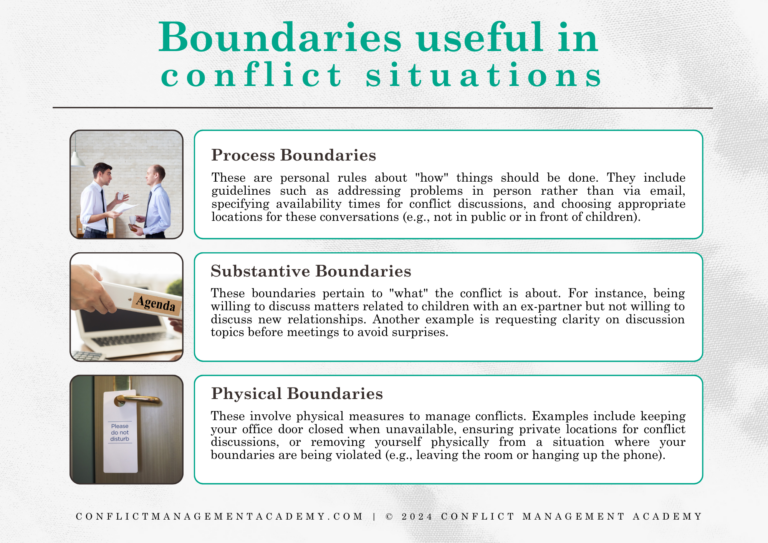
There are different kinds of boundaries that are useful for different situations. In conflict, there are three main types of boundaries: process boundaries, substantive boundaries and physical boundaries. These can all be used to prevent unnecessary conflict or to support you to manage conflict that does arrive courageously and with integrity.

A process boundary is a personal rule about “how” things should be done. For example, you may say to your employees that if they have a problem with something that you do at work, they should come and speak to you about it in person, rather than complaining behind your back or sending an email. Other process boundaries might relate to time – when you are and are not available to talk about a conflict, and for how long. Process boundaries may also relate to where conflict conversations take place (e.g. not in a public place, or not in front of children).

A substantive boundary relates to “what” the conflict is about. You may, for example, set a boundary that you are willing to talk to your ex-partner about what is best for the kids, but you are not willing to talk about your new relationship. A substantive boundary might be asking someone to be very clear about what they want to talk with you about before a meeting, so that you can be prepared to discuss those particular issues without being taken by surprise.

Physical boundaries are very useful in conflict situations. They may include things like keeping your office door closed when you are not available to have a conversation; ensuring that conflict discussions take place in a location where nobody can overhear what people are saying; or you physically removing yourself from a conversation in which someone is breaching your other boundaries (e.g. by walking out of the room, or hanging up the phone).

How to set boundaries

In order to set good boundaries, we need to know what is important to us. Our boundaries should support us to act in accordance with our values. We also need to know what kinds of behaviours from others make it difficult for us to maintain our integrity in conflict situations, and what kind of actions support us to communicate effectively. We need to distinguish between things that make us feel safe, but prevent us from managing conflict effectively (e.g. avoiding the other person) and things that enable us to interact in a constructive way.

Try to think about preventative boundaries, as well as boundaries that you might be able to use in the moment during a conflict conversation.

Things to think about when setting boundaries in conflict situations:

  • Which of our values are most important to us in conflict situations?
  • What kind of behaviour would be consistent with our values?
  • What would we like others to do in conflict situations to enable us to manage the conflict constructively?
  • What would help us to communicate effectively in conflict situations, so that we can listen respectfully but also say what we need to say?
  1. What makes you uncomfortable or stressed in conflict situations?
  2. What helps you communicate effectively in conflict situations?
  3. What process boundaries would support you in conflict situations?
  4. What substantive boundaries would support you in conflict situations?
  5. What physical boundaries would support you in conflict situations?

It can be difficult to get started and learn how to set effective boundaries in conflict situations, but fortunately The Conflict Management Academy provides an online module so you can develop the skills to interact with courage!

Medianos Intercultural: Constructive Intercultural Protocol for Sustainable Conflict Responses

Massimiliano Ferrari’s creation of Medianos, a board game designed to help parties align with “interests and needs” rather than “positions”, demonstrates measurable success in Western mediation training contexts (Tambù Creative Team, 2023). The board game is designed to effectively teach collaborative problem-solving skills and transform adversarial thinking patterns. Ferrari’s intent to democratize mediation knowledge through accessible gameplay merits recognition (Gowers, 2025).

However a critical problem emerges as the western Medianos board game expands internationally: “most standard mediation practice is the antithesis of social transformation; it is interculturally incompetent” (Gowers, 2023). When Western-derived intervention tools spread globally, regardless of noble intentions, they risk reproducing colonial paradigms. At this point in history, we need “a new intercultural competence playbook” that honours Ferrari’s democratic vision while co-creating genuinely inclusive, inter-culturally capable conflict responsive approaches.

The Cultural Assumptions Challenge

Medianos succeeds within Western contexts because it aligns with specific cultural values of individual agency, rational discourse, and negotiated outcomes. However, Ting-Toomey’s (1988, 2005) face negotiation theory reveals that conflict parties must manage “face-related concerns” that vary widely between individualistic and collectivistic cultures. The core issue is that game-based mediation training may embed the implicit cultural assumptions of its creator.

Xiao and Chen (2009) observed that Western communication competence (defined as “goal-oriented, self-oriented, lauding assertiveness”), directly contradicts what Chinese and other Asian cultures have considered communicatively competent for centuries. When mediation training reinforces Western competence models, it undermines inter-cultural rapport.

Māori scholar Tauri (2024) warns that Western alternatives become “a way for policymakers and politicians to silence Indigenous critique” by “repackag[ing] and sell[ing] the system back to itself.” Research (Gowers, 2023) confirms this pattern, showing how standard practices “restrict access to justice by using negotiation powerplay to deny the potential for greater benefit for all parties.”

Indigenous Epistemological Challenges

Contemporary indigenous scholarship identifies fundamental clashes with Western conflict resolution approaches. Latin American decolonial theorists document how Western models emerge from “the project of modernity and the ongoing expansion of a European cultural imaginary” (Rodriguez & Inturias, 2018; Quijano, 2000). Australian Aboriginal experts specify that Indigenous approaches “embrace a deeper level of healing and renewal of relationships” compared to Western “dispute resolution” (ADRAC, 2020).

Indian Adivasi philosophy of “Adivasiyat” emphasizes “a strong sense of connection to land, nature, spirits and community” (Xalxo, 2021) that conflicts with the anthropocentric individuality in Western mediation training. When conflict resolution focuses exclusively on person-to-person negotiation while excluding relationships with land, community, ancestors, and spiritual dimensions, it violates fundamental worldviews of numerous global communities.

Smith (2012) identifies this as reproducing “imperial and colonial discourses” that marginalize non-Western ways of knowing within supposedly inclusive frameworks.

Research Imperatives

To honour Ferrari’s democratic vision while avoiding colonial reproduction, research must build on the insight that “interculturally competent mediators recognize these gaps and propose just and intelligent solutions that include all relevant third parties” (Gowers, 2023).

Specific requirements include:

  • Collaborative epistemological mapping that documents indigenous and traditional conflict resolution approaches from specified continents, understanding their philosophical foundations rather than extracting techniques.
  • Critical analysis of embedded assumptions in game-based mediation training through “crossing over with appropriate immersion in at least one other culture” (Gowers, 2023) to identify where Western individualism, rationality, and anthropocentrism conflict with other worldviews. Of course, in instances where other dominant cultures implicitly enforce their worldview the same concerns may also require critical appraisal.   
  • Development of genuine intercultural frameworks where Western innovations like Medianos engage with other traditions as equals, applying for example the “7 steps of RESPECT” methodology (Gowers, 2023).
  • Testing of hybrid approaches that integrate indigenous knowledge systems as equal partners, recognizing the principle that “conflict is endemic in the process of social change itself” (Gowers, 2023).

The Intercultural Mastermind Initiative

This moment demands concrete action aligned with a call for stakeholder collaboration to “define the principles, practices, and techniques necessary to navigate intercultural complexity sensitively and effectively” Gowers’ (2023). We propose establishing an Intercultural Mastermind Working Groupbringing together Ferrari, Gowers, and indigenous knowledge holders from specified continents to co-design Medianos Alternative Protocol (MAP): An Intercultural Framework for Constructive Problem-Solving and Peace-Building.

This initiative embodies the vision that “interculturally competent mediation practice is adaptable to social transformation” through equal partnership including:

  • Indigenous knowledge holders from Australian Aboriginal (including Professor Marcia Langton’s frameworks), Māori, Latin American, Middle Eastern, and Indian Adivasi traditions
  • Intercultural communication theorists who understand both Western and non-Western approaches
  • Community practitioners working at the intersection of traditional and contemporary conflict responses
  • The original creators bringing expertise in game-based learning and mediation theory

The MAP Development Process

The Medianos Alternative Protocol would emerge through the “7 steps of RESPECT” (Gowers’ (2023) methodology:

  1. Reframe the Context by revealing foresight and establish focus. Each tradition shares its cultural background and expectations about conflict resolution. Identify how different approaches engage with mediation based on their cultural contexts.
  2. Resolve the Content by specifying facts, pondering feelings and examining findings. Document where approaches complement, contradict, or offer alternatives while honouring diverse motivations.
  3. Recreate the Contract by confirming finalization and tracking fulfilment. Co-create methodologies integrating multiple epistemologies, test through community implementation with relationship tracking. Verify that agreements are fulfilled or re-negotiated until complete.

This framework develops “inter-cultural respect-ability” (Gowers 2023) terms through the insight that effective intercultural mediation requires “crossing over with appropriate immersion in at least one other culture” while maintaining cultural integrity.

Modelling the Solution

The Intercultural Mastermind approach provides specific advantages over traditional research-then-application models:

  • Immediate Impact: Creates practical tools while building theoretical understanding
  • Authentic Partnership: Positions indigenous knowledge holders as co-creators rather than consultants
  • Living Laboratory: The collaborative process models the intercultural problem-responses it teaches
  • Scalable Innovation: Success informs broader cross-cultural program development

Conclusion: Beyond Cultural Wars to Co-Creation

Current trajectories risk reproducing patterns where Western innovations spread globally with cultural modifications while fundamental power dynamics remain unchanged. The Intercultural Mastermind approach requires courage to question whether appropriate participation demands genuine co-creation from the foundation level.

Ferrari’s vision of democratizing mediation knowledge through accessible, engaging methods deserves fulfillment through the most ambitious interpretation possible. True ‘democratization’ (spoiler alert – a western paradigm) requires surrendering Western centrality for multicultural co-creation that produces innovations none of the traditions could create alone.

The proposed Intercultural Mastermind Working Group represents both urgent scholarly priority and opportunity to model “transforming our viewpoints, priorities, and actions” to “create a new era of intercultural mediation” (Gowers 2023). Rather than studying cross-cultural adaptation, we could demonstrate inter-cultural innovation and answer the question: “How do you plan to come out of these current crises?” (Gowers, 2023).

This moment calls for investigation matching the scope of the challenge, not merely examining how diverse human traditions might inform conflict responses but bringing them together to create new possibilities for our interconnected world.

Note: This Intercultural Mastermind approach demands international collaboration, indigenous partnership, and creative courage that could transform not just conflict response education but our broader approaches to respectful intercultural collaboration. What might be the learnings to use in future IT and AI developments?


References

What’s the alternative to mediation? Meet the European Board Game Going Global

Responding to @Massimiliano Ferrari’s recent post sharing @Dr. Anna Maria Bernard’s powerful insights about digital conflicts in Basilicata. Here’s what we’re seeing as Medianos spreads globally…

Massimiliano Ferrari’s sharing of Dr. Anna Maria Bernard’s insights from Basilicata Region perfectly captures what those who understand transformation are witnessing worldwide – the emerging need for approaches that naturally dissolve digital-age conflicts. Dr. Bernard’s experience with Medianos confirms what you may already be sensing as this remarkable method continues spreading across continents.

She writes about how “digital conflicts are the order of the day” and as you consider this, you might recognize the truth in her observation. Just last month, I watched a CEO and his teenage daughter discover something profound as they sat across from each other, both having believed the other “just doesn’t get it” about screen time boundaries. Traditional mediation would have had them negotiate rules and compromises. But what happened next was something that transforms everything.

In the past, families like theirs relied on authority-based solutions that inevitably left children feeling unheard and parents feeling frustrated. When conflicts arose over homework, curfews, or device usage, conversations naturally escalated into battles of will rather than becoming opportunities for deeper understanding. The tools available were limited to expensive counseling, theoretical parenting books, or time-consuming mediation processes that few families could access or sustain effectively.

Then the digital revolution changed everything, didn’t it? As Dr Bernard observes, we’re dealing with conflicts our parents never imagined: How much screen time creates balance? What about online privacy and safety? How do we manage social media wisely? The generational digital divide widened as children became native users while parents struggled to keep pace with change. These “digital conflicts” became daily occurrences, with the adolescent brain still developing and naturally impulsive constantly stimulated by digital temptations that multiply exponentially.

What she discovered in Basilicata, you’re now beginning to see replicated across Europe and beyond. Medianos – The Game isn’t just resolving these conflicts; it’s fundamentally transforming how families, schools, and even workplaces naturally approach disagreement.

That CEO and his daughter? Within two hours of facilitated gameplay, something remarkable began to unfold. By “playing” each other’s roles in a safe, structured environment, they started to understand perspectives they’d never allowed themselves to consider. The daughter experienced the weight of parental responsibility for digital safety, and the father felt the frustration of being constantly monitored and distrusted. When they returned to their original roles, their conversation had completely shifted – from positional bargaining to collaborative problem-solving that felt surprisingly natural.

This is the power Dr Bernard wrote about when she described how Medianos allows participants to “go beyond the conflict and enhance what you feel at the level of emotions, thoughts and behaviours.” And what’s truly exciting is how rapidly this approach continues spreading globally, creating transformation wherever it goes.

Created by Massimiliano Ferrari and supported by a rapidly expanding community of Ambassadors, Medianos is spreading across the world at unprecedented pace, and as it does, more people are discovering its effectiveness. Recent weeks have seen new Ambassadors recognized across Italy, Canada, France, Spain, Brasil, Latvia, Ecuador, and Albania.

I, Rory Gowers, as the newly appointed Australasian Medianos Ambassador and creator of the My-RESPECT-Ability negotiation framework, am curious to discover how this face-to-face board game experience will resonate with digital natives here in Australasia while delivering the profound results Dr Bernard described.

The game format creates what she calls “a safe, secure, and stimulating environment” where participants naturally develop genuine empathy through facilitated face-to-face interaction. Communication skills emerge organically as players learn active listening and assertive expression without it feeling like traditional training. Hidden needs surface safely as the game reveals unexpressed fears that fuel conflicts. Most importantly, players develop what I call “respect-ability” the expanding capacity to engage respectfully even during difficult conversations.

Dr Bernard’s observation that “gaming experience with Medianos was pivotal in translating theoretical concepts into practical skills” captures exactly why this approach succeeds where traditional methods struggle. In our screen-saturated world, bringing the power of gaming back to physical interaction creates genuine human connection that digital experiences simply cannot replicate.

The transformation extends far beyond individual families, doesn’t it? As she noted with the teachers in Basilicata who were “fascinated by the educational and formative opportunity,” we’re witnessing schools, workplaces, and communities naturally develop cultures of respectful engagement. When conflicts become catalysts for deeper understanding rather than relationship damage, entire organizational cultures begin to shift.

Imagine, if you will, boardrooms where disagreements become opportunities for innovation rather than positional battles. Picture classrooms where teachers and students collaborate through understanding rather than authority. Envision families where generational divides bridge naturally through shared gaming experiences that honour everyone’s perspective completely.

This is the future Dr Bernard glimpsed in Basilicata – and it’s spreading globally with increasing momentum. Her closing question resonates deeply, and you might find yourself wondering: “What strategies are you using to manage digital conflicts in the family or at school, or in the workplace?”

The answer, increasingly, is becoming Medianos – The Game. We’re actively preparing for launch in Australasia in Quarter 4 2025, bringing this proven approach to a region where digital conflicts are as prevalent as anywhere in the world, and where solutions are needed most.

As Dr Bernard concluded, “Open dialogue, empathy, emotional intelligence education and novel tools like Medianos are the key to transforming ‘digital conflicts’ into opportunities for growth and deeper bonds.” The enthusiasm she witnessed in Basilicata is now spreading across continents – one family, one school, one workplace at a time, creating lasting change.

For more information about bringing Medianos to your organisation or community, reach out to MyRespectAbility or respond to the post directly and discover what becomes possible.

What strategies are you using to transform conflict into connection? Join the conversation below and share what you’re discovering.

Author Biography

Rory Gowers is a Master of Dispute Resolution (MDR), Master of Education (MEd), certified Master NLP Practitioner, and intercultural mediator with deep experience leading transformative change across global business and community settings. Based in Greater Sydney, Australia, Rory helps leaders and organisations replace conflict cycles with clarity, cooperation, and lasting resolution.

As the founder of The Constructive Solution, Rory applies structured, values-based methodologies to resolve complex interpersonal and systemic challenges—especially in high-stakes environments like construction, government, and professional services. His work produces measurable outcomes: reduced rework, improved trust, and faster decision-making.

He also leads Mastering Intercultural Mediation Initiatives (MIMI)—a high-impact executive program that equips senior leaders to build inclusive, high-functioning ecosystems by mastering cultural agility and conflict competence.

Now, Rory is bringing the internationally acclaimed Medianos – The Board Game to Australasia. As the official Australasian ambassador, he introduces this dynamic, play-based tool to transform how professionals learn and practise negotiation, mediation, and respectful engagement.

Rory’s mission is clear: to grow respect, resolve conflict, and realise the shared vision of a place for all and peace for all in our time—by guiding people and systems to adopt practical, repeatable solutions that build trust and deliver sustainable results.

Contact Rory:
🌐 Web: www.myRESPECTability.com
📧 Email: rory.gowers@gmail.com
📱 Mobile: +61 425 292 811
🔗 LinkedIn: linkedin.com/in/constructiveconflictsolutions

AI and Dispute Resolution: Why You’ll Need It Sooner Than You Think

John Lande
This article has been republished and adapted with permission. The original publication can be located within Indisputably.

Imagine doing your work without word processing, spell checkers, email, the internet, search engines, voicemail, cell phones, or Zoom.

That’s how you’ll probably feel in the not-too-distant future about working without artificial intelligence (AI).

Innovations often seem radical at first. In time, people just take them for granted.

ABA Formal Opinion 512 states that lawyers soon may be ethically obligated to use AI. “As GAI [general artificial intelligence] tools continue to develop and become more widely available, it is conceivable that lawyers will eventually have to use them to competently complete certain tasks for clients.”

AI isn’t replacing dispute resolution professionals any more than calculators replaced accountants. But just like calculators, AI tools are becoming essential tools for legal and dispute resolution work.

Remember when everyone freaked out when they first had to use Zoom at the beginning of the pandemic? Now people don’t give it a second thought. It probably will be the same way with AI before you know it.

You Don’t Have to Love AI – But You’d Better Get to Know It Soon

Two companion articles – How I Learned to Stop Worrying and Love the Bot: What I Learned About AI and What You Can Too and Getting the Most from AI Tools: A Practical Guide to Writing Effective Prompts – are designed to help dispute resolution faculty, practitioners, students, and program administrators get comfortable with AI. The first article tells why AI literacy is becoming more important all the time. The second shows how you can easily become more AI literate.

Together, they offer a friendly nudge for people who feel they’re behind – spoiler alert: this may be you – and training wheels so you don’t fall flat on your face.

Love the Bot describes my own reluctance to use AI. Now I use it every day to think and write better, faster, and more creatively.

But I’m not the only one. Law students are already using AI. Practitioners and clients are too.

So this isn’t a quirky corner of practice anymore. It’s the center of a growing professional expectation. Law schools are adding AI courses. Some are embedding it across the curriculum. If professors don’t engage with AI now, they’ll be learning from their students instead of the other way around.

Good Prompting Can Be Your Superpower

Getting the Most from AI Tools is a hands-on guide to producing better results with AI.

It walks you through the mechanics of writing effective prompts. It’s packed with examples for mediators, attorneys, students, faculty, program administrators, and even disputants.

We all know that AI sometimes hallucinates. But you’re hallucinating if you think that you can wait to start using AI tools until they stop hallucinating. Ain’t gonna happen anytime soon.

In the meantime, you can benefit from AI tools if you know how to use them (and how to manage hallucinations and other problems). You don’t need to be an expert – just thoughtful, curious, and careful.

The results from AI tools may depend less on the technology itself and more on users’ skills. Like other skills, it improves with practice.

Becoming AI Literate Is Easier Than You Think

These articles describe AI literacy as a process of continual learning as AI technology continues to evolve.

The first steps are just getting curious and trying it at your own pace. Try starting with simple tasks like:

  • Asking questions you already know the answers to
  • Getting recommendations for movies appealing to your tastes
  • Summarizing something long and boring
  • Brainstorming ideas for a class, article, or paper
  • Polishing a rough email, memo, or draft

As you gain confidence, you can ask it to help with your work. Professors can revise a syllabus. Students can prep for a simulation. Mediators can brainstorm tough moments. Program directors can develop orientation materials. Etc. Etc. Etc.

The possibilities are limited mostly by imagination and fear. These articles help with both.

Don’t Regret Waiting to Get the Benefits of AI

AI isn’t just about efficiency. It’s about equity, ethics, and excellence. You can choose how to express your values through it.

AI tools can reveal students’ thinking, making teaching more responsive. They can also help lawyers and clients make better decisions, especially when time or money is short. And lots more.

If you’ve been hesitant, these articles can help you do things you want to do – and things you haven’t even imagined. But only if you take the first step.

Washington Post columnist Megan McArdle writes, “We are resting in the eye of a gathering [AI] storm, and those who fail to fortify themselves now risk being swept away when the storm finally unleashes its full power.”

Take a look – and don’t get swept away.

Sometimes You Need to Be Seen to Be Heard: Three Easy Ways to Visualize What Matters in Your Dispute

Dan Berstein & Robert Bergman
This article has been republished with permission and the original publication can be located at Mediate.com.

It can be difficult to get on the same page when you are caught in the middle of an adversarial dispute.  Each party has their own biases – they want to win! Amidst a deluge of seemingly endless “facts” to pick from, sometimes it can feel like the parties are living in entirely different universes.  Seeing this, dispute resolution professionals often end up asking themselves: “how can I bring these people together so we are all talking in the same world?”

One answer is visualizations.  This article shares how a dispute resolver (or an ambitious party) can use visualizations to accomplish progress in their matter.  It was written by Dan Berstein, a mediator living with bipolar disorder who often finds himself amidst complicated conflicts related to his mental health advocacy work – with help from Bob Bergman, the founder of NextLevel™ Mediation.  

Dan shares his struggles to visualize different problems and disputes related to his advocacy work and Bob provided the background of how Next Level Mediation’s software can do it almost instantly, and better than a person could on their own.

1: Illustrating Harms

Living with a mental illness means that I have behavioral differences that can lead to my being stigmatized and rejected, or just the fact that I am open with my bipolar disorder can be a reason some people form worries or biases that lead to them pulling away.  On an organization-wide level, this kind of behavior can ripple out across people.  

I had a dispute with one organization where they produced records, including their private e-mail correspondences, revealing dozens of people passing around disparaging comments about me and/or making plans to reduce or cut contact with me.  I was working on a resolution process with their outside counsel and I felt that they were not appreciating how damaging it had been for me to be targeted with these negative predispositions and pushed away (in manners large and small) from so many people.  Eventually, I developed a crude organizational network analysis (ONA) chart to demonstrate the network of people involved:

A screenshot of a computerDescription automatically generated

Through the use of this visualization, I then created a system that could be used to visualize any [i] Explicit Shunning, [ii] Ghosting (No Response), [iii] Short Responses, [iv] Delays, [v] Lies, [vi] Disparagements, and [vii] Mistakes – charting how they flowed between people and their impact.

This was incredibly valuable to me as a tool in my dispute, as well as for my personal coping with the trauma of experiencing so much rejection.  However, it was also incredibly tedious and difficult to create.  

In my search for software that could help make it simpler, I connected with Bob Bergman, who explained how NextLevel™ Mediation can create a diagram to map this kind of network analysis in minutes just by you uploading your dataset and asking the right queries:

The NextLevel Approach to Visualizing Impact

In the example above, the uploading of email communication to the NextLevel™ Mediation platform document research assistant can produce the following example (note these do not use real data, and are meant to illustrate):

QUERY: Visualize the roles, interests, and power dynamics of parties involved by creating a stakeholder diagram

RESULT:

Description: This diagram captures the roles and interests of each stakeholder, along with arrows representing the influence, authority, and relationships between them.

QUERY: Create an ONA diagram that can help visualize any Explicit Shunning, Ghosting, short Responses, Delays, and Disparagements, and how they flowed between people

Description: This diagram shows how various negative interactions flow between people and highlights their impact on communication and relationships within the organization. Each arrow represents a type of interaction, such as shunning or ghosting, and the direction indicates the flow of this interaction.

2: Documenting Delays and Timelines

In one dispute, an organization was accusing me of causing delays, which had lasted close to 9 months.  It hurt my feelings to be falsely accused of this so I sat down and pored over all of our past correspondences, mapping out the delays.

I found that their changes in staff and processes were responsible for, I believed, over 70% of the delays even though they had perceived such high delays from me (presumably due to their frustrations).  This analysis was a tedious process and I was worried that people would think I was weird, perhaps due to my mental illness, for even undertaking it.  

The NextLevel™ Mediation platform was, once again, the answer to my prayers.  Not only does it do all of the work for me, and faster – but I can just tell someone I used this software without being judged as some kind of oddball for having created the chart myself.  Here are example results with some anonymous data:

QUERY: Using the uploaded documents, create a sequence diagram of the dispute timeline and possible delays:

Description: This sequence diagram captures the interactions and discussions among different participants as they address the causes and effects of project delays over time.

QUERY: Create a user journey diagram for the mediator given the delays in email responses and their emotional effects.

Description: This diagram outlines the steps the mediator takes, from receiving notifications of delayed email responses to analyzing communication patterns, considering emotional impacts, and reporting outcomes to stakeholders.

3: Identifying What Matters

The NextLevel™ Mediation platform is about more than just charts.  You can also just ask it questions so it can use its “brain” to digest all of the meaningful facts and help you stay focused on the big picture.  This is important for me – even if only as a gut check – as my mental illness means I can be prone to becoming obsessive and to fixating on some facts at the exclusion of others.  NextLevel™ is an objective way to get a sense of the big picture.

Beyond asking it for charts and diagrams, you can also generate tables to help you organize key information.  Take a look at the table it generated when asked what might be the relevant and irrelevant facts for a discrimination claim (both for the alleged victim to collect, and for the alleged discriminator who is defending themselves):

If you have ever found yourself overwhelmed sorting through what happened, or just looking for a way to double-check your perspective – the NextLevel™ Mediation platform can instantly provide you breakdowns and summaries like this to help you find your way.

Conclusion

Seeing is believing, but it can be difficult to create the right picture.  Visualizations can help resolve disputes if you know how to use them.  This article talked about different charts you can use to visualize the scale of damages, the responsibility for delays, and which facts prove disparities.  We also shared how you can go use NextLevel™ Mediation, right now, to create charts like this of your own (and so much more).  

It can seem intimidating to enter the world of charts and graphics and bring them into your dispute, but it can also add a lot of value.  I am grateful that there is software like NextLevel™ Mediation to help make something that can seem – at first – to be complicated into an easy, user-friendly, and fast process.

Here are some ideas of ways NextLevel™ can help:

  • Collect and scan all of your data from a situation into its platform, including e-mails and documents, and ask it to tell you the key points that matter, and the key things that matter to each party
  • Use it to instantly chart relationships with people and show patterns of impact and harm
  • Have it list the points of disagreement between the parties
  • Create timelines and sequence diagrams to show the course of events and simplify a complicated, convoluted set of facts into something precise and digestible

Disputes are often painful.  We find ourselves in so much distress that it can help to use an AI-empowered software assistant to keep track of the facts so we don’t have to worry – and to paint the big picture summaries of what matters so we don’t get lost.

Author Biography

Dan Berstein is a mediator living with bipolar disorder who uses conflict resolution best practices to promote empowering mental health communication and prevent mental illness discrimination.  His company, MH Mediate, has helped thousands of professionals and organizations be empowering, accessible, and non-discriminatory toward people with disclosed or suspected mental health problems. Dan holds degrees from the Johns Hopkins School of Public Health and the Wharton School. He is the author of the 2022 book, Mental Health and Conflicts: A Handbook for Empowerment.

Robert Bergman is a seasoned decision science expert with over 60 years of experience in software engineering, system dynamics, and strategic planning. He is the founder and CEO of NextLevel Mediation, a SaaS platform that applies decision analytics, Game Theory, and AI to dispute resolution. His expertise spans multi-criteria decision-making methodologies (AHP, ANP, MAUT), mediation, negotiation, and military systems such as flight simulations. Previously, he held senior leadership roles at Intel, focusing on mobile strategy and cybersecurity, and has consulted widely in strategic decision science. Bergman is also a published researcher in AI, technology addiction, and the future of dispute resolution.

Informed, Involved, Inclusive: Why MIMI, why NOW, and why ME?

Rory Gowers & Milan Nitopi
This article is Part 3 of 3 in our series ‘Informed, Involved, Inclusive’.

Rory and Milan (left to right) presenting at the 12th Conference World Mediation Forum – Foro Mundial de Mediación in Brazil in November 2024.

The story of fisherman Mark and how mediators are not so different…

Mark Schenk recently shared a fishing story to illustrate when 90% isn’t enough.1 Mark tells us that he loves beach fishing, and beach worms make great bait–but at $9 each, he decided to catch his own. Turns out, it’s trickier than he expected.

Over several months, Mark learned to pick the right beaches, attract worms, spot them, and get them to latch onto bait. But despite all that effort, he would spend two hours catching just one or two worms. He kept missing the final step–grabbing them.

Frustrated, Mark studied everything there was to know about catching worms and learned insight from a highly experienced fisherman. That’s when he discovered the problem, that his instincts were wrong. Mark was using a pincer grip, like picking up a pencil. But the right way? He needed to press the flat his thumb into the first joint of his index finger.

Once Mark changed his grip, he started catching worms immediately–but only if he was focused. Whenever his attention lapsed, old habits crept back.

We share this story because intercultural mediation is not so different.

Although Mark spent months learning the skills and techniques to catch beach worms, it would be entirely futile as what he lacked was insight and experience. Once he learned the ways of experienced fishermen, his ability to catch worms increased exponentially.

Although mediators might be highly trained and skilled in their own right, they can lack the experience and insight required to mediate intercultural interactions effectively. Mediators can prepare meticulously, understand the key players, and enter negotiations with good intentions–but it is just not enough. Like Mark, they can often rely on ingrained instincts that don’t quite translate in another cultural context.

What is missing within intercultural mediation?

It is simply not enough to just understand different cultures, it is about recognising and appreciating how other people perceive fairness, respect, and the process within their own cultural lens. Ask yourself this:

  • Am I engaging with each parties’ culture on their own terms?
  • Am I identifying and discerning their expectations, needs, interests, or concerns accurately (including what they may require for the process to feel appropriate and fair)?
  • Am I adapting my approach to mediation so that each party can contribute their best in achieving mutually beneficial outcomes?

Without this level of intercultural predisposition, negotiations by and between parties may seem productive on the surface, but will fall apart in practice—just like Mark spending hours on the beach with only one or two worms to show for his efforts.

Why MIMI is the missing link–especially in 2025!

The world is shifting rapidly. Geopolitical tensions, economic realignments, and global challenges mean that current top-level negotiation skills are no longer enough.

Mediators need more than just knowledge of culture, they need an intercultural predisposition–a first-hand experience which complements their current knowledge and skills. The ability to move beyond rigid frameworks and adapt in real time to cultural expectations will produce fairness and respect from multiple perspectives.

Mediators must facilitate an environment where all parties can contribute their best, even when they feel like they are in foreign territory. Without this, agreements that are technically sound lack true buy-in, and those agreements will unravel under pressure or strain.

The cost of misalignment is growing. Whether in business, diplomacy, or public service, failure to navigate cultural expectations means failed projects, lost trust, and missed opportunities. MIMI helps mediators to develop that final 10% needed to excel within cultural interactions, and this cultural adaptability then turns competence into mastery. Like Mark’s fishing lesson, it’s a small shift that changes everything.

Who else can benefit from MIMI?

Mediators are not the only ones who can benefit from what MIMI has to offer. Leaders, coaches, negotiators, managers or executives in business, lawyers and legal professionals, doctors and nurses can all benefit immensely by mastering these intercultural skills.

Reflect on your own experiences… Has there ever been a time in your life, or the life of a person you might know, where there was a cultural disconnect? Where expectations within that interaction were not adequately met? Where needs, interests, or concerns were not accurately addressed? If you have, now imagine how others might feel where there is an even greater cultural disconnect–where the stakes, risks, and loss are substantial.

At MIMI, we have spent years refining our craft, and now we are guiding you to develop that same instinct—not by giving rigid rules, but by helping you see and feel the process differently. By completing our training program, you will begin your journey in becoming a master of intercultural mediation and you will be able to assist others in ways that are culturally relevant.

MIMI will teach you how intercultural mastery can become second nature, just like Mark adjusting his grip. MIMI is not just another training program–it is a transformational shift. This kind of shift, once made, cannot be unseen and will contribute to much beneficial change.

Join the MIMI Pilot Program—A Transformative Experience!

We invite you to express your interest in completing our pilot program and to contribute your thoughts on how we can make it better.

We are selecting only 8 accomplished professionals for the exclusive pilot cohort: the Mastering Intercultural Mediation Initiatives (MIMI) Program. If you would like to be a part of this transformative experience, express your interest here.

Expressions of interests close 31 May 2025.

Who should apply?

✔️ Experienced mediators who have navigated complex, high-stakes disputes.
✔️ Senior leaders and negotiators who operate across cultural boundaries.
✔️ Professionals with a proven ability to build rapport in challenging intercultural situations.

As a pilot participant, you will:

  • Be the first to experience MIMI
  • Expand on your intercultural toolkit
  • Join an elite mastermind, shaping the future of intercultural mediation

Don’t let that worm get away… Apply today!

  1. See Mark Schenk’s article at https://www.anecdote.com/ ↩︎

TIPS FOR NEW PRACTITIONERS: Getting your documents in order

Samantha Hardy
This article has been republished and adapted with permission. The original publication can be located within The Conflict Management Academy.

When setting up your practice, it’s important to have all your documents in order. Many people don’t prepare in advance and then are in a last-minute panic when the first client turns up and they need paperwork! 

It’s also important to remember that each client may need different types of paperwork, so you adapt and tailor your documents to each client and context.

What documents do you need?

During your training as a coach or mediator, you probably discussed things like agreements to mediate, or coaching contracts, but these are not all you need. You will also need things like:

  • Enquiry-related documents (e.g. information sheets and brochures for parties, lawyers, support people or employers)
  • Business-related documents (e.g. proposals, scope of work, invoices or client databases)
  • Service-related documents (e.g. questionnaires and intake forms agreements to participate, privacy and confidentiality agreements, record of mediation outcomes, spreadsheet for recording property items, value or distribution documents)
  • Correspondence templates
  • Feedback sheets, surveys, and evaluation documents

You may need a few versions of each kind of document for different clients and situations. For example, when an employer is involved as sponsor or when there are multiple parties involved in the conflict (whether a workplace or family conflict) or documents related for different services (e.g. mediation and coaching).

How do you make these documents available?

As well as the content of these documents, you should consider carefully when and how they are made available to prospective or current clients. For example:

  • Are the documents (in a generic version) made available publicly (e.g. on your website)?
  • Are the documents sent to prospective or current clients (as templates or with their details added)?
  • How important is it that the clients read and/or understand the documents? How do you ensure this is likely to happen? What happens if the client does not read the documents you provided?
  • Do you recommend and/or suggest clients obtain (legal or other) advice about the contents of any documents provided?
  • How accessible are your documents (e.g. for people who have visual or other impairments)?
  • What opportunities are there for clients to discuss the contents of the documents with you?
  • Do clients need to sign any documents? Do these need to be witnessed (by anyone, a lawyer or JP)? Can they be signed electronically?

You may have been provided with pro-forma examples of documents, like agreements to mediate or confidentiality agreements, from your trainers or your accreditation bodies, and these are a useful foundation to work from. However, using them “out of the box” is not ideal, as your brand, your clients, and your context are unique, and you need documents that are designed for your particular practice.

I highly recommend you go through any template very carefully and identify any contents or language that needs adjusting.  You should do this when creating your own branded template, but you should also do a quick check for each client, to ensure that each document is tailored appropriately for the specific client and their situation.

Check the content is applicable

Check that the content of the document suits your client and their situation. For example:

  • Is there is an employer or sponsor involved?
  • Is this a two-party or a multi-party situation?
  • Will you be working in person or online?
  • Is the process going to be confidential, or are there reporting requirements (e.g. to an employer)?
  • Does the template refer to laws (e.g. in relation to a mediator’s obligation to disclose information to authorities in certain circumstances) that might vary across jurisdictions?
  • Does the document use terminology that is not relevant to your client’s context. For example, does the document refer to litigation or going to court when this isn’t something your client is likely to be considering, or include statements like “settlement is legally binding” which may not apply to your client’s situation.

Check that the language is suitable

Formal or informal? The language used will differ greatly depending on your client-base. If you are working as a mediator in a legal context, many of your lawyer-clients may be repeat clients so will not need a great deal of information. However, referring lawyers may be providing information to their clients (e.g. a panel of three mediators for the client to choose between) and so you may also want to provide information suitable for lawyers to give to their clients to help inform the client’s choice.

How the people involved are referred to? If you are working with two employees involved in a personality clash at work, they may not find it comfortable to be referred to as “disputants” or “parties”. Try to accommodate language that is suitable for the dispute. For example, if it is a family dispute involving children, referring to the parties as “parents”.

How is the situation or conflict described? If your clients are currently involved in litigation, it might be perfectly acceptable to refer to the situation using language like “the dispute”. However, if you are mediating between family members in a personal conflict or employees who have a personality difference, this terminology might not sit well with them. You might be better using language like “your concerns” or “your working relationship”. Try to be sensitive to what would be comfortable for your clients.

Is it consistent with your brand? If your brand is down-to-earth, plain English, and informal, then providing clients with documents full of legal-ease or formal terminology and language may create a disconnect for your clients. This doesn’t mean you don’t include necessary information, but rather try to use language that is clear and also consistent with your brand ‘voice’.

Is it ambiguous, overstating, or misleading?  Be very careful not to use sweeping statements that may be misinterpreted. Terms to be careful about include “voluntary” and “confidential”. Depending on the client’s circumstances, these terms may not apply in a straightforward manner and can create confusion and distrust (and even sometimes lead to complaints).  For example, an employee who is required to attend mediation as a condition of their employment may not feel that their participation is voluntary. Similarly, if following a workplace mediation, one participant breaches an agreement to keep the discussions confidential by talking with a colleague about what happened, there is often very little anyone can do about this.  This can lead to the other person complaining that “the mediator said it was confidential and yet they couldn’t stop them from talking about what happened”.

Conclusion

Getting your documents in order and knowing how to adapt them when needed is important to build credibility and professionalism in your work.

In our Beyond the Table course accessible on the Conflict Management Academy, we have created an entire module on Your Documents which can help you review a broad variety of examples of different kinds of documents and be tailored to fit your practice and your brand.

We consider different categories of documents, including:

  • Enquiry-related documents (e.g. information sheets and brochures for parties, lawyers, support people or employers)
  • Business-related documents (e.g. proposals, scope of work, invoices or client databases)
  • Service-related documents (e.g. questionnaires and intake forms agreements to participate, privacy and confidentiality agreements, record of mediation outcomes, spreadsheet for recording property items, value or distribution documents)
  • Correspondence templates
  • Feedback sheets, surveys, and evaluation documents

Author Biography

Dr Samantha (Sam) Hardy is the Director and Lead Trainer of the Conflict Management Academy. Sam is an experienced mediator, conflict coach, and the founder of the REAL Conflict Coaching System™. She provides conflict support to managers and leaders across the world as well as professional development training, supervision and mentorship to mediators and coaches who work with clients in conflict. Sam is an accredited mediator under the Australian National Mediation Accreditation System (NMAS), a certified transformative mediator by the United States Institute of Conflict Transformation, and a certified narrative coach. She has been awarded Conflict Coach of the Year at the Australian Dispute Resolution Awards in 2022 as well as the Australian Resolution Institute Award for Service to Dispute Resolution in 2021 for her leadership and innovation in the field. Sam also publishes widely in dispute and conflict resolution, including Dispute Resolution in Australia, Mediation for Lawyers and Conflict Coaching Fundamentals: Working with Conflict Stories.