The ADR Research Network is a group of Australian dispute resolution academics. Blogging & tweeting high quality, critical dispute resolution scholarship.
Milan Nitopi a Sydney-based lawyer and mediator whose passion surrounds people, law, and resolution. He writes with a focus on conflict management and legal dispute resolution. Connect with Milan via LinkedIn and Instagram!
By John Sturrock KC The original publication can be found at The Scotsman.
The founder of a site where AI models communicate with one another compared them to a “new species that is on planet Earth that is now smarter than us.”
These seemingly apocalyptic words, in a recent email from an American mediator colleague, certainly caused a stir among its recipients. A debate ensued about whether AI will usurp the function of mediators – as it threatens to do with many professional jobs in the near future.
It is interesting that many of these American mediators report the widespread use of AI by parties and lawyers participating in mediations. Indeed, a number of those mediators are themselves using AI to summarise the mediation papers, structure possible negotiation approaches, help prepare “mediator proposals”, assess emotions and assist with strategies to overcome impasse. Some are even developing their own software programmes (or asking AI to do that for them).
Commenting on the use of AI in recruitment, a legal careers adviser recently observed that “law is fundamentally people-focused and technology should enhance rather than replace human judgment”.
With that in mind, I had intended to write about how mediators and lawyers can adapt to the advent of AI, on the assumption that the strengths we have, such as building relationships and trust over many years, cannot be displaced. And then I read an article by Matt Shumer, entitled ‘Something Big Is Happening’, and watched the first of mathematician Professor Hannah Fry’s BBC documentaries on the subject of AI. The enormity of what could be facing us hit me. Shumer describes it as “like the moment you realise the water has been rising around you and is now at your chest.”
According to Shumer, the AI models available today are unrecognisable from what existed even a few months ago. The most recent models make decisions that would have been unthinkable a year ago. They have something that “felt, for the first time, like judgment.” Chat GPT and Claude have released new models that make “everything before them feel like a different era.” AI is now building itself, with the ability to improve exponentially, not linearly. The people behind this technology are “simultaneously more excited and more frightened than anyone else on the planet”. One has said that AI models “substantially smarter than almost all humans at almost all tasks” are on track for 2026 or 2027. Shumer concludes that massive disruption could occur by the end of this year. We need to prepare, he says.
To those who argue we have been here before, it is said that this is different from every previous wave of automation. AI isn’t replacing one specific skill. It’s a general substitute for cognitive work. It gets better at everything simultaneously. We know that some law firms are making significant use of AI to do work that associates would once have carried out. One managing partner apparently expects AI be able to do most of what he does before long…
Shumer’s article has been dismissed as self-serving and way over the top. But questions remain. Will AI replicate deep human empathy? Replace the trust built over years of a relationship? We would hope not. But that some people have begun to rely on AI for emotional support, advice and companionship is illustrated in Hannah Fry’s startling documentary.
So, where might this lead, even for mediators, among whose key attributes is working with very complex human situations? I suspect that we don’t yet know – and that the biggest threat is complacency. We may be facing the biggest change any of us have experienced.
Author Biography
John Sturrock KC is the founder and senior mediator at Core Solutions. He is a pioneer of mediation throughout the UK and elsewhere with his work extending to the commercial, professional, sports, public sector, policy and political fields. He is a Distinguished Fellow Emeritus of the international Academy of Mediators and was also formerly a mediator with Brick Court Chambers in London. John also specialises in facilitation, negotiation and conflict management training and coaching for public sector leaders, civil servants, politicians, and sports and business leaders. He has worked with various parliamentary bodies throughout the UK on effective scrutiny of policy, and led a major review for the Scottish Government into allegations of bullying and harassment in the national health service in Scotland. He also founded Collaborative Scotland, a non-for-profit promoting nonpartisan respectful dialogue about difficult issues. John also has published two volumes of his book, A Mediator’s Musings (available on Amazon).
Toward the end of November 2025, I had the great honor and pleasure of facilitating the opening session of the ADR Research Forum. The theme I chose was Transforming Conflict from the Inside Out: Exploring the Inner Work that Supports Our Outer Work. I introduced several approaches emphasizing the need for researchers and practitioners in the field of alternative dispute resolution, which I prefer to think of as conflict transformation (shoutout to John Paul Lederach), to engage in ongoing, deep, and critical self-reflection to ensure their efforts are effective and contribute to positive social change.
As a follow up, I want to offer here what I have called the “Four Rs”: Relational Consciousness, Radical Acceptance, Realignment, and Repair. In other writings, I have discussed these ideas and practices as ways of embodying what it means to repair the world, or Tikkun Olam as it is known in the Jewish tradition. Repairing the world requires us to engage in daily and lifelong practices that can contribute to our own healing and heal our relationships, and have broader ripple effects that ultimately can heal the larger systems and even whole societies we inhabit.
The first R stands for Relational Consciousness, our interconnectedness and interdependence with all beings. Much of my scholarship and teaching has focused on promoting what I call relational and wholehearted lawyering, an interdisciplinary framework consisting of habits of mind and tools we can cultivate to help us engage in meaningful conversations across differences in order to generate new and creative possibilities. We can bring relational lawyering into the work of conflict transformation by pursuing our roles as researchers and practitioners in ways that affirm all participants’ mutuality and connection rather than contributing to greater separation and disconnection. Using the term relational consciousness reminds us that being relational in our professional lives can only happen if we bring those practices into every interaction and every aspect of our daily lives.
The second R stands for Radical Acceptance, a term I learned from the work of Tara Brach. The two components of radical acceptance are awareness, the ability to see clearly what is happening within us, and compassion, which Brach describes as embracing fully whatever is present, including our pain and our desires. Radical acceptance includes the ideas of approaching ourselves and others with unconditional friendliness and accepting that everyone carries within them elements of brokenness along with the things that make them shine. This combination is what truly makes us whole and is an intrinsic part of our shared humanity. By practicing self- compassion, we strengthen our ability to see the light in others and the living world around us.
The third R stands for Realignment, which we can also think of as return. The premise is that we all have a great amount of innate wisdom, including all the knowledge we have accumulated from our lived experiences. Many challenging aspects of our society and culture create separation within and among us that often leads us to distrust ourselves and the wisdom we carry. When we forget our interconnectedness, our path, and our inner voice, we become distrustful toward others, which leads to further disconnection, pain, and even cruelty. The good news is that we can always “re-turn” or turn again toward to our core values and aspirations of how we want to behave toward others and how we want to be in the world. Importantly, the practice of return is always available to us regardless of how far we have strayed from the values connected to relational consciousness. The more we can accept this process of forgetting as part and parcel of what it means to be human, we are engaging in the practice of radical acceptance, which in turn helps us come back into realignment.
The fourth and final R emphasizes the importance of the work of Repair. Taking action toward repairing historical and ongoing harms is an essential part of conflict transformation at the personal, interpersonal, and systemic levels. In other words, we need to take concrete steps toward repair to heal ourselves, our relationships, and our world. The idea of repair brings to mind the work of Isabel Wilkerson, author of the book CASTE. Wilkerson compare the current conditions of systemic racism in the U.S. to purchasing an old home. When we buy an old home, of course we are not responsible for having created all the challenging issues that come along with that purchase. And yet, it is still fully our responsibility to address every one of those concerns. If we fail to address what is broken, we are the ones who suffer as much if not more than anyone else.
Speaking more broadly, all of us who are alive today throughout the world are not responsible for originally bringing about our current injustices connected to the history of oppression and marginalization of certain individuals and groups. And yet we must embrace and act on our responsibility to take concrete steps to address oppression and marginalization wherever we can. This notion of repair reminds us that we need to pursue conflict transformation as a habit of mind and practice in our everyday lives. Even if we do not experience ourselves as being immediately impacted by injustice, unless we take an active role in the work of repair, the foundation of our house, and, indeed, our entire global society, will be in danger of collapse.
I want to close with these lines taken from the poem and song called Anthem by Leonard Cohen. They speak to how by doing our inner work and embracing the wholeness of who we are along with acting in alignment with our values toward everyone we encounter in our work and lives, we make a meaningful contribution toward repairing the world.
Ring the bells that still can ring Forget your perfect offering There is a crack, a crack in everything That’s how the light gets in.
Author Biography
Susan L. Brooks has over three decades of experience as a creative educator, scholar, facilitator, and presenter in the areas of experiential and community-based learning, professional development, and cross-cultural communication. She recently retired and has been appointed Professor of Law Emerita. Professor Brooks received a Fulbright Global Research award to study culturally sustaining forms of conflict transformation, including restorative justice, mediation, and facilitated dialogue. She holds a J.D. as well as a M.A. and B.A. in clinical social work, and is a licensed attorney, mediator, trained restorative justice facilitator, and a certified yoga and mindfulness teacher.
When people find themselves locked in conflict, the usual advice is to stand firm and assert their position, interests and rights. Self-assertion dominates our cultural playbook. The titles of popular conflict resolution books give the flavour succinctly: Getting to Yes: Negotiating Agreement WithoutGiving In;1I Wanted Fries with That: How to Ask for What You Want andGet What You Need;2Your Perfect Right: Assertiveness and Equality in Your Lifeand Relationships.3 Yet in many situations, insisting on one’s way only deepens wounds, escalates hostility, and pushes relationships into deadlock.
Alongside this dominant self-assertion pathway, mediation practice sometimes relies on a different cluster of actions and behaviours. Rather than demanding rights or ‘repayment’ for wrongs, parties make concessions, offer conciliatory gestures, apologise, or forgive—sometimes as strategic compromises, but at other times in ways that involve voluntarily bearing a meaningful personal cost.
These voluntary and costly moves, when they involve the relinquishing of something deeply valued or rightfully held, are not standard objects of analytic focus within negotiation theory. Rarely have they been grouped together and analysed as a distinct category with their own logic and relational impact. While concessions are a routine feature of mediation, here the term self-sacrifice is used to refer to a narrower class of actions involving the voluntary relinquishing of something meaningfully valued or rightfully held at a cost to the self without expectation of reciprocal gain.
Understood as forms of self-sacrifice when they involve such cost, these actions require giving up something meaningfully connected to the self for the sake of another or the relationship in response to conflict. While seldom named as self-sacrifice or analysed as such in mainstream conflict-resolution theory, self-sacrificial actions quietly operate in everyday life—and, I suggest, within mediation practice—where they may help restore trust, soften hostility, and open pathways toward reconciliation that may otherwise remain inaccessible.
Mediation theory has largely noticed the moves—concessions, apologies, forgiveness, and other costly actions—but has paid less attention to the deeper work some of those moves can perform—the voluntary absorption of cost, the relinquishing of rightful claims, and the re-ordering of relations between parties.
Self-Assertion vs. Self-Sacrifice
Self-assertion is widely understood as a personal right—the act of standing up for one’s interests or opinions. In moderation, it can be healthy and necessary. But when used indiscriminately, especially in high-stakes disputes, it often backfires, triggering retaliation, escalating emotions, and entrenching divisions.4
By contrast, self-sacrifice is commonly defined as the giving up of one’s interests, or wellbeing to help others or advance a cause.5 It might sound extreme, yet even modest sacrifices—conceding a point that matters deeply, offering an apology, or forgiving an offence—when voluntary and appropriate to the relational context can alter the dynamics and relational fabric of a conflict.6 In contrast to the prominence of self-assertion, however, self-sacrifice rarely appears as an articulated option in a mediator’s conflict resolution toolkit.
Accordingly, my research asks: What is the relationship between self-sacrifice of parties in the mediation of seemingly intractable interpersonal conflict and potential pathways for resolution of such conflict?
Sorokin’s Five Dimensions of Creative Altruism
To explore this question, I draw on the work of sociologist Pitirim Sorokin (1889–1968), who described five dimensions of ‘creative altruism’:7 intensity, purity, adequacy, duration, and extensity. Among these, intensity—how costly an action is to the self—relates most directly to self-sacrifice. It captures acts that impose real loss or risk on the giver, such as apology, forgiveness, surrendering rightful claims.
Rather than abstract virtues, such costly gestures may form part of the often-invisible infrastructure through which reconciliation becomes possible in mediation.
Transactional and Relational Mechanisms
Self-sacrifice may operate through two broad mechanisms:
1. Transactional Mechanism
Conflict often produces a relational deficit—a sense that something is owed. This debt can be ‘collected’ through self-assertion or ‘absorbed’ through self-sacrifice.8 To forgive, apologise, or concede is to bear the cost oneself, thereby discharging the debt.9
2. Relational Mechanisms
Beyond the act itself, self-sacrifice can set relational dynamics in motion. These may include trust activation, triggered reciprocity, empathy arousal, re-interpretation of the other, and a cooperative orientation—each of which can reshape how parties engage with one another.10
Together, these mechanisms may help explain why costly gestures sometimes succeed where negotiation stalemates persist.
Why Cost Matters
Across disciplines, scholars suggest that costliness matters. An apology is often perceived as more credible when it carries risk or vulnerability; a conciliatory gesture more persuasive when it involves sacrifice. As conflict scholar Christopher Mitchell11 observed ‘The greater the sacrifice involved, the more likely it will be evaluated as a credible change.’
Costliness, however, is not determined solely by the scale of an action. Even small sacrifices may carry significant personal or relational cost to the person making them. Offering patience when irritated, extending kindness when resentful, or taking the first step toward reconciliation all involve relinquishing pride, comfort, or control. Such acts can initiate meaningful relational shifts.
Ambiguity and Risk
Self-sacrifice is not without danger. It may be ignored, resisted or exploited, and can harm the giver if it reinforces unhealthy dynamics. Sorokin’s adequacy dimension captures this ambiguity by asking whether an act of sacrifice actually produces constructive outcomes.
Conclusion
Intractable conflict often appears irresolvable because parties are locked in cycles of self-assertion. Yet interdisciplinary research suggests another possibility worth examining: self-sacrifice as a distinct but under-theorised pathway. By absorbing costs rather than demanding repayment, parties may alter the dynamics and relational balance of conflict.
In mediation, this does not mean encouraging people to become doormats. Rather, it raises the possibility that costly, appropriate, voluntary acts—risky, and often counter-cultural—may function as meaningful interventions. Because self-sacrifice remains underexplored in conflict resolution scholarship, it warrants closer attention. My research seeks to analyse whether and how such actions shape pathways towards resolution, through fieldwork with mediators and parties to conflict.
Author Biography
Elenne Ford is a dispute resolution consultant with a long-standing background in law and mediation. Elenne brings a sustained commitment to transforming conflict into pathways for connection and growth. Elenne’s professional experience spans several decades as a barrister and mediator, complemented by ongoing study in counselling and peacemaking. Elenne is currently undertaking a PhD at the University of Queensland, examining intractable interpersonal conflict and the role of self-sacrifice in mediation, with a particular focus on how relational repair may be enabled through voluntary, redemptive self-giving. Grounded in a relational understanding of human wellbeing, Elenne’s research and practice centre on fostering constructive, relationally attuned responses to conflict.
References
Fisher, R., Ury, W., & Patton, B. (2011). Getting to yes: negotiating agreement without giving in (3rd , updated and revised ed.). Penguin. ↩︎
Fish, A. (2020). I Wanted Fries with That: How to Ask for What You Want and Get What You Need.↩︎
Alberti, R., & Emmons, M. (2017). Your Perfect Right: Assertiveness and Equality in Your Life and Relationships.↩︎
Pruitt, D. G., & Nowak, A. (2014). Attractor landscapes and reaction functions in escalation and de-escalation. The International journal of conflict management, 25(4), p388. Hargie, O. (2021). Skilled Interpersonal Communication : Research, Theory and Practice. Taylor & Francis Group p339,340. ↩︎
Axinn, S. (2010). Sacrifice and Value: A Kantian Interpretation (1 ed.). Lexington Books/Fortress Academic. P3,5. Bahr, H. M., & Bahr, K. S. (2001). Families and Self-Sacrifice: Alternative Models and Meanings for Family Theory. Social Forces, 79(4), 1232; Rosati, C. S. (2009). Self-Interest and Self-Sacrifice. Proceedings of the Aristotelian Society, p324; ↩︎
Molander, P. (1985). The Optimal Level of Generosity in a Selfish, Uncertain Environment. The Journal of Conflict Resolution, 29(4), 612,613,617. Cloke, K. (2001). Mediating Dangerously: the frontiers of conflict resolution. Wiley/Jossey-Bass p90. Barkat, J. S. (2019). Reaching for ripeness: promoting negotiation through unilateral conciliatory action. The International Journal of Conflict Management, 30(2), 184 ↩︎
Sorokin, P. A., & Post, S. G. (2002). The Ways and Power of Love : types, factors, and techniques of moral transformation:pbk (Timeless classic paperback ed.). Templeton Foundation Press. ↩︎
Keller, T. (2022). Forgive: Why Should I and How Can I? (1 ed.). Penguin Publishing Group p59 ↩︎
Keller, T. (2022). Forgive: Why Should I and How Can I? (1 ed.). Penguin Publishing Group p209,210 ↩︎
Coleman, P., & Deutsch, M. (2015). Morton Deutsch: a pioneer in developing peace psychology. Springer (Vol 30) pp. 24, 50,51); Van Lange, P. A. M., & Righetti, F. (2009). Willingness to Sacrifice. In H. T. Reis, &, & S. Sprecher (Eds.), Encyclopedia of Human Relationships. Thousand Oaks Thousand Oaks, California: SAGE Publications, Inc. p. 1690; Barkat, J. S. (2019). Reaching for ripeness: promoting negotiation through unilateral conciliatory action. The International Journal of Conflict Management, 30(2), p. 181,184; Schumann, K., & Dragotta, A. (2021). Empathy as a predictor of high‐quality interpersonal apologies. European Journal of Social Psychology, 51(6), p906 ↩︎
Mitchell, C. R. (2000). Gestures of Conciliation : factors contributing to successful olive branches. Macmillan. p157 ↩︎
Sitong Li PhD Student (Chinese University of Hong Kong)
International dispute settlement mechanisms have significantly proliferated in recent decades, playing a central role in global governance. The volume of litigation before these international courts and tribunals is also on the rise. Among the various international dispute settlement mechanisms, investor-State arbitration plays a significant role. Investor-State arbitration can take place under various rules, one of which is the Convention on the Settlement of Investment Disputes between States and Nationals of Other States (the ICSID Convention).
ICSID arbitrators’ lack of independence and impartiality has long been considered a threat to the legitimacy of the ICSID system. Considering the large sums of money involved in ICSID arbitration and the public interests at stake, the obligations of arbitrators to be impartial and independent are crucial in today’s international arbitration landscape.
The existing substantive standard for the challenge and disqualification of ICSID arbitrators is stipulated in Article 57 and Article 14 of the ICSID Convention, which is the “manifest lack of” independence and impartiality standard. Article 14(1) of the ICSID Convention sets forth the qualities that ICSID arbitrators should possess, which stipulates “persons designated to serve on Panels shall be persons, …who may be relied upon to exercise independent judgment.” According to Article 57, a party may propose the disqualification of an arbitrator “on account of any fact indicating a manifest lack of qualities required by paragraph (1) of Article 14…” This specific standard of ‘manifest lack’ of independence and impartiality is unique among arbitration rules, as no other arbitral institutions or arbitration legislation uses this expression.
The language of Article 57 and Article 14 indicates a relatively high burden on the party that seeks to challenge the arbitrator compared with the standards adopted in international commercial arbitration. However, it is troubling that the existing legislation does not offer clear guidance for the understanding of this standard, and therefore, the interpretations adopted by different ICSID tribunals are often ambiguous and extend beyond a strict application of legal rules.
However, the development trend reveals that, this strict “quasi-certain” approach has been substituted by other interpretations. For example, in Compañia de Aguas del Aconquija S.A. and Vivendi Universal S.A. v. Argentine Republic, ICSID Case No. ARB/97/3, the unchallenged members criticized the high bar standard (the “quasi-certain” standard) established in Amco Asia and argued that the appropriate standard should be whether the relationship is “significant enough” to raise a “reasonable doubt” about the challenged member’s capacity to render a decision independently and impartially.
While several scholars have examined this development process, most existing studies focus on cases resolved at least nine years ago. Recent disqualification decisions represent an under-explored area containing several new issues that warrant further research. The author has examined all publicly available decisions on the challenge of ICSID arbitrators, in order to take a critical look at the standard for challenging ICSID arbitrators. Special attention is given to new developments and obstacles raised in recent years by conducting a thorough case study. The author finds that in recent years, the ICSID tribunals introduced additional supplementary requirements when interpreting this “manifest lack of independence” standard.
For example, in İmeks İnşaat Makina Elektrik Konstrüksiyon Sanayi Limited Şirketi v. Turkmenistan, ICSID Case No. ARB/21/23, the unchallenged arbitrators argued that whether the lack of independence is ‘manifest’ should be the result of an “extensive argumentation and analysis…as long as it is sufficiently clear and serious.” ‘Manifest’ does not mean that “the process of analysis must necessarily be easy or simple, or that little reasoning or argumentation is needed to justify a disqualification.” The unchallenged arbitrators therefore emphasized that the process of interpretation requires extensive discussion.
As a consequence, the interpretation of this “manifest lack of independence” standard has undergone a process of evolution, and in recent years, some ICSID tribunals have further supplemented their rulings with new interpretations of this standard. However, the ICSID tribunal’s interpretation of this standard should not be unrestricted and entirely unfettered. It is a broadly recognized phenomenon that, when an adjudicator is determining disputes based on the text of a treaty or a statute, it may give the relevant provisions a meaning different from what their drafters intended. The reasons for this deviation of rules in judicial practice are multiple. In order to examine to what extent this deviation is permissible, the functions of the dispute settlement mechanism and the functions of the adjudicator within that dispute settlement mechanism should be examined. A proper interpretation of the ICSID arbitrator’s functions requires a precise analysis of the functions of ICSID as an investor-state dispute settlement mechanism.
Author Biography
Sitong Li is a PhD student at the Chinese University of Hong Kong. She is an awardee of the Hong Kong PhD Fellowship Scheme (HKPFS) and a recipient of the CUHK Vice-Chancellor’s PhD Scholarship Scheme. She graduated with an LLB from Shandong University (2021, China). She holds two LLM degrees, the first from Cornell Law School (2022, US) and the second from Leiden University (2024, Netherlands, Cum Laude, Adv. LLM in International Dispute Settlement and Arbitration). She pursues her research on international commercial and investment arbitration, private international law, and comparative law.
[i] Tupman., W. Michael, “Challenge and Disqualification of Arbitrators in International Commercial Arbitration,” in International and Comparative Law Quarterly 38, no.1 (1989): 26-52, at 44.
The Australasian Dispute Resolution Research Network is pleased to be hosting its 13th research roundtable on 27-28 November 2025 at Monash University Clayton campus, Melbourne. The roundtable is supported by the Faculty of Law at Monash University and the Australian Centre for Justice Innovation.
We are accepting paper proposal’s for the Roundtable. We welcome proposals that consider dispute resolution from a scholarly, critical and/or empirical perspective. Topics can be addressed for any disciplinary perspective and we are especially interested in interdisciplinary approaches to dispute resolution. We particularly encourage submissions from postgraduate students and early career researchers. All proposals will be considered. Papers must not have been published or submitted for publication, as the focus is work in progress.
For several decades, the Australian family dispute resolution literature has examined the operation of family mediation and other family dispute resolution procedures. Much of this data comes from funded evaluations and projects following the Family Law Amendment (Shared Parental Responsibilities) Act 2006. However, the English and Welsh literature on contemporary family mediation is limited in comparison. Much of our research has remained focused on the court system, even though many, if not most, people involved in child arrangements or post-separation financial matters deal with their disputes outside of it. My monograph, Rethinking Family Mediation: The Role of the Mediator in Contemporary Times, seeks to reinvigorate discourse and debate on family mediator practice within not only England and Wales, but also other jurisdictions, including Australia. Its opening paragraph reads:
‘Family mediation, like many other procedures, is in a transitionary period. Several traditional concepts – neutrality, facilitation and non-legal support – continue to dominate the discussions around the role of family mediation and the family mediator. These notions remain fundamental to family mediator practice, though their hold has weakened over time. Following decades of reform to the family justice landscape, the work of family mediators is now underpinned by a number of other concepts: flexibility, evaluation and, sometimes, quasi-legal oversight. Family mediators continue to perform their traditional functions, but balance them alongside a rising demand to adapt. They follow a flexible conceptualization in order to provide more comprehensive support to their clients, many of whom have limited access to legal or other advice in the early 21st century.’ (Blakey 2025, p. 1)
Today’s English and Welsh family justice system is very different to that in Australia. We do not have any triage system like the Child and Family Hubs, nor is family dispute resolution mandated. In fact, the Ministry of Justice recently backtracked from 2023 proposals to require most private family law disputants to demonstrate a ‘reasonable attempt to mediate’ before initiating court proceedings, citing concerns about the use of family mediation in cases of domestic abuse. Interestingly, amendments to our Family Procedure Rules in April 2024 mean that judges now have more power to adjourn court proceedings to encourage the use of ‘non-court dispute resolution’ (including family mediation). Judges can also impose a cost order on parties who do not attend a non-court dispute resolution process ‘without good reason’. Whether the Family Procedure Rules have led to non-court dispute resolution becoming mandatory has yet to be seen. Regardless, Rethinking Family Mediation offers valuable insights for family dispute resolution practitioners and academics in various other jurisdictions. It illustrates how policy and legislation can shape mediator practice over time, highlighting mediation’s central positioning within the broader family justice system.
Uncovering the transition from limited to flexible mediator practice
The key thesis underpinning Rethinking Family Mediation is that the role of the family mediator (particularly in England and Wales) has broadened over time, and it is the lack of recognition that this development has occurred, not the development itself, that is inherently problematic. More specifically, I argue that there has been a transition from a limited mediator archetype to a flexible mediator archetype.
The limited mediator archetype is how family mediation practice was, and typically continues to be, conceptualised. They are facilitative and strictly neutral, ensuring that decision-making power rests with the parties at all times. This limited archetype was logical in the traditional English and Welsh family justice system when funding was accessible for many separating parties. Many individuals could still afford a lawyer, even if they were not eligible for legal aid. The limited mediator’s strictly facilitative role was thus appropriate, as more evaluative support and guidance was provided by a lawyer (or other legal practitioner) (figure 1). Nonetheless, the monograph uncovers a long-standing neutrality dilemma for family mediators: neutrality prohibits them from reacting to a power imbalance, yet, in many instances, to do nothing is also an unneutral act. This paradox suggests that the limited mediator was never a perfect or perhaps even ideal archetype.
Figure 1: A binary understanding of facilitative and evaluative behaviours
This critique holds even more weight today. The family justice system in England and Wales is drastically different to when family mediation was first piloted in the late 1970s and early 1980s. Over several decades, policy has increasingly presented mediation as the norm, not simply an alternative, for family matters. This push for private ordering accumulated in the Legal Aid, Sentencing and Punishment of Offenders Act 2012 (LASPO) which, as of April 2013, removed legal aid for the majority of private family law court proceedings. At the same time, traditional legal support has become increasingly inaccessible for most separating families. Both factors have led family mediation’s clientele to diversify, with many cases now involving complex legal disputes or difficult party dynamics. The limited mediator, who is unable to provide any form of evaluation, is poorly suited to this clientele. Calls for mediators to adapt have increased as a result.
The monograph argues that mediators have transitioned to a flexible archetype over several decades. It recognises that the demand – both within policy and academic scholarship – for mediators to do more is, in fact, a call for mediators to become more evaluative. The flexible mediator archetype continues to perform a facilitative role, but evaluation is woven within their practices. Facilitation and evaluation are thus not a binary distinction, but rather two concepts on a continuum of mediator practice (as originally proposed by Riskin in 1996, though much of the contemporary English and Welsh literature on family mediation does not acknowledge his work). Mediator neutrality is subsequently re-understood as a moderate concept that does not need to be strictly upheld when doing so would compromise fairness or another normative concept. My monograph recognises that the flexible mediator archetype operated prior to the LASPO reforms, with a number of earlier studies demonstrating the varied work of mediators. However, it is submitted that the contemporary family justice landscape necessitates the archetype even further.
Revealing the flexible mediator archetype after the LASPO reforms
In England and Wales, and many other jurisdictions, debates around how to reform family mediation often become circular. It is said that change is needed to provide a better service. However, such change is not possible under the traditional conceptualisation of the (limited) family mediator. Rethinking Family Mediation submits that this stagnancy is resolved if the flexible mediator archetype is explicitly recognised.
To inform debate, the book outlines findings from an empirical project, consisting of a content analysis of family mediation Codes of Practice and semi-structured interviews with 17 family mediators. Its empirical findings first reveal a new theoretical framework of four mediation functions, all of which are recognised and adopted by both family mediators and their regulatory bodies (figure 2). Mediators are primarily helpers, but regularly evaluate the proposed settlement or party dynamic to determine if they should become referrers to another service (notably legal advice). Mediator evaluation becomes significantly more prominent as they become assessors and, furthermore, intervenors. Additional interview data shows that mediators feel that they are responsible for responding to difficult party dynamics and unfair settlements, justifying their more evaluative practices. Of particular note within the empirical data is the mediator sample’s regular reference to legal rules, set out in both legislation and case precedent. This alludes to a growing quasi-legal role for today’s family mediators, most likely influenced by the withdrawal of accessible legal support after the LASPO reforms.
Figure 2: The mediator function framework, plotted on a continuum of facilitative to evaluative strategies
These more evaluative behaviours are discussed by the entire mediator sample, even if a participant understands their neutrality in very strict, absolute terms. Intriguingly, over two-fifths of the mediator sample prefer an alternative understanding of their neutrality that enables them to intervene in negotiations to encourage a good quality settlement. This stance appears more closely aligned with the concept of impartiality, rather than neutrality, though whether the former is a better term to describe the flexible mediator archetype is unclear (mirroring similar debates in Australia).
Implications for family justice going forward
The quasi-legal role of flexible mediators, as identified through the monograph’s empirical data, has significant implications for the professionalism and training of the profession. One chapter of Rethinking Family Mediation specifically considers the extrinsic and organisational barriers to reform, asking whether family mediation should be regarded as a ‘legal service’ under English and Welsh legislation. While the monograph does not provide a definitive answer to the question, it hopes to reinvigorate debate in the area. The chapter also uncovers findings on the current status of family mediation services at a time when the government expects parties to mediate but has provided very little government funding to support mediators themselves.
Importantly, the findings covered in this book have significant implications for our understanding of family justice. Family justice is generally understood as something that is only available through court (and supported by legal representation). Yet much of the empirical data discussed in the book is evidence of a shift in not only family mediator practice, but family justice itself. In the contemporary English and Welsh, as well as Australian, landscape, family justice is increasingly provided through non-lawyers, such as mediators, who are often informed by legal norms. The book connects these changes to a rising hybridity across family law practice, with lawyers additionally becoming more collaborative and less adversarial over time.
This contemporary vision of family justice is not ideal, nor perfect. Without further scrutiny of the various professionals within the family justice system, the risk of improper or unfair outcomes increases. However, Rethinking Family Mediation is premised on finding pragmatic solutions to the challenges within our modern family justice systems. In order to do so, the reality of non-dispute resolution practice must be identified and, importantly, recognised.
It is of no surprise that the monograph regularly returns to the concealment of the flexible mediator archetype – and most likely many other flexible practitioners – as a key issue within our current discourse around family justice reform. Ultimately, it argues that the changes in family mediator practice have been both a natural part of the profession’s development, as well as a consequence of the contemporary family justice system with limited funding and inaccessible legal support. The book will therefore be of significant interest to anyone interested in learning more about family dispute resolution in terms of not simply how the process was traditionally conceived, but how it operates in reality.
Author Biography
Dr Rachael Blakey is an Associate Professor at the University of Warwick. Her research focuses on family mediation and access to justice. She is a co-opted Director of the Family Mediation Council, the main regulatory body for family mediators in England and Wales. Rachael is interested in legal professionalism more widely, and is currently conducting the first empirical study on the English and Welsh ‘one-lawyer-two-clients’ format of family law support.
Dan Berstein & Robert Bergman This article has been republished with permission and the original publication can be located at Mediate.com.
It can be difficult to get on the same page when you are caught in the middle of an adversarial dispute. Each party has their own biases – they want to win! Amidst a deluge of seemingly endless “facts” to pick from, sometimes it can feel like the parties are living in entirely different universes. Seeing this, dispute resolution professionals often end up asking themselves: “how can I bring these people together so we are all talking in the same world?”
One answer is visualizations. This article shares how a dispute resolver (or an ambitious party) can use visualizations to accomplish progress in their matter. It was written by Dan Berstein, a mediator living with bipolar disorder who often finds himself amidst complicated conflicts related to his mental health advocacy work – with help from Bob Bergman, the founder of NextLevel™ Mediation.
Dan shares his struggles to visualize different problems and disputes related to his advocacy work and Bob provided the background of how Next Level Mediation’s software can do it almost instantly, and better than a person could on their own.
1: Illustrating Harms
Living with a mental illness means that I have behavioral differences that can lead to my being stigmatized and rejected, or just the fact that I am open with my bipolar disorder can be a reason some people form worries or biases that lead to them pulling away. On an organization-wide level, this kind of behavior can ripple out across people.
I had a dispute with one organization where they produced records, including their private e-mail correspondences, revealing dozens of people passing around disparaging comments about me and/or making plans to reduce or cut contact with me. I was working on a resolution process with their outside counsel and I felt that they were not appreciating how damaging it had been for me to be targeted with these negative predispositions and pushed away (in manners large and small) from so many people. Eventually, I developed a crude organizational network analysis (ONA) chart to demonstrate the network of people involved:
Through the use of this visualization, I then created a system that could be used to visualize any [i] Explicit Shunning, [ii] Ghosting (No Response), [iii] Short Responses, [iv] Delays, [v] Lies, [vi] Disparagements, and [vii] Mistakes – charting how they flowed between people and their impact.
This was incredibly valuable to me as a tool in my dispute, as well as for my personal coping with the trauma of experiencing so much rejection. However, it was also incredibly tedious and difficult to create.
In my search for software that could help make it simpler, I connected with Bob Bergman, who explained how NextLevel™ Mediation can create a diagram to map this kind of network analysis in minutes just by you uploading your dataset and asking the right queries:
The NextLevel Approach to Visualizing Impact
In the example above, the uploading of email communication to the NextLevel™ Mediation platform document research assistant can produce the following example (note these do not use real data, and are meant to illustrate):
QUERY: Visualize the roles, interests, and power dynamics of parties involved by creating a stakeholder diagram
RESULT:
Description: This diagram captures the roles and interests of each stakeholder, along with arrows representing the influence, authority, and relationships between them.
QUERY: Create an ONA diagram that can help visualize any Explicit Shunning, Ghosting, short Responses, Delays, and Disparagements, and how they flowed between people
Description: This diagram shows how various negative interactions flow between people and highlights their impact on communication and relationships within the organization. Each arrow represents a type of interaction, such as shunning or ghosting, and the direction indicates the flow of this interaction.
2: Documenting Delays and Timelines
In one dispute, an organization was accusing me of causing delays, which had lasted close to 9 months. It hurt my feelings to be falsely accused of this so I sat down and pored over all of our past correspondences, mapping out the delays.
I found that their changes in staff and processes were responsible for, I believed, over 70% of the delays even though they had perceived such high delays from me (presumably due to their frustrations). This analysis was a tedious process and I was worried that people would think I was weird, perhaps due to my mental illness, for even undertaking it.
The NextLevel™ Mediation platform was, once again, the answer to my prayers. Not only does it do all of the work for me, and faster – but I can just tell someone I used this software without being judged as some kind of oddball for having created the chart myself. Here are example results with some anonymous data:
QUERY: Using the uploaded documents, create a sequence diagram of the dispute timeline and possible delays:
Description: This sequence diagram captures the interactions and discussions among different participants as they address the causes and effects of project delays over time.
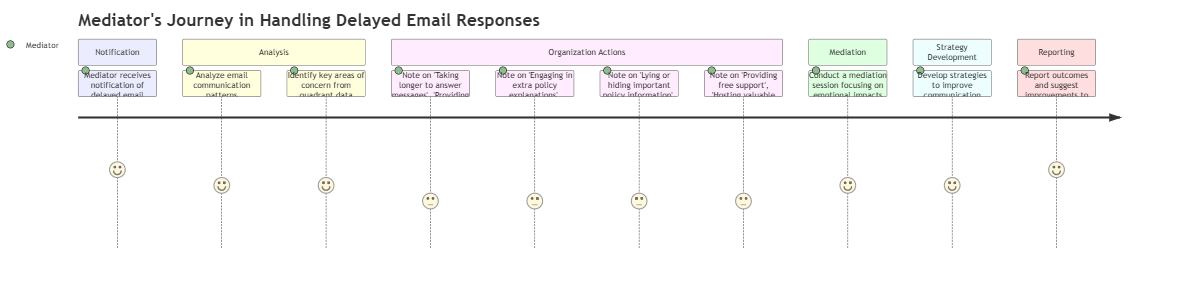
QUERY: Create a user journey diagram for the mediator given the delays in email responses and their emotional effects.
Description: This diagram outlines the steps the mediator takes, from receiving notifications of delayed email responses to analyzing communication patterns, considering emotional impacts, and reporting outcomes to stakeholders.
3: Identifying What Matters
The NextLevel™ Mediation platform is about more than just charts. You can also just ask it questions so it can use its “brain” to digest all of the meaningful facts and help you stay focused on the big picture. This is important for me – even if only as a gut check – as my mental illness means I can be prone to becoming obsessive and to fixating on some facts at the exclusion of others. NextLevel™ is an objective way to get a sense of the big picture.
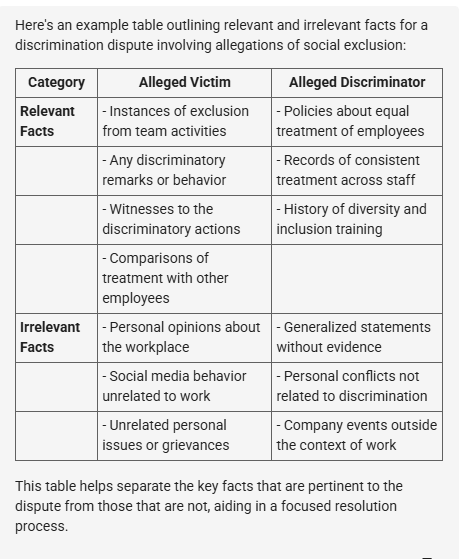
Beyond asking it for charts and diagrams, you can also generate tables to help you organize key information. Take a look at the table it generated when asked what might be the relevant and irrelevant facts for a discrimination claim (both for the alleged victim to collect, and for the alleged discriminator who is defending themselves):
If you have ever found yourself overwhelmed sorting through what happened, or just looking for a way to double-check your perspective – the NextLevel™ Mediation platform can instantly provide you breakdowns and summaries like this to help you find your way.
Conclusion
Seeing is believing, but it can be difficult to create the right picture. Visualizations can help resolve disputes if you know how to use them. This article talked about different charts you can use to visualize the scale of damages, the responsibility for delays, and which facts prove disparities. We also shared how you can go use NextLevel™ Mediation, right now, to create charts like this of your own (and so much more).
It can seem intimidating to enter the world of charts and graphics and bring them into your dispute, but it can also add a lot of value. I am grateful that there is software like NextLevel™ Mediation to help make something that can seem – at first – to be complicated into an easy, user-friendly, and fast process.
Here are some ideas of ways NextLevel™ can help:
Collect and scan all of your data from a situation into its platform, including e-mails and documents, and ask it to tell you the key points that matter, and the key things that matter to each party
Use it to instantly chart relationships with people and show patterns of impact and harm
Have it list the points of disagreement between the parties
Create timelines and sequence diagrams to show the course of events and simplify a complicated, convoluted set of facts into something precise and digestible
Disputes are often painful. We find ourselves in so much distress that it can help to use an AI-empowered software assistant to keep track of the facts so we don’t have to worry – and to paint the big picture summaries of what matters so we don’t get lost.
Author Biography
Dan Berstein is a mediator living with bipolar disorder who uses conflict resolution best practices to promote empowering mental health communication and prevent mental illness discrimination. His company, MH Mediate, has helped thousands of professionals and organizations be empowering, accessible, and non-discriminatory toward people with disclosed or suspected mental health problems. Dan holds degrees from the Johns Hopkins School of Public Health and the Wharton School. He is the author of the 2022 book, Mental Health and Conflicts: A Handbook for Empowerment.
Robert Bergman is a seasoned decision science expert with over 60 years of experience in software engineering, system dynamics, and strategic planning. He is the founder and CEO of NextLevel Mediation, a SaaS platform that applies decision analytics, Game Theory, and AI to dispute resolution. His expertise spans multi-criteria decision-making methodologies (AHP, ANP, MAUT), mediation, negotiation, and military systems such as flight simulations. Previously, he held senior leadership roles at Intel, focusing on mobile strategy and cybersecurity, and has consulted widely in strategic decision science. Bergman is also a published researcher in AI, technology addiction, and the future of dispute resolution.
Although the legal profession prides itself on rigorous training and high standards, recent research reveals a gap between education and practice.
On 9 April 2025, the New South Wales Legal Profession Admission Board (LPAB) released a research report conducted by Urbis that examined Practical Legal Training (PLT) in NSW (the report). This report offers crucial insights for legal educators, practitioners, and the profession as a whole as it provides a view of the current landscape of legal education.
The Graduate Perspective
Most interestingly, 1 in 3 PLT graduates (33%) did not agree that the coursework was useful and that the course lacked deep relevance to legal practice. Direct feedback included comments like:1
“The core and elective subjects were not particularly helpful for my career”
“… it is difficult to grasp what each subject is intended to achieve”
Many characterised their PLT experience as merely a “box-ticking” exercise, which is gravely concerning considering the program is designed to bridge the gap between academic learning and professional practice. The purpose of PLT is to prepare future lawyers with the knowledge and skills required to practice competently and confidently, though feedback signifies otherwise.
Further, graduates reported that professional experience gained as paralegals or in other legal roles proved more valuable than the coursework itself. This practical exposure apparently delivered what formal PLT could not.
Though this was not a shared experience for all. Some respondents reported inadequate supervision, including being stationed to complete mundane administrative tasks or working under difficult supervisors.
In particular, one participant highlighted the challenges that would typially be faced by ‘first-generation’ lawyers–those who lack established connections within the legal profession–and described witnessing exploitative practices, power imbalances, absent quality control, and a lack of accountability.
The Supervisor Perspective
On the other hand, the supervisor perspective appears to be equally troubling. Over 2 in 5 PLT supervisors (42%) expressed dissatisfaction with the practical legal skills demonstrated by graduates. Even more concerning, 4 in 5 reported that graduates frequently required support to complete basic tasks and that they were not adequately prepared for workplace realities. Supervisors were particularly blunt in their feedback, with some commenting that graduates:2
“… [were] not up to the standards in private practice compared to [those] before the pandemic”
“… [were] unable to construct a sentence, have no idea what a title deed is, how to put together a brief, answer the phone, address an envelope, construct a cogent argument or conduct legal research”
Yikes… the latter response particularly raises some alarm bells to say the least. However, the quality of work will naturally vary from person to person, as one supervisor identified.
Furthermore, and somewhat optimistically, many supervisors explained that essential skills were ultimately better taught “on the job”, particularly in small or ’boutique’ firms. This suggests that graduates who receive proper guidance early on in their careers can develop the necessary practical skills effectively regardless of any deficiencies or challenges they might face in their formal studies or training.
An Extension of an Invitation
On 14 April 2025, the Honourable Andrew Bell, Chief Justice of New South Wales, issued a statement responding to the findings in this report. His honour highlighted these concerns and extended an invitation to members of the profession to make a submission in response.
I encourage readers, particularly practising lawyers, to peruse that report and consider its relevance to your own legal practice. Perhaps even make a submission to the LPAB with your concerns, reflections, insights, and experience.
A Personal Reflection
As a recently admitted NSW practitioner myself, though not a participant in this research, I can share and appreciate others’ likely frustration post-PLT and the intimidating reality in beginning the journey as a young lawyer.
The major concern emerging from this research is that the current PLT program fails to adequately equip students with the knowledge, skills, and competencies required for professional excellence. And if this is true for PLT, what does it suggest about the overall law curriculum from which it extends?
This gap became immediately apparent to me upon entering the profession. As a ‘second-generation’ lawyer, I was fortunate to have benefited from opportunities that offered invaluable guidance. Having worked with both barristers and solicitors during my PLT and early career–those whom I am most grateful–I received mentorship that provided me with essential skills which were not covered in my formal legal education.
It is unacceptable that not all graduates are afforded the same basic level of guidance and respect by supervisors or colleagues within the profession. It is an absolute privilege to be part of this great legal profession, and it is shameful that some might not recognise that privilege in this same light.
When opportune and appropriate to do so, we all ought to guide future lawyers, colleagues, and even opponents. This is not merely a matter of goodwill but rather a professional duty toward maintaining a competent, credible, and reputable profession.
Addressing this Gap
This gap in education and practice requires our urgent attention and reform.
To address an aspect of this problem, I will be speaking alongside Philippe Doyle Gray, Barrister-At-Law at 8 Wentworth Chambers, at the 2025 Australasian Law Academics Association Conference this July in our address titled “Evidence in a ‘Paperless’ Practice: Bridging the gap between theory and practice in legal education”.
Our address will focus on just one gap, specifically, how the Evidence Law compulsory unit fails to translate theoretical knowledge into professional “real-world” skills. We will explain that theory alone is insufficient in today’s legal landscape, particularly in an increasingly digital practice environment, and that graduands desperately need practical skills development before they enter into the workforce.
What You Can Do
While I have highlighted certain aspects that were revealed within the report, it contains many additional findings worthy of your attention, including issues around the high cost of completing PLT and the shift from face-to-face to online learning.
I strongly encourage all members of the profession to review the report in its entirety and take a keen interest in these issues. The quality of legal education directly impacts the quality of our profession.
Rory Gowers & Milan Nitopi This article is Part 3 of 3 in our series ‘Informed, Involved, Inclusive’.
Rory and Milan (left to right) presenting at the 12th Conference World Mediation Forum – Foro Mundial de Mediación in Brazil in November 2024.
The story of fisherman Mark and how mediators are not so different…
Mark Schenk recently shared a fishing story to illustrate when 90% isn’t enough.1 Mark tells us that he loves beach fishing, and beach worms make great bait–but at $9 each, he decided to catch his own. Turns out, it’s trickier than he expected.
Over several months, Mark learned to pick the right beaches, attract worms, spot them, and get them to latch onto bait. But despite all that effort, he would spend two hours catching just one or two worms. He kept missing the final step–grabbing them.
Frustrated, Mark studied everything there was to know about catching worms and learned insight from a highly experienced fisherman. That’s when he discovered the problem, that his instincts were wrong. Mark was using a pincer grip, like picking up a pencil. But the right way? He needed to press the flat his thumb into the first joint of his index finger.
Once Mark changed his grip, he started catching worms immediately–but only if he was focused. Whenever his attention lapsed, old habits crept back.
We share this story because intercultural mediation is not so different.
Although Mark spent months learning the skills and techniques to catch beach worms, it would be entirely futile as what he lacked was insight and experience. Once he learned the ways of experienced fishermen, his ability to catch worms increased exponentially.
Although mediators might be highly trained and skilled in their own right, they can lack the experience and insight required to mediate intercultural interactions effectively. Mediators can prepare meticulously, understand the key players, and enter negotiations with good intentions–but it is justnot enough. Like Mark, they can often rely on ingrained instincts that don’t quite translate in another cultural context.
What is missing within intercultural mediation?
It is simply not enough to just understand different cultures, it is about recognising and appreciating how other people perceive fairness, respect, and the process within their own cultural lens. Ask yourself this:
Am I engaging with each parties’ culture on their own terms?
Am I identifying and discerning their expectations, needs, interests, or concerns accurately (including what they may require for the process to feel appropriate and fair)?
Am I adapting my approach to mediation so that each party can contribute their best in achieving mutually beneficial outcomes?
Without this level of intercultural predisposition, negotiations by and between parties may seem productive on the surface, but will fall apart in practice—just like Mark spending hours on the beach with only one or two worms to show for his efforts.
Why MIMI is the missing link–especially in 2025!
The world is shifting rapidly. Geopolitical tensions, economic realignments, and global challenges mean that current top-level negotiation skills are no longer enough.
Mediators need more than just knowledge of culture, they need an intercultural predisposition–a first-hand experience which complements their current knowledge and skills. The ability to move beyond rigid frameworks and adapt in real time to cultural expectations will produce fairness and respect from multiple perspectives.
Mediators must facilitate an environment where all parties can contribute their best, even when they feel like they are in foreign territory. Without this, agreements that are technically sound lack true buy-in, and those agreements will unravel under pressure or strain.
The cost of misalignment is growing. Whether in business, diplomacy, or public service, failure to navigate cultural expectations means failed projects, lost trust, and missed opportunities. MIMI helps mediators to develop that final 10% needed to excel within cultural interactions, and this cultural adaptability then turns competence into mastery. Like Mark’s fishing lesson, it’s a small shift that changes everything.
Who else can benefit from MIMI?
Mediators are not the only ones who can benefit from what MIMI has to offer. Leaders, coaches, negotiators, managers or executives in business, lawyers and legal professionals, doctors and nurses can all benefit immensely by mastering these intercultural skills.
Reflect on your own experiences… Has there ever been a time in your life, or the life of a person you might know, where there was a cultural disconnect? Where expectations within that interaction were not adequately met? Where needs, interests, or concerns were not accurately addressed? If you have, now imagine how others might feel where there is an even greater cultural disconnect–where the stakes, risks, and loss are substantial.
At MIMI, we have spent years refining our craft, and now we are guiding you to develop that same instinct—not by giving rigid rules, but by helping you see and feel the process differently. By completing our training program, you will begin your journey in becoming a master of intercultural mediation and you will be able to assist others in ways that are culturally relevant.
MIMI will teach you how intercultural mastery can become second nature, just like Mark adjusting his grip. MIMI is not just another training program–it is a transformational shift. This kind of shift, once made, cannot be unseen and will contribute to much beneficial change.
Join the MIMI Pilot Program—A Transformative Experience!
We invite you to express your interest in completing our pilot program and to contribute your thoughts on how we can make it better.
We are selecting only8 accomplished professionals for the exclusive pilot cohort: the Mastering Intercultural Mediation Initiatives (MIMI) Program.If you would like to be a part of this transformative experience, express your interest here.
Expressions of interests close 31 May 2025.
Who should apply?
✔️ Experienced mediators who have navigated complex, high-stakes disputes. ✔️ Senior leaders and negotiators who operate across cultural boundaries. ✔️ Professionals with a proven ability to build rapport in challenging intercultural situations.
As a pilot participant, you will:
Be the first to experience MIMI
Expand on your intercultural toolkit
Join an elite mastermind, shaping the future of intercultural mediation
Why Law School Faculty Should Increase Instruction in Mediation Representation
I’m a retired law professor who mediated and taught mediation for years. The main purpose of my article was to encourage law school faculty who teach mediation to increase their instruction about how attorneys can promote good decision-making by representing clients in mediation. About 90% of law school mediation instruction in the US focuses on the neutral role, with relatively little instruction in mediation representation.
Many faculty want to encourage their graduates to promote self-determination, and they focus on the mediators’ role in doing so. There are significant limits on mediators’ capabilities to do this. Attorneys actually are in a much better position to help clients make good decisions in mediation sessions by carefully preparing them before mediation sessions.
Unfortunately, many attorneys don’t do a good job of preparing their clients for mediation sessions. That’s one reason why faculty should teach students how to do it well. This also would prepare them for the NextGen bar exam in the US (which will include questions about client management and dispute resolution skills) and to represent clients after graduation. New graduates are much more likely to represent clients in mediation than to serve as mediators.
How Preparation Promotes Self-Determination
For many parties, mediation sessions are very stressful. They are in the middle of an unresolved conflict, and they don’t know how the process or outcome will turn out. They may experience strong emotions, possibly aggravated by hostile reactions from the other side (who might be represented by a scary attorney). They may not be sure whether the mediator will help them. And they may be forced to respond to the mediator and other side under time pressure. So mediation sessions may be challenging environments for parties to make decisions.
Some mediators can’t or don’t do much to help parties prepare before mediation sessions. My article, How Can Courts – Practically for Free – Help Parties Prepare for Mediation Sessions?, suggests things that courts and mediators can do, and it includes links to lots of resources. Parties represent themselves in many mediations, and that article includes suggestions to help self-represented parties.
Mediators should do whatever they appropriately can to help parties prepare. Even when they do encourage preparation, however, there are significant limits to the assistance they can provide because of their neutral role. Mediators typically do not provide advice that parties need before and during mediation sessions.
Attorneys are particularly well positioned to help their clients prepare for mediation sessions in legal cases. Attorneys can engage clients to make choices about dispute resolution processes (if they have a choice), obtain and exchange relevant information with their counterparts and the mediator, educate clients about the applicable law, provide legal advice, explain how the mediation process would work in their case, help them identify and prioritize their goals, anticipate the counterparts’ perspectives and tactics, consider the likely outcomes if the parties do not reach agreement, and plan possible mediation strategies.
When parties are well prepared before mediation sessions, they can participate as effectively as possible from the start of the sessions. Such parties are in a much better position than when the only efforts to promote self-determination occur when mediators do so during mediation sessions.
Realistically Promoting Self-Determination
Standard I.A of the Model Standards of Conduct for Mediators defines self-determination as follows: “Self-determination is the act of coming to a voluntary, uncoerced decision in which each party makes free and informed choices as to process and outcome.”
Making “free” choices is an admirable ideal. What does it mean in practice?
My article noted that there are many factors that can limit parties’ decision-making freedom, including many they aren’t even aware of. Indeed, mediators generally have limited knowledge about what affects parties’ decisions.
So I suggested how we might practically operationalize this ideal. Mediators and attorneys can help parties become knowledgeable, confident, and assertive, with the goal of making the best possible decisions under their circumstances. I think that this is the best we realistically can do to fulfill the goal of self-determination.
Choosing Our Language
In our field, we use many vague terms that feel good, like self-determination. Unfortunately, many of these terms are opaque, so people can attach many different meanings to them and misunderstand each other.
In my article Oxymorons R Us, I suggested that we should communicate so that people actually do understand what we mean – especially people who are not in our field, like parties.
Some readers like our traditional concepts and want to continue using them. I hope to prompt people to reflect on the concepts they prefer and to consider whether other concepts would be more useful.
Author Biography
John Lande, JD, PhD is the Isidor Loeb Professor Emeritus at the University of Missouri School of Law and former director of its LLM Program in Dispute Resolution. He earned his JD from Hastings College of Law and his PhD in sociology from the University of Wisconsin-Madison. Since 1980, John has practiced law and mediation in California, and since the 1990’s, he has directed a child protection mediation clinic.
The American Bar Association has published John’s books, including ‘Lawyering with Planned Early Negotiation: How You Can Get Good Results for Clients and Make Money‘ and ‘Litigation Interest and Risk Assessment: Help Your Clients Make Good Litigation Decisions‘ (co-authored with Michaela Keet and Heather Heavin).
John frequently writes for the Indisputably blog and has received many awards for his scholarship, most recently the American Bar Association Section of Dispute Resolution’s award for outstanding scholarly work. You can download articles on a wide range of dispute resolution topics from his website.







 The Australian Dispute Resolution Research Network