
By Claire Holland and Peter Condliffe
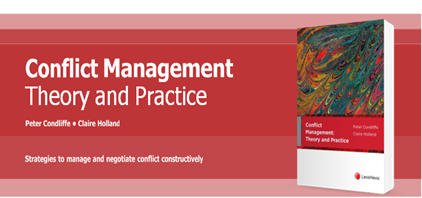
We are delighted to share with our colleagues and friends at the Australian Dispute Resolution Research Network that the 7th edition of Conflict Management: Theory and Practice has been published by LexisNexis. This milestone marks not only a significant revision of the text, but a new chapter in the book’s own story, one that now carries two names on the cover for the first time.
A Book That Has Kept Pace with the Field
First published under the title Conflict Management: A Practical Guide, this text has been a staple resource in Australian conflict management education and practice for many years. The seventh edition arrives with a new title, Conflict Management: Theory and Practice, reflecting a deliberate shift in emphasis: theory and practice are not opposites, but partners. The book draws on law, psychology, sociology and beyond to offer readers both intellectual rigour and practical grounding.
As Dr Rachael Field writes in her foreword: Peter Condliffe “has long been recognised as one of Australia’s most thoughtful and influential voices in the field of dispute resolution” whose “work has shaped generations of practitioners, scholars and students.” With this edition, Claire Holland joins as co-author, bringing what Dr Field describes as “renewed clarity, contemporary insight and practical innovation to the work’s lasting foundations.”
What’s New in the Seventh Edition
This edition has been substantially revised to reflect the rapidly changing landscape of conflict management in Australia and internationally. Key updates include:
National mediation standards. The text incorporates the significant reforms introduced through the establishment in 2025 of new national standards overseen by the Australian Mediator and Dispute Resolution Accreditation Standards (AMDRAS) Board. Peter played a central role in developing these standards over the period 2019–25, and that expertise is woven throughout the relevant chapters.
A new conflict analysis framework. Claire introduces the Holland & Herrmann-Rafferty conflict analysis framework, an advanced framework as a practical tool to support parties, practitioners and students in understanding how conflicts arise and evolve, and how to systematically examine multiple dimensions of conflict so that decisions on actions are informed by both theory and practice, and are appropriate.
Expanded perspectives. The edition includes commentary from Indigenous and multicultural conflict perspectives, improved analysis of multi-party and multi-issue conflict contexts, and expanded treatment of feminist theory and other contemporary approaches.
Neuroscience and emotion. Updated approaches to managing emotions, informed by the latest neuroscience research, are integrated into guidance on facilitation, difficult conversations, and ongoing conflict management.
Technology and AI. The text examines advances in online dispute resolution and the ethical implications of artificial intelligence in dispute resolution; a theme Dr Field rightly identifies as essential to “the complexity of modern conflict.”
The twelve chapters span the full breadth of the field, from navigating and responding to conflict, through negotiation, mediation and restorative justice, to collaborative practice, group facilitation and conflict management system design, with justice as a core principle throughout.
For Practitioners, Academics and Students
Dr Field captures the book’s reach well: “From seasoned dispute resolution practitioners to students just beginning to embrace dispute resolution, from legal professionals to community advocates, the text offers theoretical depth to pragmatic wisdom.” It is, as she writes, “a practical guide for anyone who encounters conflict — which is to say, all of us.”
We wrote this book for a wide audience, including academics and scholars interested in conflict theory, practitioners looking for frameworks and inspiration, and students preparing for careers across law, human resources, community development and leadership. As Justice Michael Kirby noted in the foreword to an earlier edition, “management of conflict, as the author says, is a daily imperative.” That observation feels no less true today.
A Thank You to Our ADRRN Colleagues
We want to take this opportunity to express our sincere gratitude to the many friends and colleagues in the ADR Research Network who reached out to us during the writing of this edition, sharing new research, flagging emerging developments, and offering encouragement. This community exemplifies the kind of collegial, collaborative spirit that the field of conflict management aspires to. We are genuinely glad to be part of it and grateful for your continued engagement.
How to Access the Book
Conflict Management: Theory and Practice (7th edition) is available through:
- University libraries — the text is held in many university library collections across Australia
- LexisNexis— available as part of the LexisNexis suite of books, in hardcopy or online, at https://store.lexisnexis.com/en-au/products/conflict-management-theory-and-practice.html
If you are considering using the book as a teaching textbook, we warmly invite you to get in touch with us directly, or to request a desk copy from LexisNexis.
Peter Condliffe: pc@vicbar.com.au Claire Holland: claire.holland@jcu.edu.au
We hope the seventh edition serves you well in your teaching, your research, and your practice.
Peter Condliffe PhD and Claire Holland PhD

