
Boundaries in conflict

Samantha Hardy
This article has been republished with permission. The original publication can be found at The Conflict Management Academy.

In my work with clients in conflict, I constantly find that they have missed many opportunities to manage conflict more effectively. In particular, they often fail to set appropriate boundaries (or ANY boundaries) to allow themselves to be at their best in conflict situations.

Boundaries are a fundamental part of preventing unnecessary conflict, and managing conflict effectively when it does arise. Once you identify which kinds of boundaries work best for you, they are easy to set and maintain. You will start to become more courageous in conflict, bet better outcomes, and keep your integrity intact.

Caution

In any conflict situation, there are risks as well as opportunities. The information provided in this article includes general suggestions that are useful in many conflict situations. However, there are certain types of conflict, particularly when someone is using coercive or controlling behaviour over another person, in which boundaries are unlikely to work. Please think carefully before implementing any of the suggestions in this article, and ensure that you do not put yourself or others in danger. If in doubt, seek professional support, from a counsellor, a therapist or even the police if the risk of harm is imminent.

What are boundaries?

Boundaries are basically our own personal rules about what is, and what is not, okay. Effective boundaries support us to behave at our best in difficult situations. Brené Brown explains that boundaries help us to find ways to be generous to others, while still behaving in a way that is consistent with our personal values.

In conflict, boundaries allow us to engage in constructive conflict management, instead of simply avoiding the conflict or lashing out in order to protect ourselves. They provide a structure for communicating effectively in difficult situations.

If you don’t set good boundaries in conflict situations, you will end up feeling resentment, anger and frustration. You will act in ways that you later regret. You will damage relationships and your own reputation. You will not get what you need, you will not say what you need to say, and you will say things that you later wish you hadn’t said.

With good boundaries

  • You will prevent unnecessary conflict.
  • You will be able to stand up for yourself in conflict, while maintaining your integrity.
  • You will be able to communicate better in conflict situations.
  • You will be more understanding towards those with whom you are in conflict.
  • You will manage your emotions better in conflict interactions.

Types of boundaries

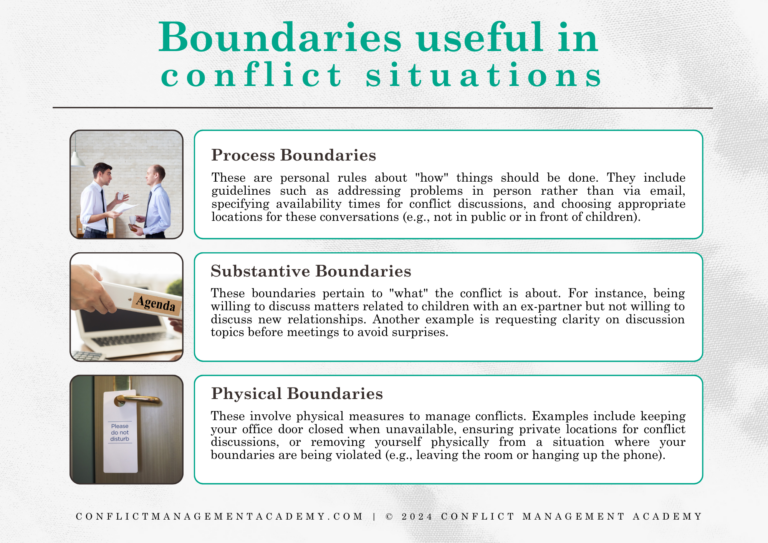
There are different kinds of boundaries that are useful for different situations. In conflict, there are three main types of boundaries: process boundaries, substantive boundaries and physical boundaries. These can all be used to prevent unnecessary conflict or to support you to manage conflict that does arrive courageously and with integrity.

A process boundary is a personal rule about “how” things should be done. For example, you may say to your employees that if they have a problem with something that you do at work, they should come and speak to you about it in person, rather than complaining behind your back or sending an email. Other process boundaries might relate to time – when you are and are not available to talk about a conflict, and for how long. Process boundaries may also relate to where conflict conversations take place (e.g. not in a public place, or not in front of children).

A substantive boundary relates to “what” the conflict is about. You may, for example, set a boundary that you are willing to talk to your ex-partner about what is best for the kids, but you are not willing to talk about your new relationship. A substantive boundary might be asking someone to be very clear about what they want to talk with you about before a meeting, so that you can be prepared to discuss those particular issues without being taken by surprise.

Physical boundaries are very useful in conflict situations. They may include things like keeping your office door closed when you are not available to have a conversation; ensuring that conflict discussions take place in a location where nobody can overhear what people are saying; or you physically removing yourself from a conversation in which someone is breaching your other boundaries (e.g. by walking out of the room, or hanging up the phone).
How to set boundaries

In order to set good boundaries, we need to know what is important to us. Our boundaries should support us to act in accordance with our values. We also need to know what kinds of behaviours from others make it difficult for us to maintain our integrity in conflict situations, and what kind of actions support us to communicate effectively. We need to distinguish between things that make us feel safe, but prevent us from managing conflict effectively (e.g. avoiding the other person) and things that enable us to interact in a constructive way.

Try to think about preventative boundaries, as well as boundaries that you might be able to use in the moment during a conflict conversation.

Things to think about when setting boundaries in conflict situations:

  • Which of our values are most important to us in conflict situations?
  • What kind of behaviour would be consistent with our values?
  • What would we like others to do in conflict situations to enable us to manage the conflict constructively?
  • What would help us to communicate effectively in conflict situations, so that we can listen respectfully but also say what we need to say?
  1. What makes you uncomfortable or stressed in conflict situations?
  2. What helps you communicate effectively in conflict situations?
  3. What process boundaries would support you in conflict situations?
  4. What substantive boundaries would support you in conflict situations?
  5. What physical boundaries would support you in conflict situations?

It can be difficult to get started and learn how to set effective boundaries in conflict situations, but fortunately The Conflict Management Academy provides an online module so you can develop the skills to interact with courage!

Medianos Intercultural: Constructive Intercultural Protocol for Sustainable Conflict Responses

Massimiliano Ferrari’s creation of Medianos, a board game designed to help parties align with “interests and needs” rather than “positions”, demonstrates measurable success in Western mediation training contexts (Tambù Creative Team, 2023). The board game is designed to effectively teach collaborative problem-solving skills and transform adversarial thinking patterns. Ferrari’s intent to democratize mediation knowledge through accessible gameplay merits recognition (Gowers, 2025).

However a critical problem emerges as the western Medianos board game expands internationally: “most standard mediation practice is the antithesis of social transformation; it is interculturally incompetent” (Gowers, 2023). When Western-derived intervention tools spread globally, regardless of noble intentions, they risk reproducing colonial paradigms. At this point in history, we need “a new intercultural competence playbook” that honours Ferrari’s democratic vision while co-creating genuinely inclusive, inter-culturally capable conflict responsive approaches.

The Cultural Assumptions Challenge

Medianos succeeds within Western contexts because it aligns with specific cultural values of individual agency, rational discourse, and negotiated outcomes. However, Ting-Toomey’s (1988, 2005) face negotiation theory reveals that conflict parties must manage “face-related concerns” that vary widely between individualistic and collectivistic cultures. The core issue is that game-based mediation training may embed the implicit cultural assumptions of its creator.

Xiao and Chen (2009) observed that Western communication competence (defined as “goal-oriented, self-oriented, lauding assertiveness”), directly contradicts what Chinese and other Asian cultures have considered communicatively competent for centuries. When mediation training reinforces Western competence models, it undermines inter-cultural rapport.

Māori scholar Tauri (2024) warns that Western alternatives become “a way for policymakers and politicians to silence Indigenous critique” by “repackag[ing] and sell[ing] the system back to itself.” Research (Gowers, 2023) confirms this pattern, showing how standard practices “restrict access to justice by using negotiation powerplay to deny the potential for greater benefit for all parties.”

Indigenous Epistemological Challenges

Contemporary indigenous scholarship identifies fundamental clashes with Western conflict resolution approaches. Latin American decolonial theorists document how Western models emerge from “the project of modernity and the ongoing expansion of a European cultural imaginary” (Rodriguez & Inturias, 2018; Quijano, 2000). Australian Aboriginal experts specify that Indigenous approaches “embrace a deeper level of healing and renewal of relationships” compared to Western “dispute resolution” (ADRAC, 2020).

Indian Adivasi philosophy of “Adivasiyat” emphasizes “a strong sense of connection to land, nature, spirits and community” (Xalxo, 2021) that conflicts with the anthropocentric individuality in Western mediation training. When conflict resolution focuses exclusively on person-to-person negotiation while excluding relationships with land, community, ancestors, and spiritual dimensions, it violates fundamental worldviews of numerous global communities.

Smith (2012) identifies this as reproducing “imperial and colonial discourses” that marginalize non-Western ways of knowing within supposedly inclusive frameworks.

Research Imperatives

To honour Ferrari’s democratic vision while avoiding colonial reproduction, research must build on the insight that “interculturally competent mediators recognize these gaps and propose just and intelligent solutions that include all relevant third parties” (Gowers, 2023).

Specific requirements include:

  • Collaborative epistemological mapping that documents indigenous and traditional conflict resolution approaches from specified continents, understanding their philosophical foundations rather than extracting techniques.
  • Critical analysis of embedded assumptions in game-based mediation training through “crossing over with appropriate immersion in at least one other culture” (Gowers, 2023) to identify where Western individualism, rationality, and anthropocentrism conflict with other worldviews. Of course, in instances where other dominant cultures implicitly enforce their worldview the same concerns may also require critical appraisal.   
  • Development of genuine intercultural frameworks where Western innovations like Medianos engage with other traditions as equals, applying for example the “7 steps of RESPECT” methodology (Gowers, 2023).
  • Testing of hybrid approaches that integrate indigenous knowledge systems as equal partners, recognizing the principle that “conflict is endemic in the process of social change itself” (Gowers, 2023).

The Intercultural Mastermind Initiative

This moment demands concrete action aligned with a call for stakeholder collaboration to “define the principles, practices, and techniques necessary to navigate intercultural complexity sensitively and effectively” Gowers’ (2023). We propose establishing an Intercultural Mastermind Working Groupbringing together Ferrari, Gowers, and indigenous knowledge holders from specified continents to co-design Medianos Alternative Protocol (MAP): An Intercultural Framework for Constructive Problem-Solving and Peace-Building.

This initiative embodies the vision that “interculturally competent mediation practice is adaptable to social transformation” through equal partnership including:

  • Indigenous knowledge holders from Australian Aboriginal (including Professor Marcia Langton’s frameworks), Māori, Latin American, Middle Eastern, and Indian Adivasi traditions
  • Intercultural communication theorists who understand both Western and non-Western approaches
  • Community practitioners working at the intersection of traditional and contemporary conflict responses
  • The original creators bringing expertise in game-based learning and mediation theory

The MAP Development Process

The Medianos Alternative Protocol would emerge through the “7 steps of RESPECT” (Gowers’ (2023) methodology:

  1. Reframe the Context by revealing foresight and establish focus. Each tradition shares its cultural background and expectations about conflict resolution. Identify how different approaches engage with mediation based on their cultural contexts.
  2. Resolve the Content by specifying facts, pondering feelings and examining findings. Document where approaches complement, contradict, or offer alternatives while honouring diverse motivations.
  3. Recreate the Contract by confirming finalization and tracking fulfilment. Co-create methodologies integrating multiple epistemologies, test through community implementation with relationship tracking. Verify that agreements are fulfilled or re-negotiated until complete.

This framework develops “inter-cultural respect-ability” (Gowers 2023) terms through the insight that effective intercultural mediation requires “crossing over with appropriate immersion in at least one other culture” while maintaining cultural integrity.

Modelling the Solution

The Intercultural Mastermind approach provides specific advantages over traditional research-then-application models:

  • Immediate Impact: Creates practical tools while building theoretical understanding
  • Authentic Partnership: Positions indigenous knowledge holders as co-creators rather than consultants
  • Living Laboratory: The collaborative process models the intercultural problem-responses it teaches
  • Scalable Innovation: Success informs broader cross-cultural program development

Conclusion: Beyond Cultural Wars to Co-Creation

Current trajectories risk reproducing patterns where Western innovations spread globally with cultural modifications while fundamental power dynamics remain unchanged. The Intercultural Mastermind approach requires courage to question whether appropriate participation demands genuine co-creation from the foundation level.

Ferrari’s vision of democratizing mediation knowledge through accessible, engaging methods deserves fulfillment through the most ambitious interpretation possible. True ‘democratization’ (spoiler alert – a western paradigm) requires surrendering Western centrality for multicultural co-creation that produces innovations none of the traditions could create alone.

The proposed Intercultural Mastermind Working Group represents both urgent scholarly priority and opportunity to model “transforming our viewpoints, priorities, and actions” to “create a new era of intercultural mediation” (Gowers 2023). Rather than studying cross-cultural adaptation, we could demonstrate inter-cultural innovation and answer the question: “How do you plan to come out of these current crises?” (Gowers, 2023).

This moment calls for investigation matching the scope of the challenge, not merely examining how diverse human traditions might inform conflict responses but bringing them together to create new possibilities for our interconnected world.

Note: This Intercultural Mastermind approach demands international collaboration, indigenous partnership, and creative courage that could transform not just conflict response education but our broader approaches to respectful intercultural collaboration. What might be the learnings to use in future IT and AI developments?


References

Considering where to publish your Dispute Resolution research and experience

Pauline Collins and David Spencer
This article has been republished and adapted with permission. The original publication can be located within the Australasian Dispute Resolution Journal.

Despite people negotiating disputes since time immemorial, the formalisation of dispute resolution in Australia dates back only around half a century. Prior to this there was litigation, compromise offers and informal settlement negotiations. Dispute resolution also referred to as alternative, assisted, additional dispute resolution or just dispute management now entails a growing range of approaches to assist parties in resolving or managing their dispute.

This year the Australasian Dispute Resolution Journal (the journal) celebrates 36 years of publishing current scholarly research and in-practice experience in dispute resolution throughout the Indo-Pacific Asia region. The journal has evolved to discuss all dispute resolution approaches and is a faithfull record of change in the civil disputation landscape. Today, “[c]ivil disputes which are resolved by curial adjudication are a minute fraction of the civil disputes which arise in our (or any) society”.

The journal was the brainchild of its foundation Editors, the late Micheline Dewdney and Ruth Charlton along with the then Managing Editor of Thomson Reuters.

The value of a scholarly journal is arguably in its ‘impact’ which is defined by the Australian Research Council as, “[t]he contribution that research makes to the economy, society, environment or culture, beyond the contribution to academic research”. While measuring a journal’s impact is a contested space in academia and the professions with opinions on what constitutes impact varying from discipline-to-discipline and within disciplines, the task is a little easier in the discipline of law. For the law discipline tracing the impact of research and publication can be mapped via law reform and legislative and common law citation that initiates changes to the law.

In its short life, the journal has been cited with authority eighteen times in the work of various state and federal Law Reform Commissions in Australia. The journal has also been cited with approval in at least thirteen judgments of superior courts of record in Australia where the court has been called upon to adjudicate on the developing law surrounding dispute resolution.

The journal’s reach is another measure of its impact. The journal currently has over 500 institutional subscribers ensuring it is available to a wide audience of potential readers. Further, online subscribers accounted for over 20,000 clicks/views in the last twelve months.

From its humble Sydney-centric beginnings, today the editorial board of the journal has expanded to 24 members who hail from Australia, India, Singapore, United Kingdom and New Zealand and from a wide variety of professions and vocations.

For a double-blind peer reviewed scholarly publication, the journal prides itself on its eclectic content. Substantively the journal deals with all manner of dispute resolution from the consensual, informal and less interventiory processes such as negotiation and traditional dispute management methods to the less consensual, more formal and interventionist processes such as adjudication and arbitration. It also seeks out contributions about some of the more contemporary areas of dispute resolution such as restorative justice, therapeutic jurisprudence, collaborative practice, conflict coaching, use of government inquiry mechanisms, wise counsel mediations and the expanding knowledge of human dispute gained from advances in neuroscience.

A critical area serviced by the journal is that of continuing professional development. Our changing world, however, presents constant challenges providing journal editors with a demanding task. Not least of which is the much written about and utilised generative artificial intelligence (GenAI) technology. One of the first GenAI large language models is ChatGPT that was launched in November 2022 and together with its many relatives (knock offs), they are challenging the way researchers, writers and publishers work. This technology is here to stay and will continue to grow and become more efficient and acurate with the effluxion of time. These advances provide a historical leap for humans and the publication industry.

Much has been said about the positives and the perils of GenAI. The proliferation of writing about GenAI of itself makes addressing the topic challenging. Each new technology from clay tablets, the Gutenberg printing press, the typewriter, computers and now GenAI has raised fear, excitement and then adaptation as we adjust to the speed and content by which information and knowledge is communicated. Finding a balanced approach that accepts regulation to eliminate harm but also acknowledging the potential benefits is called for.

The impact of GenAI on the provision of dispute resolution services is now being felt. Whilst online and automated dispute resolution has been in existence for many years, the advent of GenAI, with its undectable ability to not only guide disputants to resolution but then to learn from each experience with the aim of improving its own ability over time, is a new frontier for the provision of such services.

For the researcher and author, the use of GenAI is also presenting exciting possibilities. The use of GenAI to assist with large data set comprehension and analysis can better inform decision-making that in turn can speed up creative innovation to human problems such as disputation. For publishers and editors there is already a growing uptake in the use of such tools to address editing and formatting processes. The likelihood is an increase in the speed of publication outputs and therefore circulation of knowledge.

The mainstay of the journal is original unpublished scholarly work that has not been submitted or accepted for publication elsewhere including online publication. These articles are a mixture of empirical and meta-analysis that are approximately 5,000- 8,000 words in length.

Additionally, the journal publishes a flourishing ‘In-Practice’ section where practitioners can write short articles of 1,500-2,000 words on any topical issue they may have an opinion or view on. Further, this section provides the opportunity for practitioners to raise process issues from their own experiences in the provision of dispute resolution services or as an advocate acting for parties in dispute resolution processes. The practical aspects of dispute resolution sit superbly side-by-side with the more scholarly contributions.

Each edition of the journal includes case notes on cases litigated predominantly in superior courts of record that raise a multitude of issues from enforcing dispute resolution clauses in contracts to the impartiality of third party neutrals. As before, case notes cover all the processes of dispute resolution from mediation through to domestic and international arbitration.

The journal also fufils a ‘clearing-house’ purpose providing book reviews on the latest publications concerning dispute resolution and a ‘Media-watch’ column that reports on global dispute resolution in the media.

Further, the journal hosts special editions where for example multiple papers are published from conference proceedings. Other special editions include themed editions on topics such as dispute resolution in family law or the forthcoming special edition on conflict coaching.

For 35 years the journal has found a place in the abundance of scholarly journals and remains the pre-eminent periodical on the theory, philosophy, law and practice of dispute resolution in the Indo-Pacific Asia region. So, there is a scholarly journal that is worthy of your consideration when seeking to publish your research and practice experience in dispute resolution.


Honorary Professor Pauline Collins and David Spencer are the Co-General Editors of the Australasian Dispute Resolution Journal published by Thomson Reuters.

Honorary Professor Pauline Collins, University of Southern Queensland, is a co-author of, Dispute Management (Cambridge University Press, 2021).

David Spencer is a Solicitor and Deputy Dean-of-Law at the Thomas More Law School at the Australian Catholic University and is author of, Principles of Dispute Resolution (Thomson Reuters, 4th ed, 2024), Mediation Law and Practice (Cambridge University Press, 2006) and co-author of, Dispute Resolution in Australia: Cases, Commentary & Materials (Thomson Reuters, 5th ed, 2023).

This blog is based on an article written by the authors entitled, “The Australasian Dispute Resolution Journal: Past, Present and Future” (2023) 32(4) Australasian Dispute Resolution Journal 210 and is republished and adapted with permission.