Written Off: Three Steps to Move Forward When You Feel Rejected

Dan Berstein

Whatever the reason for it and whoever it comes from, rejection hurts. 

In 2022 I wrote a book called Mental Health and Conflicts: A Handbook for Empowerment with hopes to teach people skills for managing challenging behaviors without writing off people with mental illnesses. At the time, this book represented a culmination of my life’s work and it meant a lot for to me that it found a home at the American Bar Association (ABA). 

Three years later, my ABA affiliation was unfortunately terminated following a difficult saga, for me and many others, as I was wrestling with interpersonal struggles and bipolar symptoms.   The news of my termination was very difficult. I have been hospitalized five times due to my bipolar disorder–always during times when I became overwhelmed by similar interpersonal challenges. During each episode, I would break down, my mind would get stuck on a problem, and I would decompensate into mania or even psychosis. My condition has a high risk for instability and suicide, with research showing that each subsequent episode means a decreased odds of returning to normal functioning.1

Being terminated from the ABA overwhelmed me. It was a sudden emotional crisis that put me at risk. I required emergency medication, emergency therapy sessions, and emergency support from friends and family. We summoned all of the lessons from decades of managing my condition in order to make it through.

Even though it was an immensely challenging period in my life, this time something was different. In 2023, and as part of my professional work as a conflict resolver, I had developed a system for responding to avoidance, rejection, and social exclusion. I presented a three-step model to get through these especially challenging situations, which I call the 3 R’s, at the Association for Conflict Resolution conference and the Academy of American Law Schools ADR Works-In-Progress conferences.

Without the skills of the 3 R’s, I do not know how I would have coped with being terminated. That system consists of:

  • Respect.
  • Reply.
  • Reorient. 

The 3 R’s approach readily lends itself to any situation and can be easily used by anyone when they face rejection from friends, family, colleagues. Here’s how it works:

1. Respect the person’s decision even if you find it stigmatizing or you disagree with it.

While it is tempting to try to convince them of your worth, dispel lies or inaccuracies, and seek ways to still have the relationship, it can also be dangerous. 

Sadly, I’ve learned in my life that, given I’m open with my bipolar disorder, it is easy for people to stigmatize my persistence to fight being rejected. Studies have shown that it is common that people with bipolar disorders are sensationalized in the media (such as TV shows or movies, and other portrayals).2 There is also research that shows people are more likely to worry someone that has a mental health problem is some kind of stalker.3 Amidst that kind of climate, it can be risky to continue contacting someone who may be seeing any follow-up through a stigmatizing lens. Arguing with their portrayal may only feed into the narrative.

Stigma aside, in any conflict it is helpful to separate the person’s decision to cut contact with you from the explanation you are given or the style with which it is delivered. It may feel offensive, demeaning, disrespectful to be ghosted or to hear a story that does not ring true or clearly is contrived. But no matter how poorly implemented or inaccurate the rejection may seem to be, it still provides notice of a decision: however painful the circumstances, this person wants to diminish or end their relationship to you.

Years of dispute resolution have taught me to prioritize self-determination,4 and made it easier for me to come to a place of accepting that a person made a rejection decision. 

While it does not feel good to be rejected, it has been a relief to readily accept it instead of debating. If there are other problems related to what is happening, such as bullying or discrimination, it still can be best not to fight and instead look for other kinds of support.5

2. Reply one last time to confirm the boundary.

You may not always get a formal letter or confirmation (such as a letter of termination–like I received) when it comes to rejection and social exclusion with friends, family, or others.

We live in a world filled with “ghosting” patterns–where people just pull away without contact–and things are left rather ambiguous and unclear.6 Sometimes it can be extremely ambiguous, such as in one of the latest dating trends where people engage in “breadcrumbing” to keep romantic partners on the hook or on hold.7

This is why, whenever anyone seems to be avoiding contact with me, I send one final reply to let them know that I am acknowledging what I perceive to be their boundary to be and that I plan to follow it. Depending on your personal boundaries, you might also let them know you are available in the future if they change their mind on reconnecting. In the course of my mental illness discrimination advocacy work, I typically take that approach, with hopes that one day the people or organizations who are avoiding me will evolve and want to engage. In that case, I want them to know the door is still open for that.

Sending this reply is important because it is possible–given any ambiguity–that there was a misperception. Sometimes people will immediately let you know that they didn’t mean to make you feel rejected and they might undo the boundary. On the other hand, if they are intent on the rejection, your reply documents that you are honoring their boundary and that record can be helpful, particularly to guard against the stigmas mentioned earlier.

3. Reorient to next steps rather than stay stuck in pain.

This is my favorite “R” because this approach has truly changed my life. Before the 3 R’s, I would stay fixated obsessing on hating myself, endorsing self-stigmas, wallowing, and reliving the loss over and over whilst descending into a dark place in my mind.

But there is another way. If we commit to focusing on reorienting ourselves to discover new opportunities, we can enrich our lives. Since I started using the 3 R’s model in my life, I have connected with new friends and colleagues, developed new projects and partnerships, and become active in new communities–all because I decided to immediately accept the person’s decision to cut contact with me and start looking for new people and places to be involved instead. Since 2023, when I first created this system, my life has grown at a meteoric rate with many new opportunities which I have found and nurtured every time I reorient.

My initial connection to Australia came by my efforts to reach out to someone in early 2024 and during a time when I received a different rejection letter related to my anti-discrimination advocacy work. This new relationship was a welcoming one where we collaborated on programs, and eventually led to a conference invitation from someone else and then to my writing on this Blog. None of this would have happened if I had not decided to reorient and move forward. And that example is just a fraction of the rich relationships I have developed when I took chances on reorienting toward new things instead of fighting to cling onto what I had already lost.


I am sad that my bipolar disorder and interpersonal struggles led to difficult circumstances with the ABA and led to my termination. At the same time, I am grateful that the 3 R’s helped me get through it and land on my feet. This method has helped me in a time of need where I have felt unwelcomed in any community or with any person. Remembering to do it when I am feeling hurt has allowed me to make healthier, more empowering decisions.

Even when I was so dysregulated by my serious mental illness and wrestling with an influx of distressed energy, I was still able to tap into those 3 R’s to ensure I made the best possible decisions to:

  1. Respect peoples’ choices instead of fighting to prove my worth,
  2. Reply to work things out instead of begging to return, and,
  3. Reorient to fill my life with opportunities that were a better fit for me and my sometimes-challenging mental health problems.

I will still love the American Bar Association, albeit from afar and via nostalgic memories, I still have a page posted summarizing much of my anti-discrimination work there and other projects from my four years as Co-Chair of the ABA’s Dispute Resolution Section Diversity Committee. During this time, I made many friends and did a lot of important work. Though I will certainly miss being connected with so many great opportunities and new ideas, I will keep reorienting amidst the loss. Meanwhile, I will always recommend that anyone who does have access avail themselves of the myriad of resources disseminated by the ABA and often developed from their community of over 200,000 members.

The 3 R’s have helped me prevent complete breakdowns and manage challenging times in my life. These skills have helped me find and new opportunities during times I might have otherwise fallen apart. Anyone can use this simple yet powerful system when they face rejection in their lives.

Author Biography

Dan Berstein is a mediator living with bipolar disorder who uses conflict resolution best practices to promote empowering mental health communication and prevent mental illness discrimination.  His company, MH Mediate, has helped thousands of professionals and organizations be empowering, accessible, and non-discriminatory toward people with disclosed or suspected mental health problems. Dan holds degrees from the Johns Hopkins School of Public Health and the Wharton School. He is the author of the 2022 book, Mental Health and Conflicts: A Handbook for Empowerment.


  1. Gergel, T., Adiukwu, F., & McInnis, M. (2024). Suicide and bipolar disorder: opportunities to change the agenda. The Lancet Psychiatry; Peters, A. T., West, A. E., Eisner, L., Baek, J., & Deckersbach, T. (2016). The burden of repeated mood episodes in bipolar I disorder: results from the National Epidemiological Survey on Alcohol and Related Conditions. The Journal of nervous and mental disease204(2), 87-94. ↩︎
  2. Klin, A., & Lemish, D. (2008). Mental disorders stigma in the media: Review of studies on production, content, and influences. Journal of health communication13(5), 434-449. ↩︎
  3. Wheatley, R., & Underwood, A. (2023). Stalking and the impact of labelling “There’sa difference between my offence and a stalker”. Journal of criminal psychology13(2), 91-104. ↩︎
  4. Baruch Bush, R. A., & Berstein, D. (2023). Orienting Toward Party Choice: A Simple Self-Determination Tool for Mediators. J. Disp. Resol., 1. ↩︎
  5. Tuckey, M. R., Li, Y., Neall, A. M., Chen, P. Y., Dollard, M. F., McLinton, S. S., … & Mattiske, J. (2022). Workplace bullying as an organizational problem: Spotlight on people management practices. Journal of occupational health psychology27(6), 544. ↩︎
  6. Freedman, G., Powell, D. N., Le, B., & Williams, K. D. (2019). Ghosting and destiny: Implicit theories of relationships predict beliefs about ghosting. Journal of Social and Personal Relationships36(3), 905-924. ↩︎
  7. Navarro, R., Larrañaga, E., Yubero, S., & Víllora, B. (2020). Psychological correlates of ghosting and breadcrumbing experiences: A preliminary study among adults. International journal of environmental research and public health17(3), 1116. ↩︎

Insights from cognitive psychology: Applying priming to conflict management

This post has been written by Judith Rafferty, adapted from her Open Educational Resource (OER) Neuroscience, psychology and conflict management (2024), licensed under a Creative Commons Attribution NonCommercial 4.0 Licence by James Cook University.

Neuroscience, psychology and conflict management

In a previous post, I discussed the value of neuroscience and psychology knowledge to inform conflict management theory and practice. In this post, I discuss specific learnings gained from cognitive psychology, focusing on memory and the phenomenon of priming.

Memory in conflict management

Conflict management practitioners – these include mediators, facilitators, coaches and negotiators – and negotiating parties often need to handle complex issues and juggle multiple pieces of information during a conflict management process. For example, conflict parties frequently must remember what they said, thought and did in the past, and process new information for future decision-making. These tasks require all types of the human memory, including:

  1. sensory memory
  2. short-term memory
  3. long-term memory

In this post, I focus on long-term memory and the phenomenon of priming, due to its applicability to conflict management. Before discussing priming in more detail, let’s have a brief look at what the long-term memory comprises.

Long-term memory

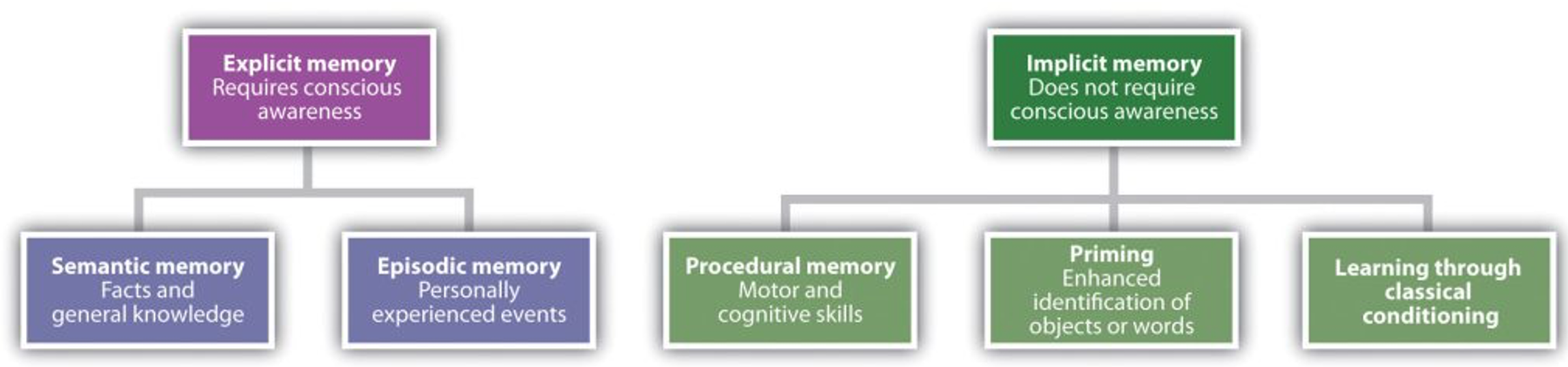
The long-term memory can be categorised as explicit and implicit memory.

The explicit memory, also known as declarative memory, refers to the type of memory that a person is consciously aware of. “You know that you know the information” (Gluck et al., 2020, p. 280). It comprises both memory of facts and general knowledge (semantic memory) and memory of personal experiences (episodic memory).

The implicit memory, by contrast, refers to memory that operates without the learner being consciously aware of it. Implicit memory is formed by:

  • procedural memory
  • priming
  • learning through classical conditioning

Figure 2.4.3. Types of Memory by Jennifer Walinga and Charles Stangor used under a CC BY-NC-SA 4.0 licence in Rafferty, J. (2024). Neuroscience, psychology and conflict management. James Cook University. https://doi.org/10.25120/k4vd-86×5

Priming

Priming is a psychological phenomenon where exposure to a stimulus influences how we respond to subsequent stimuli, and how we perceive and interpret new information. As defined by Gluck et al. (2020), priming is

“a phenomenon in which prior exposure to a stimulus can improve the ability to recognize that stimulus later” (p. 88).

Similarly, Kassin et al. (2020) describe priming as

“the tendency for frequently or recently used concepts to come to mind easily and influence the way we interpret new information” (p. 118).

In essence, priming makes certain concepts or ideas feel familiar, even if we aren’t consciously aware of the exposure.

For example, research has shown that if we’re subtly exposed to specific words or images, we may later be more likely to recognise or choose something related to those stimuli (Gluck et al., 2020; Goldstein, 2019; Kassin et al., 2020).

The impact of priming on social behaviour

Exposure to a stimulus can also lead people to behave in a particular way without their awareness, especially when the stimulus was presented subconsciously. The impact of priming on social behaviour has been demonstrated in research, including in a series of provocative (and debated) experiments by Bargh, Chen and Burrows (1996). In this study, participants were primed with different words that were thought to influence their behaviour.

For example, in experiment 1, participants were primed to activate either the constructs “rudeness” or “politeness” and were then placed in a situation where they had to either wait or interrupt the experimenter to seek some information. The research found that participants whose concept of rudeness was primed interrupted their experimenter more quickly and frequently than did participants primed with polite-related stimuli.

In experiment 2, participants were primed with words that activated elderly stereotypes. The study found that participants for whom an elderly stereotype was primed walked more slowly down the hallway when leaving the experiment than did control participants, consistent with the content of that stereotype.

How does priming relate to conflict management?

The phenomenon of priming can both help understand what creates conflict and how we can support parties in conflict management/ resolution. Most of the publications discussed in this post focus on mediation, but many of the findings could also find application in other conflict management process such as group facilitations and one-on-one conflict management coaching. 

Priming in mediation

Daniel Weitz, in his article The brains behind mediation: Reflections on neuroscience, conflict resolution and decision-making discusses how priming can influence the mediation process. He suggests that using words like “listen to,” “hearing each other,” “dialogue,” “options,” and “future” in their opening statements, mediators may be able to “prime” parties for collaboration rather than competition (p. 478).

Similarly, Hoffman and Wolman in their article The psychology of mediation note that the mediator’s initial description of the mediation process is the most powerful form of priming in mediation. Based on priming studies (which the authors mention but don’t specifically list), they suggest that mediators may wish to include expressions such as “being ‘flexible’ and ‘open-minded,’ the goal of reaching ‘a fair and reasonable resolution,’ and the need for ‘creativity’ and ‘thinking outside the box’” in their opening statements (p. 3).

Beyond the mediator’s opening statement, Sourdin and Hioe, in their article Mediation and psychological priming, discuss other opportunities for priming during the mediation process. They suggest that mediators can “strategically moderate the environment” to foster a positive atmosphere and encourage successful outcomes (p. 79). Such moderation can be achieved, for example, by carefully selecting and setting up the physical location of the mediation, including considerations of room colour, temperature, and the provision of food and water.

Amanda Carruthers, in her article on The impact of psychological priming in the context of commercial law mediation, explores factors such as the physical appearance of the mediator and legal representatives, the choice of venue, language use, and the influence of stress and references to money. She concludes that mediators and legal practitioners should avoid overt priming cues related to strength, power, and money to improve the positions of both parties in a commercial mediation.

How priming can affect perception

People are particularly likely to rely on the priming effect when new information is ambiguous. This is because we rely more on top-down processing than bottom-up processing when we are confronted with an ambiguous stimulus.

Bottom-up processing begins with our receptors, which take in sensory information and then send signals to our brain. Our brain processes these signals and constructs a perception based on the signals. When our perception depends on more than the stimulation of our receptors – and this is frequently the case when information is ambiguous – we speak about top-down processing. During top-down processing, we interpret incoming information according to our prior experiences and knowledge. This process is frequently referred to as concept or schema-driven. As we learned earlier, when we have been primed, frequently or recently used concepts come to mind more easily and influence the way we interpret new information.

In her blog post Priming in psychology, Kendra Cherry discusses how the priming effect influences what people hear when confronted with ambiguous auditory information, referring to the 2018 Yanny/Laurel viral phenomenon.

As an example for visual perception, Lisa Feldman Barrett explains in her book How Emotions are made how priming can significantly influence our visual perception of others’ emotions. She emphasises that facial expressions are often much more ambiguous than many popular readings suggest, which would make us particularly susceptible to the effects of priming. For instance, if we’re told a person in a photo is screaming in anger, we are more likely to see anger in their expression, even if this is inaccurate.

The person might actually be celebrating something positive, such as winning an important tennis match, potentially involving a whole mix of (positive) emotions, but the priming narrows our interpretation. With contextual information provided, we are likely to interpret the facial configuration more accurately than when taken out of context.

How does the priming effect and perception relate to conflict management?

A mediator might misinterpret facial configurations of parties in a mediation, perceiving emotions like anger, based on preconceived ideas of how people may “show” that emotion on their face, or influenced by comments made by the other mediation party.

Knowing about priming can sensitise us to potential misinterpretations of emotions and encourages us to use multiple cues and information to perceive parties’ emotions more accurately. For a more detailed discussion on the cues that we can use to more accurately perceive others’ emotions, see Chapter 3, Topic 3.4 in Neuroscience, psychology and conflict management. These cues and the topic of emotions in conflict is also discussed in much more detail in Sam Hardy’s course on Working with Emotions in Conflict.  

Priming to improve inter-group relationships

Recent research by Capozza, Falvo and Bernardo explored whether activating a sense of attachment security through priming can reduce the tendency to dehumanise “outgroups”—groups with which individuals don’t feel a connection. They conducted two studies:

  • The first study primed attachment security by showing participants images of relationships with attachment figures and then measured how they humanised an outgroup, in this case, the homeless.
  • The second study had participants recall a warm, safe interaction to activate a sense of interpersonal security and then measured how they humanised another outgroup, the Roma.

Both studies found that attachment security led to greater humanization of outgroups, with the second study showing that increased empathy played a key role in this effect. These findings suggest that fostering a sense of security can enhance intergroup relations, which has implications for intergroup conflicts. The successful use of priming to boost feelings of security highlights the importance of applying cognitive psychology to conflict management.

The calming effect

Capozza, Falvo and Bernardo, in their article, discuss several further positive effects of security priming, many of which are relevant to conflict and conflict management/resolution. For example, they emphasise the calming effect of security priming, noting that “even a momentary sense of security can shift the attention from one’s needs to others’ needs…” (p.3).

Conflict management processes often aim to help individuals in conflict consider the needs and concerns of others. Understanding the calming effect of security priming and its ability to foster perspective-taking may provide conflict management practitioners with additional strategies to support their clients. Such strategies could consider aspects like:

  • The choice of physical setting for a mediation or coaching session (or other conflict management process).
  • The language used by the practitioner, such as during the mediator’s opening statement.
  • The types of questions the practitioner asks throughout the process.

Remaining questions and considerations

This post explored the priming effect and its relevance to conflict management, particularly in understanding why conflicts arise and how practitioners can support parties to manage or resolve them. Research suggests that there are multiple opportunities to prime parties during a conflict management process, such as mediation, as discussed in the sources mentioned throughout this blog. However, many questions remain, such as how much control a practitioner truly has over priming in a conflict management process Additionally, practitioners should consider the ethical implications, including the potential for manipulation, when applying priming techniques to their practice.

A full reference list of the readings referred to in this post that have not been linked in the text can be found here.

Author Biography

Judith Rafferty is an Adjunct Senior Research Fellow at the Cairns Institute, JCU, and a Senior Trainer at the Conflict Management Academy. She integrates over 12 years of experience as a conflict management practitioner, researcher, and educator/trainer. She holds a PhD in Conflict Resolution, a Master of Conflict and Dispute Resolution, a Graduate Business Administration Diploma, and a Graduate Certificate in Psychology. As a Senior Lecturer and former Director of the postgraduate Conflict Management and Resolution program at James Cook University, Judith played a key role in developing curriculum and training resources that assist professionals in navigating complex conflict situations.
Judith can be contacted on:
Email: judith@conflictmanagementacademy.com
LinkedIn: https://www.linkedin.com/in/judith-rafferty-770a329b

Enhancing Conflict Management Theory and Practice through Insights from Psychology and Neuroscience

This post has been written by Judith Rafferty, adapted from her Open Educational Resource (OER) Neuroscience, psychology and conflict management (2024), licensed under a Creative Commons Attribution NonCommercial 4.0 Licence by James Cook University.

Conflict Management: A Multidisciplinary Field

While there are designated conflict management scholars and practitioners, many ideas that inform both theory and practice come from outside the field. Individuals involved in conflict management often come from a broad spectrum of disciplines, particularly in the social sciences, such as psychology, sociology, history, geography, communication studies, political science, international relations, organizational behavior, and anthropology.

Contributions to conflict management are also made from the formal sciences like mathematics, physics, biology, and neuroscience. By exploring some of these disciplines in more detail, we can gain valuable perspectives that deepen our understanding of conflict formation, escalation, management, and resolution. Psychology and neuroscience offer some especially useful perspectives and are the focus of this post.

The Role of Psychology in Conflict Management

Psychology and some of its branches are highly relevant for both theory and practice in conflict management. For instance, the American Psychological Association has a division specifically dedicated to applying psychology knowledge to conflict situations, called “The Society for the Study of Peace, Conflict, and Violence: Peace Psychology”. In fact, peace psychology is a distinct field of study with an International Centre for Peace Psychology, and the journal Peace and Conflict: Journal of Peace Psychology.

Similarly, the Australian Psychological Society (APS) highlights the contributions psychologists make to understanding and managing conflict. According to the APS, psychology provides key insights into the psychological factors that underpin social conflict and aims to identify effective ways to foster positive relationships and productive outcomes. These approaches include strategies for resolving conflicts and governance models that prioritise cooperation over coercion (APS, 2023).

Understanding Psychology: A Foundation for Conflict Management

Psychology focuses on the study of mental processes and behaviour (and their relationship) (Zimbardo, Johnson, & McCann, 2009). The field of psychology comprises multiple sub-groups, or branches of psychology (Mullin, n.d.). Some of these branches are especially relevant to conflict management, including personality psychology, cognitive psychology, and social psychology. So, what do these branches focus on and how are they relevant to conflict management?

Cognitive psychology

Most generally, cognitive psychology is concerned with the study of mental processes such as thinking, learning, remembering, perception, information processing, language, problem-solving, decision-making, and reasoning. Cognitive psychology also considers people’s emotions and the impact of emotions on cognition. All cognitive processes mentioned earlier, as well as the effect of emotions on them, are highly relevant to the experience and management of conflict. For example, multiple mental processes and emotions are involved when people try to resolve conflicts, e.g. they must retrieve information about past conflict events and make decisions as to how to move forward. At the same time, mental processes and emotions are likely to have contributed to and have been affected by the conflict in the first place. For example, many conflicts arise because people have perceived events differently. More information about how cognitive psychology may relate to conflict management can be found here.

Figure 2.2.1. Six or Nine? Image generated with Adobe Firefly; Rafferty, J. (2024). Neuroscience, psychology, and conflict management. James Cook University. https://doi.org/10.25120/k4vd-86×5

Personality Psychology

Personality psychology is the scientific study of the whole person (McAdams, 2009). It focuses on human individuality and may address questions like:

  • Why does Paul act more violently than Peter in the same situation?
  • Why do Tracey and Sam have such different ways of communicating and managing conflict?

Personality psychology is distinct from other branches of psychology by focusing more on the person than on the situation. This is not to say though, that personality psychology neglects the situation. But rather than exploring how most people would act under certain circumstances, personality psychology tries to explain or predict how a specific type of person would most react in each situation. Conflict management practitioners and theorists have noted the effects that individual differences in personality may have on the formation and escalation of conflict, as well as on conflict resolution processes and their outcomes (Sandy et al., 2014). More information on how personality psychology may inform conflict management can be found here.

Social psychology

Social psychology seeks to answer questions like:

  • Why do people act differently when they are in a group compared to when they are on their own?
  • Why do people behave differently among their co-workers compared to when they are with their friends and family?
  • Why do people hold prejudice and stereotypes against certain groups and how may these affect their behaviours?
  • How can social cohesion best be strengthened to prevent social division and conflict?

Social psychology may be defined as “the scientific study of how individuals think, feel, and behave in a social context” (Kassin et al., 2020, p. 4). All three areas, thinking, feeling, and behaving are involved and affected during the emergence, escalation, management, and resolution of conflicts. Several notable books in the field have focused on the applications of social psychology for conflict theory and practice, such as:

A more detailed discussion of the application of social psychology for conflict management can be accessed here.

Neuroscience and Conflict: Bridging the Gap

Beyond psychology, the field of conflict management is increasingly looking to neuroscience for insights into why conflicts occur and how they can be effectively managed or resolved. Many conflict management scholars and practitioners recognise that people’s brains and bodies are significantly involved in facilitating societal conflict.

For instance, Mary Fitzduff (2021) notes in her book Our brains at war that recent advancements in genetics, brain science, and hormonal research suggest that many personality characteristics are rooted in the brain’s biology. By offering “new and more sophisticated and nuanced insights into the way that people actually think”, neuroscience makes a critical contribution to the field of conflict management (Burgess, 2022). As another example, Bruneau (2015), in her book chapter Putting neuroscience to work for peace, emphasises the value of directly examining neural activity to transform psychology-based conflict theories into mechanistic understandings (p. 143).

Knowledge from neuroscience can also help inform and evaluate the purpose, potential, design and principles of justice and conflict resolution processes, as well as the role and skills of conflict practitioners. For instance, findings from neuroscience can increase our understanding of aggression in people, which again may have implications for processes like restorative justice, as discussed in a Ted Talk by Dan Reisel. Other examples of how neuroscience can inform conflict management theory and practice, as well as links to related readings, can be found here.

Neuroscience Meets Psychology: A Synergy for Conflict Management

Neuroscience is the scientific study of the nervous system and an interdisciplinary field that integrates biology, chemistry, psychology, and more. Of particular interest for conflict management theory and practice are the intersections between neuroscience and psychology. It may help to think of neuroscience as dealing with the ‘physical’ (brain) and psychology dealing with the ‘abstract’ (mind).

The functioning of our brain, hormones and neurotransmitters significantly affects our behaviours, cognitions, and social experiences. That is why the links between neuroscience and different areas of psychology are increasingly being recognised, studied, and taught. The growing recognition of these links has led to the emergence of new interdisciplinary fields, such as social neuroscience and cognitive neuroscience (Ito & Kubota, 2022). Both are highly relevant to conflict management theory and practice.

Knowledge from social neuroscience, for instance, can increase our understanding of intergroup and social conflict, including the sources and factors that create, perpetuate, contribute to, and escalate intergroup conflict. This knowledge may again inform the planning and design of conflict intervention initiatives to help manage intergroup and social conflict. You can find further readings about social neuroscience and intergroup conflict in the previously mentioned Peace and Conflict: Journal of Peace Psychology as well as other Peace Psychology publications, including the newsletter The Peace Psychologist and the blog Dialogues with Peace and Conflict.

Conclusion

The integration of psychology and its branches, as well as of neuroscience offers critical insights into the questions why conflict occurs, how it develops and how it may be managed. By exploring the connections between the human mind, brain, and behavior, conflict management can be more effective and nuanced. Many of these connections are discussed in more detail in Judith’s (2024) eBook Neuroscience, psychology and conflict management, from which this post has been adapted. A course on Neuroscience, Psychology and Conflict Management will also be developed next year to be offered through the Conflict Management Academy.

A full reference list of the readings referred to in this post can be found here.

Author Biography

Judith Rafferty is an Adjunct Senior Research Fellow at the Cairns Institute, JCU, and a Senior Trainer at the Conflict Management Academy. She integrates over 12 years of experience as a conflict management practitioner, researcher, and educator/trainer. She holds a PhD in Conflict Resolution, a Master of Conflict and Dispute Resolution, a Graduate Business Administration Diploma, and a Graduate Certificate in Psychology. As a Senior Lecturer and former Director of the postgraduate Conflict Management and Resolution program at James Cook University, Judith played a key role in developing curriculum and training resources that assist professionals in navigating complex conflict situations.
Judith can be contacted on:
Email: judith@conflictmanagementacademy.com
LinkedIn: https://www.linkedin.com/in/judith-rafferty-770a329b