
Dan Berstein & Robert Bergman
This article has been republished with permission and the original publication can be located at Mediate.com.
It can be difficult to get on the same page when you are caught in the middle of an adversarial dispute. Each party has their own biases – they want to win! Amidst a deluge of seemingly endless “facts” to pick from, sometimes it can feel like the parties are living in entirely different universes. Seeing this, dispute resolution professionals often end up asking themselves: “how can I bring these people together so we are all talking in the same world?”
One answer is visualizations. This article shares how a dispute resolver (or an ambitious party) can use visualizations to accomplish progress in their matter. It was written by Dan Berstein, a mediator living with bipolar disorder who often finds himself amidst complicated conflicts related to his mental health advocacy work – with help from Bob Bergman, the founder of NextLevel™ Mediation.
Dan shares his struggles to visualize different problems and disputes related to his advocacy work and Bob provided the background of how Next Level Mediation’s software can do it almost instantly, and better than a person could on their own.
1: Illustrating Harms
Living with a mental illness means that I have behavioral differences that can lead to my being stigmatized and rejected, or just the fact that I am open with my bipolar disorder can be a reason some people form worries or biases that lead to them pulling away. On an organization-wide level, this kind of behavior can ripple out across people.
I had a dispute with one organization where they produced records, including their private e-mail correspondences, revealing dozens of people passing around disparaging comments about me and/or making plans to reduce or cut contact with me. I was working on a resolution process with their outside counsel and I felt that they were not appreciating how damaging it had been for me to be targeted with these negative predispositions and pushed away (in manners large and small) from so many people. Eventually, I developed a crude organizational network analysis (ONA) chart to demonstrate the network of people involved:

Through the use of this visualization, I then created a system that could be used to visualize any [i] Explicit Shunning, [ii] Ghosting (No Response), [iii] Short Responses, [iv] Delays, [v] Lies, [vi] Disparagements, and [vii] Mistakes – charting how they flowed between people and their impact.
This was incredibly valuable to me as a tool in my dispute, as well as for my personal coping with the trauma of experiencing so much rejection. However, it was also incredibly tedious and difficult to create.
In my search for software that could help make it simpler, I connected with Bob Bergman, who explained how NextLevel™ Mediation can create a diagram to map this kind of network analysis in minutes just by you uploading your dataset and asking the right queries:
The NextLevel Approach to Visualizing Impact
In the example above, the uploading of email communication to the NextLevel™ Mediation platform document research assistant can produce the following example (note these do not use real data, and are meant to illustrate):
QUERY: Visualize the roles, interests, and power dynamics of parties involved by creating a stakeholder diagram
RESULT:

QUERY: Create an ONA diagram that can help visualize any Explicit Shunning, Ghosting, short Responses, Delays, and Disparagements, and how they flowed between people

2: Documenting Delays and Timelines
In one dispute, an organization was accusing me of causing delays, which had lasted close to 9 months. It hurt my feelings to be falsely accused of this so I sat down and pored over all of our past correspondences, mapping out the delays.
I found that their changes in staff and processes were responsible for, I believed, over 70% of the delays even though they had perceived such high delays from me (presumably due to their frustrations). This analysis was a tedious process and I was worried that people would think I was weird, perhaps due to my mental illness, for even undertaking it.
The NextLevel™ Mediation platform was, once again, the answer to my prayers. Not only does it do all of the work for me, and faster – but I can just tell someone I used this software without being judged as some kind of oddball for having created the chart myself. Here are example results with some anonymous data:
QUERY: Using the uploaded documents, create a sequence diagram of the dispute timeline and possible delays:

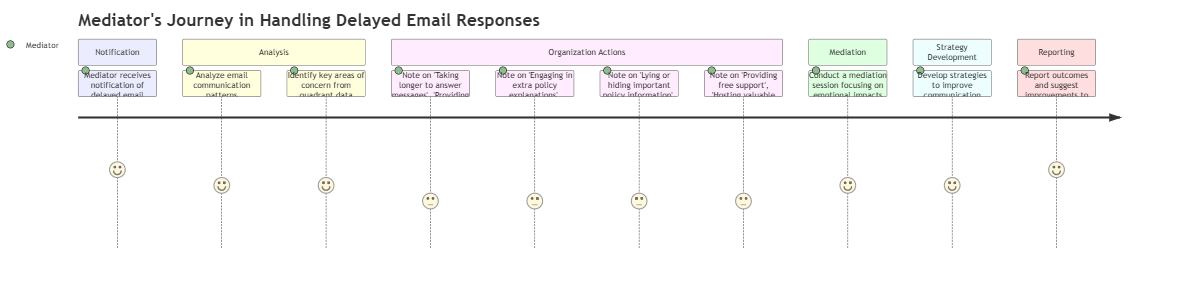
QUERY: Create a user journey diagram for the mediator given the delays in email responses and their emotional effects.
3: Identifying What Matters
The NextLevel™ Mediation platform is about more than just charts. You can also just ask it questions so it can use its “brain” to digest all of the meaningful facts and help you stay focused on the big picture. This is important for me – even if only as a gut check – as my mental illness means I can be prone to becoming obsessive and to fixating on some facts at the exclusion of others. NextLevel™ is an objective way to get a sense of the big picture.
Beyond asking it for charts and diagrams, you can also generate tables to help you organize key information. Take a look at the table it generated when asked what might be the relevant and irrelevant facts for a discrimination claim (both for the alleged victim to collect, and for the alleged discriminator who is defending themselves):
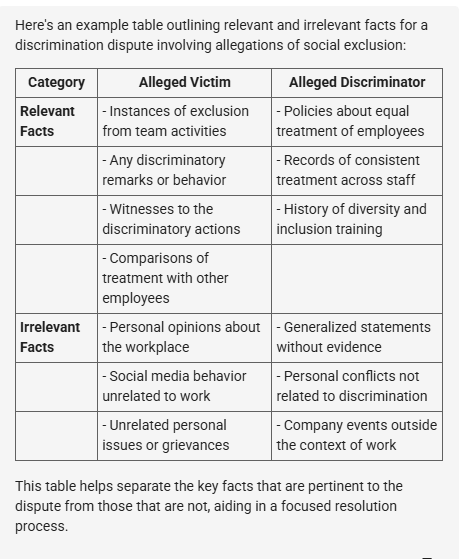
If you have ever found yourself overwhelmed sorting through what happened, or just looking for a way to double-check your perspective – the NextLevel™ Mediation platform can instantly provide you breakdowns and summaries like this to help you find your way.
Conclusion
Seeing is believing, but it can be difficult to create the right picture. Visualizations can help resolve disputes if you know how to use them. This article talked about different charts you can use to visualize the scale of damages, the responsibility for delays, and which facts prove disparities. We also shared how you can go use NextLevel™ Mediation, right now, to create charts like this of your own (and so much more).
It can seem intimidating to enter the world of charts and graphics and bring them into your dispute, but it can also add a lot of value. I am grateful that there is software like NextLevel™ Mediation to help make something that can seem – at first – to be complicated into an easy, user-friendly, and fast process.
Here are some ideas of ways NextLevel™ can help:
- Collect and scan all of your data from a situation into its platform, including e-mails and documents, and ask it to tell you the key points that matter, and the key things that matter to each party
- Use it to instantly chart relationships with people and show patterns of impact and harm
- Have it list the points of disagreement between the parties
- Create timelines and sequence diagrams to show the course of events and simplify a complicated, convoluted set of facts into something precise and digestible
Disputes are often painful. We find ourselves in so much distress that it can help to use an AI-empowered software assistant to keep track of the facts so we don’t have to worry – and to paint the big picture summaries of what matters so we don’t get lost.
Author Biography
Dan Berstein is a mediator living with bipolar disorder who uses conflict resolution best practices to promote empowering mental health communication and prevent mental illness discrimination. His company, MH Mediate, has helped thousands of professionals and organizations be empowering, accessible, and non-discriminatory toward people with disclosed or suspected mental health problems. Dan holds degrees from the Johns Hopkins School of Public Health and the Wharton School. He is the author of the 2022 book, Mental Health and Conflicts: A Handbook for Empowerment.
Robert Bergman is a seasoned decision science expert with over 60 years of experience in software engineering, system dynamics, and strategic planning. He is the founder and CEO of NextLevel Mediation, a SaaS platform that applies decision analytics, Game Theory, and AI to dispute resolution. His expertise spans multi-criteria decision-making methodologies (AHP, ANP, MAUT), mediation, negotiation, and military systems such as flight simulations. Previously, he held senior leadership roles at Intel, focusing on mobile strategy and cybersecurity, and has consulted widely in strategic decision science. Bergman is also a published researcher in AI, technology addiction, and the future of dispute resolution.
 The Australian Dispute Resolution Research Network