Introducing the Financial Industry Disputes Resolution Centre in Singapore and its Unique Approach to Mediation

By Eunice Chua (CEO, FIDReC) and Rachel Lim (Intern, FIDReC)

The context of consumer financial disputes

Tom went on an overseas holiday with his friends, and they went out to a pub on their last night. They drank till the early hours of the morning. Tom was in a celebratory mood and paid for everyone’s drinks with his credit card. He and his friends left for their hotel at 3am. Tom only woke up at 2pm the next day and hurriedly rushed to catch his flight back to Singapore. After he arrived in Singapore, he realised that one of his credit cards was missing. He immediately made a police report and called the bank to report the loss. In the meantime, someone had already gone on a shopping spree with Tom’s credit card and bought various items to the tune of S$7,000. The bank billed Tom for this amount, but Tom disagreed.

Sally purchased a hospital and surgical insurance policy from her brother-in-law a few years ago. Because she trusted him, she left him to fill out all the details and signed where he told her to. Her brother-in-law went through with Sally a list of questions at the end of the proposal form and the terms and conditions of the policy, but Sally did not pay much attention at the time. Unfortunately, Sally was diagnosed with a tumour on her breast. She was admitted to the hospital for surgery. After her surgery and hospital stay, Sally submitted an insurance claim. As part of its usual process, the insurer contacted Sally’s doctor to request information on Sally’s condition. It was then that the insurer found out that Sally had a history of diabetes. Sally had failed to disclose this information in the insurance proposal form.  The insurer told Sally they would void her policy due to her failure to disclose her diabetes.

These scenarios reflect real cases that consumers bring to the Financial Industry Disputes Resolution Centre (FIDReC) in Singapore. FIDReC was established in August 2025 as an initiative from the financial industry to provide an accessible platform for financial institutions to resolve customer complaints in an effective, amicable, and fair way. Accordingly, filing a claim at FIDReC is free for consumers. The process is simple, with mediation being deployed first and adjudication being offered as an option only if there is no settlement at mediation.

The FIDReC approach to dispute resolution

Five core principles shape FIDReC’s approach to dispute resolution: accessibility, independence, effectiveness, accountability, and fairness. Most of these are self-explanatory but it is worth saying more about fairness.

The FIDReC process is designed in a way that recognises the inherent imbalance of power between an individual consumer and a financial institution and seeks to address that balance in a fair manner.

First, designated financial institutions are required by regulation to subscribe to FIDReC and participate in its process. This ensures that consumers will have the opportunity to bring their claims to FIDReC and have them answered. Second, only consumers may bring claims at FIDReC. They may do so without any filing fee and the claims filing is done online. This promotes accessibility even for those that are not well off. Third, mediators are staff of FIDReC who are well versed with the regulations governing the financial industry as well as industry standards and expectations. Whilst maintaining their impartiality, they may make suggestions to parties and provide information to help them in their decision-making. This promotes a fairer playing field especially for more vulnerable consumers. Should there be any settlement, the mediator gives parties time to consider before they sign on any agreement. This reduces the risk of any pressure to settle. Finally, the process is driven by the consumer who can opt to proceed to adjudication if they are not satisfied with the mediation outcome. They pay a nominal fee of S$50 per claim for an independent adjudicator to review their submissions, conduct a hearing and decide on whether they have a valid claim. Subject to approval by the adjudicator, the consumer can choose the mode of adjudication – in-person, online or based on documents review. The adjudication outcome binds only the financial institution who must enter a settlement in the terms of any award made by the adjudicator if the consumer so accepts. If the consumer disagrees with the adjudicator’s decision, the consumer’s legal rights are not affected, and they may still pursue a case in court or in other avenues.

Mediation first

More than 80% of claims filed at FIDReC are resolved at mediation, demonstrating the value of mediation to bring about closure in consumer financial disputes. Mediation is a resource-intensive activity as one mediator is assigned to each case and follows that case through from beginning to end. The mediator will need time to understand and clarify the claim that the consumer is bringing as well as to review the financial institution’s investigation report. It is hard work and “heart work” for the mediator as consumers may come with varying expectations and intense emotions. It is also a journey that could take place over months. Nevertheless, the benefits of mediation are clear.

First, mediation allows the parties to tell their stories and be directly involved in shaping a way forward. The information-exchange that takes place during mediation educates the parties on their rights and responsibilities and equips them with knowledge. They may also be able to negotiate better with each other in a confidential setting with the support of a mediator.

In Tom’s case, mediation allowed Tom to acknowledge that he could have been more careful to safeguard his credit card while putting forward the efforts he did take to report the loss of his card when he discovered it. The bank was able to share about the dispute resolution process it had in place for credit card disputes and its considerations. Nevertheless, the bank was not limited to considering the legalities of the claim and could also account for Tom’s history with them. In the end, the bank made a goodwill offer to absorb twenty percent of Tom’s losses, which Tom accepted.

Second, mediation outcomes can be creative solutions that meet the interests of both parties. Such outcomes may not be possible through the court process.

During the mediation in Sally’s case, the insurer showed she had answered “no” to having diabetes in the proposal form and pointed out a warning on the form in red that failure to disclose material information could lead to claims being rejected or the policy being voided. Sally explained that her diabetes was mild, well-managed, and unrelated to her breast tumour. The mediator suggested she submit a medical report on her diabetes condition to allow the insurer to review its assessment. After considering the additional medical report, the insurer agreed—on a goodwill basis—not to void the policy but to adjust the policy terms. Although Sally’s claim was not reimbursed due to the non-disclosure, Sally accepted the outcome because it was important for her to keep her insurance coverage.

Third, relative to adjudication and going to court, mediation helps to save time and costs. Most cases at FIDReC are closed within six months from the date they are accepted for handling. Cases resolved through mediation usually close within three months.

Why not something different?

FIDReC is certainly not the only model existing in the world that deals specifically with consumer financial disputes. The Australian Financial Complaints Authority (“AFCA”) shows another way forward with its own model of dispute resolution that combines conciliation with a preliminary assessment followed by a binding determination (if the consumer accepts it).

The key difference between the two is that AFCA is a statutory body equipped with a broad fairness jurisdiction and powers to order more than just financial compensation (AFCA can even order an apology as a remedy!). This imbues AFCA with more authority whereas FIDReC relies on the cooperation of the parties to promote settlement at mediation, with adjudicators limited to ordering financial compensation. The local context is also a crucial factor. AFCA supports more than 26 million people spread across an entire continent. FIDReC supports a population of about 6 million in a small island state 0.009% the size of Australia. Even as FIDReC can offer a personalised high human touch approach including the option of in-person mediation meetings and adjudication hearings, this may not be feasible in Australia where conciliation is conducted through a telephone conference and preliminary evaluations and determinations are based on a documentary review.

The scope of work of AFCA and FIDReC is different too. Although the focus is consumer financial disputes, AFCA has a much higher claim limit exceeding AUD1 million. FIDReC does not impose any claim limit during mediation but has a limit of S$150,000 per claim for adjudication. This has consequences for process design. For example, AFCA permits external legal representation given that high value claims can have greater complexity, whereas FIDReC does not as it prioritises a more informal and low-cost approach. AFCA relies on more evaluative modes of dispute resolution like conciliation, preliminary assessment, and determination. FIDReC primarily relies on mediation with adjudication being resorted to less than 20% of the time.

FIDReC’s mediation-first model has proven to be effective within Singapore’s context. By focusing on amicable resolutions and keeping processes informal, FIDReC ensures that everyday consumers can navigate financial disputes without being overwhelmed and can continue their relationships with their financial institutions. 

That said, we recognise that the financial landscape is constantly evolving. As products grow more complex and consumer expectations shift, FIDReC remains open to refining its approach. Be it integrating new tools, expanding our jurisdiction, or adapting elements from other models like AFCA’s, we are committed to staying relevant and responsive whilst being guided by our core principles.

Eunice Chua is the FIDReC CEO overseeing mediation and adjudication of consumer financial disputes in Singapore. Before that, Eunice was Assistant Professor at the Singapore Management University, specializing in alternative dispute resolution, evidence, and procedure. She remains a Research Fellow at the Singapore International Dispute Resolution Academy. Eunice was formerly Justices’ Law Clerk and Assistant Registrar of the Singapore Supreme Court, where she concurrently held appointments as Magistrate of the State Courts and Assistant Director of the Singapore Mediation Centre. She was also the founding Deputy CEO of the Singapore International Mediation Centre. 

Rachel Lim is an aspiring Law and Finance student and a proud graduate of Hwa Chong Institution. With a deep interest in Economics and meaningful involvement in grassroots organisations, she has developed a quiet yet insightful appreciation for how money moves through society. In this debut work, Rachel explores the growing issue of scams in Singapore’s payment systems, emphasising the importance of awareness and financial mindfulness. Through compassionate storytelling and clear guidance, she hopes to shed light on the support systems available to victims, offering a hopeful and empowering message for those navigating today’s complex financial landscape.

Sometimes You Need to Be Seen to Be Heard: Three Easy Ways to Visualize What Matters in Your Dispute

Dan Berstein & Robert Bergman
This article has been republished with permission and the original publication can be located at Mediate.com.

It can be difficult to get on the same page when you are caught in the middle of an adversarial dispute.  Each party has their own biases – they want to win! Amidst a deluge of seemingly endless “facts” to pick from, sometimes it can feel like the parties are living in entirely different universes.  Seeing this, dispute resolution professionals often end up asking themselves: “how can I bring these people together so we are all talking in the same world?”

One answer is visualizations.  This article shares how a dispute resolver (or an ambitious party) can use visualizations to accomplish progress in their matter.  It was written by Dan Berstein, a mediator living with bipolar disorder who often finds himself amidst complicated conflicts related to his mental health advocacy work – with help from Bob Bergman, the founder of NextLevel™ Mediation.  

Dan shares his struggles to visualize different problems and disputes related to his advocacy work and Bob provided the background of how Next Level Mediation’s software can do it almost instantly, and better than a person could on their own.

1: Illustrating Harms

Living with a mental illness means that I have behavioral differences that can lead to my being stigmatized and rejected, or just the fact that I am open with my bipolar disorder can be a reason some people form worries or biases that lead to them pulling away.  On an organization-wide level, this kind of behavior can ripple out across people.  

I had a dispute with one organization where they produced records, including their private e-mail correspondences, revealing dozens of people passing around disparaging comments about me and/or making plans to reduce or cut contact with me.  I was working on a resolution process with their outside counsel and I felt that they were not appreciating how damaging it had been for me to be targeted with these negative predispositions and pushed away (in manners large and small) from so many people.  Eventually, I developed a crude organizational network analysis (ONA) chart to demonstrate the network of people involved:

A screenshot of a computerDescription automatically generated

Through the use of this visualization, I then created a system that could be used to visualize any [i] Explicit Shunning, [ii] Ghosting (No Response), [iii] Short Responses, [iv] Delays, [v] Lies, [vi] Disparagements, and [vii] Mistakes – charting how they flowed between people and their impact.

This was incredibly valuable to me as a tool in my dispute, as well as for my personal coping with the trauma of experiencing so much rejection.  However, it was also incredibly tedious and difficult to create.  

In my search for software that could help make it simpler, I connected with Bob Bergman, who explained how NextLevel™ Mediation can create a diagram to map this kind of network analysis in minutes just by you uploading your dataset and asking the right queries:

The NextLevel Approach to Visualizing Impact

In the example above, the uploading of email communication to the NextLevel™ Mediation platform document research assistant can produce the following example (note these do not use real data, and are meant to illustrate):

QUERY: Visualize the roles, interests, and power dynamics of parties involved by creating a stakeholder diagram

RESULT:

Description: This diagram captures the roles and interests of each stakeholder, along with arrows representing the influence, authority, and relationships between them.

QUERY: Create an ONA diagram that can help visualize any Explicit Shunning, Ghosting, short Responses, Delays, and Disparagements, and how they flowed between people

Description: This diagram shows how various negative interactions flow between people and highlights their impact on communication and relationships within the organization. Each arrow represents a type of interaction, such as shunning or ghosting, and the direction indicates the flow of this interaction.

2: Documenting Delays and Timelines

In one dispute, an organization was accusing me of causing delays, which had lasted close to 9 months.  It hurt my feelings to be falsely accused of this so I sat down and pored over all of our past correspondences, mapping out the delays.

I found that their changes in staff and processes were responsible for, I believed, over 70% of the delays even though they had perceived such high delays from me (presumably due to their frustrations).  This analysis was a tedious process and I was worried that people would think I was weird, perhaps due to my mental illness, for even undertaking it.  

The NextLevel™ Mediation platform was, once again, the answer to my prayers.  Not only does it do all of the work for me, and faster – but I can just tell someone I used this software without being judged as some kind of oddball for having created the chart myself.  Here are example results with some anonymous data:

QUERY: Using the uploaded documents, create a sequence diagram of the dispute timeline and possible delays:

Description: This sequence diagram captures the interactions and discussions among different participants as they address the causes and effects of project delays over time.

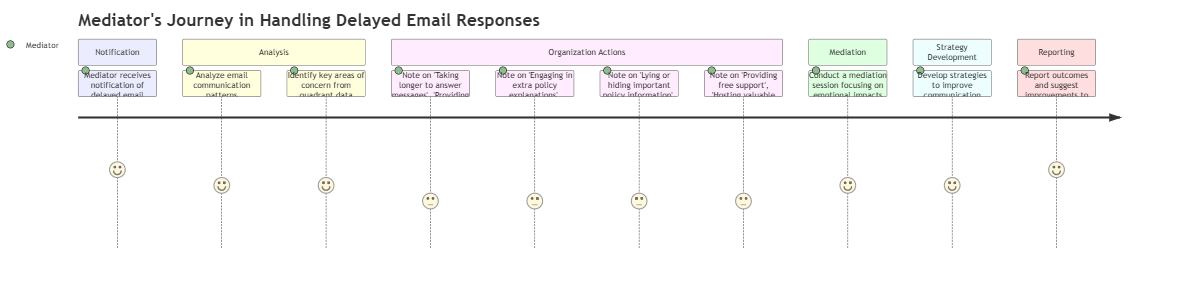
QUERY: Create a user journey diagram for the mediator given the delays in email responses and their emotional effects.

Description: This diagram outlines the steps the mediator takes, from receiving notifications of delayed email responses to analyzing communication patterns, considering emotional impacts, and reporting outcomes to stakeholders.

3: Identifying What Matters

The NextLevel™ Mediation platform is about more than just charts.  You can also just ask it questions so it can use its “brain” to digest all of the meaningful facts and help you stay focused on the big picture.  This is important for me – even if only as a gut check – as my mental illness means I can be prone to becoming obsessive and to fixating on some facts at the exclusion of others.  NextLevel™ is an objective way to get a sense of the big picture.

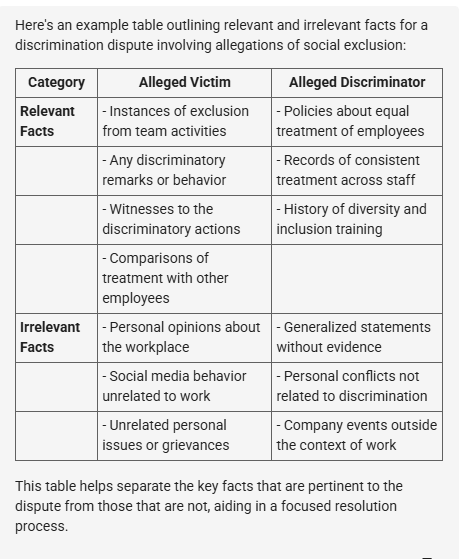
Beyond asking it for charts and diagrams, you can also generate tables to help you organize key information.  Take a look at the table it generated when asked what might be the relevant and irrelevant facts for a discrimination claim (both for the alleged victim to collect, and for the alleged discriminator who is defending themselves):

If you have ever found yourself overwhelmed sorting through what happened, or just looking for a way to double-check your perspective – the NextLevel™ Mediation platform can instantly provide you breakdowns and summaries like this to help you find your way.

Conclusion

Seeing is believing, but it can be difficult to create the right picture.  Visualizations can help resolve disputes if you know how to use them.  This article talked about different charts you can use to visualize the scale of damages, the responsibility for delays, and which facts prove disparities.  We also shared how you can go use NextLevel™ Mediation, right now, to create charts like this of your own (and so much more).  

It can seem intimidating to enter the world of charts and graphics and bring them into your dispute, but it can also add a lot of value.  I am grateful that there is software like NextLevel™ Mediation to help make something that can seem – at first – to be complicated into an easy, user-friendly, and fast process.

Here are some ideas of ways NextLevel™ can help:

  • Collect and scan all of your data from a situation into its platform, including e-mails and documents, and ask it to tell you the key points that matter, and the key things that matter to each party
  • Use it to instantly chart relationships with people and show patterns of impact and harm
  • Have it list the points of disagreement between the parties
  • Create timelines and sequence diagrams to show the course of events and simplify a complicated, convoluted set of facts into something precise and digestible

Disputes are often painful.  We find ourselves in so much distress that it can help to use an AI-empowered software assistant to keep track of the facts so we don’t have to worry – and to paint the big picture summaries of what matters so we don’t get lost.

Author Biography

Dan Berstein is a mediator living with bipolar disorder who uses conflict resolution best practices to promote empowering mental health communication and prevent mental illness discrimination.  His company, MH Mediate, has helped thousands of professionals and organizations be empowering, accessible, and non-discriminatory toward people with disclosed or suspected mental health problems. Dan holds degrees from the Johns Hopkins School of Public Health and the Wharton School. He is the author of the 2022 book, Mental Health and Conflicts: A Handbook for Empowerment.

Robert Bergman is a seasoned decision science expert with over 60 years of experience in software engineering, system dynamics, and strategic planning. He is the founder and CEO of NextLevel Mediation, a SaaS platform that applies decision analytics, Game Theory, and AI to dispute resolution. His expertise spans multi-criteria decision-making methodologies (AHP, ANP, MAUT), mediation, negotiation, and military systems such as flight simulations. Previously, he held senior leadership roles at Intel, focusing on mobile strategy and cybersecurity, and has consulted widely in strategic decision science. Bergman is also a published researcher in AI, technology addiction, and the future of dispute resolution.

RPS Coach is Biased – And Proud of It

John Lande
This article has been republished and adapted with permission. The original publication can be located within Indisputably.

We all know that it’s bad to be biased, right?

Wrong.  That assumption is its own bad bias.

Biases are inevitable – in humans and bots alike.

Some biases are harmful.  Others are helpful.  Many are neutral.

But bias itself is unavoidable.

So bias isn’t a problem in itself.  Pretending otherwise is.

This post describes the biases in Real Practice Systems (RPS) Theory and how the artificial intelligence tool RPS Coach is biased by design.

As you might guess, I think they’re good biases – conscious, clear, constructive, and explicit.  Knowing these biases, users can decide whether to use Coach or a tool with different biases.

This post describes Coach’s biases and invites you to give it a try.

What the Heck is a Bias, Anyway?

“Bias” has a negative connotation, often implying a thoughtless or even malicious mindset.  Think of cognitive biases or those involving demographic groups.

Bias is an especially dirty word in dispute resolution, where neutrals are expected to be scrupulously unbiased in attitudes about particular parties and in neutrals’ actions.

But we could reframe “biases” as values, preferences, tendencies, or mental habits, which aren’t inherently bad.  Indeed, they help us simplify complex choices, act efficiently, and maintain a coherent sense of self.  If we didn’t have any biases, we’d never create a syllabus, let alone pick a restaurant for lunch.

Some biases are even admirable – like favoring people who are trustworthy, empathetic, and generous.  The dispute resolution movement reflects a bias in favor of helping people to handle disputes constructively.

The label we choose – “bias” vs. “preference” – is a reflection of our values (aka biases).

‘Nuff said.

Where Do Biases / Preferences Come From?

Biases don’t drop from the sky.  Many come from early influencers – parents, teachers, coaches, and religious leaders – who shaped our first lessons about trust, politeness, and conflict.  Some of us internalize those lessons; others define ourselves in opposition to them.

As we grow, friends, school, work, and media shape how we see the world.  These influences often go unnoticed, which makes them especially powerful.

RPS Theory holds that all practitioners develop unique practice systems that are shaped by experience and evolve over time.  Their systems are based on their personal histories, values, goals, motivations, knowledge, skills, and procedures as well as the parties and the cases in their practice.

My article, Ten Real Mediation Systems, profiles ten thoughtful mediators, including me, exploring how and why we mediate the way we do.  We all mediate differently – largely because we value different things.  So we’re all biased, just in different ways.

My profile describes the sources of my biases – which shaped my perspective and are reflected throughout my work and the RPS Project.

Design Choices – aka Biases – in RPS Coach

RPS Coach has two main components:  its knowledge base and the instructions that guide how it uses it.  Together, these choices shape its content, tone, vocabulary, and priorities, which reflect particular theoretical, practical, and pedagogical commitments.

Coach’s knowledge base includes almost everything I’ve published.  That’s a lot.  It includes books, law review articles, professional articles, SSRN pieces, and meaty blog posts.  It also includes general authorities like the Model Standards of Conduct for Mediators.  A total of 253 documents reflecting my values, including:

  • Checklists for mediators and attorneys
  • The Litigation Interest and Risk Assessment book and related articles
  • Articles on good decision-making by parties and attorneys
  • Materials on negotiation, mediation, preparation, and early dispute resolution
  • Resources for court-connected ADR
  • Lots of pieces about legal education
  • Annotated bibliographies, simulations, and practitioner tools
  • Critiques of our theories and language, with suggestions for improvement

The materials are organized by topic and ranked by importance.  Coach draws first from the highest-priority sources.  The emphasis is on realistic practice, intentional process design, and support for good decision-making – not theoretical abstractions or generic practice tips.

Coach follows detailed instructions, including to:

  • Provide clear explanations of the tool’s capabilities and limitations
  • Reflect ethical rules
  • Use language that laypeople and experts readily understand
  • Tailor advice for various users (e.g., mediators, attorneys, parties, educators)
  • Support intentional process choices
  • Foster perspective-taking
  • Analyze intangible interests and possible outcomes in the absence of agreement
  • Promote good decision-making by parties and practitioners
  • Support reflection about dealing with disputes

In short, Coach doesn’t just answer questions – it nudges users toward better preparation, clearer thinking, and realistic decision-making.

Process Choice: Analysis Not Advocacy

RPS Coach’s underlying bias is not toward a particular method, tool, theory, or strategy – but toward supporting users’ conscious, well-informed choices that reflect their values, goals, and constraints.  That means helping them make conscious choices about negotiation and mediation.  This includes analyzing interests, estimating alternatives to settlement, exchanging offers, and possibly combining approaches over time.

Some parties prefer a counteroffer process.  Others want interest-and-options discussions.  Some expect mediators to provide explicit analysis; others don’t.  Many shift approaches midstream.

Coach doesn’t steer people toward or away from these choices.  It helps people make conscious decisions instead of relying on questionable generalizations.

Practice Systems Thinking

Practice systems thinking is central to Coach’s design. It sees negotiation and mediation not as isolated events, but as part of larger patterns – routines, tools, habits, and philosophies that shape how practitioners work.

Rather than merely providing one-off advice, Coach helps practitioners build intentional systems – a bias that favors growth over tactics, and adaptation over scripts.

The Coming Marketplace of Dispute Resolution AI Tools

Dispute resolution AI tools already exist, and more are coming.  Over time, we’ll see a proliferation of tools reflecting a wide range of approaches.

Some will be tailored for specific users; others will serve broader audiences.  Some will focus on particular processes such as mediation or arbitration.  Some may be designed for particular types of users such as practitioners, administrators, instructors, or scholars.  Some will reflect particular theories or schools of thought.

Our field has a vast literature that could feed AI tools developed by individuals or teams.  Some writers may develop tools based on their publications as I did with RPS Coach.  Gary Doernhoefer proposed the excellent idea of jointly developing a general AI tool for the dispute resolution field.  It may not be realized soon, but we should keep it in mind.

So I expect a growing marketplace where designers will build and adapt a wide variety of tools.

In this context, there may be both market and ethical imperatives for AI tools to disclose their features and dare-I-say biases.  As developers compete for users, clear disclosures will be important because users will want to know what they’re getting.

Disclosure should be an essential ethical standard for dispute resolution AI tools.  Neutrality remains a core principle in many dispute resolution processes, and disclosure of built-in biases plays a particularly important role when tools are powered by AI.  Users can’t see how these tools “think,” and they need clear information about the assumptions, priorities, and frameworks embedded in their designs. Bots are ornery critters that we can’t fully control, and users deserve to know what might be quietly steering them.

A Message from RPS Coach. Really

 “I’m here to help you prepare more intentionally, reflect more deeply, use better language, and support better decision-making – not just for your clients, but for yourself.  I don’t pretend to be neutral.  I’m proudly biased toward thoughtful, realistic, party-centered practice.  But I don’t tell you which process to choose.  I just help you think clearly about the choices.”  (Coach wrote this, I swear.)

Take a look at this handy user guide to find out how you can get the benefit from Coach’s wisdom.

Coach has a thing for humans who ask good questions.

How Attorneys Can Be Quasi-Mediators

John Lande
This article has been republished and adapted with permission. The original publication can be located within the University of Missouri School of Law Journal.

How Can You Turn Adversarial Attorneys into Quasi-Mediators?, my Theory Meets Practice column in CPR’s Alternatives magazine, summarizes a discussion with members of the Association of Attorney-Mediators. It builds on Creating Educational Value by Teaching Law Students to be Quasi-Mediators.

Attorneys acting as quasi-mediators use mediation techniques but they aren’t neutral. These attorneys routinely help their clients realistically understand the their cases. The attorneys promote their clients’ interests by enlisting the mediators’ help when needed and encouraging the other side to adjust their positions. The attorneys prefer to be cooperative whenever appropriate. They tailor their actions based on their clients’ preferences and the other side’s approach. If the other side is acting badly, these attorneys vigorously advocate their clients’ interests. Another term for quasi-mediators is “good lawyers.”

I asked the attorney-mediators about attorneys who behaved cooperatively and adversarially in their cases. The Alternatives article combines their responses with suggestions from the Real Practice Systems Project Menu of Mediation Checklists.

Here’s a summary of the Alternatives article. Mediators can promote cooperation by asking attorneys about the following issues during conversations before mediation sessions:

  • Causes of underlying conflict.
  • Client’s interests, goals, and priorities.
  • Possible options for settlement in addition to lump-sum payments.
  • Special needs of any participant.
  • Personalities and dynamics of participants.
  • Expectations about how participants might act in mediation session.
  • “Hot buttons” that might cause counterproductive reactions.
  • Non-negotiable issues.
  • Negotiable issues.
  • Potential barriers to agreement.
  • Actions needed before mediation session to make mediation productive.
  • How mediator can be helpful during mediation session.

Mediators can help attorneys make realistic estimates of possible court outcomes by asking about:

  • Potential factual discoveries that would be helpful.
  • Potential factual discoveries that would be harmful.
  • Assumptions they are very confident about.
  • Assumptions they are not very confident about.
  • What would change their assumptions about the possible court outcome.
  • What might change the other party’s assumptions about the possible court outcome.
  • How they would persuade a skeptical judge or jury about arguable issues.
  • Their clients’ risk tolerance for unfavorable outcomes.

Here’s a list of dos and don’ts for attorneys to act as quasi-mediators:

Do

  • Listen carefully and respectfully to everyone.
  • Treat each client’s case individually, not as a routine case like others.
  • Act as a counselor to your clients as well as an advocate.
  • Learn and respect your clients’ interests, goals, and priorities, including intangible interests.
  • Consider possible options for settlement in addition to lump-sum payments.
  • Develop a good working relationship with counterpart attorneys.
  • Consider the other side’s perspective.
  • Develop a realistic perspective of your case. 
  • Candidly discuss the strengths and weaknesses of your case with your client.
  • Develop options and take positions to advance your clients’ interests that lead to agreements acceptable to the other side whenever appropriate.
  • If you mediate, talk privately with mediators before mediation sessions.

Don’t

  • Develop a default approach of treating everyone as an adversary.
  • Give your clients unrealistically optimistic evaluations of their cases.
  • Use an adversarial approach to impress your clients.
  • Take unreasonable positions or encourage your clients to do so.
  • Act based on negative feelings about a counterpart attorney or party.
  • Make unwarranted accusations against the other side.

The Artificially Intelligent RPS Negotiation and Mediation Coach

John Lande
This article has been republished and adapted with permission. The original publication can be located within Indisputably.

Until January 27, I hadn’t planned to develop an AI tool for dispute resolution. That changed when I Zoomed into a program where Susan Guthrie showed how AI could be used in mediation. A brief conversation at the end shifted from mediating disputes to improving writing – and that’s when a light bulb lit up in my head.

I soon created the RPS Negotiation and Mediation Coach (“RPS Coach”) tool, which is an outgrowth of the Real Practice Systems (RPS) Project. Although I originally focused on developing a tool just for writing, I quickly realized that it had many other potential uses, especially to help people deal with disputes.

RPS theory is designed to help attorneys and mediators help their clients make good decisions in negotiation and mediation. The goal is for parties to be as knowledgeable, confident, and assertive as possible when making decisions.

RPS Coach was “trained” on almost all of my substantive writings. It absorbed the RPS checklists, key dispute resolution resources, and a generous helping of practical theory – giving it a distinctive perspective compared to generic AI tools.

It is designed to address users’ needs with clear, practical suggestions understandable to both experts and laypersons. It creates checklists and strategies tailored to specific situations. It asks clarifying questions and invites users to ask follow-up questions.

This document describes the elements of RPS Coach, how it differs from off-the-shelf AI tools, and why you might want to test it out.

What Can RPS Coach Do For You? A Lot, It Turns Out

RPS Coach is designed to help many different users perform numerous tasks including but not limited to:

  • Attorneys planning strategy, preparing clients, and anticipating tough spots
  • Mediators preparing for mediation sessions and generating creative options
  • Disputing parties looking for help to make better-informed decisions
  • ADR program administrators developing rules, policies, and materials
  • Educators and trainers crafting syllabi, exercises, and simulations
  • Students and trainees sharpening their thinking and skills

Educators can use RPS Coach during class discussions. They also can use it to design and apply rubrics analyzing students’ exams and papers. Students and trainees can use it to help prepare for and participate in simulations and to write course papers.

Want to See if You Can Benefit From RPS Coach?

Check it out.  Here’s a link to access RPS Coach. To use it, you must subscribe to ChatGPT, possibly using a free subscription. Be sure to read the description so you understand how it works.  It’s still a work in progress – and I’d love your feedback.

Live Field Test

Curious how it performs with real-world issues? Hiro Aragaki, the director of the Center for Negotiation and Dispute Resolution at UC Law San Francisco, kindly invited me to give a talk where I demonstrated the RPS Coach. After describing RPS theory and the RPS Coach, I invited people to pose questions to test the tool.

Hiro started by describing a case he mediated in which the parties reached agreement on the substance of their disagreement but deadlocked about a confidentiality provision to include in a mediated agreement.

A student asked about how one could apply experiences from the 9/11 Victim Compensation Fund to issues arising from the recent LA fires.

Another student asked if arbitration law allows companies to extend arbitration clauses to disputes unrelated to the original agreement.

Here’s the chat, the powerpoint of my presentation, and a 50-minute YouTube video of the session.

So What Did We Learn?

Mediation Coaching and De-Briefing. RPS Coach offered solid suggestions to handle the deadlock over the confidentiality clause. Hiro had tried some of these ideas but not others. That’s exactly the kind of “second brain” support the tool was designed to provide.

In this situation, RPS Coach essentially de-briefed the case. If Hiro used it during a mediation session, it might have suggested some options that he could have discussed with the parties.

Parties also can use the tool in mediated and unmediated negotiations. They might use it individually, in consultations with their attorneys, in private sessions with mediators (aka caucus), and/or in joint mediation sessions.

Here’s an intriguing recent study, When AI Joins the Table:  How Large Language Models Transform Negotiations, finding that when both parties used AI, it produced “84.4% higher joint gains compared to non-assisted negotiations. This improvement came with increased information sharing (+28.7%), creative solution development (+58.5%), and value creation (+45.3%).”

Assistance Analyzing Issues and Writing Papers. RPS Coach also did a great job developing insights about compensation related to the LA fires based on the experience of the September 11 Victim Compensation Fund. The first prompt was pretty general, and RPS Coach provided a list of practical resources for injured parties to seek benefits. I asked a follow-up question about dispute system design insights from the September 11 Victim Compensation Fund experience that would inform policy makers about how best to deal with the LA fires, and it produced a helpful outline suitable for writing a paper.

To get the best out of RPS Coach – or any AI tool – you may need to play a bit of conversational ping pong. AI tools may not “understand” what you are asking, and they often provide fairly short answers. Ask clarifying questions and test their assumptions.

I can attest that RPS Coach is a very good editor. I have fed it drafts and taken many of its good suggestions. Indeed, I have repeated the process with several successive drafts, and it provided incremental improvements each time.

Using the Right Tool. RPS Coach provided a plausible sounding response to the question about arbitration law, but there was some question whether it was accurate, particularly some of the citations.

RPS Coach is not the right tool to answer this question. It was designed to help with negotiation and mediation, not arbitration and not about legal rules. Despite its lack of training, it provided some plausible responses presumably based on material on the internet. I assume that AI tools in Westlaw and Lexis would provide much better responses about arbitration law.

AI tools can provide good responses – and people always should evaluate the responses and use their judgment in deciding what to do with them.

Build Your Own AI Tool. Many readers of this blog have written valuable publications that you can use to train your own tool. For example, some of you are arbitration experts and could develop your own tools that would have provided better responses to the arbitration law question. You’ve already done the hard part – writing useful, insightful material. Why not put it to work? You can create a tool solely for your own use or make it available to others.

Coming Attractions (Sorry, No Popcorn)

Developing RPS Coach has been quite an education for me. And it’s not over. I plan to write more blog posts about what I learn in the process and how you might benefit from RPS Coach in your work.

Stay tuned.

Informed, Involved, Inclusive: Why MIMI, why NOW, and why ME?

Rory Gowers & Milan Nitopi
This article is Part 3 of 3 in our series ‘Informed, Involved, Inclusive’.

Rory and Milan (left to right) presenting at the 12th Conference World Mediation Forum – Foro Mundial de Mediación in Brazil in November 2024.

The story of fisherman Mark and how mediators are not so different…

Mark Schenk recently shared a fishing story to illustrate when 90% isn’t enough.1 Mark tells us that he loves beach fishing, and beach worms make great bait–but at $9 each, he decided to catch his own. Turns out, it’s trickier than he expected.

Over several months, Mark learned to pick the right beaches, attract worms, spot them, and get them to latch onto bait. But despite all that effort, he would spend two hours catching just one or two worms. He kept missing the final step–grabbing them.

Frustrated, Mark studied everything there was to know about catching worms and learned insight from a highly experienced fisherman. That’s when he discovered the problem, that his instincts were wrong. Mark was using a pincer grip, like picking up a pencil. But the right way? He needed to press the flat his thumb into the first joint of his index finger.

Once Mark changed his grip, he started catching worms immediately–but only if he was focused. Whenever his attention lapsed, old habits crept back.

We share this story because intercultural mediation is not so different.

Although Mark spent months learning the skills and techniques to catch beach worms, it would be entirely futile as what he lacked was insight and experience. Once he learned the ways of experienced fishermen, his ability to catch worms increased exponentially.

Although mediators might be highly trained and skilled in their own right, they can lack the experience and insight required to mediate intercultural interactions effectively. Mediators can prepare meticulously, understand the key players, and enter negotiations with good intentions–but it is just not enough. Like Mark, they can often rely on ingrained instincts that don’t quite translate in another cultural context.

What is missing within intercultural mediation?

It is simply not enough to just understand different cultures, it is about recognising and appreciating how other people perceive fairness, respect, and the process within their own cultural lens. Ask yourself this:

  • Am I engaging with each parties’ culture on their own terms?
  • Am I identifying and discerning their expectations, needs, interests, or concerns accurately (including what they may require for the process to feel appropriate and fair)?
  • Am I adapting my approach to mediation so that each party can contribute their best in achieving mutually beneficial outcomes?

Without this level of intercultural predisposition, negotiations by and between parties may seem productive on the surface, but will fall apart in practice—just like Mark spending hours on the beach with only one or two worms to show for his efforts.

Why MIMI is the missing link–especially in 2025!

The world is shifting rapidly. Geopolitical tensions, economic realignments, and global challenges mean that current top-level negotiation skills are no longer enough.

Mediators need more than just knowledge of culture, they need an intercultural predisposition–a first-hand experience which complements their current knowledge and skills. The ability to move beyond rigid frameworks and adapt in real time to cultural expectations will produce fairness and respect from multiple perspectives.

Mediators must facilitate an environment where all parties can contribute their best, even when they feel like they are in foreign territory. Without this, agreements that are technically sound lack true buy-in, and those agreements will unravel under pressure or strain.

The cost of misalignment is growing. Whether in business, diplomacy, or public service, failure to navigate cultural expectations means failed projects, lost trust, and missed opportunities. MIMI helps mediators to develop that final 10% needed to excel within cultural interactions, and this cultural adaptability then turns competence into mastery. Like Mark’s fishing lesson, it’s a small shift that changes everything.

Who else can benefit from MIMI?

Mediators are not the only ones who can benefit from what MIMI has to offer. Leaders, coaches, negotiators, managers or executives in business, lawyers and legal professionals, doctors and nurses can all benefit immensely by mastering these intercultural skills.

Reflect on your own experiences… Has there ever been a time in your life, or the life of a person you might know, where there was a cultural disconnect? Where expectations within that interaction were not adequately met? Where needs, interests, or concerns were not accurately addressed? If you have, now imagine how others might feel where there is an even greater cultural disconnect–where the stakes, risks, and loss are substantial.

At MIMI, we have spent years refining our craft, and now we are guiding you to develop that same instinct—not by giving rigid rules, but by helping you see and feel the process differently. By completing our training program, you will begin your journey in becoming a master of intercultural mediation and you will be able to assist others in ways that are culturally relevant.

MIMI will teach you how intercultural mastery can become second nature, just like Mark adjusting his grip. MIMI is not just another training program–it is a transformational shift. This kind of shift, once made, cannot be unseen and will contribute to much beneficial change.

Join the MIMI Pilot Program—A Transformative Experience!

We invite you to express your interest in completing our pilot program and to contribute your thoughts on how we can make it better.

We are selecting only 8 accomplished professionals for the exclusive pilot cohort: the Mastering Intercultural Mediation Initiatives (MIMI) Program. If you would like to be a part of this transformative experience, express your interest here.

Expressions of interests close 31 May 2025.

Who should apply?

✔️ Experienced mediators who have navigated complex, high-stakes disputes.
✔️ Senior leaders and negotiators who operate across cultural boundaries.
✔️ Professionals with a proven ability to build rapport in challenging intercultural situations.

As a pilot participant, you will:

  • Be the first to experience MIMI
  • Expand on your intercultural toolkit
  • Join an elite mastermind, shaping the future of intercultural mediation

Don’t let that worm get away… Apply today!

  1. See Mark Schenk’s article at https://www.anecdote.com/ ↩︎

The Lawyer-Assisted Family Law Property Mediation: Legal Aid Commission Trial vs The Priority Property Pool: Which Should You Choose?

By Amy Li

This post is part of a series of the best posts written by undergraduate law students enrolled in 2024 in Non-adversarial Justice at Monash University.

Victims of abusive relationships are at a higher risk of being financially disadvantaged and at poverty after separation. They are more likely to accept unfair property settlements and are three times more likely to receive less than 40% of the property pool. Parties who perpetrate abuse can continue to abuse them through the legal system, by delaying legal procedures, sending unnecessary legal letters, deliberately increasing their legal fees and causing the victim to be the subject of harsh cross-examinations. Due to little funding in Legal Aid, only 8% of Australian households are eligible to access a grant to receive legal aid.

Image by <a href=”http://<a href=”https://www.vecteezy.com/free-photos/business”>Business Stock photos by VecteezyArrmypicca

Due to these issues, the Lawyer-Assisted Family Law Property Mediation: Legal Aid Commission Trial and Priority Property Pools were recently established and aimed to increase access to resolving post-separation property matters through efficient and low-cost avenues aimed at parties experiencing family violence and economic abuse.

This article aims to provide a comparative analysis of the evaluation of the Lawyer-Assisted Family Law Property Mediation: Legal Aid Commission Trial (the LAC Trial) and the Priority Property Pools under $500,000 (PPP500) pilot programs. This post is designed to be especially useful for women who are experiencing ongoing severe financial hardship as a result of family violence and are seeking a family law property settlement in the State of Victoria, Australia, where the author is based.

The LAC Trial

The LAC Trial was initially established in 2020 and was funded to be a two-year trial. It provides legally assisted mediation for dividing property where net assets are $500,000 or less (excluding superannuation). The applicant must also be a priority client of the Family Dispute Resolution Service, a Legal Aid service designed to organise family dispute resolution conferences between parties at no cost (excluding the cost of legal representation). Priority clients includes people who have experienced, or is at risk of experiencing family violence.

If the application is successful, the applicant will be appointed a lawyer who will make an application on behalf of the client. A case manager can also provide the applicant with referrals to family violence support services and provide alternative solutions if mediation is deemed inappropriate. In Victoria, financial disclosure must be required before the first conference, which is intended to make the process more efficient. If resolved, parties are encouraged to sign a Heads of Agreement and lawyers apply for consent orders.

This program allows more women experiencing financial hardship to access legal representation for a property settlement. The more intensive case management is helpful for vulnerable parties as they are able to work with non-legal professionals to get the support and advice needed. The legal representation can level out the playing field for a victim who has a lack of bargaining power in private negotiations. Participants are also less likely to agree to a minority settlement as they receive constant advice from their lawyers and have a realistic proposal in mind. Where a party has experienced extensive family violence, mediation can be held between lawyers on behalf of the parties privately. The outcome is legally binding which allows victims to ‘move on’ and have separate finances without a connection. The fact that Legal Aid is involved removes another aspect of systems abuse, as Legal Aid can fund to obtain certain forms of financial disclosure for the vulnerable parties and avoid obstructive behaviour from the aggravating party.

However, the primary reason why this option may not be suitable for some clients experiencing financial hardship is that mediation requires cooperation from the other party. If the case manager does not receive a response from other party or they decline to participate, the matter is closed. The requirement of needing financial disclosure before the first mediation could also backfire for victims of abuse. This is because victims experiencing family violence may have limited access to financial information as well as the necessary documentation. Furthermore, during the pilot program, some legal professionals observed that parties who had a history of perpetrating family violence were likely to be obstructive in their financial disclosure. These parties would ‘drag their feet’ and be very slow with their paperwork, decreasing the efficiency of this program and increasing trauma for victims. There is also less incentive for parties to settle during mediation as they are not funding the process. However, it should be noted that these are aspects of systems abuse and are not unique to the LAC Trial.

Priority Property Pool

The priority property pool (PPP) was established as a pilot program in the Federal Circuit and Family Court of Australia in 2020. It was designed to provide access to more simple and efficient court processes for property dispute settlements in family law. It was created for similar reasons of ensuring the court-led process would mitigate any power imbalances and ensuring that disclosure occurs expediently and efficiently while achieving just and equitable outcomes. To be eligible, the main requirement is for parties to file their initial application seeking a property or financial order only and that the value of the net assets must be less than $550,000 (excluding superannuation). Neither party can seek a parenting order unless the court makes an exception and declares the case to be a PPP case. There are two streams:

  1. a registrar-led stream where a judicial registrar assists the parties to resolve their property and financial arrangements by consent; and
  2. a judge-led limb which is a simpler procedural process and ends in a judicial determination if the registrar-led limb is unsuccessful.

In comparison to standard litigation, PPP is able to assist parties who were unable to negotiate out of court. Vulnerable parties are naturally more intimidated by the court process but can have better access due to simplified forms and reducing the number of forms required during the proceedings. This leads to a much more efficient court procedure, with an average turnaround of 6 months, much shorter than the years long standard litigation process. A timely resolution is important for vulnerable parties as to not increase financial hardship and trauma. Furthermore, the streamlined court process removes the requirement to file affidavit material which could reduce trauma for victims of family violence as they would not need to recount their experience or hear the other party’s affidavit as well. The registrar-led limb also has a more ‘hands-on’ case management approach and are able to identify unequal bargaining power or other dynamics. The other parties seem to be more compliant even in the registrar-limb, which focuses on a consensual solution, and parties take the process more seriously compared to mediation.

Similar to the LAC Trial, there could be difficulties with parties refusing to make frank financial disclosures and vulnerable parties having little access to financial documents, however, in PPP, judges can make orders. The major issue with PPP is that it leaves a gap for people experiencing family violence who fall within the PPP program but are ineligible for legal aid representation. Therefore, for a client who is experiencing financial hardship and unable to afford private representation, PPP may not be as helpful as the LAC Trial. It also excludes victims who are seeking a parenting order as well. While judges can make findings about family violence, the absence of affidavit material can decrease the likelihood for family violence allegations to be identified. Registrars have limited capacity to manage complex dynamics when it comes to non-compliance from the other party and usually requires the matter to be referred to a judge, which could increase the time required to finalise the outcome.

Continuation after the Pilot Programs

The LAC Trial and PPP were very successful during their pilot program period and have since been expanded by Victoria Legal Aid and the Federal Circuit and Family Court of Australia respectively. The LAC Trial has been transformed into the Family Law Property Program and eligibility requirements for clients remain the same. Since the pilot program, funding has been extended twice with a current end date of 30 June 2025. The grants are capped for 20 parties per month and a lawyer can apply through Victoria Legal Aid’s online system, ATLAS.

The PPP program has continued since the pilot program and have expanded to all filing registries since. After an application has been made, a Judicial Registrar will review the application and determine whether it is a PPP case. If the applicant has an asset pool under $550,000, the required documents to initiate the process are the initiating application, a financial summary and a genuine steps certificate.

Overall, the LAC Trial is suited to a client who is in severe financial hardship and has experienced family violence, where the other party is willing to have mediation to resolve the dispute. The PPP is most suited towards a client whose other party is unwilling to engage with the client as the courts can help to make a judicial decision as it is a comparatively more formal setting. Both programs are suited towards clients who have serious financial hardship, however the LAC Trial guarantees legal representation. They are also both sensitive to that fact that a majority of the client base includes parties who have experienced family violence and try to even out unequal bargaining powers.

About Amy Li

Amy Li is a penultimate year student completing her Bachelor of Laws (Honours) and Commerce double degree at Monash University. Amy is currently a paralegal at a plaintiff class actions firm and volunteers to assist refugees. Through her studies, she has developed a strong interest to improving access to the legal system for vulnerable individuals.

TIPS FOR NEW PRACTITIONERS: Getting your documents in order

Samantha Hardy
This article has been republished and adapted with permission. The original publication can be located within The Conflict Management Academy.

When setting up your practice, it’s important to have all your documents in order. Many people don’t prepare in advance and then are in a last-minute panic when the first client turns up and they need paperwork! 

It’s also important to remember that each client may need different types of paperwork, so you adapt and tailor your documents to each client and context.

What documents do you need?

During your training as a coach or mediator, you probably discussed things like agreements to mediate, or coaching contracts, but these are not all you need. You will also need things like:

  • Enquiry-related documents (e.g. information sheets and brochures for parties, lawyers, support people or employers)
  • Business-related documents (e.g. proposals, scope of work, invoices or client databases)
  • Service-related documents (e.g. questionnaires and intake forms agreements to participate, privacy and confidentiality agreements, record of mediation outcomes, spreadsheet for recording property items, value or distribution documents)
  • Correspondence templates
  • Feedback sheets, surveys, and evaluation documents

You may need a few versions of each kind of document for different clients and situations. For example, when an employer is involved as sponsor or when there are multiple parties involved in the conflict (whether a workplace or family conflict) or documents related for different services (e.g. mediation and coaching).

How do you make these documents available?

As well as the content of these documents, you should consider carefully when and how they are made available to prospective or current clients. For example:

  • Are the documents (in a generic version) made available publicly (e.g. on your website)?
  • Are the documents sent to prospective or current clients (as templates or with their details added)?
  • How important is it that the clients read and/or understand the documents? How do you ensure this is likely to happen? What happens if the client does not read the documents you provided?
  • Do you recommend and/or suggest clients obtain (legal or other) advice about the contents of any documents provided?
  • How accessible are your documents (e.g. for people who have visual or other impairments)?
  • What opportunities are there for clients to discuss the contents of the documents with you?
  • Do clients need to sign any documents? Do these need to be witnessed (by anyone, a lawyer or JP)? Can they be signed electronically?

You may have been provided with pro-forma examples of documents, like agreements to mediate or confidentiality agreements, from your trainers or your accreditation bodies, and these are a useful foundation to work from. However, using them “out of the box” is not ideal, as your brand, your clients, and your context are unique, and you need documents that are designed for your particular practice.

I highly recommend you go through any template very carefully and identify any contents or language that needs adjusting.  You should do this when creating your own branded template, but you should also do a quick check for each client, to ensure that each document is tailored appropriately for the specific client and their situation.

Check the content is applicable

Check that the content of the document suits your client and their situation. For example:

  • Is there is an employer or sponsor involved?
  • Is this a two-party or a multi-party situation?
  • Will you be working in person or online?
  • Is the process going to be confidential, or are there reporting requirements (e.g. to an employer)?
  • Does the template refer to laws (e.g. in relation to a mediator’s obligation to disclose information to authorities in certain circumstances) that might vary across jurisdictions?
  • Does the document use terminology that is not relevant to your client’s context. For example, does the document refer to litigation or going to court when this isn’t something your client is likely to be considering, or include statements like “settlement is legally binding” which may not apply to your client’s situation.

Check that the language is suitable

Formal or informal? The language used will differ greatly depending on your client-base. If you are working as a mediator in a legal context, many of your lawyer-clients may be repeat clients so will not need a great deal of information. However, referring lawyers may be providing information to their clients (e.g. a panel of three mediators for the client to choose between) and so you may also want to provide information suitable for lawyers to give to their clients to help inform the client’s choice.

How the people involved are referred to? If you are working with two employees involved in a personality clash at work, they may not find it comfortable to be referred to as “disputants” or “parties”. Try to accommodate language that is suitable for the dispute. For example, if it is a family dispute involving children, referring to the parties as “parents”.

How is the situation or conflict described? If your clients are currently involved in litigation, it might be perfectly acceptable to refer to the situation using language like “the dispute”. However, if you are mediating between family members in a personal conflict or employees who have a personality difference, this terminology might not sit well with them. You might be better using language like “your concerns” or “your working relationship”. Try to be sensitive to what would be comfortable for your clients.

Is it consistent with your brand? If your brand is down-to-earth, plain English, and informal, then providing clients with documents full of legal-ease or formal terminology and language may create a disconnect for your clients. This doesn’t mean you don’t include necessary information, but rather try to use language that is clear and also consistent with your brand ‘voice’.

Is it ambiguous, overstating, or misleading?  Be very careful not to use sweeping statements that may be misinterpreted. Terms to be careful about include “voluntary” and “confidential”. Depending on the client’s circumstances, these terms may not apply in a straightforward manner and can create confusion and distrust (and even sometimes lead to complaints).  For example, an employee who is required to attend mediation as a condition of their employment may not feel that their participation is voluntary. Similarly, if following a workplace mediation, one participant breaches an agreement to keep the discussions confidential by talking with a colleague about what happened, there is often very little anyone can do about this.  This can lead to the other person complaining that “the mediator said it was confidential and yet they couldn’t stop them from talking about what happened”.

Conclusion

Getting your documents in order and knowing how to adapt them when needed is important to build credibility and professionalism in your work.

In our Beyond the Table course accessible on the Conflict Management Academy, we have created an entire module on Your Documents which can help you review a broad variety of examples of different kinds of documents and be tailored to fit your practice and your brand.

We consider different categories of documents, including:

  • Enquiry-related documents (e.g. information sheets and brochures for parties, lawyers, support people or employers)
  • Business-related documents (e.g. proposals, scope of work, invoices or client databases)
  • Service-related documents (e.g. questionnaires and intake forms agreements to participate, privacy and confidentiality agreements, record of mediation outcomes, spreadsheet for recording property items, value or distribution documents)
  • Correspondence templates
  • Feedback sheets, surveys, and evaluation documents

Author Biography

Dr Samantha (Sam) Hardy is the Director and Lead Trainer of the Conflict Management Academy. Sam is an experienced mediator, conflict coach, and the founder of the REAL Conflict Coaching System™. She provides conflict support to managers and leaders across the world as well as professional development training, supervision and mentorship to mediators and coaches who work with clients in conflict. Sam is an accredited mediator under the Australian National Mediation Accreditation System (NMAS), a certified transformative mediator by the United States Institute of Conflict Transformation, and a certified narrative coach. She has been awarded Conflict Coach of the Year at the Australian Dispute Resolution Awards in 2022 as well as the Australian Resolution Institute Award for Service to Dispute Resolution in 2021 for her leadership and innovation in the field. Sam also publishes widely in dispute and conflict resolution, including Dispute Resolution in Australia, Mediation for Lawyers and Conflict Coaching Fundamentals: Working with Conflict Stories.

Informed, Involved, Inclusive: The Proposed Curriculum

Rory Gowers & Milan Nitopi
This article is Part 2 of 3 in our series ‘Informed, Involved, Inclusive’.

Rory and Milan (left to right) presenting at the 12th Conference World Mediation Forum – Foro Mundial de Mediación in Brazil in November 2024.

Disclaimer: ​​This introductory story is a work of fiction and does not intend to resemble any person or their lived experiences. Names, persons, places, and incidents are products of the author’s imagination. Any resemblance to actual events, locales, or persons is purely coincidental.

In the past…
Ashita had a promising future in Aressa, Syria. As a rising star in the development of artificial intelligence, she was ecstatic when her supervisor pulled her aside on Friday afternoon to share exciting news—her talents had been noticed. Come Monday morning, she would step into a new role, a significant leap forward in her career. As she travelled home that evening, she imagined the innovations she would contribute and the problems she would solve. But by Sunday night, the world she knew was gone.

Then something happened…
The war arrived without warning. Bombs shattered in the night sky, and chaos erupted in the streets. Her family fled in the back of a cattle truck that night, carrying with them only what they could. As the days turned into weeks, and the weeks turned into months, her past was slowly stripped away as she crossed each border. 

But eventually she arrived in her host country, and she was alone—her family was scattered, lost in the chaos of displacement. In her host country, Ashita faced a new kind of struggle. The temporary permit allowed her to stay, but it did not offer any sense of belonging. She could barely communicate her basic needs, let alone articulate her expertise in AI–employers saw a refugee, not a specialist. The locals eyed her with suspicion, their mistrust became a barrier she could not break down. Without any support or others willingness to understand, her talents and her livelihood began slipping away.

So now we’re doing this…
But there is another way. We offer a fresh and constructive path forward with specific application of the myRESPECTability model (Gowers, 2023) and through the Mastering Intercultural Mediation Initiatives (MIMI) training program. MIMI equips professionals in all fields with the skills to turn challenging intercultural communication into innovative and constructive dialogue with the involved stakeholders central to the issues in question. MIMI trained professionals will gain enhanced skills and competencies that enable them to facilitate sophisticated intercultural bridges to overcome long-standing cultural divides and reflect the current realities of our diverse, complex, and globalised world.

So we can have a future like this…
With skilled intercultural professionals, Ashita does not have to remain unseen. Professionals who are interculturally competent can help resolve situations–like Ashita’s–by adapting the standard mediation principles, processes and practices to ensure all parties feel able to express and address their interests, needs, and concerns in culturally relevant ways so that they may have an equal place at the table.

In this way, people who may be experiencing a sense of ‘out-culture’ can come into their foreground and make significant contributions for the benefit of the whole community as they now have an opportunity to share their insights and talents.
The Author/s have labeled this AI-generated content (AIGC). This indicates that this content was completely AI-generated or significantly edited with AI.

We share this so that we can create a future that bridges the gap between culture and encourages collaboration between people of all nations. We share this so that we can all work together to address global challenges and achieve solutions that promote peace, equity, and sustainability for all life on this planet. And, we share this so that we can equip the world with the knowledge and skills required for tomorrow’s challenges. But let us explain how we propose to do this…

In our first article we laid the foundations that underpin our proposed intercultural competency training model. In this article, we share our working developments that set out curriculum and rubric which outline the key assessments and learning objectives we intend to achieve.

As becoming interculturally competent is more than an intellectual and mindful journey, we decided it is crucial to centre our training model on participant transformation. This means ensuring that key learning objectives are met, including:

  1. Participant engagement
  2. Research informed learning
  3. Self-reflection
  4. Flexibility

MIMI Foundation 1: Interculturally Informed

As the first foundation is a structured learning process centered on establishing the baseline knowledge of intercultural competence, we decided that participants would benefit most by undergoing an intensive workshop whereby they can both learn theory as well as engage in practical exercises with their cohort.

We envision the workshop to be a total of 12 hours completed over a 3 day period (4 hours each day). Throughout the 3 days, participants will engage in collaborative style learning to learn intercultural theory as well as participate in group discussions and completion of case studies. Upon completion of the 3 days, participants will submit a portfolio detailing their reflections of the theory and activities they engaged in.

Group discussions will focus on key interculturality issues in mediation practice, root causes for communication and dialogue issues, as well as a discussion of case studies to address questions such as:

  • How did each party feel about the experience?
  • What was the impact on the parties?
  • What could the facilitator have done differently?
  • How did the different communication skills influence the outcome?
  • What does that tell us about the importance of intercultural principles in mediation?

We expect participants will satisfy the following rubric components to demonstrate their competence in being interculturally informed:

  1. To engage in the workshop including all group discussions, case study analyses, and other activities. This will be evidenced by their attendance and their portfolio submission following the 3 days.
  2. To learn and demonstrate an understanding of intercultural theory and its application to communication and dialogue within mediation practice. This will be evidenced by their portfolio submission following the 3 days.
  3. To self-reflect on learnings, insights, and peer contributions. This will also be evidenced by their portfolio submission following the 3 days.

MIMI Foundation 2:  Interculturally Involved

As the second foundation is centered on developing a deeper understanding of other-cultural needs, values, and expectations, we decided that participants would benefit most by undergoing a full other-culture immersion program whereby they can become practically involved to witness, first-hand, their stories, songs, and symbols.

We recommend that participants undergo 10 consecutive days of immersion (with no less than 3 consecutive days). However, it is not a ‘one size fits all’ situation. Some participants may require more or less time to become fully involved in the other-culture–and that is okay! We support flexibility and we encourage participants to be self-determined in their own learning. During and upon completion of their immersion experience, participants will be required to submit a portfolio documenting their daily and final reflections.

In documenting their daily reflections, participants will be prompted on a variety of intercultural issues, such as:

  • What is a specific cultural difference and similarity you experienced today?
  • What was a communication and dialogue challenge you perceived today?
  • How and why did you address and/or manage the intercultural challenge that you faced today?
  • Record one specific cultural story, song, or symbol that you experienced today.

In documenting their final reflection, participants will be prompted on key interculturality issues in mediation practice or root causes for communication and dialogue issues by drawing on their own knowledge, insights, and immersion experience, such as:

  • How have your learnings and experiences affected your approach to peoples of an other-culture in your day to day life and/or in your mediation practice?
  • What communication or dialogue skills will you bring into your life and/or mediation practice?
  • How are those communication or dialogue skills relevant to effective mediation practice?
  • What do your learnings and experiences tell you about the importance of intercultural principles in mediation?

We expect participants will satisfy the following rubric components to demonstrate their competence in being interculturally informed:

  1. To engage in at least 3 days of immersion in the other-culture and demonstrate a willingness to participate despite feeling a sense of discomfort, unease, or unfamiliarity. This will be evidenced by their attendance and daily reflections.
  2. To learn and develop an acceptance of the needs, interests, concerns, expectations of the other-culture in a way that is culturally relevant to their own intercultural interactions and mediation practice. This will be evidenced by their daily and final reflections.
  3. To self-reflect on learnings, insights, and lived experience. This will also be evidenced by their daily and final reflections.

MIMI Foundation 3: Interculturally Included 

As the third foundation is focused on putting learnings and reflections into practice, we decided that participants would benefit most by engaging in a final practical workshop to adapt their current core principles, practices, and processes to the interests, needs, concerns, and expectations of the other-culture they immersed themselves in.

We envision the workshop to be a total of 20 hours completed over a 5-day period (4 hours each day). Throughout the 5 days, participants will engage in activities such as group discussions, case studies, and role-play exercises. The key focus of this workshop is for participants to demonstrate they are able to accurately identify and address communication and dialogue issues within an intercultural context. Upon completion of the 5 days, participants will be required to submit an ‘Intercultural Practice Statement’ as well as a portfolio detailing the activities they engaged in.

Group discussions, case studies, and role-play exercises will focus on key interculturality issues in mediation practice, root causes for communication and dialogue issues, as well as a discussion of case studies to address questions such as:

  • How did each party feel about the experience?
  • What was the impact on the parties?
  • What could the facilitator have done differently?
  • How did the different communication skills influence the outcome?
  • What does that tell us about the importance of intercultural principles in mediation?

The ‘Intercultural Practice Statement’ is a refined methodology for intercultural interaction and participants will be required to present this with their cohort. This provides an opportunity for them, as well as their cohort, to share insights and experience so that they can learn from each other. Participants will be asked to address a final question such as:

  • What are you going to do differently (i.e., how are you planning to include your learnings and experience into your life) now that you are informed and involved with the other-culture?

We expect participants will satisfy the following rubric components to demonstrate their competence in being interculturally informed:

  1. To engage in the workshop including all group discussions, case study analyses, role-plays, and other activities. This will be evidenced by their attendance and their portfolio submission following the 5 days.
  2. To apply their learnings and insights accurately to identify and address communication and dialogue issues within an intercultural context and in a way that is culturally relevant to their own intercultural interactions and mediation practice. This will be demonstrated by their portfolio submission following the 5 days.
  3. To present their intercultural practice statement to their cohort. This will be evidenced by their attendance and portfolio submission following the 5 days. 
  4. To self-reflect on learnings, insights, lived experience, and peer contributions. This will also be evidenced by their intercultural practice statement and portfolio submission following the 5 days.

Intercultural Competency Specialisation (optional add-on)
As an optional add-on, practitioner-based participants (mediators, family dispute resolution practitioners, lawyers, etc.) can elect to undergo a further 1.5 hour role-play assessment to apply their learnings in a practical scenario.

Our vision for the future is to incorporate this training model within leading institutions (such as mediator Recognised Accreditation Providers, Law Societies, Bar Associations, etc.) to develop an intercultural competency specialisation that practitioners can obtain and enhance their own competencies and professional practices.

Continuing Professional Development (CPD)

Each foundation addresses a different, but very necessary, aspect in intercultural competence development. But, because we believe that competency requires ongoing and continual development, the program will provide life-time access to resources and be supported by mentors, alumni, and peers in the online myRespectAbility community.

Professional Members will also receive exclusive discounts on registration in other myRespectAbility or Affiliate programs and workshops. 

Participants who demonstrate extraordinary performance throughout the program may be invited to add a chapter to the Intercultural Competence Playbook–a journal that we will publish, print, and mail annually–and is an opportunity for all to learn from others’ insights and experiences.

Author Biography

Rory Gowers is a Master of Dispute Resolution (MDR), a Master of Education (MEd), an intercultural mediator, and a business strategist, residing in Greater Sydney, Australia. Rory has extensive international experience as a visionary business problem solver, and certified results coach. Rory’s mission is to facilitate a more respectful world by inspiring people and groups to transform business ecosystems with practical sustainable solutions with a vision to facilitate a place for all and peace for all in our time. Contact Rory via
Webpage: www.myRESPECTability.com
Email: rory.gowers@gmail.com
Mobile: +61 425 292 811
LinkedIn: www.linkedin.com/in/constructiveconflictsolutions

Milan Nitopi is an accredited lawyer and mediator with a Master of Laws in Family Dispute Resolution (LLM FDR). Milan has a passion concerning people, law, and resolution and he strives to equip people with skills for better communication and dialogue to address all kinds of conflict.
Contact Milan via
Email: manitopi@outlook.com
Mobile: +61 432 547 538
LinkedIn: www.linkedin.com/in/manitopi/

Designing a Trauma-Informed Family Dispute Resolution Process

By Shanza Shafeek       

This is the first blog post in a series written by undergraduate law students enrolled in Monash University’s Non-Adversarial Justice unit in 2024. The very best posts have been published here.

Family disputes are inherently stressful, but for those who have experienced trauma—especially from domestic and family violence—the process can be even more overwhelming.

While the Family Law Act 1975 (Cth)  promotes Family Dispute Resolution (FDR) as a flexible, less adversarial alternative to litigation, it often fails to adequately address the unique needs of trauma survivors. This highlights the urgent need for a trauma-informed FDR service that supports victims while promoting healing.

In this blog post, we will explore the concept of FDR, the importance of a trauma-informed approach, the key elements that make it effective, the challenges it presents, and how these elements contribute to a more empathetic, supportive process.

What is Family Dispute Resolution?

FDR is a process where an accredited Family Dispute Resolution Practitioner (‘FDRP’) helps families resolve disputes related to separation or divorce outside of court.

The FDRP assists in creating parenting plans that outline future arrangements based on the best interests of the children. The goal is to resolve issues through ‘genuine effort’before resorting to court orders, promoting ‘cooperative parenting’.

Mandatory FDR requirements include exemptions for cases involving child abuse, family violence, urgency, or an inability to participate, ensuring that FDR is only used when appropriate.

The Need for a Trauma-Informed FDR Service

Trauma-informed care recognises the profound impact trauma has on individuals and strives to create a safe, supportive environment for survivors. Despite some exemptions, around 41% of family violence victims still use FDR to address their needs. However, the adversarial nature of disputes, the presence of perpetrators, and the language used in FDR can trigger past trauma, making the process harmful for victims.

Philippa Davis from the Women’s Legal Service emphasises the importance of having ‘safe processes’ for family violence survivors. Around 23% of victims report feelings of fear and power imbalances during FDR, which often leads to pressure to accept unsafe and undesired agreements. A trauma-informed FDR service, on the other hand, facilitates safer participation, enhances communication, and increases the likelihood of reaching mutually satisfactory agreements.

For example, Rachael Field and Angela Lynch introduced the ‘Coordinated Family Dispute Resolution’ (CFDR) model in 2009—a trauma-informed, four-phase framework. Piloted in five Australian locations, this model was evaluated as ‘holistic and safe’ for victims, demonstrating the positive impact of trauma-informed practices in FDR.

Elements of a Trauma-Informed FDR Service

A trauma-informed FDR service must integrate six key elements to address trauma.

  1. Before the Session:

Assessments:

A trauma-informed FDR service must start with comprehensive suitability and risk assessments to ensure the process is both safe and supportive for victims. These assessments should evaluate critical factors such as violence, power imbalances, and the psychological well-being of participants to determine whether FDR is suitable.

FDRPs should be trained to conduct trauma assessments effectively in cases involving trauma. Studies show that around 30% of parents feel FDRPs lack the necessary expertise to address abuse, highlighting a significant gap in knowledge. This points to an urgent need for targeted training in trauma-informed practices, including safety planning and psychological first aid, so FDRPs can perform these assessments effectively.

Cultural competence is also a key component of these assessments, especially when working with diverse trauma survivors. Susan Armstrong emphasises that FDRPs have reported ‘less confidence’ in cultural competence, indicating the need for cultural training (including First Nations traditions) to ensure parties feel understood, respected and supported from the outset.

Once FDR is deemed suitable, practitioners and domestic violence workers should adopt a ‘multidisciplinary’ approach to develop risk management plans that address the specific trauma needs identified during assessments. Andrew Bickerdike highlights that these plans may include measures such as separate waiting areas and virtual FDR options to create a more supportive environment for victims.

Information:

Clear and comprehensive information must be provided to participants before FDR sessions. As Joanne Law highlights, this information should include details on participation requirements, the roles of FDRPs and lawyers, any necessary religious or cultural accommodations, and the availability of breaks.

Participants should also be informed of their right to have a support person, their ability to express discomfort or withdraw from the process, and the trauma-informed practices in place, such as promoting autonomy and empowerment. Eugene Opperman emphasises that providing this information helps alleviate pre-session anxiety, as it ensures participants are fully aware of their rights and the measures in place to safeguard their well-being.

  • During the Session:

Safe Participation

During the sessions, it is crucial to create a safe environment that encourages active participation. A ‘co-mediation approach’ as suggested by Field and Lynch for the CFDR model, can be particularly effective. This approach involves using gender-balanced mediators and legal advocates for both parties to prevent ‘gender bias’– an issue highlighted in the Post-2006 Evaluation Report.

FDRPs must cultivate a welcoming atmosphere using calming language, offering private rooms to ensure confidentiality, and ‘giving ample time for each party to speak’—strategies emphasised by Dee Hardy. Such an environment helps parties make decisions that align with their own interests and the best interests of their children, rather than feeling pressured into ‘unfavourable choices’, which has been a noted concern.

Corinne Henderson and Isobel Everett further recommend minimising staffing changes, offering a variety of choices, and avoiding arbitrary rules to ensure consistent participation. These elements enhance trauma-management and foster open communication, ultimately making the process more effective for everyone involved.

Validation:

Validation is a crucial component of a trauma-informed FDR service. FDRPs should actively listen to participants, ask trauma-sensitive questions like “How did that make you feel?” and express genuine empathy. These actions help bolster participants’ self-worth and support their emotional well-being, addressing the high levels of acrimony and self-doubt reported by 17% of parties in family disputes.

FDRPs should also remain attuned to participants’ emotional states throughout the session. The concept of the ‘window of tolerance,’ as described by Pat Ogden, Clare Pain and Janina Fisher, is particularly useful. This framework helps FDRPs recognise when a participant is approaching the limits of their emotional regulation—whether in a state of hyperarousal (anxiety) or hypo-arousal (shutdown).

By adjusting the process to stay within the participant’s ‘their ‘optimal state of balance’, FDRPs create a supportive and constructive environment.

  • After the Session:

Summaries:

After each session, FDRPs should provide a clear summary of the outcomes and outline the next steps to ensure that all parties understand the progress made, helping to alleviate anxiety.

Conducting a debriefing immediately after the session allows participants to reflect on their experiences, validate their emotions, and address any lingering concerns. By actively involving them in determining the next steps, this trauma-informed approach enhances their sense of control and supports their healing.

Follow-Ups:

Follow-ups are essential for providing ongoing support and ensuring the long-term effectiveness of agreements. Around 19% of parents who reach an FDR agreement no longer have one a year later. To address this, a follow-up within 1-3 months should assess the agreement’s effectiveness and evaluate parties’ evolving needs. Itshould also include a specialist risk assessment for any new concerns and seek feedback on the trauma-informed FDR service.

A second follow-up, 6-12 months later, should focus on the long-term impact of the mediation, review any additional support needs (such as counselling), and explore the possibility of further mediation. Similar to the CFDR approach, this continued access to resources ensures that parties receive sustained support throughout their healing journey.

Challenges:

Designing a trauma-informed FDR service comes with its challenges. The AIFS evaluation of CFDR found that “some parents still experienced considerable emotional difficulty, even trauma, in mediation,” highlighting the ongoing challenge of effectively addressing trauma within FDR processes.

Additionally, Field and Lynch point out that trauma can significantly impair communication skills, suggesting that specialised training in ‘communication’ and negotiation strategies is essential for trauma-informed FDR services—though such training can be costly.

A trauma-informed FDR service also requires substantial resources, including ongoing, high-quality training for FDRPs and regular evaluations. These challenges must be carefully managed to ensure that trauma-informed FDR services are effective and sustainable.

A trauma-informed FDR service is crucial to effectively support trauma survivors. By integrating the six core elements, FDR can foster healing and achieve outcomes that the adversarial system often fails to provide. As our understanding of trauma continues to grow, FDR services must evolve to offer the compassionate care that victims truly need.

ChatGPT use:

This blog post was developed with the assistance of ChatGPT to identify key issues, which were subsequently fact-checked and supported with relevant journal articles. The insights provided by ChatGPT helped shape the initial framework, ensuring a comprehensive exploration of the topic.

About the author:

My name is Shanza Shafeek, and I am a fourth-year Law/Arts student at Monash University, specialising in sociology. I am currently working as a paralegal in institutional abuse and as a marketing team member for the Muslim Legal Network. I have also been actively involved as a Monash Law Ambassador and a Human Rights Project member for Amnesty International. I am passionate about legal policy, family law, and promoting culturally responsive approaches within legal practice to support diverse communities. I can be found on Linked In.