The ADR Research Network is a group of Australian dispute resolution academics. Blogging & tweeting high quality, critical dispute resolution scholarship.
It provides practical guidance about how to use AI tools responsibly, ethically, and effectively. It describes core skills including:
Choosing the right AI tool
Writing good prompts
Using follow-up questions
Avoiding AI’s problems
Applying professional judgment when using results
It’s important to choose the right AI tool. A brilliant prompt to the wrong tool is a bad prompt. The article includes a list of specialized legal AI tools for legal and dispute resolution practice.
You shouldn’t just take the first response – it’s important to ask follow-up questions. This article offers a long list of suggested follow-up prompts.
It also provides examples of prompts across the life of a case – before, during, and after mediation.
It cites ABA Ethics Opinion 512, which describes lawyers’ ethical duty of technological competence under the ABA Model Rules.
If you would like to see some hands-on demonstrations, I also posted two short SSRN articles with companion 30-minute videos:
A Video Guide for Teaching Law Students to Use AI Wisely is a resource for faculty and students, showing how AI can advance legal education without undermining core lawyering skills. It includes sample uses for negotiation prep, writing support, and simulation design.
AI won’t do your work for you. But it can help you do it better – and probably faster.
Although the legal profession prides itself on rigorous training and high standards, recent research reveals a gap between education and practice.
On 9 April 2025, the New South Wales Legal Profession Admission Board (LPAB) released a research report conducted by Urbis that examined Practical Legal Training (PLT) in NSW (the report). This report offers crucial insights for legal educators, practitioners, and the profession as a whole as it provides a view of the current landscape of legal education.
The Graduate Perspective
Most interestingly, 1 in 3 PLT graduates (33%) did not agree that the coursework was useful and that the course lacked deep relevance to legal practice. Direct feedback included comments like:1
“The core and elective subjects were not particularly helpful for my career”
“… it is difficult to grasp what each subject is intended to achieve”
Many characterised their PLT experience as merely a “box-ticking” exercise, which is gravely concerning considering the program is designed to bridge the gap between academic learning and professional practice. The purpose of PLT is to prepare future lawyers with the knowledge and skills required to practice competently and confidently, though feedback signifies otherwise.
Further, graduates reported that professional experience gained as paralegals or in other legal roles proved more valuable than the coursework itself. This practical exposure apparently delivered what formal PLT could not.
Though this was not a shared experience for all. Some respondents reported inadequate supervision, including being stationed to complete mundane administrative tasks or working under difficult supervisors.
In particular, one participant highlighted the challenges that would typially be faced by ‘first-generation’ lawyers–those who lack established connections within the legal profession–and described witnessing exploitative practices, power imbalances, absent quality control, and a lack of accountability.
The Supervisor Perspective
On the other hand, the supervisor perspective appears to be equally troubling. Over 2 in 5 PLT supervisors (42%) expressed dissatisfaction with the practical legal skills demonstrated by graduates. Even more concerning, 4 in 5 reported that graduates frequently required support to complete basic tasks and that they were not adequately prepared for workplace realities. Supervisors were particularly blunt in their feedback, with some commenting that graduates:2
“… [were] not up to the standards in private practice compared to [those] before the pandemic”
“… [were] unable to construct a sentence, have no idea what a title deed is, how to put together a brief, answer the phone, address an envelope, construct a cogent argument or conduct legal research”
Yikes… the latter response particularly raises some alarm bells to say the least. However, the quality of work will naturally vary from person to person, as one supervisor identified.
Furthermore, and somewhat optimistically, many supervisors explained that essential skills were ultimately better taught “on the job”, particularly in small or ’boutique’ firms. This suggests that graduates who receive proper guidance early on in their careers can develop the necessary practical skills effectively regardless of any deficiencies or challenges they might face in their formal studies or training.
An Extension of an Invitation
On 14 April 2025, the Honourable Andrew Bell, Chief Justice of New South Wales, issued a statement responding to the findings in this report. His honour highlighted these concerns and extended an invitation to members of the profession to make a submission in response.
I encourage readers, particularly practising lawyers, to peruse that report and consider its relevance to your own legal practice. Perhaps even make a submission to the LPAB with your concerns, reflections, insights, and experience.
A Personal Reflection
As a recently admitted NSW practitioner myself, though not a participant in this research, I can share and appreciate others’ likely frustration post-PLT and the intimidating reality in beginning the journey as a young lawyer.
The major concern emerging from this research is that the current PLT program fails to adequately equip students with the knowledge, skills, and competencies required for professional excellence. And if this is true for PLT, what does it suggest about the overall law curriculum from which it extends?
This gap became immediately apparent to me upon entering the profession. As a ‘second-generation’ lawyer, I was fortunate to have benefited from opportunities that offered invaluable guidance. Having worked with both barristers and solicitors during my PLT and early career–those whom I am most grateful–I received mentorship that provided me with essential skills which were not covered in my formal legal education.
It is unacceptable that not all graduates are afforded the same basic level of guidance and respect by supervisors or colleagues within the profession. It is an absolute privilege to be part of this great legal profession, and it is shameful that some might not recognise that privilege in this same light.
When opportune and appropriate to do so, we all ought to guide future lawyers, colleagues, and even opponents. This is not merely a matter of goodwill but rather a professional duty toward maintaining a competent, credible, and reputable profession.
Addressing this Gap
This gap in education and practice requires our urgent attention and reform.
To address an aspect of this problem, I will be speaking alongside Philippe Doyle Gray, Barrister-At-Law at 8 Wentworth Chambers, at the 2025 Australasian Law Academics Association Conference this July in our address titled “Evidence in a ‘Paperless’ Practice: Bridging the gap between theory and practice in legal education”.
Our address will focus on just one gap, specifically, how the Evidence Law compulsory unit fails to translate theoretical knowledge into professional “real-world” skills. We will explain that theory alone is insufficient in today’s legal landscape, particularly in an increasingly digital practice environment, and that graduands desperately need practical skills development before they enter into the workforce.
What You Can Do
While I have highlighted certain aspects that were revealed within the report, it contains many additional findings worthy of your attention, including issues around the high cost of completing PLT and the shift from face-to-face to online learning.
I strongly encourage all members of the profession to review the report in its entirety and take a keen interest in these issues. The quality of legal education directly impacts the quality of our profession.
Rory Gowers & Milan Nitopi This article is Part 3 of 3 in our series ‘Informed, Involved, Inclusive’.
Rory and Milan (left to right) presenting at the 12th Conference World Mediation Forum – Foro Mundial de Mediación in Brazil in November 2024.
The story of fisherman Mark and how mediators are not so different…
Mark Schenk recently shared a fishing story to illustrate when 90% isn’t enough.1 Mark tells us that he loves beach fishing, and beach worms make great bait–but at $9 each, he decided to catch his own. Turns out, it’s trickier than he expected.
Over several months, Mark learned to pick the right beaches, attract worms, spot them, and get them to latch onto bait. But despite all that effort, he would spend two hours catching just one or two worms. He kept missing the final step–grabbing them.
Frustrated, Mark studied everything there was to know about catching worms and learned insight from a highly experienced fisherman. That’s when he discovered the problem, that his instincts were wrong. Mark was using a pincer grip, like picking up a pencil. But the right way? He needed to press the flat his thumb into the first joint of his index finger.
Once Mark changed his grip, he started catching worms immediately–but only if he was focused. Whenever his attention lapsed, old habits crept back.
We share this story because intercultural mediation is not so different.
Although Mark spent months learning the skills and techniques to catch beach worms, it would be entirely futile as what he lacked was insight and experience. Once he learned the ways of experienced fishermen, his ability to catch worms increased exponentially.
Although mediators might be highly trained and skilled in their own right, they can lack the experience and insight required to mediate intercultural interactions effectively. Mediators can prepare meticulously, understand the key players, and enter negotiations with good intentions–but it is justnot enough. Like Mark, they can often rely on ingrained instincts that don’t quite translate in another cultural context.
What is missing within intercultural mediation?
It is simply not enough to just understand different cultures, it is about recognising and appreciating how other people perceive fairness, respect, and the process within their own cultural lens. Ask yourself this:
Am I engaging with each parties’ culture on their own terms?
Am I identifying and discerning their expectations, needs, interests, or concerns accurately (including what they may require for the process to feel appropriate and fair)?
Am I adapting my approach to mediation so that each party can contribute their best in achieving mutually beneficial outcomes?
Without this level of intercultural predisposition, negotiations by and between parties may seem productive on the surface, but will fall apart in practice—just like Mark spending hours on the beach with only one or two worms to show for his efforts.
Why MIMI is the missing link–especially in 2025!
The world is shifting rapidly. Geopolitical tensions, economic realignments, and global challenges mean that current top-level negotiation skills are no longer enough.
Mediators need more than just knowledge of culture, they need an intercultural predisposition–a first-hand experience which complements their current knowledge and skills. The ability to move beyond rigid frameworks and adapt in real time to cultural expectations will produce fairness and respect from multiple perspectives.
Mediators must facilitate an environment where all parties can contribute their best, even when they feel like they are in foreign territory. Without this, agreements that are technically sound lack true buy-in, and those agreements will unravel under pressure or strain.
The cost of misalignment is growing. Whether in business, diplomacy, or public service, failure to navigate cultural expectations means failed projects, lost trust, and missed opportunities. MIMI helps mediators to develop that final 10% needed to excel within cultural interactions, and this cultural adaptability then turns competence into mastery. Like Mark’s fishing lesson, it’s a small shift that changes everything.
Who else can benefit from MIMI?
Mediators are not the only ones who can benefit from what MIMI has to offer. Leaders, coaches, negotiators, managers or executives in business, lawyers and legal professionals, doctors and nurses can all benefit immensely by mastering these intercultural skills.
Reflect on your own experiences… Has there ever been a time in your life, or the life of a person you might know, where there was a cultural disconnect? Where expectations within that interaction were not adequately met? Where needs, interests, or concerns were not accurately addressed? If you have, now imagine how others might feel where there is an even greater cultural disconnect–where the stakes, risks, and loss are substantial.
At MIMI, we have spent years refining our craft, and now we are guiding you to develop that same instinct—not by giving rigid rules, but by helping you see and feel the process differently. By completing our training program, you will begin your journey in becoming a master of intercultural mediation and you will be able to assist others in ways that are culturally relevant.
MIMI will teach you how intercultural mastery can become second nature, just like Mark adjusting his grip. MIMI is not just another training program–it is a transformational shift. This kind of shift, once made, cannot be unseen and will contribute to much beneficial change.
Join the MIMI Pilot Program—A Transformative Experience!
We invite you to express your interest in completing our pilot program and to contribute your thoughts on how we can make it better.
We are selecting only8 accomplished professionals for the exclusive pilot cohort: the Mastering Intercultural Mediation Initiatives (MIMI) Program.If you would like to be a part of this transformative experience, express your interest here.
Expressions of interests close 31 May 2025.
Who should apply?
✔️ Experienced mediators who have navigated complex, high-stakes disputes. ✔️ Senior leaders and negotiators who operate across cultural boundaries. ✔️ Professionals with a proven ability to build rapport in challenging intercultural situations.
As a pilot participant, you will:
Be the first to experience MIMI
Expand on your intercultural toolkit
Join an elite mastermind, shaping the future of intercultural mediation
This post is part of a series of the best blog posts written by undergraduate law students enrolled in 2024 in Non-Adversarial Justice at Monash Law.
The criminal justice system often leaves victim-survivors feeling that they themselves are on trial, paving the way for Restorative Justice (‘RJ’) to emerge as a compelling alternative. However, is RJ suitable for responding to sexual violence? More importantly, does it resonate with the experiences of First Nations women, who are significantly overrepresented in sexual violence statistics?
The Australian Law Reform Commission (ALRC) yesterday released its report, Safe, Informed, Supported: Reforming Justice Responses to Sexual Violence, recommending use of RJ in some sexual violence matters. In particular, the ALRC recommends funding for First Nations communities to design, build, and deliver accredited restorative justice programs for First Nations people (recommendation 63).
This blog post explores the extent to which RJ can effectively respond to sexual violence, and how it can be implemented to respect First Nations women’s experiences. We hope the ALRC’s proposals lead to prioritising First Nations voices in discussions around RJ as a response to sexual violence.
Due to the limited availability of direct testimonies, this post primarily draws on general perspectives of First Nations women gathered from reports by First Nations organisations and the Wiyi Yani U Thangani (‘Women’s Voices’) project.
The need for an alternative justice response
First Nations women experience sexual violence at a rate approximately three times higher than non-Indigenous women. This alarming statistic both stems from and perpetuates the ongoing negative impacts of colonisation, which have resulted in increased socioeconomic disadvantage and intergenerational trauma.
The criminal justice system often compounds this issue, by failing to provide an adequate response to First Nations women. A staggering 90% of violence goes unreported due to a fundamental fear of the police, compounded by police inaction and discriminatory decision-making. First Nations women describe their interactions with the justice system as having exacerbated the impacts of violence and worsened their trauma. Research shows that typical ‘Western’ responses to sexual violence, including the current criminal justice response, are often ineffective for First Nations communities.
The question then becomes whether alternative forms of justice, such as RJ, can provide a better response to sexual violence.
What is RJ and how can it respond to sexual violence?
RJ is multifaceted concept, sometimes perceived as confusing and incoherent. The Australian Law Reform Commission defines RJ is a ‘victim-centred, party-led process’ focused on identifying and addressing the harm caused by the offence and exploring options for repairing that harm’. Unlike the criminal justice system, which prioritises punishing the offender, RJ is designed to address the victim-survivor’s needs and experiences. It typically involves a voluntary and confidential dialogue between the victim-survivor and personal responsible.
The use of RJ in cases of sexual violence has sparked debate. Proponents argue that RJ can meet the complex needs of victim-survivors in ways the criminal justice system often cannot. For instance, victim-survivors often need to tell their story in their own words, have their story believed, and ask the person responsible any unresolved questions, and see them take accountability. RJ can provide a platform for these needs to be met.
However, critics are concerned that RJ risks re-privatising and decriminalising sexual violence. It may be seen as a ‘soft’ approach that diminishes the seriousness of sexual violence. Given that persons responsible often abuse the trust of victim-survivors, there are concerns that they might exploit their position of relative power in the RJ process and further harm victim-survivors. Additionally, RJ processes might not be culturally appropriate for some participants and might face challenges with linguistically diverse individuals.
Conclusively determining the effectiveness of RJ as a response to sexual violence is difficult due to the limited number of peer-reviewed studies. However, the risks of RJ are real and should be managed through a well-designed principle-based approach.
Voluntary participation: Participants join voluntarily and can leave at any point.
Accountability: The person responsible must be truthful and admit to their actions.
Prioritising victim-survivors: RJ processes should prioritise the victim survivor’s needs and interests.
Safety and respect: RJ processes should adapt to different needs, with power imbalances addressed and skilled experts in sexual violence involved.
Confidentiality: What happens during RJ remains strictly confidential.
Transparency: Anonymised data is used to continually improve RJ processes.
Integrated justice response: RJ processes should work alongside the criminal justice system and therapeutic services.
Clear governance: Legislation should empower and oversee RJ.
Adopting a RJ model based on these principles shows promising potential for dealing effectively with sexual violence. The question then, is how might it be successfully implemented for First Nations women?
RJ and First Nations women: a potential solution
Research in the context of family violence indicates that First Nations women tend to favour RJ more than non-First Nations women. This preference is linked to their perception of the criminal justice system as oppressive and contributing to the violence against them. First Nations women interviewed by Heather Nancarrow expressed optimism that RJ processes could empower them. They believed that involving their families and broader community in RJ would lead to successful outcomes. A practical model for this might involve Elders and respected members of First Nations communities on an expert panel that conveners in the RJ conference could consult with.
By offering opportunities for self-determination that respect cultural values, RJ might help First Nations women feel empowered, and lead to more meaningful resolutions to sexual violence.
RJ and First Nations women: challenges and concerns
Despite these potential benefits, the application of RJ must carefully navigate concerns raised by First Nations women. There are significant fears that RJ processes could inadvertently perpetuate harm rather than heal it. Some women fear that RJ, if not carefully managed, might become a vehicle for reinforcing power imbalances within their communities or become another ‘white justice model’ that doesn’t fully respect or address their needs.
There are also concerns about how RJ might be received within their communities. Concerns include the potential for male leaders or community members to misuse the RJ process to their advantage, or for cultural arguments to be employed in ways that undermine victim-survivors’ needs.
For RJ processes to be an effective response to sexual violence, it is crucial to design them with these risks in mind and establish strong safeguards.
What needs to be done?
To effectively implement RJ for First Nations women, a collaborative design process involving meaningful engagement with their lived experiences is vital. Many First Nations organisations, such as Djirra, stress that any RJ model must be co-designed with First Nations women to ensure it is sufficiently sensitive to their needs and does not become another mechanism of oppression. It is necessary to hear from First Nations women directly to identify the wellbeing, safety, procedural and privacy aspects they might need for an RJ model to work.
Ultimately, the potential benefits of RJ as a response to sexual violence appear to outweigh the challenges, provided a principle-based approach is implemented to address the risks. RJ offers a promising alternative to the criminal justice system for addressing sexual violence against First Nations women. Its success, however, depends on the active participation of families and communities as well as the establishment of a culturally safe environment. Through a collaborative design process, RJ has the potential to be a powerful response to sexual violence that aligns with the experiences of First Nations women.
ChatGPT (version 4.0) was used to check grammatical errors and suggest improvements in writing style in this blog post.
About Lavanya de Mel
Lavanya is a final-year law student at Monash University, minoring in Economics and Business Strategy. She is passionate about improving access to justice for culturally diverse and socioeconomically disadvantaged individuals. Later this year, she will begin her legal career as a graduate lawyer at a commercial law firm, where she hopes to explore the role of alternative dispute resolution in a commercial context.
This post is part of a series of the best posts written by undergraduate law students enrolled in 2024 in Non-adversarial Justice at Monash University.
Victims of abusive relationships are at a higher risk of being financially disadvantaged and at poverty after separation. They are more likely to accept unfair property settlements and are three times more likely to receive less than 40% of the property pool. Parties who perpetrate abuse can continue to abuse them through the legal system, by delaying legal procedures, sending unnecessary legal letters, deliberately increasing their legal fees and causing the victim to be the subject of harsh cross-examinations. Due to little funding in Legal Aid, only 8% of Australian households are eligible to access a grant to receive legal aid.
Due to these issues, the Lawyer-Assisted Family Law Property Mediation: Legal Aid Commission Trial and Priority Property Pools were recently established and aimed to increase access to resolving post-separation property matters through efficient and low-cost avenues aimed at parties experiencing family violence and economic abuse.
The LAC Trial was initially established in 2020 and was funded to be a two-year trial. It provides legally assisted mediation for dividing property where net assets are $500,000 or less (excluding superannuation). The applicant must also be a priority client of the Family Dispute Resolution Service, a Legal Aid service designed to organise family dispute resolution conferences between parties at no cost (excluding the cost of legal representation). Priority clients includes people who have experienced, or is at risk of experiencing family violence.
If the application is successful, the applicant will be appointed a lawyer who will make an application on behalf of the client. A case manager can also provide the applicant with referrals to family violence support services and provide alternative solutions if mediation is deemed inappropriate. In Victoria, financial disclosure must be required before the first conference, which is intended to make the process more efficient. If resolved, parties are encouraged to sign a Heads of Agreement and lawyers apply for consent orders.
This program allows more women experiencing financial hardship to access legal representation for a property settlement. The more intensive case management is helpful for vulnerable parties as they are able to work with non-legal professionals to get the support and advice needed. The legal representation can level out the playing field for a victim who has a lack of bargaining power in private negotiations. Participants are also less likely to agree to a minority settlement as they receive constant advice from their lawyers and have a realistic proposal in mind. Where a party has experienced extensive family violence, mediation can be held between lawyers on behalf of the parties privately. The outcome is legally binding which allows victims to ‘move on’ and have separate finances without a connection. The fact that Legal Aid is involved removes another aspect of systems abuse, as Legal Aid can fund to obtain certain forms of financial disclosure for the vulnerable parties and avoid obstructive behaviour from the aggravating party.
However, the primary reason why this option may not be suitable for some clients experiencing financial hardship is that mediation requires cooperation from the other party. If the case manager does not receive a response from other party or they decline to participate, the matter is closed. The requirement of needing financial disclosure before the first mediation could also backfire for victims of abuse. This is because victims experiencing family violence may have limited access to financial information as well as the necessary documentation. Furthermore, during the pilot program, some legal professionals observed that parties who had a history of perpetrating family violence were likely to be obstructive in their financial disclosure. These parties would ‘drag their feet’ and be very slow with their paperwork, decreasing the efficiency of this program and increasing trauma for victims. There is also less incentive for parties to settle during mediation as they are not funding the process. However, it should be noted that these are aspects of systems abuse and are not unique to the LAC Trial.
Priority Property Pool
The priority property pool (PPP) was established as a pilot program in the Federal Circuit and Family Court of Australia in 2020. It was designed to provide access to more simple and efficient court processes for property dispute settlements in family law. It was created for similar reasons of ensuring the court-led process would mitigate any power imbalances and ensuring that disclosure occurs expediently and efficiently while achieving just and equitable outcomes. To be eligible, the main requirement is for parties to file their initial application seeking a property or financial order only and that the value of the net assets must be less than $550,000 (excluding superannuation). Neither party can seek a parenting order unless the court makes an exception and declares the case to be a PPP case. There are two streams:
a registrar-led stream where a judicial registrar assists the parties to resolve their property and financial arrangements by consent; and
a judge-led limb which is a simpler procedural process and ends in a judicial determination if the registrar-led limb is unsuccessful.
In comparison to standard litigation, PPP is able to assist parties who were unable to negotiate out of court. Vulnerable parties are naturally more intimidated by the court process but can have better access due to simplified forms and reducing the number of forms required during the proceedings. This leads to a much more efficient court procedure, with an average turnaround of 6 months, much shorter than the years long standard litigation process. A timely resolution is important for vulnerable parties as to not increase financial hardship and trauma. Furthermore, the streamlined court process removes the requirement to file affidavit material which could reduce trauma for victims of family violence as they would not need to recount their experience or hear the other party’s affidavit as well. The registrar-led limb also has a more ‘hands-on’ case management approach and are able to identify unequal bargaining power or other dynamics. The other parties seem to be more compliant even in the registrar-limb, which focuses on a consensual solution, and parties take the process more seriously compared to mediation.
The LAC Trial and PPP were very successful during their pilot program period and have since been expanded by Victoria Legal Aid and the Federal Circuit and Family Court of Australia respectively. The LAC Trial has been transformed into the Family Law Property Program and eligibility requirements for clients remain the same. Since the pilot program, funding has been extended twice with a current end date of 30 June 2025. The grants are capped for 20 parties per month and a lawyer can apply through Victoria Legal Aid’s online system, ATLAS.
The PPP program has continued since the pilot program and have expanded to all filing registries since. After an application has been made, a Judicial Registrar will review the application and determine whether it is a PPP case. If the applicant has an asset pool under $550,000, the required documents to initiate the process are the initiating application, a financial summary and a genuine steps certificate.
Overall, the LAC Trial is suited to a client who is in severe financial hardship and has experienced family violence, where the other party is willing to have mediation to resolve the dispute. The PPP is most suited towards a client whose other party is unwilling to engage with the client as the courts can help to make a judicial decision as it is a comparatively more formal setting. Both programs are suited towards clients who have serious financial hardship, however the LAC Trial guarantees legal representation. They are also both sensitive to that fact that a majority of the client base includes parties who have experienced family violence and try to even out unequal bargaining powers.
About Amy Li
Amy Li is a penultimate year student completing her Bachelor of Laws (Honours) and Commerce double degree at Monash University. Amy is currently a paralegal at a plaintiff class actions firm and volunteers to assist refugees. Through her studies, she has developed a strong interest to improving access to the legal system for vulnerable individuals.
This is the first blog post in a series written by undergraduate law students enrolled in Monash University’s Non-Adversarial Justice unit in 2024.The very best posts have been published here.
Family disputes are inherently stressful, but for those who have experienced trauma—especially from domestic and family violence—the process can be even more overwhelming.
While the Family Law Act 1975 (Cth) promotes Family Dispute Resolution (FDR) as a flexible, less adversarial alternative to litigation, it often fails to adequately address the unique needs of trauma survivors. This highlights the urgent need for a trauma-informed FDR service that supports victims while promoting healing.
In this blog post, we will explore the concept of FDR, the importance of a trauma-informed approach, the key elements that make it effective, the challenges it presents, and how these elements contribute to a more empathetic, supportive process.
Trauma-informed care recognises the profound impact trauma has on individuals and strives to create a safe, supportive environment for survivors. Despite some exemptions, around 41% of family violence victims still use FDR to address their needs. However, the adversarial nature of disputes, the presence of perpetrators, and the language used in FDR can trigger past trauma, making the process harmful for victims.
Philippa Davis from the Women’s Legal Service emphasises the importance of having ‘safe processes’ for family violence survivors. Around 23% of victims report feelings of fear and power imbalances during FDR, which often leads to pressure to accept unsafe and undesired agreements. A trauma-informed FDR service, on the other hand, facilitates safer participation, enhances communication, and increases the likelihood of reaching mutually satisfactory agreements.
For example, Rachael Field and Angela Lynch introduced the ‘Coordinated Family Dispute Resolution’ (CFDR) model in 2009—a trauma-informed, four-phase framework. Piloted in five Australian locations, this model was evaluated as ‘holistic and safe’ for victims, demonstrating the positive impact of trauma-informed practices in FDR.
Elements of a Trauma-Informed FDR Service
A trauma-informed FDR service must integrate six key elements to address trauma.
Before the Session:
Assessments:
A trauma-informed FDR service must start with comprehensive suitability and risk assessments to ensure the process is both safe and supportive for victims. These assessments should evaluate critical factors such as violence, power imbalances, and the psychological well-being of participants to determine whether FDR is suitable.
FDRPs should be trained to conduct trauma assessments effectively in cases involving trauma. Studies show that around 30% of parents feel FDRPs lack the necessary expertise to address abuse, highlighting a significant gap in knowledge. This points to an urgent need for targeted training in trauma-informed practices, including safety planning and psychological first aid, so FDRPs can perform these assessments effectively.
Cultural competence is also a key component of these assessments, especially when working with diverse trauma survivors. Susan Armstrong emphasises that FDRPs have reported ‘less confidence’ in cultural competence, indicating the need for cultural training (including First Nations traditions) to ensure parties feel understood, respected and supported from the outset.
Once FDR is deemed suitable, practitioners and domestic violence workers should adopt a ‘multidisciplinary’ approach to develop risk management plans that address the specific trauma needs identified during assessments. Andrew Bickerdike highlights that these plans may include measures such as separate waiting areas and virtual FDR options to create a more supportive environment for victims.
Information:
Clear and comprehensive information must be provided to participants before FDR sessions. As Joanne Law highlights, this information should include details on participation requirements, the roles of FDRPs and lawyers, any necessary religious or cultural accommodations, and the availability of breaks.
Participants should also be informed of their right to have a support person, their ability to express discomfort or withdraw from the process, and the trauma-informed practices in place, such as promoting autonomy and empowerment. Eugene Opperman emphasises that providing this information helps alleviate pre-session anxiety, as it ensures participants are fully aware of their rights and the measures in place to safeguard their well-being.
During the Session:
Safe Participation
During the sessions, it is crucial to create a safe environment that encourages active participation. A ‘co-mediation approach’ as suggested by Field and Lynch for the CFDR model, can be particularly effective. This approach involves using gender-balanced mediators and legal advocates for both parties to prevent ‘gender bias’– an issue highlighted in the Post-2006 Evaluation Report.
FDRPs must cultivate a welcoming atmosphere using calming language, offering private rooms to ensure confidentiality, and ‘giving ample time for each party to speak’—strategies emphasised by Dee Hardy. Such an environment helps parties make decisions that align with their own interests and the best interests of their children, rather than feeling pressured into ‘unfavourable choices’, which has been a noted concern.
Corinne Henderson and Isobel Everett further recommend minimising staffing changes, offering a variety of choices, and avoiding arbitrary rules to ensure consistent participation. These elements enhance trauma-management and foster open communication, ultimately making the process more effective for everyone involved.
Validation:
Validation is a crucial component of a trauma-informed FDR service. FDRPs should actively listen to participants, ask trauma-sensitive questions like “How did that make you feel?” and express genuine empathy. These actions help bolster participants’ self-worth and support their emotional well-being, addressing the high levels of acrimony and self-doubt reported by 17% of parties in family disputes.
FDRPs should also remain attuned to participants’ emotional states throughout the session. The concept of the ‘window of tolerance,’ as described by Pat Ogden, Clare Pain and Janina Fisher, is particularly useful. This framework helps FDRPs recognise when a participant is approaching the limits of their emotional regulation—whether in a state of hyperarousal (anxiety) or hypo-arousal (shutdown).
By adjusting the process to stay within the participant’s ‘their ‘optimal state of balance’, FDRPs create a supportive and constructive environment.
After the Session:
Summaries:
After each session, FDRPs should provide a clear summary of the outcomes and outline the next steps to ensure that all parties understand the progress made, helping to alleviate anxiety.
Conducting a debriefing immediately after the session allows participants to reflect on their experiences, validate their emotions, and address any lingering concerns. By actively involving them in determining the next steps, this trauma-informed approach enhances their sense of control and supports their healing.
Follow-Ups:
Follow-ups are essential for providing ongoing support and ensuring the long-term effectiveness of agreements. Around 19% of parents who reach an FDR agreement no longer have one a year later. To address this, a follow-up within 1-3 months should assess the agreement’s effectiveness and evaluate parties’ evolving needs. Itshould also include a specialist risk assessment for any new concerns and seek feedback on the trauma-informed FDR service.
A second follow-up, 6-12 months later, should focus on the long-term impact of the mediation, review any additional support needs (such as counselling), and explore the possibility of further mediation. Similar to the CFDR approach, this continued access to resources ensures that parties receive sustained support throughout their healing journey.
Additionally, Field and Lynch point out that trauma can significantly impair communication skills, suggesting that specialised training in ‘communication’ and negotiation strategies is essential for trauma-informed FDR services—though such training can be costly.
A trauma-informed FDR service also requires substantial resources, including ongoing, high-quality training for FDRPs and regular evaluations. These challenges must be carefully managed to ensure that trauma-informed FDR services are effective and sustainable.
A trauma-informed FDR service is crucial to effectively support trauma survivors. By integrating the six core elements, FDR can foster healing and achieve outcomes that the adversarial system often fails to provide. As our understanding of trauma continues to grow, FDR services must evolve to offer the compassionate care that victims truly need.
ChatGPT use:
This blog post was developed with the assistance of ChatGPT to identify key issues, which were subsequently fact-checked and supported with relevant journal articles. The insights provided by ChatGPT helped shape the initial framework, ensuring a comprehensive exploration of the topic.
About the author:
My name is Shanza Shafeek, and I am a fourth-year Law/Arts student at Monash University, specialising in sociology. I am currently working as a paralegal in institutional abuse and as a marketing team member for the Muslim Legal Network. I have also been actively involved as a Monash Law Ambassador and a Human Rights Project member for Amnesty International. I am passionate about legal policy, family law, and promoting culturally responsive approaches within legal practice to support diverse communities.I can be found on Linked In.
John, taking a break from writing at the University of Newcastle in March 2020
It is with sadness that our community honours the passing of Dr John Woodward on 5 February.
John was a trusted colleague, a dedicated member of this Network, a solicitor who spent almost 30 years in litigation practice, a mediator, an arbitrator, and a member of the Law Society of NSW ADR Committee. He was also so much more than his career achievements, a man who spoke lovingly of his family, an artist, avid tennis player and a friend to so many. One of John’s greatest contributions to the world of ADR was his time spent teaching students in the legal clinic and in civil procedure. His encyclopaedic knowledge of litigation allowed him to speak with an authority on why cultural change in the legal profession is essential, and students listened to what he had to say.
Litigation had been the cornerstone of most of John’s career, and his experience eventually led him to become a keen observer of litigation’s shortcomings. Here is how John explained his ‘conversion’ from hard-nosed litigator to a strong believer in the power of mediation and “the vision of a broader view of justice“:
“[My conclusion was] after thirty years of legal practice as a commercial litigator, that the solutions being offered to litigants by the traditional justice system were somewhat less than ideal. Clients were complaining that the court could not offer the relief they were seeking, the costs of “winning” were prohibitively high and most of the cases in which I was instructed were resolved on some basis well before they reached a hearing.
Try as I might, I could never quite be convinced of the claim that the public interest in having the courts “…explicate and give force to the values embodied in authoritative texts…” (1) or otherwise declare the law for the benefit of the public good, had any real relevance to some of the mundane and routine cases in which I was involved. In fact, of all of the hundreds of cases in which I acted throughout my career as a lawyer, only two found their way into the law reports.” 1
After graduating with a Masters in Dispute Resolution from UNSW, John decided to commence his PhD, as he felt that regulators had made certain assumptions about the legal change that had been brought about by civil procedure rules mandating mediation. The topic resonated well with one of John’s favourite quotes:
“How small, of all that human hearts endure,that part which laws or kings can cause or cure.”
You can read an earlier profile of John and his PhD work in this blog post from 2016. He graduated in 2019, with his dissertation modestly entitled “Lawyer approaches to Court-Connected Mediation: A New Case Study,” and this is available free open access through SSRN. The key finding of John’s PhD research, based on a large set of qualitative data, was that lawyers are keenly aware of their ethical obligations towards their clients in terms of protecting them, but that this gave rise to a reluctance to have clients directly participating in the mediation process. He also identified that the profession remains generally confused about the extend of confidentiality in mediation, and that this further inhibits lawyers from engaging fully in the mediation process. Finally, he noted that there were still cultural barriers within the profession, stemming at least in part from the limits of most models of legal education.
John had a fight on his hands after being diagnosed with an aggressive glioblastoma in mid-2023, and he faced that fight with his usual sense of humour and determination, exceeding the dire predictions of his life expectancy but cautioning me regularly with a grin, “don’t buy me any green bananas.” I had the privilege of supervising John’s PhD thesis at UNSW and then at the University of Newcastle, and as the decade passed, we built a friendship based on a passion for ADR (and also for coffee) that transcended the difference in our life stages.
Thank you John for all you taught us, for the future generation of lawyers you helped educate, and for showing us all the power of change to make the world a better place. Ave atque Vale (hail and farewell).
At the 13th ADR Research Network Roundtable in November, we will hold a session in John’s honour. If you’d like to be involved, please contact me or respond to the call for papers.
Quote from John’s 2018 blog post about his PhD journey ↩︎
Over the past thirty years, there has been a ‘sea change’ in the treatment of vulnerable court and tribunal users in the United Kingdom. As noted by Lady Justice Hallett in the case of R v Lubemba: ‘Advocates must adapt to the witness, not the other way round.’ Formal rules now place a duty on judges in both civil and criminal cases to ensure that ‘every reasonable step’ is taken to facilitate the participation of witnesses in proceedings.
Emblematic of this culture shift has been the introduction of a new role known as the ‘intermediary’. The intermediary, a communication specialist, is one of a range of ‘special measures’ which were introduced in 1999 through the Youth Justice and Criminal Evidence Act (YJCEA) to improve the quality of evidence available to a court and reduce the stress associated with the justice process. The function of the intermediary is to communicate ‘questions put to the witness ’and ‘to any person asking such questions, the answers given by the witness in reply to them’. As well as assisting witnesses to give evidence in court, intermediaries also advise lawyers and judges on how best to communicate with the witness more broadly.
Background
In England and Wales, the first cohort of intermediaries was introduced in 2004 through what has become known as the ‘Witness Intermediary Scheme’ (WIS) which is run by the Ministry of Justice (MOJ). The WIS matches the vulnerable witness with an intermediary based on their communication needs. The majority of intermediaries operating in England and Wales are speech and language therapists; however, there has been an increase in numbers from other backgrounds, such as teaching, nursing, social work, psychology, and occupational therapy.
In Northern Ireland, a slightly different intermediary scheme operates compared to England and Wales. In 2013, the Department of Justice of Northern Ireland (DOJ) developed a model for the provision of intermediaries in the criminal justice system. This was based on the provisions of the Criminal Evidence (NI) Order 1999, which effectively mirror the provisions of the YJCEA. In Northern Ireland, intermediaries are all trained, registered, and regulated by the DOJ. As in England and Wales, the vast majority of those on the Registered Intermediary Scheme (RIS) register are speech and language therapists, with a number coming from a social work background. A crucial distinction between the intermediary schemes in England, Wales and Northern Ireland is that in the latter, both witnesses and defendants can access the services of registered intermediaries. The DOJ concluded that respect for the principle of ‘equality of arms’ demanded that all vulnerable individuals should be eligible for intermediary assistance.
Beyond Criminal Courts
The special measures regime in both England, Wales and Northern Ireland were originally intended to apply solely to criminal proceedings. However, requests began to be made for intermediary assistance in other justice fora, such as family courts and employment tribunals. Intermediaries now commonly assist vulnerable individuals in these settings in both jurisdictions. In a recent case in England and Wales, the High Court noted how the fundamental role of the intermediary in family courts and criminal courts is the same.1 As intermediaries have become more commonplace in criminal courts and family courts, relevant guidance has been developed to regulate the scope of their role in court. For example, in 2016, Mr Justice Charles, the Vice President of the Court of Protection in England and Wales published practical guidance entitled ‘Facilitating participation of ‘P’ and vulnerable persons in Court of Protection proceedings’. Another significant development in Great Britain has been the introduction of Practice Direction 1A, which also highlights the intermediary role in assisting vulnerable individuals to participate. In Northern Ireland, Practice Direction No.2/2019 contains detailed guidance on the intermediary role in criminal proceedings. Despite intermediaries regularly attending family court hearings, no equivalent guidance for civil courts has been issued.
Challenges
The intermediary role has played a significant part in the move towards promoting ‘best evidence’ and accommodating the needs of vulnerable individuals in court. In this regard, the role has been ‘little short of revolutionary’. The Victims’ Commissioner in England and Wales recently described it as ‘the single biggest improvement in the criminal justice system over the last thirty years’. While the intermediary role is becoming further embedded into justice processes, the role has encountered several challenges. Here are a few of the most important ones:
Duration of Appointment
Ultimately, the duration of an intermediary’s appointment is at the discretion of the court. The court may allow for an intermediary to assist the vulnerable individual for the period of oral evidence or for the entire court proceedings (or possibly for something in between). Understandably, the role of a defendant in a criminal trial is different from a witness so the length of time communication assistance will be required can vary. For example, a defendant will have legal conferences with their lawyers throughout a trial whereas a witness will not. The relevant Practice Direction in Northern Ireland states that the intermediary role is restricted to the period of oral testimony while in England and Wales, a court may exercise its powers to appoint an intermediary for longer. Again, this is at the discretion of the judge. Certain commercial providers of intermediaries, such as Communicourt, strongly argue that communication as a concept is broad and that providing intermediary assistance only for the period of evidence is superficial. The counterargument to this point is that with limited resources, intermediaries should be appointed where they are most needed.
Neutrality
As a relatively new actor to the justice system, the scope of the intermediary role has been contested. One key aspect of the role is that intermediaries operate as officers of the court and, as such, are impartial. How intermediaries operate to facilitate communication and remain impartial is a question that warrants attention. For example, if an intermediary assisting an extremely emotional witness feels that reassuring them might help them and reduce anxiety, is this breaching their impartiality? One anecdotal example from Northern Ireland involved an intermediary putting their arm around a young witness in court to comfort them. It was ultimately held by the judge that this ‘crossed the line’ and the intermediary’s involvement in the case ceased. Regardless of the venue, consideration should be given to how intermediaries can be enabled to carry out their primary role of facilitating communication and be viewed as impartial.
Skills and Qualifications
As discussed above, the majority of intermediaries in both England, Wales and Northern Ireland come from a background in speech and language therapy or social work. The MOJ in England and Wales has tried in recent years to diversify the registered intermediary cohort. In terms of the ‘matching’ of intermediaries to vulnerable individuals based on the nature of the communication issue, it is preferable that there is a wide pool of background and skillsets. For example, some intermediaries work exclusively with young children while others work with the elderly or with people diagnosed with autism spectrum disorder2 or an intellectual disability. Ultimately, a court or tribunal appointing an intermediary should have the confidence that the intermediary has the requisite skillset to facilitate communication and provide clear, practical advice to the legal professionals. Although increasingly rare in practice, some courts have permitted lawyers to effectively cross-examine the intermediary about their experience and suitability for the role. It is suggested such a practice could underline the legitimacy of the role as well as the matching process undertaken by the DOJ or MOJ which have recruited, trained and ‘matched’ the intermediary to the vulnerable individual.
Intermediaries in Australia: Scope and Application
Following on from England, Wales and Northern Ireland, New South Wales was the first Australian jurisdiction to pass legislation for intermediaries in 2015.3 Currently, intermediaries are used within the criminal justice system in Tasmania, Queensland, South Australia4, New South Wales, Victoria5 and the Australian Capital Territory.6 Intermediaries are primarily used to assist vulnerable witnesses including children to give evidence for sexual offences and homicide cases.7 In the Victorian and ACT programmes, in addition to young people, any adult with a mental illness, intellectual disability, dementia or brain injury may be eligible to have an intermediary assist them in giving evidence in a police interview or court for particular criminal matter hearings.8 The reality is that vulnerable individuals experience barriers in access to justice not only in the criminal justice system, but, also in other areas that are connected to the broader legal system, including the civil justice system and court ordered Appropriate Dispute Resolution (ADR). In Australia, ADR processes are highly integrated in the legal system, thus many courts refer parties to participate in an ADR process. In many jurisdictions attempting to participate in the ADR process may be a prerequisite to the matter proceeding to a hearing before the court.9
Potential Applications of the Intermediary in the Australian Civil Legal System
It can be argued that particular individuals who are identified as more likely to encounter greater barriers in access to justice than the general population, such as Autistic persons, or otherwise neurodivergent individuals, those living with a mental health condition or other neurological/intellectual disabilities, stand to benefit from an intermediary programme that is available in court ordered or legislation-based ADR processes. Although it is recognised that ADR processes can be varied, this post focuses on the needs of Autistic persons who are subject to court ordered mediation. While there is no research focused specifically on access to justice for Autistic people, there is significant research in relation to access to justice for people with disabilities.10 The Australian Law Reform Commission’s report11 details issues that may commonly arise when people with disabilities seek access to justice which include ‘communication barriers’ and ‘issues associated with giving instructions to legal representatives and capacity to participate in litigation’. The Report also discusses the issue of capacity to make decisions in their own best interest and in particular, the need for support in Decision-Making.12 Legal reform is likely to have limited practical impact if people do not have access to the support necessary to enable them to participate in legal processes.13 It is at this juncture that intermediaries have the opportunity to play an important role in supporting such individuals who participate in court ordered mediations, hence fostering greater access to justice.
Autistic people communicate differently to non-Autistic people. Further, Autistic people may misinterpret communication by others and may be misinterpreted in their own communication.14 This may give rise to challenges in access to justice in ADR contexts, particularly in mediation which is based on communication between the parties facilitated by a mediator. To fulfil the aims of the International Principles and Guidelines on Access to Justice for Persons with Disabilities,15 Autistic parties engaging in court-ordered ADR processes should have access to an intermediary for support if necessary. A pilot programme may be trialled where intermediaries are made available for court ordered16 family dispute resolution (FDR) mediations, based on clear eligibility criteria. Given the role of the intermediary is to facilitate communication and communication challenges being one of the most commonly challenging aspects of mediation for Autistic persons, this presents a valuable opportunity for Australia to lead other courts and extend the role of the intermediary into a new realm. Drawing on the experiences of England, Wales and Northern Ireland, Australia stands to benefit in taking part in such a significant step towards improving access to justice in ADR for vulnerable individuals, who often experience disadvantage as parties in ADR processes.17
Author Biography
Dr Özlem Sűsler is a graduate of the University of Melbourne and La Trobe University. She holds degrees in Arts, Education and Law and has been admitted as a Barrister and Solicitor of the Supreme Court of Victoria.
Özlem is a senior lecturer at La Trobe University, School of Law, where she coordinates and teaches ADR and Contract Law in the JD and LLB programmes. She is the immediate past director of the JD Programme. Dr Susler has researched and published internationally on ADR in the fields of international commercial arbitration and the scholarship of learning and teaching. More recently she has conducted qualitative research into the experience of Autistic persons engaging in ADR processes (publication forthcoming). Dr Susler has also played a key role in coaching La Trobe Law students in various ADR Mooting competitions. She is a graduate of the Chartered Institute of Arbitrators, the Australian Institute of Company Directors and an AMDRAS accredited mediator.
Dr John Taggart is a Lecturer in Law at Queens’ University, Belfast and the Director of the Institute of Criminology and Criminal Justice (ICCJ). He holds a PhD in Law from the London School of Economics (LSE) and is a member of the Inn of Court of Northern Ireland and a member of Lincoln’s Inn. John’s research focuses on the criminal process, criminal justice and socio-legal approaches to criminal law. John’s research looks at special measures in criminal courts and the role of the intermediary as a communication specialist for vulnerable court users. He has recently worked as an academic consultant to the Australian Capital Territory (ACT) Human Rights Commission and as a legal trainer to the Northern Ireland Department of Justice. John has published widely in publications including the Criminal Law Review, International Journal of Evidence and Proof, International Journal of Law in Context and the Journal of Law and Society.
West Northamptonshire Council (acting via Northamptonshire Children’s Trust) v KA (Mother & Anor) (Intermediaries) [2024] EWHC 79 [43]. ↩︎
Autism Spectrum Disorder is referred to as ‘autism’ hereafter. The term ‘autism’ throughout this paper intends to refer to individuals with a diagnosis of autism and no co-occurring intellectual disability. This article uses identity-first language (e.g., ‘Autistic person’) because many autistic people prefer it (Bury et al., 2020; Kenny et al., 2016), and it is considered less discriminatory (Bottema-Beutel et al., 2021). ↩︎
See Criminal Procedure Amendment (Child Sexual Offence) Evidence Pilot Act 2015 (NSW). ↩︎
South Australia provides a communication assistance scheme. See Evidence Act 1929 (SA) and Summary Offences Regulations2016 (SA). ↩︎
New South Wales introduced an intermediary programme in 2016 and Victoria in 2018. ↩︎
For example. the Federal and Family Circuit Court of Australia generally makes it mandatory (unless exceptions apply) for the parties to be referred to Family Dispute Resolution under s.13C(1)(b) of the Family Law Act 1975 (Cth) to attempt to resolve their disputes. ↩︎
Australian Law Reform Commission, Equality, Capacity and Disability in Commonwealth Laws (Final Report, August 2014) p 4. (Access to justice issues | ALRC). ↩︎
See eg, Maya Albin, Isabella Chawrun, and Ami Tint, “Rethinking Social Communication Support: Exploring Communication Partner Training for Autistic Adults and Their Neurotypical Communication Partners” (2024) Autism in Adulthood <https://doi.org/10.1089/aut.2023.0> ↩︎
‘International Principles and Guidelines on Access to Justice for Persons with Disabilities’ (2020) United Nations Special Rapporteur on the Rights of Persons with Disabilities. Hereinafter referred to as ‘Guidelines’. ↩︎
This programme would be implemented through the Australian Family and Federal Circuit Courts. ↩︎
Forthcoming qualitative research article on the disadvantage experienced by Autistic adults who participated as a party to mediation is available upon request from Dr Ozlem Susler. ↩︎
Dr. Alperhan Babacan holds Honours degrees in Law and Political Science, a PhD and a Graduate Certificate in Tertiary Teaching in Learning. Dr Babacan is admitted as a Barrister and Solicitor of the Supreme Court of Victoria and High Court of Australia and has extensive experience in legal practice and legal education. In academia, Dr Babacan has held various senior positions including as Chair of Criminology at Navitas, deputy head of School at Swinburne university and as Director of the Juris Doctor program at RMIT University. Dr Babacan has extensive experience in unit and course development, accreditation and review. He has published very widely in areas of law, criminology and teaching and learning in the higher education sector with a specific focus on the scholarship of learning in legal education.
Much has been written about the benefits of ADR in legal education across the globe and in Australia. Various reports over the last forty years have criticised the emphasis placed on traditional Australian legal education – on the teaching of legal rules and doctrine and the focus on analysis and synthesis of these rules, coupled with the adversarial approach to legal education in the absence of skills training. The common thread running through these reports was that law graduates lacked practical legal experience and that there was a need to better align the provision of skills training and education around legal rules and theory in the legal education curriculum, so that students were provided with both academic knowledge and skills necessary for legal practice. The reports encouraged law schools to incorporate specific legal skills into the law curriculum.
Since the 1980s, law schools in Australia have incrementally incorporated the teaching of skills that form the basis of legal practice, evident through the introduction of clinical legal education (CLE) and alternative dispute resolution (ADR). The teaching of ADR to law students provides them with alternative dispute resolution options within an ethical framework, counters the formation of an adversarial legal identity and its vocational nature greatly assists to effectively impart lawyering skills. The most common forms of ADR that are taught in Australian law schools is mediation and negotiation.
In order to effectively build legal skills and to counter the formation of an adversarial legal identity, ADR needs to be included as a stand-alone and significant element of the law curriculum. Yet in Australia, there has been resistance to including ADR in the law curriculum[1] and differing approaches adopted by law schools to incorporate ADR in the law curriculum: it can be included as a specific ADR unit, incorporated into a particular law unit or can form part of a CLE unit. Generally, ADR is included as an ‘add on’ to law courses with a minimalist approach taken by many law schools to its meaningful inclusion in the curriculum. This approach reflects the convergence of two competing functions of Australian legal education: the provision of education to law students with knowledge of rules and legal theory on the one hand, and the instilling of legal practice and alternative skills on the other. James advances that legal education in Australia does not consist of a ‘stable and consistent body of knowledge and practices’ (James, 2004) and is characterised by six dominant competing discourses.[2]
He describes these discourses as ‘modes of power-knowledge’ and identifies these as doctrinalism, vocationalism, corporatism, liberalism, pedagogicalism and radicalism.[3] These six approaches to legal education reflect the competing manner in which skills training is offered in the law curriculum, particularly with respect to the minimalist approach taken by law schools to include ADR in the law curriculum. In recognition of the importance of the key role ADR can play in ‘learning by doing’ and developing lawyering skills, La Trobe University Law School is one of the few law schools in Australia where Dispute Resolution has been included as a compulsory first year law unit.
There have been calls for the inclusion of ADR as a mandatory part of the law curriculum.[4] These calls are highly justified given that ADR has been a mandatory feature of litigation processes for a considerable period of time. In addition, the inclusion of ADR as a meaningful aspect of the law curriculum will greatly assist law schools to meet the requirements of the Threshold Learning Outcomes (TLOs), developed and adopted by the Council of Australian Law Deans (CALD) in 2009. The TLOs reflect what a Bachelor of Laws graduate is expected to ‘know, understand and be able to do’ as a result of learning and cover areas relating to: knowledge (TLO 1), ethics and professional responsibility (TLO2), thinking skills (TLO 3), research skills (TLO 4), communication and collaboration (TLO 5), and self-management (TLO 6).[5]
Over the years, some law academics have been advocating for the meaningful inclusion of ADR into the legal education curriculum. Such an undertaking needs to be informed by best practice and evidence and necessitates the allocation of resources by law schools. Serious consideration needs to be given by law schools to include ADR in the law curriculum in a comprehensive manner to ensure that students are effectively educated and trained for legal practice.
References
Collins, P. 2015. “Resistance to the teaching of ADR in the legal academy”, Australasian Dispute Resolution Journal, 26(2): 64-74.
James, N ‘Australian Legal Education and the Instability of Critique’ (2004) 28 Melbourne University Law Review 375-405.
Ibid.
See e.g. Duffy, J. and Field, R. 2014. “Why ADR must be a mandatory subject in the law degree : A cheat sheet for the willing and a primer for the non-believer”, Australasian Dispute Resolution Journal,25(1): 9-19.
This paper is part of a series presented at the 2018 7th ADR Research Network Roundtable hosted by University of the Sunshine Coast Law School. The 8th ADR Research Network Roundtable will be held in December 2019 in Melbourne, hosted by LaTrobe Law School.
Over recent years, ADR has become an integral part of Australian legal practice. This, along with a number of other forces, has led to a recognition that ADR needs to be taught in law schools. In my PhD research, I explore whether it follows that ADR should be taught in clinical legal education (CLE). In this paper, I report the findings from my PhD research addressing the question of the role of ADR in CLE. Drawing upon interviews with clinicians, I consider whether ADR ‘fits’ within CLE, and if so, on what basis.
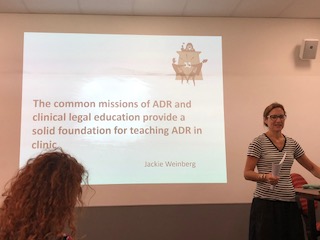
Jackie presenting her paper on 3 December 2018
My paper shows that clinicians saw CLE as striving to have a strong link to “social justice” and “legal service”. Similarly, they viewed ADR as having access to justice as its focus. Although the links were not always explicitly made by the participants, the implicit connection and “value” of ADR in CLE, in their minds, indicated that they both align with a common goal of furthering access to justice. Clinicians believed that a common mission exists between ADR and CLE in the form of the advancement of social justice. Community Legal Centres (CLCs), incorporating clinical programs, utilise ADR to accomplish their mission of social justice and this facilitates the implementation of clinical practice goals.
Some clinicians expressed caution that there are limitations in relation to ADR providing access to justice. However, in the course of exploring with the participants the issues and concerns of both CLE and ADR, it became apparent that clinicians still viewed ADR as integrally linked to social justice concerns and the advancement of access to justice. Clinicians viewed ADR as a valuable component of CLE, enhancing student awareness about social justice and the various options for dispute resolution. Bloch echoes these views, stating “clinical legal education has always had a broader goal-to teach law students about what lawyers do and to understand lawyers’ professional role in the legal system in the context of having students provide various forms of legal aid services.”[1] Bloch goes on to emphasise that because ADR and clinical education share overlapping goals of advancing the interests of parties and addressing deficiencies in access to justice, ADR education and CLE are “slowly integrating and advancing beyond the teaching and practice of basic negotiation skills that have been included in the clinical curriculum for years.”[2] Bloch opines, “clinical programs that teach and practice ADR can inform, improve, and reform not only legal education, but also-over time-the practice of law and the legal profession as well, thereby furthering the social justice goals of the global clinical movement.”[3]
From my findings and supported literature, I argue that the close association between the social justice “missions” of CLE and ADR, enhanced by their relationships with CLCs and legal aid programs, provides a solid foundation for the teaching of ADR in CLE.
Jackie Weinberg is a law lecturer, PhD Candidate, and Clinical Supervisor in Monash Legal Practice Programs at the Faculty of Law, Monash University. Jackie’s research is focused on an exploration of ADR in clinical legal education. Jackie recently published an article in the IJCLE titled: Keeping Up With Change: No Alternative To Teaching ADR In Clinic. An Australian Perspective. In addition to ADR, Jackie has keen interest in student well-being and technology and the law, focusing on access to justice in clinical legal education.
[1] Frank S. Bloch, The Global Clinical Movement (Oxford University Press, 2011) 167













 The Australian Dispute Resolution Research Network