
Rethinking Family Mediation in England and Wales, and Beyond

Dr Rachael Blakey

For several decades, the Australian family dispute resolution literature has examined the operation of family mediation and other family dispute resolution procedures. Much of this data comes from funded evaluations and projects following the Family Law Amendment (Shared Parental Responsibilities) Act 2006. However, the English and Welsh literature on contemporary family mediation is limited in comparison. Much of our research has remained focused on the court system, even though many, if not most, people involved in child arrangements or post-separation financial matters deal with their disputes outside of it. My monograph, Rethinking Family Mediation: The Role of the Mediator in Contemporary Times, seeks to reinvigorate discourse and debate on family mediator practice within not only England and Wales, but also other jurisdictions, including Australia. Its opening paragraph reads:

‘Family mediation, like many other procedures, is in a transitionary period. Several traditional concepts – neutrality, facilitation and non-legal support – continue to dominate the discussions around the role of family mediation and the family mediator. These notions remain fundamental to family mediator practice, though their hold has weakened over time. Following decades of reform to the family justice landscape, the work of family mediators is now underpinned by a number of other concepts: flexibility, evaluation and, sometimes, quasi-legal oversight. Family mediators continue to perform their traditional functions, but balance them alongside a rising demand to adapt. They follow a flexible conceptualization in order to provide more comprehensive support to their clients, many of whom have limited access to legal or other advice in the early 21st century.’ (Blakey 2025, p. 1)

Today’s English and Welsh family justice system is very different to that in Australia. We do not have any triage system like the Child and Family Hubs, nor is family dispute resolution mandated. In fact, the Ministry of Justice recently backtracked from 2023 proposals to require most private family law disputants to demonstrate a ‘reasonable attempt to mediate’ before initiating court proceedings, citing concerns about the use of family mediation in cases of domestic abuse. Interestingly, amendments to our Family Procedure Rules in April 2024 mean that judges now have more power to adjourn court proceedings to encourage the use of ‘non-court dispute resolution’ (including family mediation). Judges can also impose a cost order on parties who do not attend a non-court dispute resolution process ‘without good reason’. Whether the Family Procedure Rules have led to non-court dispute resolution becoming mandatory has yet to be seen. Regardless, Rethinking Family Mediation offers valuable insights for family dispute resolution practitioners and academics in various other jurisdictions. It illustrates how policy and legislation can shape mediator practice over time, highlighting mediation’s central positioning within the broader family justice system.

Uncovering the transition from limited to flexible mediator practice

The key thesis underpinning Rethinking Family Mediation is that the role of the family mediator (particularly in England and Wales) has broadened over time, and it is the lack of recognition that this development has occurred, not the development itself, that is inherently problematic. More specifically, I argue that there has been a transition from a limited mediator archetype to a flexible mediator archetype.

The limited mediator archetype is how family mediation practice was, and typically continues to be, conceptualised. They are facilitative and strictly neutral, ensuring that decision-making power rests with the parties at all times. This limited archetype was logical in the traditional English and Welsh family justice system when funding was accessible for many separating parties. Many individuals could still afford a lawyer, even if they were not eligible for legal aid. The limited mediator’s strictly facilitative role was thus appropriate, as more evaluative support and guidance was provided by a lawyer (or other legal practitioner) (figure 1). Nonetheless, the monograph uncovers a long-standing neutrality dilemma for family mediators: neutrality prohibits them from reacting to a power imbalance, yet, in many instances, to do nothing is also an unneutral act. This paradox suggests that the limited mediator was never a perfect or perhaps even ideal archetype.

Figure 1: A binary understanding of facilitative and evaluative behaviours

This critique holds even more weight today. The family justice system in England and Wales is drastically different to when family mediation was first piloted in the late 1970s and early 1980s. Over several decades, policy has increasingly presented mediation as the norm, not simply an alternative, for family matters. This push for private ordering accumulated in the Legal Aid, Sentencing and Punishment of Offenders Act 2012 (LASPO) which, as of April 2013, removed legal aid for the majority of private family law court proceedings. At the same time, traditional legal support has become increasingly inaccessible for most separating families. Both factors have led family mediation’s clientele to diversify, with many cases now involving complex legal disputes or difficult party dynamics. The limited mediator, who is unable to provide any form of evaluation, is poorly suited to this clientele. Calls for mediators to adapt have increased as a result.

The monograph argues that mediators have transitioned to a flexible archetype over several decades. It recognises that the demand – both within policy and academic scholarship – for mediators to do more is, in fact, a call for mediators to become more evaluative. The flexible mediator archetype continues to perform a facilitative role, but evaluation is woven within their practices. Facilitation and evaluation are thus not a binary distinction, but rather two concepts on a continuum of mediator practice (as originally proposed by Riskin in 1996, though much of the contemporary English and Welsh literature on family mediation does not acknowledge his work). Mediator neutrality is subsequently re-understood as a moderate concept that does not need to be strictly upheld when doing so would compromise fairness or another normative concept. My monograph recognises that the flexible mediator archetype operated prior to the LASPO reforms, with a number of earlier studies demonstrating the varied work of mediators. However, it is submitted that the contemporary family justice landscape necessitates the archetype even further.

Revealing the flexible mediator archetype after the LASPO reforms

In England and Wales, and many other jurisdictions, debates around how to reform family mediation often become circular. It is said that change is needed to provide a better service. However, such change is not possible under the traditional conceptualisation of the (limited) family mediator. Rethinking Family Mediation submits that this stagnancy is resolved if the flexible mediator archetype is explicitly recognised.

To inform debate, the book outlines findings from an empirical project, consisting of a content analysis of family mediation Codes of Practice and semi-structured interviews with 17 family mediators. Its empirical findings first reveal a new theoretical framework of four mediation functions, all of which are recognised and adopted by both family mediators and their regulatory bodies (figure 2). Mediators are primarily helpers, but regularly evaluate the proposed settlement or party dynamic to determine if they should become referrers to another service (notably legal advice). Mediator evaluation becomes significantly more prominent as they become assessors and, furthermore, intervenors. Additional interview data shows that mediators feel that they are responsible for responding to difficult party dynamics and unfair settlements, justifying their more evaluative practices. Of particular note within the empirical data is the mediator sample’s regular reference to legal rules, set out in both legislation and case precedent. This alludes to a growing quasi-legal role for today’s family mediators, most likely influenced by the withdrawal of accessible legal support after the LASPO reforms.

Figure 2: The mediator function framework, plotted on a continuum of facilitative to evaluative strategies

These more evaluative behaviours are discussed by the entire mediator sample, even if a participant understands their neutrality in very strict, absolute terms. Intriguingly, over two-fifths of the mediator sample prefer an alternative understanding of their neutrality that enables them to intervene in negotiations to encourage a good quality settlement. This stance appears more closely aligned with the concept of impartiality, rather than neutrality, though whether the former is a better term to describe the flexible mediator archetype is unclear (mirroring similar debates in Australia).

Implications for family justice going forward

The quasi-legal role of flexible mediators, as identified through the monograph’s empirical data, has significant implications for the professionalism and training of the profession. One chapter of Rethinking Family Mediation specifically considers the extrinsic and organisational barriers to reform, asking whether family mediation should be regarded as a ‘legal service’ under English and Welsh legislation. While the monograph does not provide a definitive answer to the question, it hopes to reinvigorate debate in the area. The chapter also uncovers findings on the current status of family mediation services at a time when the government expects parties to mediate but has provided very little government funding to support mediators themselves.

Importantly, the findings covered in this book have significant implications for our understanding of family justice. Family justice is generally understood as something that is only available through court (and supported by legal representation). Yet much of the empirical data discussed in the book is evidence of a shift in not only family mediator practice, but family justice itself. In the contemporary English and Welsh, as well as Australian, landscape, family justice is increasingly provided through non-lawyers, such as mediators, who are often informed by legal norms. The book connects these changes to a rising hybridity across family law practice, with lawyers additionally becoming more collaborative and less adversarial over time.

This contemporary vision of family justice is not ideal, nor perfect. Without further scrutiny of the various professionals within the family justice system, the risk of improper or unfair outcomes increases. However, Rethinking Family Mediation is premised on finding pragmatic solutions to the challenges within our modern family justice systems. In order to do so, the reality of non-dispute resolution practice must be identified and, importantly, recognised.

It is of no surprise that the monograph regularly returns to the concealment of the flexible mediator archetype – and most likely many other flexible practitioners – as a key issue within our current discourse around family justice reform. Ultimately, it argues that the changes in family mediator practice have been both a natural part of the profession’s development, as well as a consequence of the contemporary family justice system with limited funding and inaccessible legal support. The book will therefore be of significant interest to anyone interested in learning more about family dispute resolution in terms of not simply how the process was traditionally conceived, but how it operates in reality.

Author Biography

Dr Rachael Blakey is an Associate Professor at the University of Warwick. Her research focuses on family mediation and access to justice. She is a co-opted Director of the Family Mediation Council, the main regulatory body for family mediators in England and Wales. Rachael is interested in legal professionalism more widely, and is currently conducting the first empirical study on the English and Welsh ‘one-lawyer-two-clients’ format of family law support.

Author details: rachael.blakey@warwick.ac.ukUniversity ProfileLinkedIn | Rethinking Family Mediation: The Role of The Family Mediator in Contemporary Times (Bristol University Press 2025)

All figures were provided with permission from Bristol University Press.
The Problem with ‘Genuine Effort Certificates’ in Family Law and Options for Law Reform

Emma Mills
Monash University

In Australia, most parents who are trying to resolve a parenting dispute must first attempt family dispute resolution (‘FDR’), usually in the form of mediation. This must be done before commencing family law court proceedings. If FDR is unsuccessful, a family dispute resolution practitioner (‘FDRP’) will issue parties with a certificate to take to the court, which outlines why parties were unable to resolve their dispute during FDR. These are known as ‘genuine effort certificates’. However, genuine effort certificates given by FDRPs pose many issues, such as the lack of clarity about what a genuine effort looks like, lack of consistency and negatively impacting vulnerable parties. Due to these issues, I argue that changes should be made to the Family Law Act (‘FLA’). Specifically, I propose two separate solutions that could be considered. First, I propose that genuine effort should be a term that is defined in the FLA and second, that genuine effort certificates should be abolished and replaced with attendance certificates.

What is the genuine effort certificate and FDR?

In 2006, the Australian Government introduced changes to improve the Australian family law system. The main reason behind the sweeping reforms was to find ways for parents to come to a parenting agreement collaboratively, rather than commencing legal proceedings. Due to these reforms, attendance at FDR is effectively a pre-requisite for family law matters involving children. FDR is where a FDRP, who is independent to the parties, acts as a mediator to facilitate parties coming to a solution between themselves, so that they can seek to resolve their dispute outside of court. A court is unable to hear an application regarding a parenting dispute, unless a genuine effort certificate is issued by a FDRP or an exception applies. The certificates are based on whether parties have made a ‘genuine effort’ to participate in FDR. For example, a parent could be issued with a certificate that says that they ‘did not make a genuine effort to resolve the issue’ (‘non-genuine effort certificate’). The type of certificate issued can determine whether the court decides to send parties back to FDR and can be a consideration when determining to award costs against a party.

As a result of the genuine effort certificate scheme, FDRPs have been referred to as being ‘gatekeepers to family courts’. There are some advantages to this. For instance, the genuine effort requirement places an obligation on parties to take responsibility to resolve the dispute before going to court. Following the introduction of the FDR requirement, there was a 25% reduction in court filings and parties reported high levels of satisfaction with the process. However, genuine effort is not defined in the FLA. The FLA does not provide any guidance as to what circumstances, conduct or factors constitute a ‘genuine’ or a ‘non-genuine’ effort. This means that the implementation of this requirement is problematic in practice.

What are the negative impacts of the genuine effort certificates?

Undermining the Impartiality of a Mediator

The main role of a FDRP in mediation is to be ‘independent’ from parties. The neutrality of the FDRP is a fundamental component of the practice of mediation. Neutrality is described as going ‘to the heart’ of mediation theory and means ‘freedom from bias’. Field and Crowe talk about the ‘folklore of neutrality’, which suggests that true neutrality can be difficult to achieve. This concept is especially true in the context of the genuine effort certificates.

When issuing a genuine effort certificate, FDRPs must make a subjective judgement about whether each party has genuinely attempted FDR. The FDRP may have to make a judgement about whether the party has acted reasonably. This can occur in situations where a party refuses to move from their initial position, which could be perceived as the party being unrealistic and unreasonable by the FDRP. Also, whilst FDRPs are trained to be as objective as possible, decisions about whether parties have been genuine in their effort may be unavoidably influenced by their own personal values, experiences and subconscious biases, particularly in the context of family and separation. This can mean that FDRPs may potentially act in a biased way when deciding on the type of certificate to issue.

The genuine effort requirement, therefore, places immense pressure on FDRPs to make a judgement about how they perceive each party to be genuinely participating in the process. This function is arguably well beyond a FDRP’s scope as mediators, when they take on a role of being an ‘assessor’. The requirement for a FDRP to issue a genuine effort certificate is a legislative obligation that overrides the fundamental obligation of FDRPs to treat parties impartially, which is central to mediation.

Lack of Clarity and Consistency

As discussed earlier, the FLA does not define genuine effort. Therefore, whether a party has genuinely participated in FDR is a highly subjective analysis which must be undertaken by FDRPs in the absence of guidance on how a genuine effort is to be determined. Due to the lack of clarity, pressure is placed on parties to appear reasonable and cooperative, so that they can satisfy the individual FDRPs perception of genuine effort. This strain may impact parties to the extent that they do not feel like they can participate in the process in a full and frank manner, or negotiate effectively. For example, parties may change their behaviour, possibly to their detriment, if they know that the FDRP will be making a judgement about their behaviour. This strain placed upon parties, lawyers and FRDPs is a result of the genuine effort requirements being unclear and undefined.

Since there is no definition of genuine effort, it is extremely difficult to promote consistency in the issuing of genuine effort certificates. FDRPs are often influenced by a range of factors, including their prior professional experiences and their personal views. This can mean that there is a lack of consistency for parties, which can create apprehension about what certificate they may be issued. Therefore, due to the lack of clarity about what is a genuine effort, it creates an area of law that is inconsistent and unreliable.

Gendered Implications

For parties to appear as though they are genuinely participating in the process, it is likely that the party must present as rational, reasonable and cooperative. This poses a risk for parties who may appear difficult, angry or unreasonable, to be seen as not genuinely participating.  This expectation can create problems, especially for vulnerable individuals, who might not fully understand what is expected of them.

Viewing this through a gendered lens, Rachael Field argues that women are more likely to face unfair judgements and to be labelled as being ‘unreasonable’ after separation. This can make it harder for women to show FDRPs that they are genuinely trying to participate in the process. After separation, women are often already enduring gendered disadvantage, such as distress, poverty or repercussions of family violence, which can affect both how they behave and how their behaviour is perceived during FDRP. Also, when FDRPs evaluate how genuine parties are, they may be influenced by their societal views and values of women, including what they consider to be stereotypically feminine behaviour. This raises the possibility that if a woman behaves in a way that falls outside of gendered norms, she may then be issued with a non-genuine effort certificate. This can worsen the post separation vulnerability that women experience, especially if they then run the risk of receiving a cost order against them once the case progresses to court.

What are the solutions?

As discussed, the way that genuine effort certificates are operationalised in practice may undermine the overall aim of increased participation in FDR for parenting disputes. There are two separate potential avenues for reform that I will now consider, which could assist in working towards addressing these problems.

  • Defining Genuine Effort

As mentioned earlier, the lack of clarity around what counts as a genuine effort in FDR creates significant problems, especially for vulnerable parties and women post separation. Without a clear definition of genuine effort in the FLA, it reduces consistency for parties. Therefore, one solution is that the FLA should be amended to include a definition of genuine effort. This definition would provide a guideline for FDRPs, lawyers and parties. For example, the Migration Act 1958 (Cth) includes a provision where the holder of a certain visa has made a ‘genuine effort’ to commence employment or engage in business. A list of factors is included to help with the assessment of what is considered genuine effort in the circumstances. Whilst the factors included in the Migration Act are not helpful in assessing genuine effort in FDR, this provides an example of how the FLA can include such guidelines to assist in the interpretation of genuine effort.

The possibility of using a list of factors has already been considered by leading family law scholars. For instance, Hilary Astor suggests that a definition of genuine effort should include factors such as the ‘willingness to consider options put forward by the other party’, ‘willingness to consider putting forward options’ and ‘willingness to focus on the needs and interests of the children’. These factors would help to give parties a guide on how they should act in FDR. These factors align with broader comments made by Einstein J in Aiton Australia Pty Ltd v Transfield Pty Ltd (1999) 153 FLR 236 [at 156], where he says that parties should be open minded and receptive in mediation and be willing to put forward options for a resolution.

These factors, therefore, could be legislated in the FLA. This would provide much needed clarity about what genuine effort means, which would in turn help to create consistency and provide parties with a clearer understanding about what is required of them during FDR.

  • Abolishing the Genuine Effort Certificate

There are significant issues with issuing genuine effort certificates, which defining genuine effort in the FLA cannot alleviate alone. Therefore, an alternative solution that has been suggested is to abolish the types of genuine effort certificates issued altogether. Whilst defining genuine effort in the FLA may be of some assistance, determining whether parties are giving a genuine effort in FDR is still highly contextual in nature and would still require the FRDP to make a discretionary judgement. Simply providing FDRPs with a set of factors to be considered may not resolve the issue of FDRPs making a subjective decision about the type of certificate to issue or clarify FDRPs’ role within mediation.

Instead, through abolishing the types of genuine effort certificates issued, the FDRP would instead issue an attendance certificate. This would simplify the process and would just require the FDRP to note whether participants did or did not attend FDR. An attendance certificate would help FDRPs to maintain their position of independence and neutrality within mediation, and would eliminate the issues around the lack of clarity and consistency. It would also help to alleviate the potential repercussions for parties who are issued with a non-genuine effort certificate, especially for women post separation. In addition, without having to assess parties’ behaviour, it would enable FDRPs to focus on their main goal: to assist parties to find a workable arrangement between themselves.

Next Steps

Whilst the genuine effort requirement has been an important factor in encouraging parties to try and resolve their parenting disputes through FDR, its implementation poses issues for parties, lawyers and FDRPs. In this post, I have proposed two separate pathways that could be followed to begin to address these problems. Introducing a factor-based definition of genuine effort into the FLA provides a small, short-term adjustment that can assist in clarifying the standard of genuine effort for parties. On the other hand, a more radical, longer-term solution is to abolish the genuine effort certificates altogether and replace them with mere attendance certificates. Attendance certificates would remove the evaluative function of FDRPs altogether, whilst still mandating engagement with FDR.

Author Biography

Emma Mills is a Law and Criminology student in the Faculty of Law at Monash University. Emma has a particular interest in social justice and volunteers with the Epilepsy Foundation in her spare time. After graduation, Emma wants to pursue a career in family law and to dedicate herself to creating a fairer legal system.

Open letter of thanks and appreciation #ADRRN18

By Jo Burnett, Research Masters student, Southern Cross University

The ADR Roundtable 2018 was a network event and conference on the Sunshine Coast in Dec. I came across this event by chance when looking for resources in ADR for research purposes.

burnett

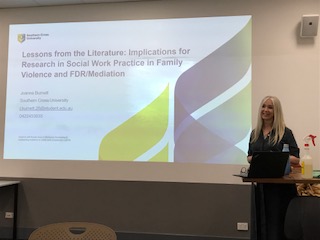
Jo presenting her paper at the ADR Research Network meeting on 4 December 2018

Submitting a draft paper for presenting was a new and exciting prospect for me and I was unsure of the format, audience, members and a little intimidated by many of the esteemed academics and authors submitting and blogging on the ADR blog site.

The organisers Dr Sue Douglas and Dr Lola Akin Ojelabi, and commentator and co-founder Dr Becky Batagol were in contact early through email and very reassuring and approachable.

First contact was a group meal on the evening beforehand and gave us all a chance to meet and greet in an informal and friendly way over dinner and drinks, this was a great idea and not knowing anyone, helped me enormously to settle and get to know everyone. The meal on day two was also a great time to relax and get to know everyone.

coffee ADR 2018

Jo and Drossos deep in discussion: Chats over coffee before the days starts are a great way to get to know other members and continue conversations from the sessions

First day arrival at The University of the Sunshine Coast was terrifically relaxed with great facilities and a warm friendly atmosphere.  The quality and range of speakers and presentations was exciting.  A number of changes were discussed with all the attendees and the program was altered to suit the number and requests of the attendees, making this a truly collaborative event.

ADR Roundtable Dec 2018 Sunshine Coast

Group discussion on each paper is a central feature of the network roundtable format

The quality and industry expertise of all the presenters and the range of presentations and research was astounding.  For a new researcher in the field, this event, the contacts and exposure has been  invaluable and all in the interest of building capacity for and in researchers in the DR field. Again, a big thank you for the organisers and founders who provide their time and expertise on a voluntary basis.

ADR rountable dec 2018

Mary Riley, Janet Barnes and Becky Batagol in the audience

I will definitely being attending next year’s event in Dec 2019 and will be further along in my research journey, with a big input from the feedback of the commentators, chair and attendees who’s feedback has been of great value and merit to my research.

Anyone who is conducting research in this field would find great benefit in attending, for me, this experience and contacts have been unbelievably rewarding.

Thank you all.


j burnett PHOTO (1)Joanna Burnett has been a professional Social Worker  for 15 years, receiving her undergraduate degree in 2003 from Deakin University in Melbourne.  Prior to receiving her degree, Joanna had been working in the northern NSW local magistrate’s courts supporting women experiencing domestic violence in a court support role in a women’s service, non-government agency since 1998. Joanna worked in a mental health and dual diagnosis hospital for the past 10 years and gained a Master degree in Forensic Mental Health through Griffith University in 2013. She continues to work in her private practice across NSW/QLD border as an AASW accredited family violence and mental health social worker as a counsellor.For the past 12 months, Joanna has been working with a family law firm in a mediation program in a family violence screening and assessment role and is enrolled in a Masters of thesis (Research) with Southern Cross University conducting research in family violence, FDR and Social Work.

What’s in a frame? Power, control and desire in the experience of family mediation.

picture-frame-427233_1920picture-frame-427233_1920

We bring our readers another blog post, written by Assoc Prof Jill Howieson. The post is version of paper presented at the just concluded ADR Research Network Roundtable, 4 -5- December 2017 #ADRRN2017. Happy reading!

“By the tragic gap I mean the gap between the hard realities around us and what we know is possible — not because we wish it were so, but because we’ve seen it with our own eyes.” —Parker J. Palmer

In 2011, I wrote on the Kluwer Mediation blog. I wrote about the same transcripts from the family mediations that I have analysed for this paper. In 2011, I wrote that I was reading about desire in these transcripts. I had returned to my 1985 language, literature and culture textbook, Modern Literary Theory, and to psychoanalytic and linguistic theories to try to understand what I was reading.

I was drawn particularly to Lacan and Foucault, and their analysis of language. A few years on and Parker J Palmer captivates me with his notion of the tragic gap –“the gap between the hard realities around us and what we know is possible.

Now these concepts converge. Jacques Lacan’s lack, or the “endless chain of signifiers” that we use in pursuit of a ‘real’ satisfaction or desire; Michel Foucault’s recognisable objects (or hierarchies) of importance, and the practices that derive from them that we create to uphold power; and Parker J Palmer’s tension gap, where we “faithfully hold the tension between reality and possibility.” These are all concepts that can inform our understandings about mediation.

Firstly, I wondered if we as mediators do not ‘faithfully hold the tension’; namely, the tension between what parties say they want and what they desire. The present analyses of the transcripts suggests that mediators can create tight frames for their mediation discourses and thereby impose a control on the parties’ language, and thus on their needs and desires – or at least their acknowledgement of their needs and desires.

The Foucauldian analysis alerted us to the power that mediators can create through their language. It showed that a mediator’s language could create recognisable objects or hierarchies of importance, which has the effect of elevating these objects and giving them power. The mediators in the study were able to elevate the status of various ‘objects’ including the notion of ‘good parents’ who will compromise and come to agreements, and parents who displayed calm rational ways of disputing or negotiating through their choice of words. By elevating these objects, the mediators could control the practices that flowed from them. For instance, where the mediators accorded importance to the notion of ‘good parents’ and excluded ‘naughty parents’ from the discourse, this empowered the mediators to push the ‘naughty parents’ into attending child-focussed sessions.

Further, with their language, the mediators seemed to create frameworks for the mediation that would cause the parties to work within those discoursal frames.  Through a repetition of Court-focused words, the mediators created court-focused frames, which had the effect of creating fear in the parties and empowered the mediators to push for agreement (to keep the parties out of court).  The parties would follow the mediator’s language and tailor their conversation to suit regardless of whether this was where they wanted to go or not. For instance, a discoursal frame of court had the result of moving the parties towards plans and agreements, and took them away from their ‘real’ fears and desires.

Further, the results revealed that mediators would listen according to their mediation orientation. If mediators worked within a settlement orientated frame, then they would listen for agreements or signals that might lead to agreements and use interventions to suit, such as writing options on the whiteboard and recording agreements.  On the other hand, mediators working within a ‘best interests of the child’ framework would listen for examples about the child’s perspective and how the children might be experiencing the separation, and then choose child-focussed interventions to encourage the parents to think of themselves as parents rather than as disputants.

Essentially, it seemed that despite their best intentions, the mediators would often miss the real desires of the parties and/or ignore the power discourse that they were creating as they pushed towards certain outcomes rather than sitting in the process tension of possibility.

According to Lacan, needs, if left unattended (or are reframed), do not disappear but turn into desire. In 2011, I asked what language in mediation do we have to address the parties’ unmet needs and desires. Now, I ask, how do we even hear these desires and needs when we mask them so well with our own desires for outcomes?

If we want to hear the desires of the parties (and I am not saying that all mediators do) then we need to begin to listen differently. We need to listen for the structures of desire in mediation that tell us what it is that the parties crave. We need to sit in the process-outcome tension and listen to the repetitions; the patterns and the experience of the parties so that they can access their true selves and their true desires, and then tell us what these are if they need to.

The Lacanian analysis revealed that the parties would often repeat words or patterns of words that would give ideas about their desires:

  • their attachment desires (I haven’t found someone worth living with and having my children involved with; I don’t live with somebody that helps me share my rent, helps me share my bills).
  • desire to be a good parent or better person (But that will change in the next … probably ten weeks…that will change), or
  • a desire to give the children what they perceived they needed (I’ve always said to M and to a mediator that assessed me …They’re four boys. They need their dad).


These examples of repetition occurred within conversations about which school the children would go to and who would pay for the children’s after-school sport activities—they were not so easily identifiable as desires.

So, what do parties say as they seek attachment to calm their unattached selves, or calmness to keep their selves intact in the chaos of conflict? What hidden desires does their language conceal? In the transcripts, there were prolonged, sometimes nonsensical discussions about the location, denomination and even the principal of the children’s schools—signifiers perhaps? There were discussions about the children’s dental plan or child payments —masquerading as desires for closure and the ‘gestalt’ perhaps?

We can never really know, but we can guess. We can sit in the tension gap of the unfolding of meanings and the ongoing and reflexive nature of mediation. The research shows that mediators tend to focus on the agreements more so than the parties do. The parties’ conversations tended more towards an articulation of what they were experiencing rather than towards concrete agreements.  We could look at the relationship between language, outcomes and experience more closely.  As Parker J Palmer writes, tension in life is ‘inevitable, inexorable, [and] inescapable’.  We could use this tension and assist the parties to make meaning out of their situations, actions and desires; to move from the jumble of conflict – the chaos – to the destination of desire, or at least understanding their desire; to make meaning in the disorganised realm, whether of experience or thought, and sort this out into an understanding of needs.

But, what mediation language do we use? What do we use as signifiers? And what desire is repressed as we substitute our language of desire for the language of courts, or child development or parties’ needs?

In 2011, I wondered whether, in every mediation, we were selling ourselves short. I wondered whether, with our future focus, our discourse of agreement, as we shape and mould, whether we were trying to camouflage that which is continually trying to show itself – our gaps, our cracks, our ugliness, our humanity, our beauty, our desires! I think in 2017, the answer might be a resounding yes.


Nearly Neutral: A Mediator’s Best Bet

By Amanda Selvarajah

This post is the third in a series of posts on this blog written by students studying Non-Adversarial Justice at the Faculty of Law at Monash University. Students were invited to write blog posts explaining various complex areas of law relating to dispute resolution to ordinary readers. The very best post on each topic is published here.


the-gate-by-guillaume-delebarre

‘The Gate’ by  Guillaume Delebarre: Creative commons source

The National Mediator Accreditation System removed “neutrality” as a requirement on their list of ethical standards in 2015. This may suggest a trend away from the truly “neutral” mediator in the sense of a ‘detached third-party’. But does this mean we are to rule out neutrality entirely as an ethical consideration in mediation? With a trend of increasingly interventionist mediators, a complete disregard of the concept could place participants at great risk of being subjected to ethically dubious decisions.

     Perhaps the reason for the mediation community’s shift from neutrality is not because of a flaw in neutrality itself, but rather a failure to grasp a version of neutrality that can and should be an important element of an ethical mediation. Instead of defining neutrality as an unattainable attribute intrinsic in the nature of a mediator, perhaps we should be viewing neutrality as a constant practical endeavour throughout the mediation process, a mediator who’s nearly neutral.

Why Neutral At All?

A mediator in its simplest description is a ‘trained, impartial third party’ who assists parties in making their own decisions. However, mediation remains unregulated and virtually unmonitored as it is typically conducted in private with assurances of confidentiality. Mediated parties are expected to relinquish a guarantee of the principles of justice and fairness that would be inescapable in a common law court. It is these qualities of mediation that leave participants particularly vulnerable to a biased decision in the event of a potentially opinionated, interventionist mediator. Therefore, it is the consensual participation in the process and the assurance of “neutrality” that many consider the source of the process’s legitimacy.

On the spectrum of mediator involvement in mediation, the facilitative approach, which focuses a mediator’s role to procedural stages, leaves parties with as much freedom and control in the substance and outcome of the mediation as possible. The evaluative approach, on the other hand, has even been disregarded by some, like the Victorian Association for Dispute Resolution, as being a form of mediation at all. They argued that the mediator’s ‘input into the content, and sometimes the outcome’ of the mediation made the process inherently contrary to the core principles of mediation.

Such or any mediator involvement may suggest, as critics of the evaluative mediation approach do, an immediate breach of neutrality. But this is only the case if neutrality is restricted to a ‘strict, dualistic sense of the mediator either being or not being neutral.’

Why Not Be Absolutely Neutral?

To truly make the case for a re-imagined concept of neutrality, one must first accept the bold suggestion that mediations are not neutral in its literal sense and could likely never be so. Mental health professionals have found that ‘there is no such thing as total impartiality, neutrality, or lack of bias when working with people, even though as practitioners they may strive for such ideals.’ In mediation specifically, research has shown that in practice, mediators may affect and influence mediation at almost all stages of the process. Examples include ‘the ways they structure the interchange between the parties, in terms of the sequencing of storytelling and the framing of responses and what needs to be responded to.’ It follows then that any assessment of a mediator’s success in reference to their ability to be neutral, in the literal sense of the word, would set almost all our mediators up for failure.

However, regardless of a mediator’s ability to be neutral, there is the added consideration that absolute neutrality may not even be conducive to the goals of a truly successful mediation. For example, in the case of the simultaneous expectations that a mediator be both absolutely neutral but also committed to facilitating an equal conversation, one often comes at the cost of the other.

Mediated parties often experience a power imbalance. Therefore, a hands-off mediator may in these cases fail to protect ‘vulnerable parties from inappropriate pressure’. In family law mediation (family dispute resolution or FDR), for example, parties often meet at very unequal terms. Mediators in these cases may be caught between either claiming a position of absolute neutrality, thereby stripping them of the power to ‘redress imbalances’, or recognising a role in sometimes having to take ‘affirmative action… to achieve a balanced agreement.’

Family dispute resolution practitioners must consider if ‘family dispute resolution is appropriate’ before mediation is undergone. This may allow for vulnerable parties to be excluded from the mediation process, sparing mediators the struggle of balancing these competing expectations. But some victims still ‘feel that FDR processes fail to identify and manage the risk of family violence effectively.’ The exclusion also does nothing for parties beyond family abuse dynamics who may still be more vulnerable than the other party due to cultural, societal or financial factors.

This concept of absolute neutrality is similarly challenging for indigenous mediators, to whom Western notions of neutrality may not make sense. In indigenous mediation it has been recommended that a respected elder would likely be the more appropriate choice of mediator than a neutral third-party. Selecting a mediator for their ability to intimately understand the parties as opposed to their ability to detach themselves from them is arguably in direct opposition to Western expectations of a successful mediator. A commonality in our understandings of a successful mediation, however, may be the increasing interest in addressing the conflict at the heart of mediations.

Therapeutic jurisprudence, a philosophy focused on critically viewing our legal systems to maximise the health and wellbeing of those who engage with it, has been applied to improve and direct law reform throughout Australia’s legal system. Critically assessing the purely facilitative mediation process through a therapeutic jurisprudence lens unearths the potentially anti-therapeutic effects of having a non-interventional, solution-centric mediator who as a result, fails to address and redress the underlying tensions at the heart of parties’ relationships. The development of therapeutic jurisprudence throughout Australia is proof that the indigenous community’s focus on rebuilding and strengthening relationships is not unique and could be facilitated in mediations with a more involved mediator.

A New, Nearly Neutral Approach

Neutrality was seen as a cornerstone of mediation’s procedural fairness, the idea that ‘what is required by procedural fairness is a fair hearing, not a fair outcome’. The facilitative approach has, therefore, been described as having the highest regard for procedural fairness on the basis of perhaps a rather simplistic equating of a fair hearing with a decision-maker who allows parties to make their own case with as little intervention as possible.

This argument assumes, however, that participants of mediation are always equally capable of articulating and pursuing their own interests and that they are always more concerned with a practical outcome than a resolution of the underlying feelings and conflict which brought on the mediation in the first place.

However, research has shown that in mediation ‘the basis of authoritativeness (e.g. of the ability to gain voluntary acceptance from members of the public) is changing from neutrality-based to trust-based.’ This suggests that contrary to advocates for neutral mediators, parties may actually prefer a more interventionist mediator who is willing to foster openness and build a relationship of trust over a detached one.

So perhaps instead of aligning neutrality with a mediator who never intervenes, it would be best to hold mediators’ interventions to standards ‘of non-partisan fairness or impartiality’ instead. For example, weighing, as an objective third-party, whether an intervention would make sense to ‘facilitate a productive dialogue by encouraging or even coaching reticent or inarticulate parties’ to promote a generally more just proceeding. After all, in the immortal words of Theodore Roosevelt, ‘Impartial justice consists not in being neutral between right and wrong, but in finding out the right and upholding it, wherever found, against the wrong.’


Amanda Selvarajah is (@amanda_darshini) currently in her third year of the Bachelor of Law (Honours) program at Monash University. Her research has focused on questioning the limits of the law and its rooms for improvement across a variety of fields. Last year, her research into the abuse of forensic evidence in court was selected for presentation at the International Conference of Undergraduate Research.