Rethinking Family Mediation in England and Wales, and Beyond

Dr Rachael Blakey

For several decades, the Australian family dispute resolution literature has examined the operation of family mediation and other family dispute resolution procedures. Much of this data comes from funded evaluations and projects following the Family Law Amendment (Shared Parental Responsibilities) Act 2006. However, the English and Welsh literature on contemporary family mediation is limited in comparison. Much of our research has remained focused on the court system, even though many, if not most, people involved in child arrangements or post-separation financial matters deal with their disputes outside of it. My monograph, Rethinking Family Mediation: The Role of the Mediator in Contemporary Times, seeks to reinvigorate discourse and debate on family mediator practice within not only England and Wales, but also other jurisdictions, including Australia. Its opening paragraph reads:

‘Family mediation, like many other procedures, is in a transitionary period. Several traditional concepts – neutrality, facilitation and non-legal support – continue to dominate the discussions around the role of family mediation and the family mediator. These notions remain fundamental to family mediator practice, though their hold has weakened over time. Following decades of reform to the family justice landscape, the work of family mediators is now underpinned by a number of other concepts: flexibility, evaluation and, sometimes, quasi-legal oversight. Family mediators continue to perform their traditional functions, but balance them alongside a rising demand to adapt. They follow a flexible conceptualization in order to provide more comprehensive support to their clients, many of whom have limited access to legal or other advice in the early 21st century.’ (Blakey 2025, p. 1)

Today’s English and Welsh family justice system is very different to that in Australia. We do not have any triage system like the Child and Family Hubs, nor is family dispute resolution mandated. In fact, the Ministry of Justice recently backtracked from 2023 proposals to require most private family law disputants to demonstrate a ‘reasonable attempt to mediate’ before initiating court proceedings, citing concerns about the use of family mediation in cases of domestic abuse. Interestingly, amendments to our Family Procedure Rules in April 2024 mean that judges now have more power to adjourn court proceedings to encourage the use of ‘non-court dispute resolution’ (including family mediation). Judges can also impose a cost order on parties who do not attend a non-court dispute resolution process ‘without good reason’. Whether the Family Procedure Rules have led to non-court dispute resolution becoming mandatory has yet to be seen. Regardless, Rethinking Family Mediation offers valuable insights for family dispute resolution practitioners and academics in various other jurisdictions. It illustrates how policy and legislation can shape mediator practice over time, highlighting mediation’s central positioning within the broader family justice system.

Uncovering the transition from limited to flexible mediator practice

The key thesis underpinning Rethinking Family Mediation is that the role of the family mediator (particularly in England and Wales) has broadened over time, and it is the lack of recognition that this development has occurred, not the development itself, that is inherently problematic. More specifically, I argue that there has been a transition from a limited mediator archetype to a flexible mediator archetype.

The limited mediator archetype is how family mediation practice was, and typically continues to be, conceptualised. They are facilitative and strictly neutral, ensuring that decision-making power rests with the parties at all times. This limited archetype was logical in the traditional English and Welsh family justice system when funding was accessible for many separating parties. Many individuals could still afford a lawyer, even if they were not eligible for legal aid. The limited mediator’s strictly facilitative role was thus appropriate, as more evaluative support and guidance was provided by a lawyer (or other legal practitioner) (figure 1). Nonetheless, the monograph uncovers a long-standing neutrality dilemma for family mediators: neutrality prohibits them from reacting to a power imbalance, yet, in many instances, to do nothing is also an unneutral act. This paradox suggests that the limited mediator was never a perfect or perhaps even ideal archetype.

Figure 1: A binary understanding of facilitative and evaluative behaviours

This critique holds even more weight today. The family justice system in England and Wales is drastically different to when family mediation was first piloted in the late 1970s and early 1980s. Over several decades, policy has increasingly presented mediation as the norm, not simply an alternative, for family matters. This push for private ordering accumulated in the Legal Aid, Sentencing and Punishment of Offenders Act 2012 (LASPO) which, as of April 2013, removed legal aid for the majority of private family law court proceedings. At the same time, traditional legal support has become increasingly inaccessible for most separating families. Both factors have led family mediation’s clientele to diversify, with many cases now involving complex legal disputes or difficult party dynamics. The limited mediator, who is unable to provide any form of evaluation, is poorly suited to this clientele. Calls for mediators to adapt have increased as a result.

The monograph argues that mediators have transitioned to a flexible archetype over several decades. It recognises that the demand – both within policy and academic scholarship – for mediators to do more is, in fact, a call for mediators to become more evaluative. The flexible mediator archetype continues to perform a facilitative role, but evaluation is woven within their practices. Facilitation and evaluation are thus not a binary distinction, but rather two concepts on a continuum of mediator practice (as originally proposed by Riskin in 1996, though much of the contemporary English and Welsh literature on family mediation does not acknowledge his work). Mediator neutrality is subsequently re-understood as a moderate concept that does not need to be strictly upheld when doing so would compromise fairness or another normative concept. My monograph recognises that the flexible mediator archetype operated prior to the LASPO reforms, with a number of earlier studies demonstrating the varied work of mediators. However, it is submitted that the contemporary family justice landscape necessitates the archetype even further.

Revealing the flexible mediator archetype after the LASPO reforms

In England and Wales, and many other jurisdictions, debates around how to reform family mediation often become circular. It is said that change is needed to provide a better service. However, such change is not possible under the traditional conceptualisation of the (limited) family mediator. Rethinking Family Mediation submits that this stagnancy is resolved if the flexible mediator archetype is explicitly recognised.

To inform debate, the book outlines findings from an empirical project, consisting of a content analysis of family mediation Codes of Practice and semi-structured interviews with 17 family mediators. Its empirical findings first reveal a new theoretical framework of four mediation functions, all of which are recognised and adopted by both family mediators and their regulatory bodies (figure 2). Mediators are primarily helpers, but regularly evaluate the proposed settlement or party dynamic to determine if they should become referrers to another service (notably legal advice). Mediator evaluation becomes significantly more prominent as they become assessors and, furthermore, intervenors. Additional interview data shows that mediators feel that they are responsible for responding to difficult party dynamics and unfair settlements, justifying their more evaluative practices. Of particular note within the empirical data is the mediator sample’s regular reference to legal rules, set out in both legislation and case precedent. This alludes to a growing quasi-legal role for today’s family mediators, most likely influenced by the withdrawal of accessible legal support after the LASPO reforms.

Figure 2: The mediator function framework, plotted on a continuum of facilitative to evaluative strategies

These more evaluative behaviours are discussed by the entire mediator sample, even if a participant understands their neutrality in very strict, absolute terms. Intriguingly, over two-fifths of the mediator sample prefer an alternative understanding of their neutrality that enables them to intervene in negotiations to encourage a good quality settlement. This stance appears more closely aligned with the concept of impartiality, rather than neutrality, though whether the former is a better term to describe the flexible mediator archetype is unclear (mirroring similar debates in Australia).

Implications for family justice going forward

The quasi-legal role of flexible mediators, as identified through the monograph’s empirical data, has significant implications for the professionalism and training of the profession. One chapter of Rethinking Family Mediation specifically considers the extrinsic and organisational barriers to reform, asking whether family mediation should be regarded as a ‘legal service’ under English and Welsh legislation. While the monograph does not provide a definitive answer to the question, it hopes to reinvigorate debate in the area. The chapter also uncovers findings on the current status of family mediation services at a time when the government expects parties to mediate but has provided very little government funding to support mediators themselves.

Importantly, the findings covered in this book have significant implications for our understanding of family justice. Family justice is generally understood as something that is only available through court (and supported by legal representation). Yet much of the empirical data discussed in the book is evidence of a shift in not only family mediator practice, but family justice itself. In the contemporary English and Welsh, as well as Australian, landscape, family justice is increasingly provided through non-lawyers, such as mediators, who are often informed by legal norms. The book connects these changes to a rising hybridity across family law practice, with lawyers additionally becoming more collaborative and less adversarial over time.

This contemporary vision of family justice is not ideal, nor perfect. Without further scrutiny of the various professionals within the family justice system, the risk of improper or unfair outcomes increases. However, Rethinking Family Mediation is premised on finding pragmatic solutions to the challenges within our modern family justice systems. In order to do so, the reality of non-dispute resolution practice must be identified and, importantly, recognised.

It is of no surprise that the monograph regularly returns to the concealment of the flexible mediator archetype – and most likely many other flexible practitioners – as a key issue within our current discourse around family justice reform. Ultimately, it argues that the changes in family mediator practice have been both a natural part of the profession’s development, as well as a consequence of the contemporary family justice system with limited funding and inaccessible legal support. The book will therefore be of significant interest to anyone interested in learning more about family dispute resolution in terms of not simply how the process was traditionally conceived, but how it operates in reality.

Author Biography

Dr Rachael Blakey is an Associate Professor at the University of Warwick. Her research focuses on family mediation and access to justice. She is a co-opted Director of the Family Mediation Council, the main regulatory body for family mediators in England and Wales. Rachael is interested in legal professionalism more widely, and is currently conducting the first empirical study on the English and Welsh ‘one-lawyer-two-clients’ format of family law support.

Author details: rachael.blakey@warwick.ac.ukUniversity ProfileLinkedIn | Rethinking Family Mediation: The Role of The Family Mediator in Contemporary Times (Bristol University Press 2025)

All figures were provided with permission from Bristol University Press.

The Lawyer-Assisted Family Law Property Mediation: Legal Aid Commission Trial vs The Priority Property Pool: Which Should You Choose?

By Amy Li

This post is part of a series of the best posts written by undergraduate law students enrolled in 2024 in Non-adversarial Justice at Monash University.

Victims of abusive relationships are at a higher risk of being financially disadvantaged and at poverty after separation. They are more likely to accept unfair property settlements and are three times more likely to receive less than 40% of the property pool. Parties who perpetrate abuse can continue to abuse them through the legal system, by delaying legal procedures, sending unnecessary legal letters, deliberately increasing their legal fees and causing the victim to be the subject of harsh cross-examinations. Due to little funding in Legal Aid, only 8% of Australian households are eligible to access a grant to receive legal aid.

Image by <a href=”http://<a href=”https://www.vecteezy.com/free-photos/business”>Business Stock photos by VecteezyArrmypicca

Due to these issues, the Lawyer-Assisted Family Law Property Mediation: Legal Aid Commission Trial and Priority Property Pools were recently established and aimed to increase access to resolving post-separation property matters through efficient and low-cost avenues aimed at parties experiencing family violence and economic abuse.

This article aims to provide a comparative analysis of the evaluation of the Lawyer-Assisted Family Law Property Mediation: Legal Aid Commission Trial (the LAC Trial) and the Priority Property Pools under $500,000 (PPP500) pilot programs. This post is designed to be especially useful for women who are experiencing ongoing severe financial hardship as a result of family violence and are seeking a family law property settlement in the State of Victoria, Australia, where the author is based.

The LAC Trial

The LAC Trial was initially established in 2020 and was funded to be a two-year trial. It provides legally assisted mediation for dividing property where net assets are $500,000 or less (excluding superannuation). The applicant must also be a priority client of the Family Dispute Resolution Service, a Legal Aid service designed to organise family dispute resolution conferences between parties at no cost (excluding the cost of legal representation). Priority clients includes people who have experienced, or is at risk of experiencing family violence.

If the application is successful, the applicant will be appointed a lawyer who will make an application on behalf of the client. A case manager can also provide the applicant with referrals to family violence support services and provide alternative solutions if mediation is deemed inappropriate. In Victoria, financial disclosure must be required before the first conference, which is intended to make the process more efficient. If resolved, parties are encouraged to sign a Heads of Agreement and lawyers apply for consent orders.

This program allows more women experiencing financial hardship to access legal representation for a property settlement. The more intensive case management is helpful for vulnerable parties as they are able to work with non-legal professionals to get the support and advice needed. The legal representation can level out the playing field for a victim who has a lack of bargaining power in private negotiations. Participants are also less likely to agree to a minority settlement as they receive constant advice from their lawyers and have a realistic proposal in mind. Where a party has experienced extensive family violence, mediation can be held between lawyers on behalf of the parties privately. The outcome is legally binding which allows victims to ‘move on’ and have separate finances without a connection. The fact that Legal Aid is involved removes another aspect of systems abuse, as Legal Aid can fund to obtain certain forms of financial disclosure for the vulnerable parties and avoid obstructive behaviour from the aggravating party.

However, the primary reason why this option may not be suitable for some clients experiencing financial hardship is that mediation requires cooperation from the other party. If the case manager does not receive a response from other party or they decline to participate, the matter is closed. The requirement of needing financial disclosure before the first mediation could also backfire for victims of abuse. This is because victims experiencing family violence may have limited access to financial information as well as the necessary documentation. Furthermore, during the pilot program, some legal professionals observed that parties who had a history of perpetrating family violence were likely to be obstructive in their financial disclosure. These parties would ‘drag their feet’ and be very slow with their paperwork, decreasing the efficiency of this program and increasing trauma for victims. There is also less incentive for parties to settle during mediation as they are not funding the process. However, it should be noted that these are aspects of systems abuse and are not unique to the LAC Trial.

Priority Property Pool

The priority property pool (PPP) was established as a pilot program in the Federal Circuit and Family Court of Australia in 2020. It was designed to provide access to more simple and efficient court processes for property dispute settlements in family law. It was created for similar reasons of ensuring the court-led process would mitigate any power imbalances and ensuring that disclosure occurs expediently and efficiently while achieving just and equitable outcomes. To be eligible, the main requirement is for parties to file their initial application seeking a property or financial order only and that the value of the net assets must be less than $550,000 (excluding superannuation). Neither party can seek a parenting order unless the court makes an exception and declares the case to be a PPP case. There are two streams:

  1. a registrar-led stream where a judicial registrar assists the parties to resolve their property and financial arrangements by consent; and
  2. a judge-led limb which is a simpler procedural process and ends in a judicial determination if the registrar-led limb is unsuccessful.

In comparison to standard litigation, PPP is able to assist parties who were unable to negotiate out of court. Vulnerable parties are naturally more intimidated by the court process but can have better access due to simplified forms and reducing the number of forms required during the proceedings. This leads to a much more efficient court procedure, with an average turnaround of 6 months, much shorter than the years long standard litigation process. A timely resolution is important for vulnerable parties as to not increase financial hardship and trauma. Furthermore, the streamlined court process removes the requirement to file affidavit material which could reduce trauma for victims of family violence as they would not need to recount their experience or hear the other party’s affidavit as well. The registrar-led limb also has a more ‘hands-on’ case management approach and are able to identify unequal bargaining power or other dynamics. The other parties seem to be more compliant even in the registrar-limb, which focuses on a consensual solution, and parties take the process more seriously compared to mediation.

Similar to the LAC Trial, there could be difficulties with parties refusing to make frank financial disclosures and vulnerable parties having little access to financial documents, however, in PPP, judges can make orders. The major issue with PPP is that it leaves a gap for people experiencing family violence who fall within the PPP program but are ineligible for legal aid representation. Therefore, for a client who is experiencing financial hardship and unable to afford private representation, PPP may not be as helpful as the LAC Trial. It also excludes victims who are seeking a parenting order as well. While judges can make findings about family violence, the absence of affidavit material can decrease the likelihood for family violence allegations to be identified. Registrars have limited capacity to manage complex dynamics when it comes to non-compliance from the other party and usually requires the matter to be referred to a judge, which could increase the time required to finalise the outcome.

Continuation after the Pilot Programs

The LAC Trial and PPP were very successful during their pilot program period and have since been expanded by Victoria Legal Aid and the Federal Circuit and Family Court of Australia respectively. The LAC Trial has been transformed into the Family Law Property Program and eligibility requirements for clients remain the same. Since the pilot program, funding has been extended twice with a current end date of 30 June 2025. The grants are capped for 20 parties per month and a lawyer can apply through Victoria Legal Aid’s online system, ATLAS.

The PPP program has continued since the pilot program and have expanded to all filing registries since. After an application has been made, a Judicial Registrar will review the application and determine whether it is a PPP case. If the applicant has an asset pool under $550,000, the required documents to initiate the process are the initiating application, a financial summary and a genuine steps certificate.

Overall, the LAC Trial is suited to a client who is in severe financial hardship and has experienced family violence, where the other party is willing to have mediation to resolve the dispute. The PPP is most suited towards a client whose other party is unwilling to engage with the client as the courts can help to make a judicial decision as it is a comparatively more formal setting. Both programs are suited towards clients who have serious financial hardship, however the LAC Trial guarantees legal representation. They are also both sensitive to that fact that a majority of the client base includes parties who have experienced family violence and try to even out unequal bargaining powers.

About Amy Li

Amy Li is a penultimate year student completing her Bachelor of Laws (Honours) and Commerce double degree at Monash University. Amy is currently a paralegal at a plaintiff class actions firm and volunteers to assist refugees. Through her studies, she has developed a strong interest to improving access to the legal system for vulnerable individuals.

Designing a Trauma-Informed Family Dispute Resolution Process

By Shanza Shafeek       

This is the first blog post in a series written by undergraduate law students enrolled in Monash University’s Non-Adversarial Justice unit in 2024. The very best posts have been published here.

Family disputes are inherently stressful, but for those who have experienced trauma—especially from domestic and family violence—the process can be even more overwhelming.

While the Family Law Act 1975 (Cth)  promotes Family Dispute Resolution (FDR) as a flexible, less adversarial alternative to litigation, it often fails to adequately address the unique needs of trauma survivors. This highlights the urgent need for a trauma-informed FDR service that supports victims while promoting healing.

In this blog post, we will explore the concept of FDR, the importance of a trauma-informed approach, the key elements that make it effective, the challenges it presents, and how these elements contribute to a more empathetic, supportive process.

What is Family Dispute Resolution?

FDR is a process where an accredited Family Dispute Resolution Practitioner (‘FDRP’) helps families resolve disputes related to separation or divorce outside of court.

The FDRP assists in creating parenting plans that outline future arrangements based on the best interests of the children. The goal is to resolve issues through ‘genuine effort’before resorting to court orders, promoting ‘cooperative parenting’.

Mandatory FDR requirements include exemptions for cases involving child abuse, family violence, urgency, or an inability to participate, ensuring that FDR is only used when appropriate.

The Need for a Trauma-Informed FDR Service

Trauma-informed care recognises the profound impact trauma has on individuals and strives to create a safe, supportive environment for survivors. Despite some exemptions, around 41% of family violence victims still use FDR to address their needs. However, the adversarial nature of disputes, the presence of perpetrators, and the language used in FDR can trigger past trauma, making the process harmful for victims.

Philippa Davis from the Women’s Legal Service emphasises the importance of having ‘safe processes’ for family violence survivors. Around 23% of victims report feelings of fear and power imbalances during FDR, which often leads to pressure to accept unsafe and undesired agreements. A trauma-informed FDR service, on the other hand, facilitates safer participation, enhances communication, and increases the likelihood of reaching mutually satisfactory agreements.

For example, Rachael Field and Angela Lynch introduced the ‘Coordinated Family Dispute Resolution’ (CFDR) model in 2009—a trauma-informed, four-phase framework. Piloted in five Australian locations, this model was evaluated as ‘holistic and safe’ for victims, demonstrating the positive impact of trauma-informed practices in FDR.

Elements of a Trauma-Informed FDR Service

A trauma-informed FDR service must integrate six key elements to address trauma.

  1. Before the Session:

Assessments:

A trauma-informed FDR service must start with comprehensive suitability and risk assessments to ensure the process is both safe and supportive for victims. These assessments should evaluate critical factors such as violence, power imbalances, and the psychological well-being of participants to determine whether FDR is suitable.

FDRPs should be trained to conduct trauma assessments effectively in cases involving trauma. Studies show that around 30% of parents feel FDRPs lack the necessary expertise to address abuse, highlighting a significant gap in knowledge. This points to an urgent need for targeted training in trauma-informed practices, including safety planning and psychological first aid, so FDRPs can perform these assessments effectively.

Cultural competence is also a key component of these assessments, especially when working with diverse trauma survivors. Susan Armstrong emphasises that FDRPs have reported ‘less confidence’ in cultural competence, indicating the need for cultural training (including First Nations traditions) to ensure parties feel understood, respected and supported from the outset.

Once FDR is deemed suitable, practitioners and domestic violence workers should adopt a ‘multidisciplinary’ approach to develop risk management plans that address the specific trauma needs identified during assessments. Andrew Bickerdike highlights that these plans may include measures such as separate waiting areas and virtual FDR options to create a more supportive environment for victims.

Information:

Clear and comprehensive information must be provided to participants before FDR sessions. As Joanne Law highlights, this information should include details on participation requirements, the roles of FDRPs and lawyers, any necessary religious or cultural accommodations, and the availability of breaks.

Participants should also be informed of their right to have a support person, their ability to express discomfort or withdraw from the process, and the trauma-informed practices in place, such as promoting autonomy and empowerment. Eugene Opperman emphasises that providing this information helps alleviate pre-session anxiety, as it ensures participants are fully aware of their rights and the measures in place to safeguard their well-being.

  • During the Session:

Safe Participation

During the sessions, it is crucial to create a safe environment that encourages active participation. A ‘co-mediation approach’ as suggested by Field and Lynch for the CFDR model, can be particularly effective. This approach involves using gender-balanced mediators and legal advocates for both parties to prevent ‘gender bias’– an issue highlighted in the Post-2006 Evaluation Report.

FDRPs must cultivate a welcoming atmosphere using calming language, offering private rooms to ensure confidentiality, and ‘giving ample time for each party to speak’—strategies emphasised by Dee Hardy. Such an environment helps parties make decisions that align with their own interests and the best interests of their children, rather than feeling pressured into ‘unfavourable choices’, which has been a noted concern.

Corinne Henderson and Isobel Everett further recommend minimising staffing changes, offering a variety of choices, and avoiding arbitrary rules to ensure consistent participation. These elements enhance trauma-management and foster open communication, ultimately making the process more effective for everyone involved.

Validation:

Validation is a crucial component of a trauma-informed FDR service. FDRPs should actively listen to participants, ask trauma-sensitive questions like “How did that make you feel?” and express genuine empathy. These actions help bolster participants’ self-worth and support their emotional well-being, addressing the high levels of acrimony and self-doubt reported by 17% of parties in family disputes.

FDRPs should also remain attuned to participants’ emotional states throughout the session. The concept of the ‘window of tolerance,’ as described by Pat Ogden, Clare Pain and Janina Fisher, is particularly useful. This framework helps FDRPs recognise when a participant is approaching the limits of their emotional regulation—whether in a state of hyperarousal (anxiety) or hypo-arousal (shutdown).

By adjusting the process to stay within the participant’s ‘their ‘optimal state of balance’, FDRPs create a supportive and constructive environment.

  • After the Session:

Summaries:

After each session, FDRPs should provide a clear summary of the outcomes and outline the next steps to ensure that all parties understand the progress made, helping to alleviate anxiety.

Conducting a debriefing immediately after the session allows participants to reflect on their experiences, validate their emotions, and address any lingering concerns. By actively involving them in determining the next steps, this trauma-informed approach enhances their sense of control and supports their healing.

Follow-Ups:

Follow-ups are essential for providing ongoing support and ensuring the long-term effectiveness of agreements. Around 19% of parents who reach an FDR agreement no longer have one a year later. To address this, a follow-up within 1-3 months should assess the agreement’s effectiveness and evaluate parties’ evolving needs. Itshould also include a specialist risk assessment for any new concerns and seek feedback on the trauma-informed FDR service.

A second follow-up, 6-12 months later, should focus on the long-term impact of the mediation, review any additional support needs (such as counselling), and explore the possibility of further mediation. Similar to the CFDR approach, this continued access to resources ensures that parties receive sustained support throughout their healing journey.

Challenges:

Designing a trauma-informed FDR service comes with its challenges. The AIFS evaluation of CFDR found that “some parents still experienced considerable emotional difficulty, even trauma, in mediation,” highlighting the ongoing challenge of effectively addressing trauma within FDR processes.

Additionally, Field and Lynch point out that trauma can significantly impair communication skills, suggesting that specialised training in ‘communication’ and negotiation strategies is essential for trauma-informed FDR services—though such training can be costly.

A trauma-informed FDR service also requires substantial resources, including ongoing, high-quality training for FDRPs and regular evaluations. These challenges must be carefully managed to ensure that trauma-informed FDR services are effective and sustainable.

A trauma-informed FDR service is crucial to effectively support trauma survivors. By integrating the six core elements, FDR can foster healing and achieve outcomes that the adversarial system often fails to provide. As our understanding of trauma continues to grow, FDR services must evolve to offer the compassionate care that victims truly need.

ChatGPT use:

This blog post was developed with the assistance of ChatGPT to identify key issues, which were subsequently fact-checked and supported with relevant journal articles. The insights provided by ChatGPT helped shape the initial framework, ensuring a comprehensive exploration of the topic.

About the author:

My name is Shanza Shafeek, and I am a fourth-year Law/Arts student at Monash University, specialising in sociology. I am currently working as a paralegal in institutional abuse and as a marketing team member for the Muslim Legal Network. I have also been actively involved as a Monash Law Ambassador and a Human Rights Project member for Amnesty International. I am passionate about legal policy, family law, and promoting culturally responsive approaches within legal practice to support diverse communities. I can be found on Linked In.

The Problem with ‘Genuine Effort Certificates’ in Family Law and Options for Law Reform

Emma Mills
Monash University

In Australia, most parents who are trying to resolve a parenting dispute must first attempt family dispute resolution (‘FDR’), usually in the form of mediation. This must be done before commencing family law court proceedings. If FDR is unsuccessful, a family dispute resolution practitioner (‘FDRP’) will issue parties with a certificate to take to the court, which outlines why parties were unable to resolve their dispute during FDR. These are known as ‘genuine effort certificates’. However, genuine effort certificates given by FDRPs pose many issues, such as the lack of clarity about what a genuine effort looks like, lack of consistency and negatively impacting vulnerable parties. Due to these issues, I argue that changes should be made to the Family Law Act (‘FLA’). Specifically, I propose two separate solutions that could be considered. First, I propose that genuine effort should be a term that is defined in the FLA and second, that genuine effort certificates should be abolished and replaced with attendance certificates.

What is the genuine effort certificate and FDR?

In 2006, the Australian Government introduced changes to improve the Australian family law system. The main reason behind the sweeping reforms was to find ways for parents to come to a parenting agreement collaboratively, rather than commencing legal proceedings. Due to these reforms, attendance at FDR is effectively a pre-requisite for family law matters involving children. FDR is where a FDRP, who is independent to the parties, acts as a mediator to facilitate parties coming to a solution between themselves, so that they can seek to resolve their dispute outside of court. A court is unable to hear an application regarding a parenting dispute, unless a genuine effort certificate is issued by a FDRP or an exception applies. The certificates are based on whether parties have made a ‘genuine effort’ to participate in FDR. For example, a parent could be issued with a certificate that says that they ‘did not make a genuine effort to resolve the issue’ (‘non-genuine effort certificate’). The type of certificate issued can determine whether the court decides to send parties back to FDR and can be a consideration when determining to award costs against a party.

As a result of the genuine effort certificate scheme, FDRPs have been referred to as being ‘gatekeepers to family courts’. There are some advantages to this. For instance, the genuine effort requirement places an obligation on parties to take responsibility to resolve the dispute before going to court. Following the introduction of the FDR requirement, there was a 25% reduction in court filings and parties reported high levels of satisfaction with the process. However, genuine effort is not defined in the FLA. The FLA does not provide any guidance as to what circumstances, conduct or factors constitute a ‘genuine’ or a ‘non-genuine’ effort. This means that the implementation of this requirement is problematic in practice.

What are the negative impacts of the genuine effort certificates?

Undermining the Impartiality of a Mediator

The main role of a FDRP in mediation is to be ‘independent’ from parties. The neutrality of the FDRP is a fundamental component of the practice of mediation. Neutrality is described as going ‘to the heart’ of mediation theory and means ‘freedom from bias’. Field and Crowe talk about the ‘folklore of neutrality’, which suggests that true neutrality can be difficult to achieve. This concept is especially true in the context of the genuine effort certificates.

When issuing a genuine effort certificate, FDRPs must make a subjective judgement about whether each party has genuinely attempted FDR. The FDRP may have to make a judgement about whether the party has acted reasonably. This can occur in situations where a party refuses to move from their initial position, which could be perceived as the party being unrealistic and unreasonable by the FDRP. Also, whilst FDRPs are trained to be as objective as possible, decisions about whether parties have been genuine in their effort may be unavoidably influenced by their own personal values, experiences and subconscious biases, particularly in the context of family and separation. This can mean that FDRPs may potentially act in a biased way when deciding on the type of certificate to issue.

The genuine effort requirement, therefore, places immense pressure on FDRPs to make a judgement about how they perceive each party to be genuinely participating in the process. This function is arguably well beyond a FDRP’s scope as mediators, when they take on a role of being an ‘assessor’. The requirement for a FDRP to issue a genuine effort certificate is a legislative obligation that overrides the fundamental obligation of FDRPs to treat parties impartially, which is central to mediation.

Lack of Clarity and Consistency

As discussed earlier, the FLA does not define genuine effort. Therefore, whether a party has genuinely participated in FDR is a highly subjective analysis which must be undertaken by FDRPs in the absence of guidance on how a genuine effort is to be determined. Due to the lack of clarity, pressure is placed on parties to appear reasonable and cooperative, so that they can satisfy the individual FDRPs perception of genuine effort. This strain may impact parties to the extent that they do not feel like they can participate in the process in a full and frank manner, or negotiate effectively. For example, parties may change their behaviour, possibly to their detriment, if they know that the FDRP will be making a judgement about their behaviour. This strain placed upon parties, lawyers and FRDPs is a result of the genuine effort requirements being unclear and undefined.

Since there is no definition of genuine effort, it is extremely difficult to promote consistency in the issuing of genuine effort certificates. FDRPs are often influenced by a range of factors, including their prior professional experiences and their personal views. This can mean that there is a lack of consistency for parties, which can create apprehension about what certificate they may be issued. Therefore, due to the lack of clarity about what is a genuine effort, it creates an area of law that is inconsistent and unreliable.

Gendered Implications

For parties to appear as though they are genuinely participating in the process, it is likely that the party must present as rational, reasonable and cooperative. This poses a risk for parties who may appear difficult, angry or unreasonable, to be seen as not genuinely participating.  This expectation can create problems, especially for vulnerable individuals, who might not fully understand what is expected of them.

Viewing this through a gendered lens, Rachael Field argues that women are more likely to face unfair judgements and to be labelled as being ‘unreasonable’ after separation. This can make it harder for women to show FDRPs that they are genuinely trying to participate in the process. After separation, women are often already enduring gendered disadvantage, such as distress, poverty or repercussions of family violence, which can affect both how they behave and how their behaviour is perceived during FDRP. Also, when FDRPs evaluate how genuine parties are, they may be influenced by their societal views and values of women, including what they consider to be stereotypically feminine behaviour. This raises the possibility that if a woman behaves in a way that falls outside of gendered norms, she may then be issued with a non-genuine effort certificate. This can worsen the post separation vulnerability that women experience, especially if they then run the risk of receiving a cost order against them once the case progresses to court.

What are the solutions?

As discussed, the way that genuine effort certificates are operationalised in practice may undermine the overall aim of increased participation in FDR for parenting disputes. There are two separate potential avenues for reform that I will now consider, which could assist in working towards addressing these problems.

  • Defining Genuine Effort

As mentioned earlier, the lack of clarity around what counts as a genuine effort in FDR creates significant problems, especially for vulnerable parties and women post separation. Without a clear definition of genuine effort in the FLA, it reduces consistency for parties. Therefore, one solution is that the FLA should be amended to include a definition of genuine effort. This definition would provide a guideline for FDRPs, lawyers and parties. For example, the Migration Act 1958 (Cth) includes a provision where the holder of a certain visa has made a ‘genuine effort’ to commence employment or engage in business. A list of factors is included to help with the assessment of what is considered genuine effort in the circumstances. Whilst the factors included in the Migration Act are not helpful in assessing genuine effort in FDR, this provides an example of how the FLA can include such guidelines to assist in the interpretation of genuine effort.

The possibility of using a list of factors has already been considered by leading family law scholars. For instance, Hilary Astor suggests that a definition of genuine effort should include factors such as the ‘willingness to consider options put forward by the other party’, ‘willingness to consider putting forward options’ and ‘willingness to focus on the needs and interests of the children’. These factors would help to give parties a guide on how they should act in FDR. These factors align with broader comments made by Einstein J in Aiton Australia Pty Ltd v Transfield Pty Ltd (1999) 153 FLR 236 [at 156], where he says that parties should be open minded and receptive in mediation and be willing to put forward options for a resolution.

These factors, therefore, could be legislated in the FLA. This would provide much needed clarity about what genuine effort means, which would in turn help to create consistency and provide parties with a clearer understanding about what is required of them during FDR.

  • Abolishing the Genuine Effort Certificate

There are significant issues with issuing genuine effort certificates, which defining genuine effort in the FLA cannot alleviate alone. Therefore, an alternative solution that has been suggested is to abolish the types of genuine effort certificates issued altogether. Whilst defining genuine effort in the FLA may be of some assistance, determining whether parties are giving a genuine effort in FDR is still highly contextual in nature and would still require the FRDP to make a discretionary judgement. Simply providing FDRPs with a set of factors to be considered may not resolve the issue of FDRPs making a subjective decision about the type of certificate to issue or clarify FDRPs’ role within mediation.

Instead, through abolishing the types of genuine effort certificates issued, the FDRP would instead issue an attendance certificate. This would simplify the process and would just require the FDRP to note whether participants did or did not attend FDR. An attendance certificate would help FDRPs to maintain their position of independence and neutrality within mediation, and would eliminate the issues around the lack of clarity and consistency. It would also help to alleviate the potential repercussions for parties who are issued with a non-genuine effort certificate, especially for women post separation. In addition, without having to assess parties’ behaviour, it would enable FDRPs to focus on their main goal: to assist parties to find a workable arrangement between themselves.

Next Steps

Whilst the genuine effort requirement has been an important factor in encouraging parties to try and resolve their parenting disputes through FDR, its implementation poses issues for parties, lawyers and FDRPs. In this post, I have proposed two separate pathways that could be followed to begin to address these problems. Introducing a factor-based definition of genuine effort into the FLA provides a small, short-term adjustment that can assist in clarifying the standard of genuine effort for parties. On the other hand, a more radical, longer-term solution is to abolish the genuine effort certificates altogether and replace them with mere attendance certificates. Attendance certificates would remove the evaluative function of FDRPs altogether, whilst still mandating engagement with FDR.

Author Biography

Emma Mills is a Law and Criminology student in the Faculty of Law at Monash University. Emma has a particular interest in social justice and volunteers with the Epilepsy Foundation in her spare time. After graduation, Emma wants to pursue a career in family law and to dedicate herself to creating a fairer legal system.

Integrated Services: A Key Part of the Solution to Coercive Control in Australia

Becky Strauss, Monash University

Every four days in Australia, a woman is murdered by a former or current intimate partner. For decades, the “battered woman” stereotype prevented family violence from being recognised beyond physical in nature. However, recently coercive control has been labelled just as damaging as physical violence, being deeply and inherently traumatising by reducing any sense of identity and autonomy of the victim-survivor. In this post, I will explain the socio-political context of family violence in Australia and how this has shaped the nature of coercive control. Then, I will explore how integrated community services are part of the holistic solution required to reduce the effects of coercive control on victim-survivors.

Family Violence in Australia

Family violence includes violence, threats or other behaviour that coerces or controls a member of family. Family violence is multifaceted: it can be perpetrated in many ways, and the effects can be experienced differently by every victim-survivor. Family violence is inherently a gendered issue, affecting predominantly female identifying people. Family violence is the leading contributor to death, obesity and illness for Victorian woman aged 15 to 44. The exploration of why family violence is a gendered issue is complex and requires discussion of socio-political factors including power, gender roles, colonialism and racism. For the purposes of this post, the existence and nature of family violence will be simplified. Australia has a patriarchal foundation, rooted in colonial past centring white, hegemonic masculinity. This has created a climate to harbour inequality and drive violence against women and children.

Critical feminism has brought an important shift of the discourse from violence against women being “behind closed doors” to a political and social responsibility. Nevertheless, Australia continues to foster political and social environments characterised by power imbalances and sexism. A woman being raped by a Member of Parliament makes her a “lying cow” according to her Ministerial employer. Australia’s only female Prime Minister is not immune to the effects of sexism and inequality- Julia Gillard’s outstanding “Not Now, Not Ever” speech has been labelled as a “furious attack” rather than a necessary confrontation of persistent misogyny in Australian Parliament. Women cannot escape inherent sexism, as even in the workplace we are monetarily worth 21.7% less than men. Family violence in Australia is therefore, unmistakably, a gendered issue: 73% of perpetrators of family violence are men, and 71% of victim-survivors are women and the most identifiable risk of factor for becoming a victim-survivor of family violence, according to the Australian Bureau of Statistics, is being ‘female’.

Coercive Control in Australia

Coercive control involves intimidation and coercion to control a victim-survivor, create fear and diminish any sense of autonomy. The reality for a victim-survivor experiencing coercive control includes a life moulded by terror, isolation and disempowerment through “brainwashing” and “complete control and degradation” that is “tantamount to torture”. Coercive control has profound, long-lasting effects on victim-survivors with extensive impacts beyond the legal realm and into economic, social and psychological health. Coercive control can be characterised by patterns of non-physical abuse entrapping victims through economic, social and psychological abusive strategies. While this post discusses the generalised effects of coercive control, it is important to note that the experiences and effects of coercive control will be different amongst people living with disabilities, LQBTQIA+ communities, culturally linguistic and diverse (CALD) people, Aboriginal and Torres Strait Islander people and people living in rural and remote communities.

  • Economic Abuse

Economic abuse is a form of coercive control involving behaviours that control a woman’s ability to acquire, use and maintain economic resources, threatening economic security and self-sufficiency. Coercively controlling economic abuse encompasses control of economic resources like use of a car, preventing a victim-survivor from engaging in paid work, restricting access to obtaining tertiary qualifications, and even denying a victim-survivor necessities like food and clothing. Economic abuse causes victim-survivor to be economically dependent on the abuser, as the abuser can control her ability to become self-sufficient. The most significant effect of economic abuse- and the reason why men use it- is that prevents a woman from leaving a coercively controlling relationship. Many victim-survivors cite that the main reason they could not leave their abuser was due to how economically unstable they would be if they were to leave. For the first 6 years following divorce, women often struggle economically compared to men, highlighting how the effects of economic control during a relationship by an abuser continue to affect women years later.

  • Social Abuse

Social abuse in relation to coercive control includes an abuser isolating a victim-survivor through control of social activity, deprivation of liberty or the creation of unreasonable dependence. Social abuse encompasses the abuser limiting access to family and friends, and even constantly monitoring the victim-survivor, as well as more “subtle” measures such as by hiding car or house keys. A significant element of coercively controlling social abuse is restriction of a victim-survivors access to social support, leading to their isolation. Isolation is a particularly dangerous effect of social abuse is how it diminishes the capacity of the victim-survivor to confide in friends and family and seek help. Victim-survivors of social abuse often report a feeling of entrapment as they are prevented from keeping themselves and their children safe and leading an autonomous life, inhibiting the ability to escape their abuser.

  • Psychological Abuse

Psychological abuse as a form of coercive control involves intimidation, shaming, verbal abuse, manipulation and micro-management of the victim-survivor. Perpetrators maintain control through threats of violence or death to induce a state of constant terror. Psychological abuse is a social determinant of mental illness in Australia, and internationally. Constant criticism from the abuser can lead to low self-esteem in victim-survivors, as they are mentally manipulated into believing the perpetrator through the power imbalance created. Even after direct abuse had ended, victim-survivors continue to experience effects- emotional maladjustment and character disorders can develop, and in some cases, victim-survivors disassociate and construct a new personality, leading to a later diagnosis of a multiple personality disorder. Psychological abuse has been reported to lead to chronic social isolation, depression and stress, accompanied by a feeling that victim-survivors will not be believed, or that they cannot be helped. Importantly, a paradoxical attachment can develop between a victim-survivor and coercively controlling abuser, known as “trauma bonding”. This denotes the difficulty of psychologically detaching from the relationship. Coercive controlling psychological abuse leads to fear for safety, causing women to leave the family home. This is a leading cause of homelessness for women and children.

Integrated Community Services: A Potential Solution?

Although the legal system is one of the tools needed to address coercive control, it is by no means capable of addressing the totality of intersectional issues that can arise. Victim-survivors often experience intersectionality and have diverse needs requiring multiple interventions by different services. Many have to navigate their own pathway to accessing the support they need to address the effects of coercive control. Integrated family violence services are a coordinated approach bringing together disciplines to provide effective and collaborative support to victim-survivors experiencing the effects of family violence.

This post focusses specifically on how an integrated service with social workers and lawyers can help address the effects of coercive control on victim-survivors. The term “social workers” is an umbrella term describing professionals that can provide a wide range of support to address social, emotional, financial, physical, mental and economic needs. In this post, I argue that bringing social workers and lawyers together in integrated services has four key benefits.

  • Integrated services provide holistic, victim-survivor centred approaches

By working within an integrated practice, social workers and lawyers provide greater support to victim-survivors than they could alone. This allows for more coordinated responses to address the effects of coercive control and the intersecting needs of victim-survivors. Social workers can identify effects of coercive control beyond the legal realm which lawyers may not always be able to do, centring the victim-survivor. Social workers bring skills in crisis intervention, assessment of needs and support to address the economic, social and psychological effects of coercive control. For example, a lawyer may focus on a victim-survivors immediate need, perhaps being to obtain a family violence intervention-order. Meanwhile, a social worker would consider the bigger picture and identify community services the victim-survivor may benefit from to help address the effects of coercive control. They may connect the victim-survivor with services to help them gain employment and free childcare services, or a psychologist to address and work through the trauma they have experienced. This provides a holistic approach, connecting victim-survivors with avenues of support to address multi-faceted effects of coercive control.

  • Integrated services can provide improved legal and social outcomes for victim-survivors

Engaging with lawyers and the legal system is often stressful, and there is a general mistrust towards lawyers by the Australian community. Victim-survivors may require extra support to engage with legal services. An integrated service with social workers who have strong interpersonal and communication skills can assist lawyers to build rapport and trust with victim-survivors. Social workers can also facilitate communication when discussing legal issues through their ability to recognise when a victim-survivor might not understand legal jargon, providing greater support for the victim-survivor when engaging in legal processes.  Victim-survivors also have better social outcomes with integrated services: social workers can conduct in-depth assessments of victim-survivors, thus once the “legal work” is completed, they can address the intersecting effects arising from coercive control, including homelessness, mental health and substance abuse. Addressing legal and social needs has the effect of reducing stigma a victim-survivor may feel, as well as increasing wellbeing and social participation.

  • Integrated services can help to prevent re-traumatisation

Victim-survivors can experience disempowerment when engaging with a system requiring them to constantly reiterate their traumatic experiences. Victim-survivors have various entry points into the family violence service system, including community legal services, as well as healthcare, social and family services. This can create an artificial division between the overlapping services providing support for victim-survivors, which can lead to re-traumatisation as the victim-survivor is forced constantly re-tell their story. Re-traumatisation can be avoided through integrated services sharing information as a trauma-informed approach. For example, a social worker and a lawyer may attend interviews with a victim-survivor, which can allow the social worker to make various referrals to other community services using the information the victim-survivor supplied (with consent) so that she does not have to repeat her trauma. This can reduce the stress and mental impact the victim-survivor would have experienced if she had to tell her story to different professionals- a social worker may make referrals to services to help the victim-survivor build her resume, obtain employment, connect with other victim-survivors, provide free childcare, financial counselling, psychology services or social housing services.

  • Integrated services can facilitate autonomy and empowerment of victim-survivors

Integrated services enhance feelings of safety for victim-survivors, contributing to their determination and strength to persist with justice system processes to hold perpetrators of coercive control accountable.  This underpins the recognition that they are not to blame for the abuse. Clients of integrated services also express their desire to empower others as wanting to “give back” and “make a difference” to other women as “survivors, not victims”. Clients of integrated services report significant positive reduction of the effects of coercive control from having engaged with integrated services, including an ability to access further education, psychological and emotional improvement, increased self-confidence and general happiness.

Next Steps

Coercive control is a form of family violence involving intimidation and coercion to control a victim-survivor or cause them to be fearful while diminishing any sense of autonomy. It can encompass many forms, including economic, social and psychological abuse. Due to deeply rooted notions of power asymmetries that are reinforced by gender stereotypes there is no easy solution to family violence itself. However, integrated services with lawyers and social workers offer part of the solution when responding to the effects of coercive control. While Australian policy recognises the importance of integrated family violence services, there is consistently a lack of funding by the government to implement strong, integrated services. Current funding for the establishment of integrated services does not match the community need, which inhibits the reach of integrated practice for victim-survivors of coercive control.  Long-term and increased funding is urgently required to address the effects of coercive control on victim-survivors through the develop and maintenance of integrated practice for the improvement of family violence services.

Author Biography

Becky Strauss is an undergraduate law student at Monash University with a particular interest in the social and legal implications of family violence. During her degree, she has completed a range of clinical placements in which she has provided support and advice to family law clients dealing with the consequences of family violence and interrelated legal problems.
Contact Becky via LinkedIn.

Engaging family mediation clients for the long term in our new family law system

By Becky Batagol and Genevieve Grant, Monash University

This is a version of the paper we Presented at the National Mediation Conference Canberra, April 2019

This post comes out of a research collaboration between researchers at Monash University and mediation and family services provider, Better Place Australia. We believe this project showcases good practice in industry and academic collaboration.

It arises out of a research project investigating the outcomes and experiences of Family Dispute Resolution (FDR) clients whose last contact with Better Place Australia was 2.5-3 years previously. The project is funded by Better Place Australia, a leading provider of family and relationship services in Victoria who were seeking insight into client experience and outcomes to inform provision of best practice and evidence-based services.

The project is being conducted by our team of researchers from the Faculty of Law at Monash University, Monash Sustainable Development Institute and the Australian Centre for Justice Innovation at Monash.

This post focuses on the difficulty of obtaining long-term data on clients experience after they have left FDR and the importance of collecting such data. We are currently collecting data for this project. The data we have obtained so far is limited.

We contextualise our experiences collecting data from clients who are long finished FDR in terms of the recent Australian Law Reform Commission (ALRC) report, Family Law for the Future — An Inquiry into the Family Law System April 2019. This report, the first-ever whole of system review of family law in Australia’s, proposes an enhanced and better integrated role for FDR service providers and Family Relationship Centres. Such a role, we argue, requires service providers to collect data on the long-terms experiences of their clients.

We ask for readers’ comments at the end of this post about how you have engaged with past clients, especially those long-term clients and what you do with the data collected.

crystal ball

Image: Marco Verch, Blick auf einen See, CC BY 2.0

New Roles for FDR Providers in the Family Law System

In April 2019 the ALRC’s wholesale review of the family law system was released. For family law support service providers such as those running Family Relationship Centres (FRCs) and providing FDR services, the ALRC found that an increasingly complex client group requires new roles for service providers. In particular, two recommendations are most relevant here:

Recommendation 59: Family Relationship Centres should be expanded to provide case management to clients with complex needs who are engaged with the family law system.

This is an enhanced role for FRCs. The ALRC agreed with the Family Law Council that there are increasing numbers of clients seen at FRCs and in FDR services with complex needs. In 2016 the Family Law Council, in response, recommended introducing case management (recommendation 7) to better support the growing numbers of clients with complex needs seeking assistance from out-of-court family law services.

The ALRC noted that FRC work had gravitated towards FDR service provision. To an extent, this recommendation returns to the original 2006 idea of FRCs as gateways to a range of family law and other services as needed by separating families. It also echoes the Whitlam area idea of the Family Court as a helping court which would assist families experiencing breakdown with both legal and social services.

The ALRC (para 16.34) argued that “introducing case managers to FRCs would ensure that clients with complex needs receive supported referrals to relevant services identified throughout this inquiry that sit outside the family law system.”

Recommendation 60: The Australian Government should work with Family Relationship Centres to develop services, including:

  • financial counselling services;
  • mediation in property matters;
  • legal advice and Legally Assisted Dispute Resolution services; and
  • Children’s Contact Services.

This recommendation demands a more integrated role for FRCs and FDR service providers. It recommends that FRCs provide a broader range of co-located or integrated services as a one-stop to better meet the needs of families experiencing relationship breakdown. We note that some FRCs already provide a comprehensive range of services such as financial counselling, legal advice and children’s contact services.

Such case management would also include referrals to and connections with state services such as family violence and child protection services. One option for FRC service provision is that FRCs also tender for state-funded services such as family violence, housing and drug and alcohol services. This would enable service providers to paper over the jurisdictional cracks in the Australian family law system.


Better information on the long-term pathways and needs of FDR clients

A more integrated and intensive role for FRCs and FDR service providers requires better information on the long-term pathways and needs of FDR clients. Service providers will need to understand and respond to the needs of their clients as they move through the family law system and as family needs change over time. This will require data and engagement with clients over the long term.

While we have some big picture long-term data on family law service system use provided by the Australian Institute of Family Studies, we do not have service and location-specific information for FDR providers on the long-term paths of clients in the family law system.


Long-Term Studies of FDR/ Family Mediation

There is limited longitudinal research into FDR/family mediation, especially in Australia. Work in the US in the early days of divorce mediation showed promising long term outcomes for mediation compared with litigation for child custody disputes.

Pearson and Thoennes (1984) conducted an ‘experimental’ longitudinal study where participants were randomly allocated to a mediation or litigation stream to address their child custody and visitation disputes. The researchers followed up with participants three months after they obtained their final orders and about 6.9 months later (approximately 9 months after final orders). Pearson and Thoennes (1984: 510) found a that the long-term picture for mediation clients depended on whether they had reached agreement in mediation. The researchers argue that the data shows that mediation doesn’t work for everyone and that its benefits are not equally shared (Pearson & Thoennes 1984: 516-7). They state “the benefits claimed for the process seem more accurately to characterise only those who are successful in reaching agreements, rather than all who try.” (510)

Another early US study adopted a very long timeframe in its longitudinal approach to considering the benefits of family mediation (Dillon and Emery, 1996). The study involved a phone survey with participants with disputes over child custody, visitation or child support about nine years after the dispute was first brought to court. 55% of the sample could not be reached by phone (using phone numbers of themselves or family or friends) provided 9 years earlier. 14% of those contacted for follow up said that they did not want to participate in the research because they wanted to forget he painful memories of divorce or lack of time and interest.

Dillon and Emery (1996: 139-40) found that over 9 years, mediation was associated with increased visitation by children with non-custodial parents, better inter-parental communication and more involvement by non-custodial parents in decision-making. However, the 48% attrition rate in this study affects the reliability of their findings. The researchers conclude that more long-term studies of mediation and litigation samples are necessary before conclusions can be reached about the long-term effects of mediation (Dillon & Emery: 1996 : 140).

More recently in Australia, Carson, Fehlberg and Millward (2013) conducted a 3-year qualitative longitudinal study of 60 separated parents who had used FDR. The methodology employed was robust, as it contacted the same separated parents annually for three years after service provision. Remarkably low attrition rate (just 4 left the study in 3 years) because the researchers stayed in contact with respondents annually They found that where both parents were cooperative and able to negotiate, participants who accessed FDR or family law.

Carson, Fehlberg and Millward (2013) found that services where more likely to describe positive experiences and outcomes and satisfaction with the quality of the FDR services they received. However, an uncooperative, controlling and/or violent partner/ex-partner, a hostile post-separation relationship and an absence of the ability to negotiate and compromise, characterised cases where parents were dissatisfied with both the process and post-separation outcomes.


Our Current Experiences Collecting Long Term Data

With Better Place Australia, we have designed a study to investigate the longer-term outcomes of FDR service use following their engagement with Better Place. Our study is a retrospective cohort study with a longitudinal element, meaning that we are studying cohorts of FDR users over time to determine the impact of particular variables on FDR outcomes. We did not follow FDR clients throughout the time since mediation. ‘Longer term’ is defined as 2.5-3 years following last engagement with Better Place. In many cases this may be as long as 4 years since mediation took place. This is a significantly longer period than most long-term studies which tend to focus on mediation clients 12 months after mediation.

Although it is early days for our study, we have had a challengingly low response rate from clients 2.5-3 years since they finished at the service. The service provider emailed out an individually addressed request for participation to the 843 clients who were part of the 6 month cohort we were targeting. We requested completion of a 30 minute survey and invited interested people to sign up for an hour-long telephone interview. A reminder email was sent out. Phone call follow-up for bounced emails. The service provider called every person in the cohort whose email address bounced back (n=40) requesting participation.

Approximately 3 weeks later we had just 25 survey respondents, of which 16 are useful (9 further people commenced but did not provide usable data or are in progress) and six telephone interviews completed. This is a challengingly low response rate ~3% if counting all attempts at completing survey.

We are confident we will achieve a satisfactory response rate for this project. We plan to change the study cohort and involve participants who were more recent clients of Better Place Australia. We may use several other techniques to encourage participation and may supplement the data obtained with targeted focus groups.


How do we Engage with FDR Clients Over the Long Term?

There is an imperative upon FDR service providers to understand client need over the long term in any reformed family law system. This information will need to be specific to the particular client cohort seen by each FDR service provider. National large-scale longitudinal studies are less useful for this task than client and location-specific data.

Our experience collecting long-term data raises real questions about the ability of FDR service providers to engage with former clients over the long term. In our case, we attempted to recruit clients who had not been contacted by the service provider for about 2.5-3 years. Clearly this was too long.

The most successful longitudinal study of FDR, Carson, Fehlberg and Millward (2013), recruited participants while they were still engaged with the service provider and maintained annual contact throughout the three-year study period. Our funding did not permit such a methodology.

A key lesson from our experience is that service providers who wish to understand long-term client experience after FDR should maintain regular contact with former clients in ways that genuinely engages and assist clients. This is a costly exercise. Better Place plan to introduce a 3-6 month follow up survey for all former clients sent out via text message. This will be an additional cost upon the service provider, but the team expect a higher response rate as it will be less like junk email (especially for financial counselling clients).

The recommendations of the Australian Law Reform Commission for FRCs to adopt more integrated and intensive roles within the family law system requires long term data on specific client experiences and need. Accompanying any government contracts for new roles for FRC consortia should come funding specifically for long-term engagement with clients.

For family law clients, their journey through the formal system represents just a small part of the messiness of family breakdown. Funding for engagement with FDR clients over the long-term is a sound investment if we are to truly meet understand and meet the needs of separated families.


Your Thoughts?

We are keen for your thoughts. For those of you who are FDR providers or researchers in the field, how have you engaged with or recruited past clients, especially those long-term clients and what you do with the data you collect?

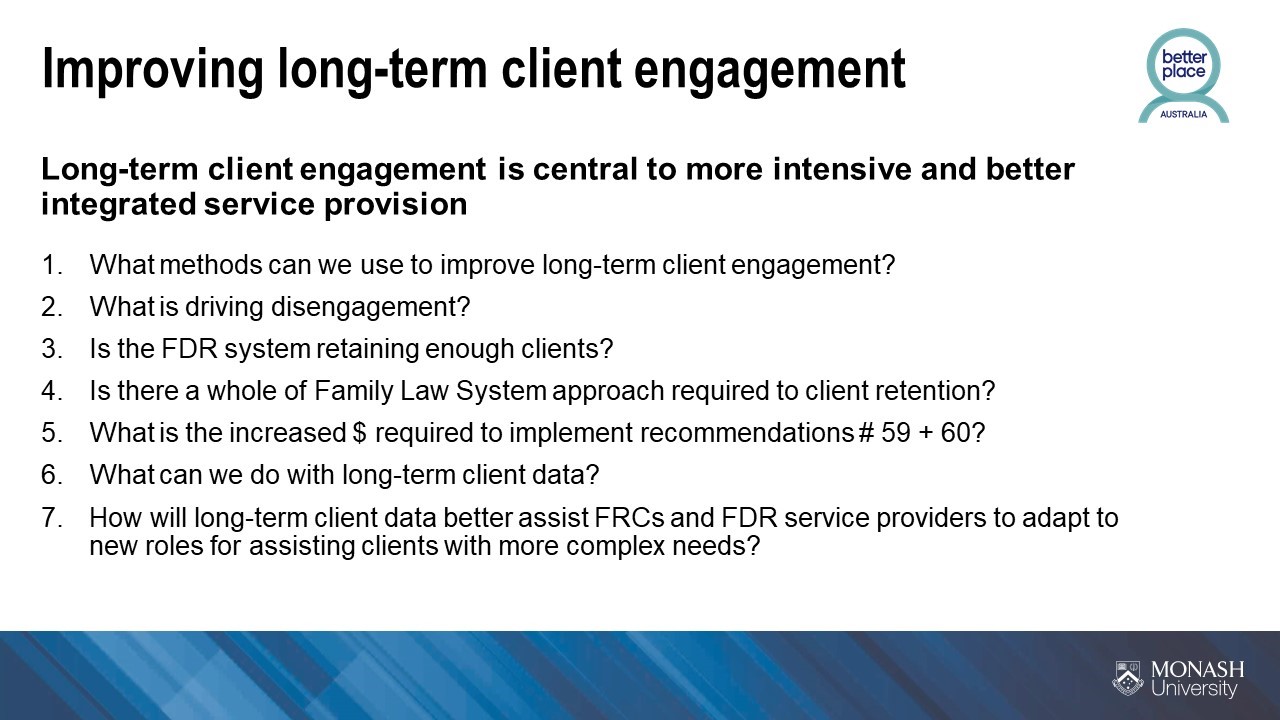
To help get you thinking, here is the final slide of our National Mediation Conference presentation, co-written with the Better Place Australia team, which stimulated a great deal of discussion at our presentation.\

BPA slides 20-19

Please comment below! We’d love to hear from you!


We are very grateful to Better Place Australia CEO Serge Sardo and the whole team there who have been such engaged and active partners in establishing, designing and recruiting participants for this research project. We are especially grateful to Graeme Westaway and Jenni Dickson from Better Place who helped prepare this National Mediation Conference presentation.

From theory to collaborative practice

hands

I was a legal academic for twenty years: teaching, researching and writing about family law and family mediation.  I have always sought to integrate theory with practice, and to inform my teaching and research with professional experience and current innovation. So, in addition to being a lawyer, I have trained and practised as a mediator, a family dispute resolution practitioner, a conflict coach and an interdisciplinary collaborative practice coach.

Interdisciplinary collaborative practice training

I thought I understood the collaborative framework and philosophy, but interdisciplinary collaborative practice training helped me better appreciate the rationale, the nuances of the process, the significance of teamwork and presence, and the value-add and roles of legal and non-legal professionals in this approach to dispute resolution. It sparked a strong interest to enrich my professional practice to include this burgeoning and important speciality.  It made me keen to develop the artistry required of an effective collaborative practitioner.

At the core of collaborative practice is commitment to enhance party self-determination through structured and staged multi-professional support and advice.  To this foundational mediation premise, collaborative practice applies current brain science to understand how separation and divorce are experienced as trauma.  This science affirms that in empathising with people who are in acute stress response, professionals walk alongside them, reduce the energy taken up by their limbic system, support them to mirror empathic behaviour and create space for the neocortex to work more effectively.

This is critical because it assists people to manage their anxiety, creates calm, enhances self-awareness and promotes the capacity for active listening. It ultimately supports considered reflection and greater capacity for understanding themself, hearing their ex partner and making informed choices.

Coaching in the five way process

One of the more recent collaborative developments is the five-way collaborative process in which in a coach is an independent and impartial facilitator and steward of the collaborative process. A coach may assess the dispute and parties for suitability, and helps the lawyers and parties to make efficient use of the process.

Coaches often manage the overall process, frame the agenda and minute meetings, as well as assist parties to prepare for the meetings and to communicate effectively. They may meet jointly or separately with each party between five-way meetings to clarify party goals, assist parties to develop strategies to regulate their emotional state, facilitate feedback from child consultants, foster parental alliance, and help the family to transition constructively through the separation.

Coaches may be mental health professionals, but in Australia they are also frequently accredited Family Dispute Resolution Practitioners, bringing mediation expertise and authority to issue family court certificates should agreement not be reached.  If appropriately trained, coaches may also bring the power of empathy to assist parties to self-regulate and to suport their capacity for empathic listening.

Coaches don’t need to be mental health professionals to do this, but do need to be aware of their professional boundaries, and to refer parties to seek psychological support or counselling if needed. The value of coaches in collaborative practice is their impartiality and their capacity to support interest-based negotiation, creatively problem solve, manage the meeting and between-meeting processes and keep the collaborative process on track.

Interdisciplinarity

Interdisciplinarity is one of the key features and advantages of contemporary collaborative practice. The support provided to parties by a multi-professional team can be invaluable and ensure informed decisions are made which have a whole-of-life and whole-of-family perspective.

A collaboratively trained financial neutral or forensic accountant can not only provide advice and options to distribute assets to meet immediate needs and just outcomes, but can do this within a longer-term perspective to address complex structuring issues, save tax and super and optimise parties’ future financial viability. Children’s specialists can also assist parents to hear their child’s experience of the separation and clarify what is in the child’s best interests.

Opportunities for lawyers

This interdisciplinarity, and especially the coach role, has the potential to decentre lawyers. But I think it actually frees lawyers to employ their expertise and advocacy to help parties achieve holistic outcomes. Whilst collaborative practice is likely to be attractive to lawyers already committed to non-adversarial and client-centred lawyering, it requires that lawyers are collaboratively trained so that they fully appreciate what teamwork requires, and what commitment to empower people to resolve their disputes jointly and collaboratively means in practice.

Because of its flexibility, collaborative practice also provides lawyers with further opportunities to reframe the process in ways consistent with protecting their client’s legal rights as well as problem solving about their needs and interests. Thus collaborative law has the potential for lawyers to contribute to reshaping the paradigms of legal practice and appropriate dispute resolution.

For many  family lawyers this is their preferred form of practice. Family law clients report the benefits of collaborative practice in easing the separation transition and supporting post separation family life.  One commented ‘my children are happy that their parents went through a non-adversarial process and they had a chance to voice their opinions to the Child Consultant and Coach’. Another reported ‘my husband and I decided we would try the process to see if we could get through our divorce amicably.  Overall this was extremely successful and I would definitely suggest that anyone going through a divorce consider the collaborative route – it is quicker, it is cheaper and it encourages the couple to remain civil despite the tense emotions that inevitably come into play during a divorce.’

Collaborative practice has enormous potential to provide multi-professional support to transition people through separation and help them make informed, child-centred and life affirming choices. Further information is available through state-wide collaborative professional networks and collaborative practice training organisations.

Also published in Collaborative Professionals (NSW) Inc Newsletter, 20 April 2018 and on Armstrongmediation.com.au blog on 11 May 2018.


Research Participants Wanted Positive post-separation parenting: What works for Australian parents?


This post is authored by Dr Kris Natalier and Dr Priscilla Dunk West, Flinders University. Priscilla and Kris study how people make sense of intimate and family relationships. This is research that we believe is important, well-conceived and worth participating in. 


Do you have a good relationship with your former partner?

We would like to hear about your experiences, to find out what works in building good relationships between separated parents.

flower heart

Photo: Nick Kenrick Creative Commons

We are interested in surveying and interviewing parents – men and women – who are 18 years or older and who have good relationships with their former partners.  We are interested in hearing about how you define ‘good relationships’ and how you build and maintain a good relationship with your former partner and other important people in your life: what works, what’s easy, what’s hard?

The study involves a survey and, if you wish two confidential, one-on-one, in-depth interviews: one where you tell us about your relationship with your former partner and one, around four months later, where you tell us if anything has changed.  We expect the interviews will last approximately one hour. We can interview you on the phone, by Skype, or if you live in Adelaide, in a place that suits you.

If you are interested in completing the survey, you can find it here.

If you are interested in being interviewed, or hearing more about the study please contact Priscilla [Priscilla.dunkwest@flinders.edu.au         08 8 8201 5288] or Kris kris.natalier@flinders.edu.au              08 8201 3391]

The study is conducted by Dr Priscilla Dunk West and Dr Kristin Natalier, researchers at Flinders University. Priscilla and Kris study how people make sense of intimate and family relationships. We are not employed by any service to conduct this study.

Taking part in this study is voluntary. Your decision to participate or not will not impact upon your access to any services or organisations.

“Safe and supported”: Developing a model for mediating family violence cases beyond family law

Dr Becky Batagol, Monash University & Professor Rachael Field, Bond University

Email contacts: Becky.Batagol@monash.edu; rfield@bond.edu.au

This post comes from work we are doing together focusing on how to appropriately identify and respond to cases of family violence in mediation practice outside the area of family law.

This is our first time working together, after many years of knowing each other (we met at the National Mediation Conference in 2000). As two feminists, we are convinced that there are ways to make dispute resolution processes safer and more supportive for the women who must use them who are also victims of family violence. The project brings together Rachael’s expertise in crafting and evaluating a model for mediating family violence cases in family law through the Coordinated Family Dispute Resolution program and Becky’s expertise in family dispute resolution and follows from her work as a consultant to the Royal Commission into Family Violence in 2015. (The views here are the views of the authors and not of their employers or organisations they have worked with previously).

Our work in this area is developing, and our thinking here is not final. We welcome your email or comment feedback. This post was developed from presentations at the 5th Annual Australian Dispute Resolution Research Network meeting in Hobart in December 2016 and at the AIJA Non-Adversarial Justice Conference, Sydney in April 2017.

tom simpson FV

Photo credit: Tom Simpson


Our aim in this project is to flesh out key elements of a safe and supported model of mediation in cases involving family violence that can be used across a range of contexts.

A great deal of attention has been paid to mediating cases of family violence in the field of family law. Outside the family law field, little attention has been paid to how to appropriately identify and respond to cases of family violence in mediation practice.

In our work together we are using what we have learned from family law dispute resolution to flesh out key elements of a safe and supported model of mediation in cases involving family violence that can be used across a range of contexts.

Beyond family law, there are a range of other contexts where dispute resolution professionals will have an ongoing role in dealing with the consequences of family violence eg

  • disputes with providers of essential services, such as electricity, water, banking and telecommunications, as a result of economic abuse
  • child protection conciliation conferences/ADR in state Children’s Courts
  • the negotiation/mediation process that takes place in finalising the conditions of family violence orders in state magistrates’ courts, and
  • restorative justice contexts as an adjunct to the criminal and family violence system

We believe that the imperatives relating to dispute resolution and family violence remain broadly similar regardless of the context. There is a legitimate concern about the use of informal dispute resolution processes in cases of family violence because of deep power imbalances between perpetrators and victims. On the other hand, with a focus on safety and with appropriate support and careful attention not to minimise the violence, there are clear potential benefits of mediation for victims of family violence which can include self-determination, certainty, reduced financial and other costs and timeliness.

We use the Coordinated Family Dispute Resolution model pilot to inform an analysis of the potentialities and possible pitfalls of the use of dispute resolution in the contexts outside family law


Context: Coordinated Family Dispute Resolution

In 2009, the Australian Federal Attorney-General’s Department commissioned a specialised model of family mediation for matters involving a history of domestic violence. The Coordinated Family Dispute Resolution model (CFDR) was piloted between 2010 and 2012 in five different locations around Australia, and evaluated by AIFS. CFDR was designed to support parties with a history of family violence to achieve safe and sustainable post-separation parenting outcomes. The model’s design sought to provide a multidisciplinary approach within a framework designed to specifically address some of the issues arising from a power imbalance resulting from a history of domestic violence. AIFS noted that the model is comprised of four case-managed phases which are implemented in ‘a multi-agency, multidisciplinary setting (which) provide a safe, non-adversarial and child-sensitive means for parents to sort out their post-separation parenting disputes’.

Eventually, funding was not provided for full roll-out of model due to political, resource and funding issues, although the fight for funding for CFDR continues.

The CFDR model was complex and multifaceted as the table below shows:

CFDR

The special features of CFDR which work together to create the potential for safe and just outcomes – and which could be integrated into the diverse dispute resolution contexts we discuss further below – include:

  1. A coordinated response

The CFDR model demonstrated that it is important to bring a range of professionals together including government and community agencies to achieve a safe process, and it is critical that these diverse agencies and professionals share information and communicate effectively with each other.

2. A focus on specialist risk assessment

A critical element of the CFDR model was the integration of specialist risk assessment across the model’s practice which maintained the safety of the participants, and particularly the victims of violence and their children, as the highest priority. The safety focus of the risk assessment process went significantly beyond the usual FDR intake screening process which predominantly assesses that the parties’ have the capacity to participate effectively in the mediation process. These specialist risk assessments were conducted only by qualified and experienced DV and men’s workers with highly developed risk assessment skills, including an ability to identify ‘predominant aggressors’ of family violence.

3. The use of a legally assisted, facilitative model of mediation

In CFDR, a facilitative, problem-solving model of mediation was practised. This was because the goal of CFDR mediation was acknowledged as being to assist the parties resolve disputes about parenting safely, rather than to have a transformative effect. The design of the model acknowledged that it is not possible – in the 3-4 hours of a mediation session to have a transformative effect on perpetrators of violence. The best way to promote the safety of victims and their children was to support the making of relatively short-term parenting decisions. Transformative changes in a perpetrators violent behaviour may be possible but require the support and expertise of professional men’s behavioural change workers.

4. Special support measures needed to respond to domestic violence in mediation

The CFDR model also featured a number of additional special measures to protect the safety of victims and children. These measures were designed to support the hearing of the parties’ voices, and enable the parties to reach post-separation parenting agreements that upheld the best interests of the children. One such special measure was the acknowledgement of the concept of a ‘predominant aggressor’ in the model

5. Listening to the child’s voice

The involvement of children in CFDR mediation was not part of the general pilot process although the model as it was developed argued for inclusion of a professional children’s worker. If the child’s voice was included in the process it was only as a result of a decision by the CFDR team of case management professionals, and after careful analysis of the safety implications of this approach. Only appropriately trained and qualified ‘children’s practitioners’ could be asked to participate in CFDR to support the hearing of the child’s voice. These practitioners were required to have extensive clinical experience working with children and family violence.

The pilot was evaluated by the highly respected researchers at the Australian Institute of Family Studies under the leadership of Dr Rae Kaspiew. A number of the evaluation findings affirmed the efficacy of the design elements of the model in terms of facilitating the safe and effective practice of family mediation where there is a history of domestic violence. For example, it was found that adequate risk assessment for the parties’ safety and well-being is critical in domestic violence contexts; preparation for the parties’ participation in the process was key; and vulnerable parties have more chance of making their voice heard in mediation in the context of lawyer-assisted models, as long as those lawyers are trained adequately in dispute resolution theory and practice. In short the report said that CFDR was ‘at the cutting edge of family law practice’ because it involved the conscious application of mediation where there had been a history of family violence, in a clinically collaborative multidisciplinary and multi-agency setting.


Context: Royal Commission into Family Violence

The work of the Victorian Royal Commission into Family Violence, has shown that an understanding of the nature of family violence and an ability to identify and respond to cases of family violence is central to the work of anyone working in law and dispute resolution in a number of diverse fields.

The Victorian government set up the Royal Commission in 2014 to examine and evaluate strategies, frameworks, policies, programs and services and establish best practice for four areas – the prevention of family violence; early intervention; support for victims of family violence, particularly for women and children; and accountability for perpetrators of family violence. The Royal Commission was also asked to investigate means of ensuring systemic responses to family violence, investigate how government agencies and community organisations can better integrate and coordinate their efforts, and make recommendations on how best to evaluate and measure the success of strategies and programs put in place to stop family violence.

On 30 March 2016, the Victorian Parliament tabled the report of the Royal Commission into Family Violence. The report represents the culmination of 13 months of work by Australia’s first ever Royal Commission into family violence.

The Royal Commission’s report contains 227 recommendations.  The Victorian government has committed to implementing all recommendations in the report, regardless of the cost. The Commission stated that its ‘recommendations are directed at improving the foundations of the current system, seizing opportunities to transform the way that we respond to family violence, and building the structures that will guide and oversee a long-term reform program that deals with all aspects of family violence’ (Summary and Recommendations, p.14).

We focus here on the recommendations which will affect the way in which a range of dispute resolution professionals will have an ongoing role in dealing with the consequences of family violence in our society.


Family violence-related debt disputes

Economic abuse is a form of family violence and is recognised as such in a few Australian jurisdictions.

The Royal Commission heard that most women who seek assistance for family violence issues leave their relationship with debt. Through the use of deception or coercion, perpetrators may avoid responsibility for a range of debts and leave their former partners with substantial liabilities (RCFV Report, Volume IV, chapter 21 p.102). This is a form of economic abuse, which is increasingly recognised as a form of family violence across the Australian jurisdictions. A recent RMIT analysis of ABS data showed that nearly 16 per cent of women surveyed had a history of economic abuse.

Women who have family violence-debt often have trouble negotiating the consequences of that debt with service providers. In their report Stepping Stones: Legal Barriers to Economic Equality After Family Violence, Women’s Legal Service Victoria noted that ‘service providers such as energy retailers, telecommunication services and banks have low awareness of the difficulties faced by women experiencing family violence and are unhelpful when interacting with these customers.’ Professor Roslyn Russell has recently shown how staff in bank branches and call centres report dealing with customers who are experiencing, trying to leave, or have left abusive relationships, yet there is limited training for banking staff on family violence.

A major proportion of Australia’s dispute resolution services are offered through industry ombudsman and complaint handling services such as the Victorian Energy and Water Ombudsman and the Commonwealth Financial Services Ombudsman and Telecommunications Industry Ombudsman. These services often use a combination of mediation, negotiation and conciliation to resolve disputes. It is clear these services are dealing with many disputes that arise with service providers as a result of family violence. Because such services are not part of the family violence system they may not have policies or training in place to identify or adequately address financial abuse and family violence.

The Royal Commission recommended that

  • the Victorian Energy and Water Ombudsman and the Commonwealth Financial Services Ombudsman and Telecommunications Ombudsman publicise the availability of their dispute-resolution processes to help victims of family violence resolve disputes (Recommendation 110)
  • comprehensive and ongoing training of customer service staff take place to help them identify customers experiencing family violence (Recommendation 109).

The Royal Commission’s recommendations are designed to develop employees’ capacity to understand, identify and respond to family violence within industry dispute resolution schemes so that victims of family violence can continue to access essential services such as household energy, water, telecommunications and financial services.


Negotiating family violence consent orders

Family Violence Intervention Orders (FVIOs) (also known as protection orders and apprehended violence orders in other jurisdictions), are orders made by the courts to protect a person from another family member who is perpetrating family violence.

There are often conditions attached to FVIOs which set out exactly what the perpetrator must do or not do in order to stop committing, and to prevent the future commission of, family violence. In Australia, FVIOs are made by state Magistrates’ courts.

The Royal Commission noted that ‘a high proportion’ of FVIOs are made by consent which means that the parties to the intervention order agree themselves to the FVIO and the conditions attached to the order which the Magistrate merely formalises (RCFV Report, Volume III, Chapter 16, p.134).

There is an incentive for perpetrators to settle orders by consent in the Victorian system because they can be made without the perpetrator admitting to any or all of the family violence allegations set out in the FVIO application.

However, for victims, there is a clear danger inherent in the negotiation process for consent orders, as described by the Commission:

‘the negotiation process involved in arriving at an order by consent may be opaque and variable depending on the situation, the parties and the presence of legal representatives. If there is a history of family violence between the parties, with everything that can entail – including an imbalance of power, fear, vulnerability, and the possibility of manipulation and coercion – it is extremely important that the negotiation process is properly managed. If the parties are not (or not adequately) legally represented, there is no guarantee that this will occur, and the result can be incomplete or inappropriate orders, whether on a primary application, a variation, extension or withdrawal, or a cross-application’ (RCFV Report, Volume III, Chapter 16, p.178).

Mediation is not formally part of the process for negotiating FVIOs in Victoria, although it is in the ACT, the only such jurisdiction in Australia to use mediation formally.

The danger of any negotiation process used to determine the terms of FVIOs is that it is the very acts of family violence that are being discussed and negotiated, and that a poor process may result in a poor order with conditions that fail to protect the victim and her children.

Because so little is known about the process for negotiating consent orders for FVIOs in Victoria, the Royal Commission adopted a cautious approach and recommended that a committee be established within the next three years to investigate how consent-based family violence intervention orders are currently negotiated and to develop a safe, supported negotiation process for victims (Recommendation 77). On this issue, the parallels to family dispute resolution are clear.


Restorative Justice and Family Violence

Restorative justice is a process which was developed from the criminal justice system which enables all parties who have a stake in an offence to come together to discuss the aftermath of the offence and implications for the future. While restorative processes have a criminal provenance, which makes them distinct from DR processes such as mediation and conciliation, the processes share in common a commitment to party empowerment and a sense that creative solutions can be found through ‘talking it out’ which would not be possible in the formal legal system.

The Royal Commission noted that while the justice system plays a fundamental role in protecting victims’ safety and promoting perpetrator accountability, that many women find the reality of the court process to be deeply dissatisfying and even re-traumatising: ‘A strong theme that emerged from consultations held by the Commission was the need for victims to understand the options available to them, and the process involved, and to be empowered to make their own decisions about what steps and outcomes are appropriate’ (RCFV Report, Volume IV, Chapter 22, p.136).

Restorative justice programs have the potential to provide family violence victims with the chance to be heard, to explain to the perpetrator what the impact of the violence has been and to be empowered to discuss future needs, including any reparations. Such a process potentially places great power in the hands of the family violence victim.

However, the same concerns can be raised about the use of restorative justice in family violence cases as there are about the use of family mediation in cases of family violence. The concerns about use of restorative justice in this context include unequal power relationships between victims and perpetrators, concerns about safety, and concerns about the appeal to apology and forgiveness which are part of the cycle of abuse in family violence.

The Commission concluded that restorative justice processes have the potential to assist victims of family violence to recover from the impact of the abuse and to mitigate the limitations of the justice system (RCFV Report, Volume IV, Chapter 22, p.143). The Commission recommended that within two years a pilot program be developed for the delivery of restorative justice options for victims of family violence which would have victims at its centre, incorporate strong safeguards, be based on international best practice, and be delivered by appropriately skilled and qualified facilitators (Recommendation 122).


Common elements of diverse family violence dispute resolution contexts?

So, what are the common elements of diverse family violence dispute resolution contexts? It is worth considering commonalities between the processes so that we can understand the nature of the dispute resolution content and process. This will better enable us to understand what elements are needed for dispute resolution processes across these diverse contexts.

We see the common elements of the diverse family violence dispute resolution processes as follows:

  1. Victim is part of dispute resolution process.

Across each of the three contexts, the victim of family violence will usually be part of the dispute resolution process. However, the victim may not be there in person (such as through resolution of disputes through ombudsman services, the dispute may be dealt with on the papers).

2. Perpetrator may or may not be part of dispute resolution process.

While the victims will be part of the process, the perpetrator may not always be there. For example, in debt disputes, the victim may be left with a debt and be unable to pay. The perpetrator may not be available or should not always be asked to explain or confirm his actions. However, in restorative justice conferences, the perpetrator may be there. In this case, safety issues must be paramount

3. Family violence may be hard to identify.

We know reporting levels of family violence are low. Matters in dispute may not initially present as a family violence matters. However, family violence may be central to matter, but extent of family violence may be hard to identify.

4. Family violence will affect how the victim will behave.

Victims of family violence are often vulnerable. The violence they have experienced will affect how they will behave in a legal or dispute resolution process.

5. Family violence is central to the nature of the dispute, the process and the outcome.


A “Safe and supported” mediation model

What then are the key elements of a safe and supported mediation process that could be used as the basis of new dispute resolution processes for cases involving family violence across a broad range of contexts? To develop these elements we draw from what we have learned in developing Coordinated Family Dispute Resolution in Australia from 2010.

We propose a “safe and supported” mediation model.

We have chosen to focus on a single dispute resolution process, mediation. Mediation is widely used. It offers flexibility and compromise between party empowerment and professional control of the process. Professional control of a process is central in cases of family violence where the risk of harm is great.

We believe that facilitative mediation is the best type of mediation in cases of family violence. A process like facilitative mediation carries with it the possibility of compromise between party autonomy and mediator control of the process necessary to provide a safe and supported negotiation process in the shadow of family violence. It also focuses on problem solving of the issue at hand, without attempting to remedy the relationship (as in transformative processes) which is arguably inappropriate in cases in family violence.

We believe that victim’s safety must always be the key priority in any dispute resolution process involving family violence. The victim’s safety must not be compromised because of her involvement in a legal process and the outcome of the negotiation must always be measured against the goal of ensuring safety for victims of family violence.

We focus on support because this is a key means of providing victims of family violence with the ability to participate in informal dispute resolution processes.


Elements of a “safe and supported” mediation process for matters involving family violence

Drawing from the CFDR model, the following are elements which we propose could be part of mediation processes involving family violence. These elements could apply across the full range of contexts mentioned above. It may be that some elements cannot be used in specific contexts. Nevertheless, dispute resolution processes for cases involving family violence should seek to implement as many of these elements as possible.

  1. That issues of safety and risk are placed at the heart of decision-making.
  2. The philosophy behind the dispute resolution process is that perpetrator accountability is a central objective of any mediation process that seeks to work effectively in contexts where there is a history of family violence.
  3. It is central that the family violence itself is not negotiated.
  4. A range of professionals must work together to achieve a safe process. It is critical that these diverse agencies and professionals share information and communicate effectively with each other.
  5. Specialist risk assessments must be conducted only by qualified and experienced family violence and men’s workers.
  6. A legally assisted, facilitative model of mediation should be employed.
  7. There must be acknowledgement of the concept of a ‘predominant aggressor’ in the dispute resolution process. This is especially important where there are cross-allegations of violence against each party, which increases the risk that tactical allegations of family violence could be used to cover up for legitimate allegations.
  8. Where perpetrators are involved in the dispute resolution process, the minimum expectation for participation in the model (and to receive its benefits such as free legal advice, counselling and other supports) is that perpetrators should have to acknowledge that family violence was an issue for their family, and that a family member believes that family violence is relevant to working out the future arrangements for the children.
  9. There must be training for dispute resolution practitioners in the nature of family violence and family violence identification

We acknowledge this this post presents the first stage in our thinking about the use of dispute resolution processes for the management or resolution of disputes beyond family law and in contexts of family violence.

More specific work needs to be done to create context and organisation-specific models of mediation which acknowledge the existence of family violence in disputes and to adequately address the needs of the parties in light of family violence.

We think that the effort that has been put into working with clients around family violence in family dispute resolution holds important lessons for those in other dispute resolution contexts.

The elements of a “safe and supported” mediation model for matters involving family violence that we propose are an important starting point in a conversation about the safety and needs of victims of family violence in our society.

Please let us know your thoughts as we continue to develop our model.

Email contacts: Becky.Batagol@monash.edu; rfield@bond.edu.au

There is a time and place for mediation but a bullying allegation in the workplace is not one

 By Carmelene Greco


This post is the final in a series of posts on this blog written by students studying Non-Adversarial Justice at the Faculty of Law at Monash University in 2016. Students were invited to write blog posts explaining various complex areas of law relating to dispute resolution to ordinary readers. The very best post on each topic is published here.


bully

Photo Credit: Dick Vos

The practice of mediation to resolve workplace bullying allegations is controversial and largely debated amongst academics. Ironically, effective resolution of such disputes is extremely important in our jurisdiction, with Australia having substantially higher rates of workplace bullying when compared to our international counterparts. This “hidden problem” requires a specialist and careful response but mediation is not it, and it may in fact make the situation worse.


Workplace bullying is notoriously difficult to define and there is still no nationally uniform definition. It has been described as “repeated, unreasonable behaviour directed towards a worker or group of workers, that creates a risk to health and safety”.  It involves an addiction to controlling others, harassment and verbal abuse and constant unjustified criticism. It is not, as accurately stated by the Fair Work Commission, “reasonable management action that’s carried out in a reasonable way”.

Mediation, which aims to be an empowering process, involves trained third parties intervening on a dispute to assist parties to make their own decisions. As stated by the National Alternative Dispute Resolution Advisory Council:

The mediator has no advisory or determinative role…but may advise on or determine the process of mediation…

Therefore, any solution is not imposed on parties but arises out of the empowerment of the parties to make it themselves.

It is important to stress that there is a lot of evidence of mediation providing an effective outcome in many cases where it helps facilitates solutions to problems that appear unsolvable. However, the key distinguishing features of mediation, which make it an attractive option in many instances, are the very reasons it is inappropriate for workplace bullying.


Comparing workplace bullying and family violence

The very nature of workplace bullying automatically suggests that mediation is an unsuited response. Workplace bullying is frequently compared to domestic violence – they are considered “almost identical twins”. In both scenarios there is an addiction to power, the controlling of another in a detrimental way and a severe power imbalance.

Mediation, and other forms of ADR, can be considered inappropriate in cases of family violence. This is exemplified by current Australian family law legislation that affords an exception to the mandate of alternative dispute resolution where there is the presence of family violence. This displays the recognition by the Australian Parliament of how a severe power imbalance can undermine the benefits of mediation.

Similarly, in the case of workplace bullying, a power imbalance and a potential ongoing relationship exists, as such the effectiveness of mediation is reduced.

Consistently, shuttle mediation may also be an ineffective solution as it can exhaust parties into premature agreement, as well as not effectively ensuring the relationship of control has ceased.

Accordingly, on the basis that mediation is not appropriate for allegations of domestic violence, it is equally unsuitable for allegations of workplace bullying. It was argued by Hadyn Olsen that:

The practice of demanding mediation as the first response to any workplace grievance (including Workplace Bullying) places our society back in the same position it was in the 60’s and 70’s in regard to domestic violence. It is an entirely inappropriate response to this problem.

In conjunction with this dynamic is the fact that there are very few options available to the target of workplace bullying. It can be that the target has already resigned, intends to resign or is still employed and wishes to remain employed. The target is likely to be placed in a position of being wedged in a toxic working environment because of their financial needs and a lack of options for alternative employment. This again places the target of workplace bullying in a particularly vulnerable position, which is unique to this category of dispute.

The defining feature of workplace bullying allegations is the power imbalance between the bully and their target, which is exacerbated if the employer is also the bully. Mediation in such conditions is likely to reinforce the dynamic and worsen the situation, as it would in the domestic violence context already discussed. Meanwhile, reaching a constructive outcome jointly between parties is the hallmark of mediation – that is it involves a compromise and a desire to settle. A bully is unlikely to have this aim but instead view the mediation as an opportunity to further manipulate the target. Furthermore, the target is likely to be further disempowered and unlikely to reach a favourable outcome because of a lack of capacity to negotiate with the bully.

Hadyn Olsen noted that he has not met any target of workplace bullying who feels mediation was fair for them but argues that instead, in most cases targets feel further abused and damaged by the process. Similarly, a representative from Northern Territory Working Women’s Centre stated that:

The imbalance of power is so profound that she is just not able to speak freely… I think it would be unsafe and really inappropriate if it required the person who was being bullied to sit face to face with the person who was bullying her….


Bullying is not and cannot be a neutral agenda item

In a typical mediation, the issue to be considered is one that both parties are equally as affected by or equally contributed to. But in the context of workplace bullying, the agenda is entirely based on the inappropriate behaviour of the bully in the workplace.

A mediator may struggle to frame this issue as an agenda item and by referring to it as a ‘relationship’ the target of the bullying may interpret this to mean the mediator does not believe the bullying occurred. At the same time, a bully would view this as a reinforcing their lack of fault. Therefore, in workplace bullying allegations the person and the issue cannot be separated and trying to frame it otherwise can be detrimental.


Mediation fails to punish past behaviour

 Mediation focuses on the present and future relationship between the parties and does not punish past behaviour. This is because it usually involves a mutually engaged in conflict. But workplace bullying is different. There is clearly one victim; one person who needs recognition of what has occurred in order to heal and move on. Dr Caponecchia stated that:

Mediation is more focused on not whether it happened or not but, ‘Let’s get back to work’, which may mean transferring someone.

Facilitators of workplace mediation argue that this is a benefit of mediation because it offers a fresh start and is about moving forward. However it is unlikely that targets of severe bullying will be looking for a fresh start and, instead, are more likely to want recognition and an apology. This is particularly the case where the target has decided to resign from their employment.


Public interest

 It may also be in the public interest for matters of workplace bullying to go to court and not to be held in a private mediation. Mediation keeps any wrongdoing outside public scrutiny or knowledge. This is not a good thing because the knowledge of the prevalence of workplace bullying is significantly restricted, which in turn, reduces the likelihood of policy being developed in response. Because of the high levels of workplace bullying in Australia, full transparency is necessitated to establish an effective response.


But does this mean mediation can never be appropriate for workplace bullying?

 It is arguable that a complete power balance between parties to a mediation is not the norm and hence it is always the role of the mediator to manage this relationship and minimise the impact of any imbalance.

Power imbalance can be managed by:

  • the use of support persons for each party (whether that be a family member or otherwise);
  • effectively communicating the rights of each parties and ensuring they are aware of these rights;
  • reality testing the options available to both parties;
  • representation by an advocate; and
  • informing the target that they have specific rights against the bullying – such as the ability to lodge a formal complaint.

If it is believed that the imbalance of power is not so severe that a mediator can effectively manage it, mediation may potentially be appropriate. However this is going to very much depend on the particular situation. It is likely that a mediator is going to be able to more effectively manage the power imbalance if intervention is early. Mediation is of no use where the target is now seeking full justice or retribution.

Consequently the suitability of mediation very much depends on the stage of escalation of the bullying. It is thought that mediation can be a helpful early intervention technique. The House of Representatives, Standing Committee on Education and Employment (2012), inquiry into workplace bullying found that several submissions supported mediation as an early intervention.  It was stated in that report that:

Mediation cannot be the panacea to workplace bullying, rather, it is an effective early intervention tool and needs to be applied on a case-by-case basis.

Moira Jenkins also supported the use of it as an early intervention model stating that:

I do not think mediation is appropriate later on when you have very damaged people, but as an early intervention I think it is great.

We should begin with the assumption that mediation is an inappropriate way of dealing with workplace bullying. Where the bully is the employer, this position will not change. In such cases, arbitration provides a more appropriate dispute resolution option as it offers the opportunity for the past wrongdoings committed by the bully to be discussed and for them to be held to accountable. This is an important process for the victim in moving on and essential to facilitate a productive working environment by focusing on past behaviour, which mediation fails to do. In addition, arbitration allows somebody in power to define what is and isn’t bullying and to avoid allegations by the bully of hypersensitivity in the victim.

Alternatively, however, if it is identified that the bullying is at the very early stages of escalation and that a mediator is able to effectively manage the existing power imbalance, mediation may then be carefully conducted. If there is any doubt, it is in the best interest of the general public and of the target, that mediation is avoided as a means of managing allegations of workplace bullying.

A consequence of this protection of the victim of workplace bullying may be, unfortunately, that their access to justice is reduced to some extent. However, this is, in many circumstances, a necessary concession. Additionally, the availability of arbitration, which is not an overly expensive option for litigants, ensures that justice is not inaccessible.


Carmelene Greco completed a Law/Arts degree, with a major in journalism, at Monash University in 2016. She is now a graduate lawyer at King & Wood Mallesons and has a keen interest in exploring alternative dispute resolution prospects within the commercial law context.