The ADR Research Network is a group of Australian dispute resolution academics. Blogging & tweeting high quality, critical dispute resolution scholarship.
I am pleased to announce the details of the 14th Australian Dispute Resolution Research Network roundtable. It will be held at RMIT University on the 18th and 19th November 2026 at our city campus. Thanks again for the hard work of the organizers for the 13th roundtable which was a big success!
RMIT last hosted our community of ADR scholars in 2014, and after many years, I am so pleased to have the opportunity to again host ADR researchers. In 2012, Professor Rachael Field and I co-organized an important ADR forum at RMIT where we welcomed presentations relating to ADR in Legal Education and Promoting Student Well-Being (see attached agenda). While of course supporting all current ADR research for our 2026 gathering, I would like to devote a section of the roundtable (an afternoon) to the evolving story of ADR in Legal Education. Current links between ADR and Student Well-Being would also be valuable to explore.
Please book a placeholder in your diaries for our annual event.
The Australasian Dispute Resolution Research Network is pleased to be hosting its 13th research roundtable on 27-28 November 2025 at Monash University Clayton campus, Melbourne. The roundtable is supported by the Faculty of Law at Monash University and the Australian Centre for Justice Innovation.
We are accepting paper proposal’s for the Roundtable. We welcome proposals that consider dispute resolution from a scholarly, critical and/or empirical perspective. Topics can be addressed for any disciplinary perspective and we are especially interested in interdisciplinary approaches to dispute resolution. We particularly encourage submissions from postgraduate students and early career researchers. All proposals will be considered. Papers must not have been published or submitted for publication, as the focus is work in progress.
John, taking a break from writing at the University of Newcastle in March 2020
It is with sadness that our community honours the passing of Dr John Woodward on 5 February.
John was a trusted colleague, a dedicated member of this Network, a solicitor who spent almost 30 years in litigation practice, a mediator, an arbitrator, and a member of the Law Society of NSW ADR Committee. He was also so much more than his career achievements, a man who spoke lovingly of his family, an artist, avid tennis player and a friend to so many. One of John’s greatest contributions to the world of ADR was his time spent teaching students in the legal clinic and in civil procedure. His encyclopaedic knowledge of litigation allowed him to speak with an authority on why cultural change in the legal profession is essential, and students listened to what he had to say.
Litigation had been the cornerstone of most of John’s career, and his experience eventually led him to become a keen observer of litigation’s shortcomings. Here is how John explained his ‘conversion’ from hard-nosed litigator to a strong believer in the power of mediation and “the vision of a broader view of justice“:
“[My conclusion was] after thirty years of legal practice as a commercial litigator, that the solutions being offered to litigants by the traditional justice system were somewhat less than ideal. Clients were complaining that the court could not offer the relief they were seeking, the costs of “winning” were prohibitively high and most of the cases in which I was instructed were resolved on some basis well before they reached a hearing.
Try as I might, I could never quite be convinced of the claim that the public interest in having the courts “…explicate and give force to the values embodied in authoritative texts…” (1) or otherwise declare the law for the benefit of the public good, had any real relevance to some of the mundane and routine cases in which I was involved. In fact, of all of the hundreds of cases in which I acted throughout my career as a lawyer, only two found their way into the law reports.” 1
After graduating with a Masters in Dispute Resolution from UNSW, John decided to commence his PhD, as he felt that regulators had made certain assumptions about the legal change that had been brought about by civil procedure rules mandating mediation. The topic resonated well with one of John’s favourite quotes:
“How small, of all that human hearts endure,that part which laws or kings can cause or cure.”
You can read an earlier profile of John and his PhD work in this blog post from 2016. He graduated in 2019, with his dissertation modestly entitled “Lawyer approaches to Court-Connected Mediation: A New Case Study,” and this is available free open access through SSRN. The key finding of John’s PhD research, based on a large set of qualitative data, was that lawyers are keenly aware of their ethical obligations towards their clients in terms of protecting them, but that this gave rise to a reluctance to have clients directly participating in the mediation process. He also identified that the profession remains generally confused about the extend of confidentiality in mediation, and that this further inhibits lawyers from engaging fully in the mediation process. Finally, he noted that there were still cultural barriers within the profession, stemming at least in part from the limits of most models of legal education.
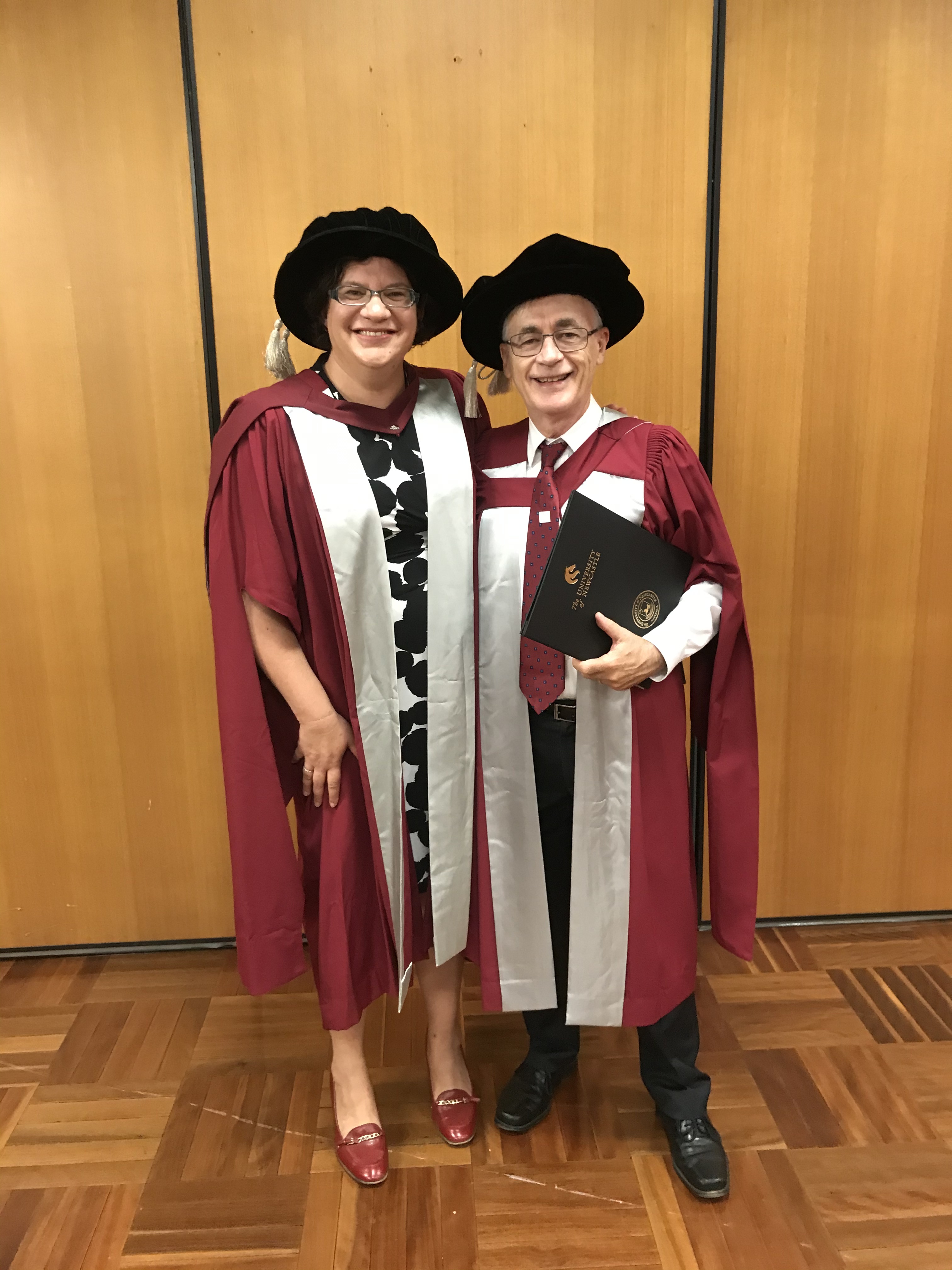
John had a fight on his hands after being diagnosed with an aggressive glioblastoma in mid-2023, and he faced that fight with his usual sense of humour and determination, exceeding the dire predictions of his life expectancy but cautioning me regularly with a grin, “don’t buy me any green bananas.” I had the privilege of supervising John’s PhD thesis at UNSW and then at the University of Newcastle, and as the decade passed, we built a friendship based on a passion for ADR (and also for coffee) that transcended the difference in our life stages.
Thank you John for all you taught us, for the future generation of lawyers you helped educate, and for showing us all the power of change to make the world a better place. Ave atque Vale (hail and farewell).
At the 13th ADR Research Network Roundtable in November, we will hold a session in John’s honour. If you’d like to be involved, please contact me or respond to the call for papers.
Quote from John’s 2018 blog post about his PhD journey ↩︎
The Faculty of Law, Monash University is proud to host the 13th Australian Dispute Resolution Research Network Roundtable on Thursday 27 and Friday 28 November 2025 at the Monash University Clayton Campus (approx. 30 minutes from Melbourne CBD). There are many public transport options to Monash from inner city Melbourne and we will share details for attendees from afar.
The Roundtable is an opportunity to present work in progress and receive feedback and critique in a supportive and friendly environment, and to network with leading dispute resolution academics. We have honed our format over the years and will adopt the following approach:
a focus on work in progress (ie, it’s not a conference, but a collaborative workshop around a table of supportive peers)
a limited number of papers selected for in-depth discussion
there is at least one appointed commentator for each paper
attendance is limited to people who are presenting or commentating upon papers
full papers must be submitted for distribution one month prior to the roundtable
publication of a blog post based upon the paper is expected for all presenters
Anyone working in civil justice and any form of dispute resolution including mediation, conciliation, negotiation and arbitration is encouraged to attend. Scholars from outside Australia are also welcome to attend.
Early Career Researchers and PhD students are particularly encouraged to participate. We are a kind and supportive group of scholars and are very welcoming of newcomers.
The call for papers will be released in June or July.
Queries can be directed to the convenor and co-President of the ADRRN: Becky Batagol (Monash University) Becky.Batagol@monash.edu.
Many of you may already be subscribed and are familiar with this Australian Dispute Resolution Research Network Blog. For those newcomers, this is a place where us practitioners, professionals, researchers, academics and students alike can collaborate and share our ideas on all things relating to dispute resolution, ideas of which, reach over17,000 individuals per year and has over25,000 hits.
The LinkedIn discussion group is a relatively new forum which has been created to provide us all a space to continue discussing our ideas and thoughts as well as to gain a further reach to those who may not be subscribed to this Blog. The discussion group is much like a ‘town hall’ rather than an official publishing forum. It is a place where you may speak freely of your ideas and thoughts relating to the topics of concern, but we ask kindly that you do not promote your commercial practices in law or dispute resolution and that you credit any authors where relevant. The discussion group follows the same guidelines here on our Blog.
To view or join the LinkedIn discussion group, you will be required to create or sign in to your LinkedIn account. For those who may not be familiar with LinkedIn, it is a social platform that is designed to connect professionals and peers to network and develop career opportunities. It is a great platform for practitioners, academics, and researchers to keep up to date with developments in their field as well as students and newly established professionals to get a running-start to their career.
Following the publishing of an article on this Blog, we encourage authors to post something brief in the LinkedIn discussion group. This allows a further reach to readers who may not be subscribed to this Blog. Some things to consider including in your LinkedIn post are relevant hashtags, appropriate emojis, and of course, the link to your blog!
For enquires, more information, or if you are interested in publishing an article on our Blog, please contact our Editors in Chief, Sam Houssain and Milan A. Nitopi.
In a recent post, I highlighted several textbooks that had been published by the ADR Research Network in 2014. This post is a quick summary of some of the journal articles produced by the network in 2014.
Jonathan Crowe, ‘Ethics and the Mediation Community’ (2015) 26 Australasian Dispute Resolution Journal 20.
Katherine Curnow, ‘Information, power and relationships: Minimising barriers to access to justice for end of life disputes’ (2014) 23(3) Australasian Dispute Resolution Journal 137.
Kathy Douglas and Claire Coburn, ‘Attitude and Response to Emotion in Dispute Resolution: The Experience of Mediators’ (2014) 16 Flinders Law Journal 111.
Susan Douglas and Kathy Douglas, ‘Re-imagining legal education: mediation and the concept of neutrality’ (2014) 7 Journal of the Australasian Law Teachers Association 1.
Stephanie Duffy and James Duffy, ‘An analysis of dispute review boards and settlement mediation as used in the Australian construction industry’ (2014) 30(3) Building and Construction Law Journal 165.
James Duffy and Rachael Field (2014) ‘Why ADR must be a mandatory subject in the law degree : A cheat sheet for the willing and a primer for the non-believer’ (2014) 25(1) Australasian Dispute Resolution Journal 9.
Mary Anne Noone and Lola Akin Ojelabi, ‘Ethical Challenges for Mediators Around the Globe – an Australian perspective’ (2014) 45 Washington University Journal of Law and Policy 145.
Lola Akin Ojelabi, “Dispute Resolution and the Demonisation of Culture” (2014) 25(1) Australasian Dispute Resolution Journal 30.






 The Australian Dispute Resolution Research Network