The IOMed Convention: How It Could Redefine Cross-Border Mediation

By Akshat Garg
This article has been republished with permission. The original publication can be found at Kluwer Mediation Blog.

On 30 May 2025, the global dispute resolution landscape quietly shifted. In Hong Kong SAR, 33 countries signed the Convention on the Establishment of the International Organization for Mediation (“IOMed”), the world’s first intergovernmental body dedicated solely to mediation.

More than 400 representatives from 85 countries and 20 international and regional organizations gathered for the signing. The Convention entered into force on 29 August 2025. At its inaugural meeting held on 20 October 2025, the Governing Council authorised the commencement of operations with effect from the same date. On paper, it appears to be just another treaty. In practice, however, it could reshape how governments, businesses, and individuals resolve some of the world’s most complex disputes.

Why does this matter now? For decades, mediation has lived in the shadow of arbitration and litigation, praised for its flexibility but lacking the institutional backbone to rival them. The IOMed could change this.

Mediation Steps Out of the Shadows

Mediation has always promised something courts and arbitral tribunals cannot: outcomes that preserve relationships rather than destroy them. While mediation had received treaty recognition through the ICSID Convention, restricted to investor-state conciliation, and the Singapore Convention, which addressed the enforcement of mediated settlements, no dedicated intergovernmental framework existed.

The IOMed Convention addresses this gap, institutionalising mediation itself as a treaty-based mechanism for resolving international disputes. It creates a permanent organization with legal personality, a governing council of states, and leadership roles open only to nationals of contracting states. In other words, mediation now has a seat at the table of international law.

How the IOMed Has Made Itself Unique

The IOMed is not a vague promise; it has teeth. The Convention envisages two separate panels of mediators: one for State-to-State disputes and another for disputes involving States and private parties, including commercial disputes. This matters because mediation in international politics requires a different skillset than mediation in business contracts. The Convention acknowledges this nuance, demanding that State-to-State mediators bring not only legal knowledge but also diplomatic judgment and geopolitical experience.

Consent remains its bedrock. No State can be dragged into a mediation without agreeing, and countries can expressly exclude sensitive disputes such as sovereignty or maritime boundaries from the IOMed’s purview. Far from weakening the system, these safeguards are likely to make the Convention more attractive to States.

The Convention takes an important step toward building global trust in mediation. By granting immunity to mediators and participants from arrest, detention, or legal action for what’s said or disclosed in mediation, it protects the process from fear or interference. This isn’t just a legal safeguard; it’s a confidence-building move that encourages openness and integrity. It may be an early step, but it’s a bold one, showing IOMed’s intent to make mediation a safer, more credible space for resolving disputes.

What makes the IOMed particularly intriguing is its accessibility. It may also provide mediation for non-contracting states or international organizations, should they wish to submit their disputes, subject to the rules adopted by the Governing Council of the IOMed. Such inclusivity could allow the IOMed to become a hub for dialogue at a time when global cooperation often feels gridlocked. It is not a court, and it will not hand down binding decisions unless parties agree. Instead, it offers a structured, principled, and confidential process for parties to craft their own solutions – as is the inherent asset of mediation – with the legitimacy of an international institution behind it.

The Quiet Gaps in the Convention

The IOMed Convention opens the door for the mediation of “international commercial disputes,” but it stops short of defining exactly what that means. It simply provides that the Organization will offer mediation services for disputes arising out of or related to international commercial relationships between private parties, subject to conditions set by the Governing Council. In practice, how the Council chooses to interpret and apply these provisions will play a crucial role in shaping the Convention’s real-world impact.

The Convention also leaves it to the parties to agree on suspending the limitation period during mediation as per applicable laws, a provision that realistically, is unlikely to see easy consensus, and to agree on whether mediation can run alongside other dispute resolution proceedings. Such flexibility, while well-intentioned, could lead to uncertainty and uneven outcomes, especially in cross-border disputes where different legal systems come into play.

When it comes to enforcement, the Convention provides that settlement agreements arising from international commercial disputes may be enforced by the contracting states, who should agree on a protocol specifying the conditions of enforcing such settlement agreements. Notably, it says nothing about the enforcement of state-to-state settlement agreements, leaving a notable gap in the framework for intergovernmental disputes.

The Governing Council also carries significant responsibilities, including adopting the rules of procedure for mediation, maintaining mediator panels, and approving the Secretariat’s capacity-building and fellowship programs. The success and credibility of IOMed will hinge on how actively and thoughtfully the Council pursues these tasks.

A Space Created for Everyone

At a time when arbitration often feels prohibitively expensive or adversarial, the IOMed offers something different: a forum designed to de-escalate, not inflame.

For businesses engaged in cross-border trade, this means a credible path to settle disputes without burning bridges.

For States, it offers a way to manage conflicts without locking themselves into binding rulings that might be politically impossible to implement.

For professionals, lawyers, mediators, and policy advisors, it signals an emerging market for a new breed of expertise: not just legal knowledge, but skills in negotiation, psychology, cross-cultural communication, and strategic problem-solving.

When the World Trade Organization was created, it reshaped trade. When the International Criminal Court was launched, it changed how we view accountability. The IOMed may not have the same headline-grabbing impact, but time will tell whether it redefines how conflicts are prevented, managed, and resolved across borders.

Mediation as the Primary Strategy, Not a Soft Alternative

As of 20 October 2025, only eight countries – China, Nicaragua, Venezuela, Congo, Kiribati, Pakistan, Kenya, and Dominica – have ratified the Convention. Major hubs like Europe, India, and Singapore are notably absent, reflecting a cautious approach. This hesitation likely stems from concerns over enforcement and procedural gaps left to the Governing Council.

Like all new institutions, the IOMed will need trust, early successes, and a generation of professionals ready to champion it. If mediation is to mature into a global institution, practitioners and policymakers will need to take it seriously, not as a “softer” option, but as a strategic one.

That is the challenge and opportunity: to ensure that this new framework is not just another treaty on paper, but a living mechanism that reshapes how the world deals with conflict. Whether you are a lawyer, business leader, diplomat, or student of international affairs, the message is clear: mediation is no longer an afterthought. With the IOMed, it could become the default.

Author Biography

Akshat Garg is an Advocate of the Supreme Court of India and an IMI-qualified mediator, blending legal practice with a global perspective on dispute resolution. Educated at Lloyd Law College, India, he has contributed to cross-border agreements, institutional and ad-hoc arbitration, and regulatory advisory, emphasising practical solutions, procedural clarity, and strategic insight. Beyond practice, Akshat coaches and judges international ADR competitions, leads initiatives to build capacity in emerging markets, and develops frameworks to enhance efficiency and accessibility. Committed to bridging law, policy, and industry, he works to advance global arbitration and mediation with purpose and lasting impact.

When Apologies Don’t Come: Understanding and Managing Refusal to Apologise in Mediation

By Dr Samantha Hardy and Dr Judith Rafferty
This article has been republished (with minor amendments) with permission. The original publication can be found at The Conflict Management Academy.

Apologies can be transformative. A genuine “I’m sorry” has the potential to mend trust, restore dignity, and signal a willingness to move forward. Yet in practice, many mediators have sat through sessions where one party waits, sometimes desperately, for an apology that never arrives. The other party’s refusal to apologise can stall dialogue, harden positions, and frustrate attempts at resolution.

This post explores the dynamics at play when apologies are withheld. We will look at why people seek apologies, why others resist offering them, what options exist when an apology never comes, and how mediators can manage this fraught terrain.

1. Why someone might want to receive an apology

An apology might meet different needs for the receiver:

  • It might provide recognition of the impact of the other’s actions on the receiver. It might validate the receiver’s pain and suffering.
  • It might confirm that what happened was “wrong”, providing a sense of justice to the receiver.
  • It might restore a sense of power or control to the receiver. An apology can restore autonomy by giving them the power to accept, reject, or withhold forgiveness.
  • It might reaffirm shared values and expectations around behaviour. An apology communicates renewed consensus around those values, reinforcing the idea that both parties agree on what is acceptable behaviour in the future.
  • High-quality apologies can also reduce anger, increase empathy, and foster willingness to reconcile. This is particularly important in ongoing relationships such as workplaces, families, or communities.

2. Why someone might not want to apologise

If apologies are so powerful, why would someone refuse to offer one? The psychology is complex. Research has identified several barriers and motivations:

They don’t feel like they’ve done anything wrong

Many equate an apology with an admission of guilt. For those convinced they acted correctly, an apology can quickly feel exaggerated or unjustified.

Fear of consequences

Some worry that an apology will be interpreted as an admission of guilt, exposing them to criticism, sanctions, or even legal liability.

Protecting self-esteem

Apologising can feel like a loss of face, signalling that your standing is diminished in front of the other person. For those with fragile self-esteem, the psychological discomfort may be too great. Karina Schumann’s work highlights “perceived threat to self-image” as one of the strongest barriers to apologising.

Concerns about power and control

Okimoto, Wenzel, and Hedrick (2013) found that refusing to apologise can actually increase a person’s self-esteem by enhancing feelings of power and value integrity. By withholding an apology, people may feel they retain dominance and control.

Low concern for the relationship

Some simply do not value the relationship enough to invest in the discomfort of apologising. Low empathy, extreme self-interest, or avoidance of closeness can all reduce the likelihood of apology.

Perceived ineffectiveness of apology

Even when someone recognises that they caused harm, they may doubt whether apologising will help. They might expect rejection or believe the other person will not forgive them anyway.

Defensive fragility mistaken for strength

As psychologist Guy Winch notes, people who cannot apologise often appear tough, but their refusal usually reflects deep vulnerability and fragile self-worth.

They have already apologised

Sometimes people refuse to apologise in a mediation because they have already apologised (one or more times) and it hasn’t made any difference.

They don’t want it to be a trigger

Occasionally an apology can act as a trigger, reminding people of the circumstances and hurt of the past. Some people wish to avoid that and just “move on”, leaving the past behind.

3. What to do when someone refuses to apologise

In many mediations, a party may openly state that they want an apology. When it does not come, the process risks collapsing into impasse.

For mediators, it is important to see refusal not simply as obstinacy but as a defensive strategy rooted in self-protection, power, or relational disengagement.

Here are some strategies for mediators to help parties navigate this reality.

Manage expectations early

At the start of the mediation, clarify that apologies may or may not occur. This helps prevent disappointment later if one party was anticipating an apology as the main outcome. Mediators can also normalise the difficulty of apologising. Mediators can gently explain that apologising is psychologically hard for many people. This can reduce personalisation of the refusal.

Attend to power dynamics

Because apologies carry symbolic weight around power and control , mediators should be alert to how apology refusal may entrench dominance. They may need to balance this by giving the other party more voice or decision-making space.

Explore the interests underlying both the request for an apology and the refusal to give one

Ask the person who wants the apology to give an example of the kind of apology they would ideally like to receive, and explain the impact it would have on them.  Often, the need is for recognition, respect, or validation rather than the exact words “I’m sorry.” Mediators can help the party articulate what they hope to gain and explore other ways of meeting those needs.

Non-judgementally, ask the person who refuses to apologise to describe their reasoning. Listen for some of the reasons outlined above, and direct your interventions to exploring and responding to those needs.

These questions are probably best asked in private sessions so that parties have a safe space to be vulnerable.  From their answers, you may be able to identify what needs the apology (and not apologising) would meet and then work to brainstorm different ways to meet those needs.

Refocus the discussion to intent and impact

Supporting parties in mediation to clarify intent and impact can help address misunderstandings which may make the desire for apologies and the apology itself obsolete. Of course, clarifying intent and impact can also help people who weren’t aware of any wrongdoing gain awareness that their actions, even if meant/ intended otherwise, caused harm for the other and may thus increase the other’s desire and the actor’s awareness for a need for an apology. Apologising for something that had a different impact to what was intended could also be “easier” in the sense that it may be less threatening to self-image – after all, the actor had not had any intentions, but misunderstandings (external factors) may have led to the misperception of harm.

Support vulnerability and self-esteem

Support the person who does not want to apologise to explore ways of being vulnerable while still maintaining safety and self-esteem.

Mediators can help parties to identify substitute behaviours.

Sometimes, non-apologisers express contrition indirectly: by being extra kind, cooperative, or attentive after the fact. Mediators can help parties notice these gestures as alternative forms of repair.

Sometimes parties resist the word “apology” but are willing to express regret or acknowledge impact. Mediators can explore softer or alternative language that validates the other person without requiring full admission of fault.

Explore ways of meeting the requesting party’s needs by framing things in different ways that may or may not look exactly like an apology.

Importantly, mediators need not overemphasise hearing the words “I’m sorry.” Expressions of genuine remorse, awareness of impact, or acknowledgement of harm can often meet the deeper needs more effectively than the word itself.

Elicit reflection on meaning of apology

In private session, mediators can ask the person refusing to apologise: “What would it mean for the other party to hear you apologise?” This question does not pressure them to apologise, but it can prompt reflection on the potential value of an apology for the other person. At times, this reflection has opened space for an apology to emerge.

Use reframing techniques

If a party expresses their refusal bluntly (“I’m not going to apologise”), mediators can reframe this as an attempt to hold onto integrity or avoid insincerity. This can de-escalate defensiveness and allow conversation to continue.

Reality test

Ask the person who does not want to apologise what they potentially stand to lose and gain from apologising.

Ask the person who wants the apology what their choices are if they don’t receive it.

Invite reflection on choice

Mediators may also be able to encourage acceptance without agreement. Radical acceptance helps individuals acknowledge painful realities without condoning them. For example, someone may not receive an apology but can still choose to accept the situation and move forward with their values intact.

When a party faces the absence of apology, mediators can help them consider whether to persist in the relationship, renegotiate boundaries, or disengage altogether. As one writer put it: “Life becomes easier when you learn to accept an apology you never got”.

Invite mutual apologies

I also feel we should talk about situations where both parties are requesting an apology from each other and how that can create additional impasse or help the situation, since it balances the “power” a little.

Facilitate mutual checking for understanding

Invite each party to check that they have understood the other, including naming what was most difficult or hurtful in the conflict. Then ask the original speaker to confirm – “Did she/he get that right?” This creates a moment of empathy and can soften defensiveness. It also lays the groundwork for acknowledgement by ensuring that each person feels genuinely heard.

Shift the focus to future arrangements

If apology is not forthcoming, help parties reorient toward practical agreements. What changes in behaviour, communication, or boundaries could rebuild trust without requiring an explicit apology?

Support emotional closure without apology

Through reflective listening, summarising impacts, and validating emotions, mediators can help parties feel heard even in the absence of an apology. This may provide enough recognition to allow agreements to move forward. Research suggests there can be significant psychological benefits in choosing to let go of anger and resentment without an apology – including in situations where extreme harm has been suffered – showing how this approach can strengthen resilience. Recognising this possibility may open space for parties to consider new pathways to closure.

Conclusion

Refusal to apologise is one of the thorniest issues mediators can encounter. For the person harmed, it can feel like justice denied. For the person refusing, it can feel like self-preservation. And for the mediator, it can feel like an immovable barrier.

Yet by understanding the psychological underpinnings, mediators can reframe the impasse. People seek apologies for validation, dignity, and reaffirmation of values. People withhold apologies to protect self-image, preserve power, or because they doubt its effectiveness. When apologies do not come, parties can still find closure through acceptance, alternative forms of recognition, and practical agreements.

For mediators, the task is not to extract apologies but to help parties understand and meet underlying needs. With skill, patience, and creativity, even the absence of “I’m sorry” can become the starting point for resolution.

Reminder: Registration and Call for Papers for Australian Dispute Resolution Research Network Roundtable 

The Australasian Dispute Resolution Research Network is pleased to be hosting its 13th research roundtable on 27-28 November 2025 at Monash University Clayton campus, Melbourne. The roundtable is supported by the Faculty of Law at Monash University and the Australian Centre for Justice Innovation.

We are accepting paper proposal’s for the Roundtable. We welcome proposals that consider dispute resolution from a scholarly, critical and/or empirical perspective. Topics can be addressed for any disciplinary perspective and we are especially interested in interdisciplinary approaches to dispute resolution. We particularly encourage submissions from postgraduate students and early career researchers. All proposals will be considered. Papers must not have been published or submitted for publication, as the focus is work in progress.

Participation is on a self-funded basis.

Submit papers at this weblink: https://forms.gle/sNfifQPx8TrJG8cD9

A programme of events will be distributed in advance.

Please do not hesitate to come back to us for any further questions you may have, email to: adrresearchnetwork@gmail.com

We look forward to seeing you at the Roundtable.

Navigating the Grey Zones: A Practical Guide to Ethical Decision-Making for Mediators

Samantha Hardy
This article has been republished with permission. The original publication can be found at The Conflict Management Academy.

The Conflict Management Academy has been running “The Mediator’s Dilemma Series” events this year, in which mediators explore a challenging hypothetical and discuss how they would deal with the dilemmas at various stages of the process. These events have been well attended and the discussions enlightening (and sometimes heated!) but what struck me after having reviewed the sessions so far is that the ethical decision making process used by participants was, well to be frank, rather ad hoc.

When mediators talk about ethics, the conversation often centres on principles we all know well:  impartiality, confidentiality, and self-determination. But knowing the principles is not the same as knowing what to do when those principles collide. Real-life mediation can place us in grey zones where personal values, professional obligations, and competing priorities pull us in different directions.

In those moments, gut instinct is rarely enough. It’s worth asking: how do we make ethical choices in a way that is both principled and defensible?

Ethics and ethical dilemmas

Ethics is the process of questioning, discovering, and defending our values, principles, and purpose (The Ethics Centre). In mediation, ethical questions arise when two or more principles we hold dearly seem to conflict creating an ethical dilemma. This might be as simple as a clash between our personal sense of fairness and our professional obligation to respect parties’ self-determination.

Ethical dilemmas are not just theoretical. They appear in intake interviews, joint sessions, private caucuses, and even after a mediation has concluded. They can be subtle, like sensing one party is being unduly influenced, or dramatic, like discovering information that could prevent harm to someone outside the mediation.

Personal and Professional Ethics

Many mediators underestimate the role of personal ethics in their professional life. Personal ethics are shaped by upbringing, culture, religion, and life experience, and they inevitably influence how we perceive conflicts and decisions.

For example, imagine being strongly pro-euthanasia, and being asked to mediate a dispute about whether someone should be able to access it. You might be able to set aside your views and remain impartial. Or you might find your values so engaged that you cannot mediate without bias or at least without the appearance of bias.

Professional ethics overlay our personal values. In Australia, mediators might refer to the AMDRAS Code of Ethics, the International Mediation Institute’s Code of Professional Conduct, or for lawyer-mediators the Law Council of Australia’s guidelines. These frameworks outline key principles, but they don’t tell us what to do in complex, context-specific dilemmas. They also don’t rank principles or explain how to decide when they are in tension.

Where Our Professional Ethics Come From

Professional ethics in mediation draw from multiple sources:

  • Codes of conduct issued by professional bodies (AMDRAS, IMI, etc.).
  • Legislation (e.g. family law provisions prioritising child welfare, or mandatory reporting laws).
  • Court cases that discuss ethical aspects of mediator conduct.
  • Academic scholarship that analyses ethical principles and categorises dilemmas.

Because no single document covers everything, mediators need a working knowledge of multiple sources and the ability to interpret them in light of the case at hand.

Ethics of mediation

Various academics and practitioners have tried to produce lists of ethical principles for mediators.  There are examples in the reading list below.

In my opinion, one of the most practical tools comes from Robert Baruch Bush, whose research in 1994 identified nine common categories (with numerous examples under each category) of ethical dilemmas mediators face:

  1. Keeping within competency – avoiding work beyond your skill or qualification.
  2. Preserving impartiality – managing bias or perceived bias.
  3. Maintaining confidentiality – between parties and with outsiders.
  4. Ensuring informed consent – avoiding coercion, ensuring understanding.
  5. Preserving self-determination / non-directiveness – resisting the urge to impose solutions.
  6. Separating mediation from counselling or legal advice – knowing the boundaries.
  7. Avoiding exposure to harm – preventing physical, emotional, or legal harm.
  8. Preventing misuse of the process – deterring fishing expeditions, stalling tactics, or intimidation.
  9. Handling conflicts of interest – both actual and perceived.

Here’s a handy infographic that summarises Bush’s categories for easy reference:

But what should we actually do?

While codes and guidelines identify principles, they rarely tell you how to make a decision when those principles conflict. For example:

  • Is self-determination more important than informed consent?
  • When does preventing harm justify breaching confidentiality?
  • How should context, cultural norms, relationships, situational risks influence our choices?

Without a process, mediators risk falling back on ad hoc decisions, which are likely to be less well informed and harder to justify if challenged.

An Eight-Step Process for Ethical Decision-Making

The following approach has been adapted from social work and refined for mediation (originally by my colleague Olivia Rundle and I in an early article). It gives mediators a clear structure for navigating ethical dilemmas, with 8 steps (set out with more detail in the infographic below):

  1. Clarify the dilemma
  2. Identify stakeholders
  3. Indentify applicable ethical principles
  4. Consider context
  5. Generate options
  6. Evaluate options
  7. Implement
  8. Reflect

Common Options in Response to a Dilemma

While the “right” choice depends on the situation, mediators often consider options such as:

  • Doing nothing (rarely ideal, but sometimes appropriate).
  • Reality-testing with the parties.
  • Taking a break to seek advice from a mentor or colleague.
  • Disclosing the dilemma to one or both parties.
  • Withdrawing from the mediation.
  • Reporting to relevant authorities or taking protective action.

There are many more possibilities depending on the dilemma, the stage of the mediation, and the particular circumstances. It’s important that, like we ask our mediation clients to do in mediation, we generate as many options as possible, evaluate them and then create a specific action plan. 

This is another thing I have noticed working with students in mediation training – they tend to come up with one option and work to justify it, rather than thinking about multiple and lateral options and then evaluating them. 

Also, they tend to come up with an action plan (e.g. report to the authorities) that is vague and incomplete.  For example, to whom will they report?  What will they say?  Will they identify themselves?  Will they share this decision with their parties?). In hypothetical activities we can be vague with no consequences, but in the real world we must act quickly and precisely. The more we practice precision in our hypothetical scenarios, the more we will be prepared in the event we face a dilemma in our practice.

Consequences of Acting Unethically

Potential outcomes include:

  • Legal liability – rare, but possible if conduct breaches laws.
  • Harm to parties or others – physical, emotional, financial.
  • Complaints and sanctions from professional bodies.
  • Damage to reputation – to the individual and the profession in general.
  • Missed opportunities for learning if we don’t reflect and share experiences.

In reality many unethical actions go unchallenged, but that doesn’t make them harmless. The absence of consequences is not the same as the presence of integrity.

Why Practice Matters

Trying to work through these eight steps in the heat of a mediation can be difficult. That’s why it’s valuable to rehearse using hypothetical scenarios (the mediation equivalent of a fire drill)! Practising with such scenarios in training, supervision, or reflective practice groups builds your repertoire of responses and your confidence in applying them.

Building an Ethical Culture in Mediation

Ethical competence isn’t just an individual skill. It’s a cultural norm we build together. By talking openly (within confidentiality limits) about ethical challenges, we normalise the idea that dilemmas are part of practice, not a sign of failure. We also expand our collective “library” of ways to handle them.

That might mean:

  • Incorporating ethical decision-making practice into professional development.
  • Participating in reflective practice groups or “mediator’s dilemma” forums.
  • Sharing anonymised case studies in articles, webinars, or conferences.
  • Encouraging a mindset of curiosity and humility, rather than certainty.

Ethics in mediation is rarely about black-and-white rules. It’s about learning to navigate the grey zones with care, courage, and a willingness to be accountable for our choices. With a clear process, a solid grounding in principles, and regular practice, mediators can face ethical challenges with confidence and model the integrity that gives our profession its credibility.

But it can be difficult to navigate this grey area. What happens when mediation meets mystery, debate, and high-stakes decision-making? Welcome to The Mediator’s Dilemma, an interactive event series that takes you to the heart of some of the toughest dilemmas mediators face.

The Mediator’s Dilemma is inspired by Geoffrey Robertson’s Hypotheticals, with each session you will be immersed in a fictional yet realistic mediation scenario that is filled with ethical quandaries, unexpected twists, and moments where the path forward isn’t clear. As the story unfolds, you’ll face the same challenges as the mediator in the story.

The facilitator will guide you through the unfolding drama, pausing at critical “dilemma moments” to ask for audience engagement. Discuss with fellow mediators from diverse backgrounds. Whether you’re stepping into your first session or reflecting on decades of experience, The Mediator’s Dilemma offers something for everyone.

RESOURCES:

  1. Boulle (2023) Mediation and Conciliation in Australia, Chapter 10. 
  2. Hardy and Rundle (2012) Applying the inclusive model of ethical decision making to mediation. James Cook University Law Review. 
  3. AMDRAS Practice Standards (2024) Code of Ethics
  4. IMI Code of Professional Conduct
  5. Law Council of Australia Ethical Guidelines for Mediators, 2011.
  6. Robert A. Baruch Bush (1994) A study of ethical dilemmas and policy implications. Journal of Dispute Resolution 1.
  7. Omer Shapira (2021) Mediation Ethics: A practitioner’s guide. American Bar Association. 

OTHER USEFUL RESOURCES ON ETHICS IN MEDIATION:

  1. Akin Ojelabi, L. (2023). The Challenges of Developing Global Ethical Standards for Mediation Practice In: Comparative and Transnational Dispute Resolution, Routledge, Oxford, United Kingdom
  2. Robert A. Baruch Bush (2019) A pluralistic approach to mediation ethics: Delivering on mediation’s different promises. Ohio State Journal on Dispute Resolution 34:459-536.
  3. Zachary R. Calo (2024) Artificial intelligence and mediation ethics. Cardozo Journal of Conflict Resolution 26:211-233.
  4. Cohen, “A Taxonomy of Dispute Resolution Ethics” in M Moffitt and R Bordone (eds), The Handbook of Dispute Resolution (Jossey Bass, San Francisco, 2005), Ch 16, p 244.
  5. Rachael Field (2012) Mediation ethics in Australia: A case for rethinking the paradigm. James Cook University Law Review 19:41-69.
  6. Rachael Field and Neal Wood (2006) “Confidentiality: An ethical dilemma for marketing mediation?” Australasian Dispute Resolution Journal 17(2): 79-87.
  7. Rachael Field and Jonathan Crowe (2020) Mediation ethics: From theory to practice.
  8. Carrie Menkel-Meadow, Ethics and Professionalism in Non-Adversarial Lawyering, 27 FLA. ST. U. L. REV. 153, 167-68 (1999).
  9. Mary Anne Noone and Lola Akin Ojelabi (2014) Ethical challenges for mediators around the globe: An Australian perspective. Journal of Law and Policy 45: 145-193.
  10. Mary Anne Noone, Lola Akin Ojelabi and Lynn Buchanan (2018). Ethics and justice in mediation.
  11. Joseph Stulberg (1995) Bush on mediator dilemmas. Journal of Dispute Resolution 57-71.
  12. Ellen Waldman (2011). Mediation Ethics: Cases and Commentaries. Jossey-Bass.

Thinking Like Mediators About the Future of AI

John Lande
This article has been republished and adapted with permission. The original publication can be located within Indisputably.

Imagine you’re a mediator and someone tells you what’s troubling them.  They’re deeply upset about a product they believe poses serious risks.  They cite past harms, question whether it should ever have been introduced, and urge that it be removed from the market or tightly restricted.  The product is already in widespread use, integrated into daily life, and – for many – has proven helpful.  What would you do?

I hope most of us would do what we train others to do:  listen carefully, help them identify their interests, and encourage them to reflect on the full picture – not only the part that feels alarming.  We’d help them explore multiple perspectives, consider realistic possibilities, and support thoughtful decision-making.

We don’t always use that approach in our field when talking about AI.  Some of us focus on the part of the glass that’s full and others on the part that’s empty.

That’s why I wrote a short essay, Thinking Like Mediators About the Future of AI – an effort to bring a dispute resolution lens to the “AI debate,” using the kind of balanced thinking we encourage in our students and clients.

Like some intense debates in the past, this one may fade more quickly than expected.  As AI becomes increasingly integrated into everyday life, the sharp divide between skeptics and enthusiasts may erode.  The conversation may shift – not from whether we use AI, but toward how we use it responsibly.  Rather than reaching a grand resolution, the controversy may simply become part of the fabric of daily life.

We’ve seen this pattern before.  Calculators, spellcheckers, and the internet all sparked anxiety when first introduced in schools and workplaces.  But over time, those concerns gave way to adaptation.  We now look back and wonder what all the fuss was about.  Obviously, AI has much greater potential risks.  And also greater potential benefits.

My article explores:

  • Why evidence of early problems with AI doesn’t prove they’re permanent
  • The important distinction between individual and societal impacts of AI
  • What a balanced analysis of energy use should include
  • How educators can help students become responsible and effective users of AI
  • How we can apply the conflict analysis frameworks we teach

Take a look.

Boundaries in conflict

Samantha Hardy
This article has been republished with permission. The original publication can be found at The Conflict Management Academy.

In my work with clients in conflict, I constantly find that they have missed many opportunities to manage conflict more effectively. In particular, they often fail to set appropriate boundaries (or ANY boundaries) to allow themselves to be at their best in conflict situations.

Boundaries are a fundamental part of preventing unnecessary conflict, and managing conflict effectively when it does arise. Once you identify which kinds of boundaries work best for you, they are easy to set and maintain. You will start to become more courageous in conflict, bet better outcomes, and keep your integrity intact.

Caution

In any conflict situation, there are risks as well as opportunities. The information provided in this article includes general suggestions that are useful in many conflict situations. However, there are certain types of conflict, particularly when someone is using coercive or controlling behaviour over another person, in which boundaries are unlikely to work. Please think carefully before implementing any of the suggestions in this article, and ensure that you do not put yourself or others in danger. If in doubt, seek professional support, from a counsellor, a therapist or even the police if the risk of harm is imminent.

What are boundaries?

Boundaries are basically our own personal rules about what is, and what is not, okay. Effective boundaries support us to behave at our best in difficult situations. Brené Brown explains that boundaries help us to find ways to be generous to others, while still behaving in a way that is consistent with our personal values.

In conflict, boundaries allow us to engage in constructive conflict management, instead of simply avoiding the conflict or lashing out in order to protect ourselves. They provide a structure for communicating effectively in difficult situations.

If you don’t set good boundaries in conflict situations, you will end up feeling resentment, anger and frustration. You will act in ways that you later regret. You will damage relationships and your own reputation. You will not get what you need, you will not say what you need to say, and you will say things that you later wish you hadn’t said.

With good boundaries

  • You will prevent unnecessary conflict.
  • You will be able to stand up for yourself in conflict, while maintaining your integrity.
  • You will be able to communicate better in conflict situations.
  • You will be more understanding towards those with whom you are in conflict.
  • You will manage your emotions better in conflict interactions.

Types of boundaries

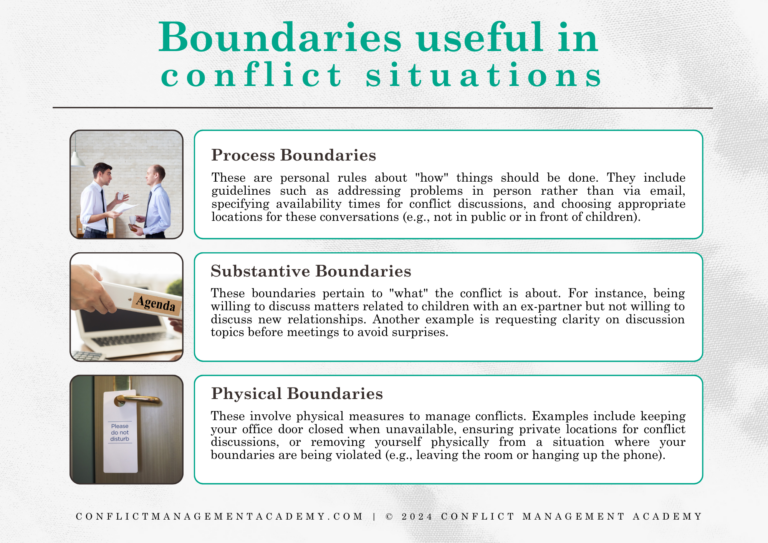
There are different kinds of boundaries that are useful for different situations. In conflict, there are three main types of boundaries: process boundaries, substantive boundaries and physical boundaries. These can all be used to prevent unnecessary conflict or to support you to manage conflict that does arrive courageously and with integrity.

A process boundary is a personal rule about “how” things should be done. For example, you may say to your employees that if they have a problem with something that you do at work, they should come and speak to you about it in person, rather than complaining behind your back or sending an email. Other process boundaries might relate to time – when you are and are not available to talk about a conflict, and for how long. Process boundaries may also relate to where conflict conversations take place (e.g. not in a public place, or not in front of children).

A substantive boundary relates to “what” the conflict is about. You may, for example, set a boundary that you are willing to talk to your ex-partner about what is best for the kids, but you are not willing to talk about your new relationship. A substantive boundary might be asking someone to be very clear about what they want to talk with you about before a meeting, so that you can be prepared to discuss those particular issues without being taken by surprise.

Physical boundaries are very useful in conflict situations. They may include things like keeping your office door closed when you are not available to have a conversation; ensuring that conflict discussions take place in a location where nobody can overhear what people are saying; or you physically removing yourself from a conversation in which someone is breaching your other boundaries (e.g. by walking out of the room, or hanging up the phone).

How to set boundaries

In order to set good boundaries, we need to know what is important to us. Our boundaries should support us to act in accordance with our values. We also need to know what kinds of behaviours from others make it difficult for us to maintain our integrity in conflict situations, and what kind of actions support us to communicate effectively. We need to distinguish between things that make us feel safe, but prevent us from managing conflict effectively (e.g. avoiding the other person) and things that enable us to interact in a constructive way.

Try to think about preventative boundaries, as well as boundaries that you might be able to use in the moment during a conflict conversation.

Things to think about when setting boundaries in conflict situations:

  • Which of our values are most important to us in conflict situations?
  • What kind of behaviour would be consistent with our values?
  • What would we like others to do in conflict situations to enable us to manage the conflict constructively?
  • What would help us to communicate effectively in conflict situations, so that we can listen respectfully but also say what we need to say?
  1. What makes you uncomfortable or stressed in conflict situations?
  2. What helps you communicate effectively in conflict situations?
  3. What process boundaries would support you in conflict situations?
  4. What substantive boundaries would support you in conflict situations?
  5. What physical boundaries would support you in conflict situations?

It can be difficult to get started and learn how to set effective boundaries in conflict situations, but fortunately The Conflict Management Academy provides an online module so you can develop the skills to interact with courage!

Considering where to publish your Dispute Resolution research and experience

Pauline Collins and David Spencer
This article has been republished and adapted with permission. The original publication can be located within the Australasian Dispute Resolution Journal.

Despite people negotiating disputes since time immemorial, the formalisation of dispute resolution in Australia dates back only around half a century. Prior to this there was litigation, compromise offers and informal settlement negotiations. Dispute resolution also referred to as alternative, assisted, additional dispute resolution or just dispute management now entails a growing range of approaches to assist parties in resolving or managing their dispute.

This year the Australasian Dispute Resolution Journal (the journal) celebrates 36 years of publishing current scholarly research and in-practice experience in dispute resolution throughout the Indo-Pacific Asia region. The journal has evolved to discuss all dispute resolution approaches and is a faithfull record of change in the civil disputation landscape. Today, “[c]ivil disputes which are resolved by curial adjudication are a minute fraction of the civil disputes which arise in our (or any) society”.

The journal was the brainchild of its foundation Editors, the late Micheline Dewdney and Ruth Charlton along with the then Managing Editor of Thomson Reuters.

The value of a scholarly journal is arguably in its ‘impact’ which is defined by the Australian Research Council as, “[t]he contribution that research makes to the economy, society, environment or culture, beyond the contribution to academic research”. While measuring a journal’s impact is a contested space in academia and the professions with opinions on what constitutes impact varying from discipline-to-discipline and within disciplines, the task is a little easier in the discipline of law. For the law discipline tracing the impact of research and publication can be mapped via law reform and legislative and common law citation that initiates changes to the law.

In its short life, the journal has been cited with authority eighteen times in the work of various state and federal Law Reform Commissions in Australia. The journal has also been cited with approval in at least thirteen judgments of superior courts of record in Australia where the court has been called upon to adjudicate on the developing law surrounding dispute resolution.

The journal’s reach is another measure of its impact. The journal currently has over 500 institutional subscribers ensuring it is available to a wide audience of potential readers. Further, online subscribers accounted for over 20,000 clicks/views in the last twelve months.

From its humble Sydney-centric beginnings, today the editorial board of the journal has expanded to 24 members who hail from Australia, India, Singapore, United Kingdom and New Zealand and from a wide variety of professions and vocations.

For a double-blind peer reviewed scholarly publication, the journal prides itself on its eclectic content. Substantively the journal deals with all manner of dispute resolution from the consensual, informal and less interventiory processes such as negotiation and traditional dispute management methods to the less consensual, more formal and interventionist processes such as adjudication and arbitration. It also seeks out contributions about some of the more contemporary areas of dispute resolution such as restorative justice, therapeutic jurisprudence, collaborative practice, conflict coaching, use of government inquiry mechanisms, wise counsel mediations and the expanding knowledge of human dispute gained from advances in neuroscience.

A critical area serviced by the journal is that of continuing professional development. Our changing world, however, presents constant challenges providing journal editors with a demanding task. Not least of which is the much written about and utilised generative artificial intelligence (GenAI) technology. One of the first GenAI large language models is ChatGPT that was launched in November 2022 and together with its many relatives (knock offs), they are challenging the way researchers, writers and publishers work. This technology is here to stay and will continue to grow and become more efficient and acurate with the effluxion of time. These advances provide a historical leap for humans and the publication industry.

Much has been said about the positives and the perils of GenAI. The proliferation of writing about GenAI of itself makes addressing the topic challenging. Each new technology from clay tablets, the Gutenberg printing press, the typewriter, computers and now GenAI has raised fear, excitement and then adaptation as we adjust to the speed and content by which information and knowledge is communicated. Finding a balanced approach that accepts regulation to eliminate harm but also acknowledging the potential benefits is called for.

The impact of GenAI on the provision of dispute resolution services is now being felt. Whilst online and automated dispute resolution has been in existence for many years, the advent of GenAI, with its undectable ability to not only guide disputants to resolution but then to learn from each experience with the aim of improving its own ability over time, is a new frontier for the provision of such services.

For the researcher and author, the use of GenAI is also presenting exciting possibilities. The use of GenAI to assist with large data set comprehension and analysis can better inform decision-making that in turn can speed up creative innovation to human problems such as disputation. For publishers and editors there is already a growing uptake in the use of such tools to address editing and formatting processes. The likelihood is an increase in the speed of publication outputs and therefore circulation of knowledge.

The mainstay of the journal is original unpublished scholarly work that has not been submitted or accepted for publication elsewhere including online publication. These articles are a mixture of empirical and meta-analysis that are approximately 5,000- 8,000 words in length.

Additionally, the journal publishes a flourishing ‘In-Practice’ section where practitioners can write short articles of 1,500-2,000 words on any topical issue they may have an opinion or view on. Further, this section provides the opportunity for practitioners to raise process issues from their own experiences in the provision of dispute resolution services or as an advocate acting for parties in dispute resolution processes. The practical aspects of dispute resolution sit superbly side-by-side with the more scholarly contributions.

Each edition of the journal includes case notes on cases litigated predominantly in superior courts of record that raise a multitude of issues from enforcing dispute resolution clauses in contracts to the impartiality of third party neutrals. As before, case notes cover all the processes of dispute resolution from mediation through to domestic and international arbitration.

The journal also fufils a ‘clearing-house’ purpose providing book reviews on the latest publications concerning dispute resolution and a ‘Media-watch’ column that reports on global dispute resolution in the media.

Further, the journal hosts special editions where for example multiple papers are published from conference proceedings. Other special editions include themed editions on topics such as dispute resolution in family law or the forthcoming special edition on conflict coaching.

For 35 years the journal has found a place in the abundance of scholarly journals and remains the pre-eminent periodical on the theory, philosophy, law and practice of dispute resolution in the Indo-Pacific Asia region. So, there is a scholarly journal that is worthy of your consideration when seeking to publish your research and practice experience in dispute resolution.


Honorary Professor Pauline Collins and David Spencer are the Co-General Editors of the Australasian Dispute Resolution Journal published by Thomson Reuters.

Honorary Professor Pauline Collins, University of Southern Queensland, is a co-author of, Dispute Management (Cambridge University Press, 2021).

David Spencer is a Solicitor and Deputy Dean-of-Law at the Thomas More Law School at the Australian Catholic University and is author of, Principles of Dispute Resolution (Thomson Reuters, 4th ed, 2024), Mediation Law and Practice (Cambridge University Press, 2006) and co-author of, Dispute Resolution in Australia: Cases, Commentary & Materials (Thomson Reuters, 5th ed, 2023).

This blog is based on an article written by the authors entitled, “The Australasian Dispute Resolution Journal: Past, Present and Future” (2023) 32(4) Australasian Dispute Resolution Journal 210 and is republished and adapted with permission.

Rethinking Family Mediation in England and Wales, and Beyond

Dr Rachael Blakey

For several decades, the Australian family dispute resolution literature has examined the operation of family mediation and other family dispute resolution procedures. Much of this data comes from funded evaluations and projects following the Family Law Amendment (Shared Parental Responsibilities) Act 2006. However, the English and Welsh literature on contemporary family mediation is limited in comparison. Much of our research has remained focused on the court system, even though many, if not most, people involved in child arrangements or post-separation financial matters deal with their disputes outside of it. My monograph, Rethinking Family Mediation: The Role of the Mediator in Contemporary Times, seeks to reinvigorate discourse and debate on family mediator practice within not only England and Wales, but also other jurisdictions, including Australia. Its opening paragraph reads:

‘Family mediation, like many other procedures, is in a transitionary period. Several traditional concepts – neutrality, facilitation and non-legal support – continue to dominate the discussions around the role of family mediation and the family mediator. These notions remain fundamental to family mediator practice, though their hold has weakened over time. Following decades of reform to the family justice landscape, the work of family mediators is now underpinned by a number of other concepts: flexibility, evaluation and, sometimes, quasi-legal oversight. Family mediators continue to perform their traditional functions, but balance them alongside a rising demand to adapt. They follow a flexible conceptualization in order to provide more comprehensive support to their clients, many of whom have limited access to legal or other advice in the early 21st century.’ (Blakey 2025, p. 1)

Today’s English and Welsh family justice system is very different to that in Australia. We do not have any triage system like the Child and Family Hubs, nor is family dispute resolution mandated. In fact, the Ministry of Justice recently backtracked from 2023 proposals to require most private family law disputants to demonstrate a ‘reasonable attempt to mediate’ before initiating court proceedings, citing concerns about the use of family mediation in cases of domestic abuse. Interestingly, amendments to our Family Procedure Rules in April 2024 mean that judges now have more power to adjourn court proceedings to encourage the use of ‘non-court dispute resolution’ (including family mediation). Judges can also impose a cost order on parties who do not attend a non-court dispute resolution process ‘without good reason’. Whether the Family Procedure Rules have led to non-court dispute resolution becoming mandatory has yet to be seen. Regardless, Rethinking Family Mediation offers valuable insights for family dispute resolution practitioners and academics in various other jurisdictions. It illustrates how policy and legislation can shape mediator practice over time, highlighting mediation’s central positioning within the broader family justice system.

Uncovering the transition from limited to flexible mediator practice

The key thesis underpinning Rethinking Family Mediation is that the role of the family mediator (particularly in England and Wales) has broadened over time, and it is the lack of recognition that this development has occurred, not the development itself, that is inherently problematic. More specifically, I argue that there has been a transition from a limited mediator archetype to a flexible mediator archetype.

The limited mediator archetype is how family mediation practice was, and typically continues to be, conceptualised. They are facilitative and strictly neutral, ensuring that decision-making power rests with the parties at all times. This limited archetype was logical in the traditional English and Welsh family justice system when funding was accessible for many separating parties. Many individuals could still afford a lawyer, even if they were not eligible for legal aid. The limited mediator’s strictly facilitative role was thus appropriate, as more evaluative support and guidance was provided by a lawyer (or other legal practitioner) (figure 1). Nonetheless, the monograph uncovers a long-standing neutrality dilemma for family mediators: neutrality prohibits them from reacting to a power imbalance, yet, in many instances, to do nothing is also an unneutral act. This paradox suggests that the limited mediator was never a perfect or perhaps even ideal archetype.

Figure 1: A binary understanding of facilitative and evaluative behaviours

This critique holds even more weight today. The family justice system in England and Wales is drastically different to when family mediation was first piloted in the late 1970s and early 1980s. Over several decades, policy has increasingly presented mediation as the norm, not simply an alternative, for family matters. This push for private ordering accumulated in the Legal Aid, Sentencing and Punishment of Offenders Act 2012 (LASPO) which, as of April 2013, removed legal aid for the majority of private family law court proceedings. At the same time, traditional legal support has become increasingly inaccessible for most separating families. Both factors have led family mediation’s clientele to diversify, with many cases now involving complex legal disputes or difficult party dynamics. The limited mediator, who is unable to provide any form of evaluation, is poorly suited to this clientele. Calls for mediators to adapt have increased as a result.

The monograph argues that mediators have transitioned to a flexible archetype over several decades. It recognises that the demand – both within policy and academic scholarship – for mediators to do more is, in fact, a call for mediators to become more evaluative. The flexible mediator archetype continues to perform a facilitative role, but evaluation is woven within their practices. Facilitation and evaluation are thus not a binary distinction, but rather two concepts on a continuum of mediator practice (as originally proposed by Riskin in 1996, though much of the contemporary English and Welsh literature on family mediation does not acknowledge his work). Mediator neutrality is subsequently re-understood as a moderate concept that does not need to be strictly upheld when doing so would compromise fairness or another normative concept. My monograph recognises that the flexible mediator archetype operated prior to the LASPO reforms, with a number of earlier studies demonstrating the varied work of mediators. However, it is submitted that the contemporary family justice landscape necessitates the archetype even further.

Revealing the flexible mediator archetype after the LASPO reforms

In England and Wales, and many other jurisdictions, debates around how to reform family mediation often become circular. It is said that change is needed to provide a better service. However, such change is not possible under the traditional conceptualisation of the (limited) family mediator. Rethinking Family Mediation submits that this stagnancy is resolved if the flexible mediator archetype is explicitly recognised.

To inform debate, the book outlines findings from an empirical project, consisting of a content analysis of family mediation Codes of Practice and semi-structured interviews with 17 family mediators. Its empirical findings first reveal a new theoretical framework of four mediation functions, all of which are recognised and adopted by both family mediators and their regulatory bodies (figure 2). Mediators are primarily helpers, but regularly evaluate the proposed settlement or party dynamic to determine if they should become referrers to another service (notably legal advice). Mediator evaluation becomes significantly more prominent as they become assessors and, furthermore, intervenors. Additional interview data shows that mediators feel that they are responsible for responding to difficult party dynamics and unfair settlements, justifying their more evaluative practices. Of particular note within the empirical data is the mediator sample’s regular reference to legal rules, set out in both legislation and case precedent. This alludes to a growing quasi-legal role for today’s family mediators, most likely influenced by the withdrawal of accessible legal support after the LASPO reforms.

Figure 2: The mediator function framework, plotted on a continuum of facilitative to evaluative strategies

These more evaluative behaviours are discussed by the entire mediator sample, even if a participant understands their neutrality in very strict, absolute terms. Intriguingly, over two-fifths of the mediator sample prefer an alternative understanding of their neutrality that enables them to intervene in negotiations to encourage a good quality settlement. This stance appears more closely aligned with the concept of impartiality, rather than neutrality, though whether the former is a better term to describe the flexible mediator archetype is unclear (mirroring similar debates in Australia).

Implications for family justice going forward

The quasi-legal role of flexible mediators, as identified through the monograph’s empirical data, has significant implications for the professionalism and training of the profession. One chapter of Rethinking Family Mediation specifically considers the extrinsic and organisational barriers to reform, asking whether family mediation should be regarded as a ‘legal service’ under English and Welsh legislation. While the monograph does not provide a definitive answer to the question, it hopes to reinvigorate debate in the area. The chapter also uncovers findings on the current status of family mediation services at a time when the government expects parties to mediate but has provided very little government funding to support mediators themselves.

Importantly, the findings covered in this book have significant implications for our understanding of family justice. Family justice is generally understood as something that is only available through court (and supported by legal representation). Yet much of the empirical data discussed in the book is evidence of a shift in not only family mediator practice, but family justice itself. In the contemporary English and Welsh, as well as Australian, landscape, family justice is increasingly provided through non-lawyers, such as mediators, who are often informed by legal norms. The book connects these changes to a rising hybridity across family law practice, with lawyers additionally becoming more collaborative and less adversarial over time.

This contemporary vision of family justice is not ideal, nor perfect. Without further scrutiny of the various professionals within the family justice system, the risk of improper or unfair outcomes increases. However, Rethinking Family Mediation is premised on finding pragmatic solutions to the challenges within our modern family justice systems. In order to do so, the reality of non-dispute resolution practice must be identified and, importantly, recognised.

It is of no surprise that the monograph regularly returns to the concealment of the flexible mediator archetype – and most likely many other flexible practitioners – as a key issue within our current discourse around family justice reform. Ultimately, it argues that the changes in family mediator practice have been both a natural part of the profession’s development, as well as a consequence of the contemporary family justice system with limited funding and inaccessible legal support. The book will therefore be of significant interest to anyone interested in learning more about family dispute resolution in terms of not simply how the process was traditionally conceived, but how it operates in reality.

Author Biography

Dr Rachael Blakey is an Associate Professor at the University of Warwick. Her research focuses on family mediation and access to justice. She is a co-opted Director of the Family Mediation Council, the main regulatory body for family mediators in England and Wales. Rachael is interested in legal professionalism more widely, and is currently conducting the first empirical study on the English and Welsh ‘one-lawyer-two-clients’ format of family law support.

Author details: rachael.blakey@warwick.ac.ukUniversity ProfileLinkedIn | Rethinking Family Mediation: The Role of The Family Mediator in Contemporary Times (Bristol University Press 2025)

All figures were provided with permission from Bristol University Press.

Are Mediators Ever Liable? Rethinking Accountability in Our Practice

Samantha Hardy
This article has been republished with permission. The original publication can be found at The Conflict Management Academy.

Inspired by Jennifer L. Schulz (2023). Mediator Liability 23 Years Later: The “Three C’s” of Case Law, Codes, & Custom. Ottawa Law Review / Revue de droit d’Ottawa, 55(1):151–186. Available at: https://doi.org/10.7202/1112508ar

A Quiet Assumption

For many of us working in the mediation field, there’s a quiet assumption we rarely question: that we’re not likely to be sued for what happens in a mediation room.

And, to date, that assumption has mostly held true. While a few attempts to sue mediators have occurred in different jurisdictions around the world, none have resulted in a mediator having to pay compensation to a party.

Canadian mediator and law professor Jennifer Schulz reviews 23 years of case law across six common law countries—including Australia—asking why mediators are not being held liable and arguing that they should be. The article is well worth reading in full, as the detailed summaries of the cases examined provide a vivid picture of the current gap between our aspirational standards of practice and the lack of accountability for those who do not meet them.

The Current Reality: A Legal Shield

Schulz’s research confirms what many of us might suspect: across Canada, the US, Australia, New Zealand, England, and South Africa, courts are still not holding mediators legally liable for negligent practice.

Even in cases involving mediator coercion, numerical errors in settlements, inappropriate behaviour, or poor handling of vulnerable parties, the most common judicial response is to set aside the agreement—not to hold the mediator accountable.

There are four main reasons for this legal shield:

  1. Causation hurdles – it’s hard to prove that a mediator’s actions caused a party’s loss.
  2. Mediator immunity – either through legislation (as in many US states and Australian courts) or through contractual terms.
  3. Mediation confidentiality – which often prevents complainants from even introducing evidence of wrongdoing.
  4. Lack of a defined standard of care – without it, there’s nothing to measure negligence against.

As Schulz puts it, we’re operating in a legal vacuum—where professional expectations are high, but legal consequences are rare.

The “Three C’s” Proposal: A Way Forward?

Schulz doesn’t advocate for a wave of mediator lawsuits. Instead, she proposes a more thoughtful framework for developing legal accountability: the Three C’s.

  • Case Law – court decisions that, even if inconsistent, begin to sketch the boundaries of acceptable practice.
  • Codes of Conduct – such as those issued by AMDRAS, state-based mediator panels, or court-connected schemes.
  • Custom – what a reasonable mediator would do in a given situation, based on community norms and practice standards.

I would personally add another C, perhaps attached to the Codes of Conduct item – and that is Complaints. More could be done to educate clients about what they should be able to expect from their mediator, and mediator complaints services could be more courageous and transparent about how they respond to client complaints. Complaints handling that is half-hearted or that aims to protect mediators rather than hold them publicly accountable only exacerbates the problem and pushes it underground.

These sources could help courts (and the profession) articulate what counts as competent mediation (the basis for a standard of care in negligence) and what crosses the line.

What the Cases Tell Us

The article walks through dozens of cases—some troubling, some absurd, many familiar. A few key themes emerge:

1. Coercive Behaviour Is Common—But Unpunished

Multiple cases involve mediators who pressured parties to settle, made legal predictions, lost their tempers, or belittled participants. Courts have rarely responded with consequences—unless the party was unrepresented and severely disadvantaged. The courts typically assume that if a party is legally represented, their lawyer will protect them from any harm.

Notably, some cases even include allegations of racist or discriminatory remarks by mediators—again, without findings of liability.

2. Vulnerability Is Often Overlooked

Incapacity cases—where a party was overwhelmed, unwell, or otherwise unable to engage effectively—are nearly always dismissed. Courts seem to assume that the voluntary nature of mediation allows a party to stop participating at any time, so choosing to continue negates their right to claim. This type of thinking shows a lack of understanding of how incapacity might show up, in that it might also make someone incapable of making a good choice to leave the mediation.

3. Mediators Who Make Mistakes Still Escape Consequence

From drafting errors to bad legal advice, mediators are largely shielded unless the consequences are glaring and the party can prove they were misled into harm. In such cases, courts tend to place responsibility on the parties’ lawyers—even where the mediator dictated the settlement. Even where there is no lawyer involved, the likely outcome is that the agreement will be set aside, rather than any consequences for the mediator.

Implications for Australian Practice

So what does this mean for those of us practising under the AMDRAS framework or in private, court-connected, or hybrid contexts?

  • Legal immunity doesn’t mean ethical impunity. Just because we’re unlikely to be sued doesn’t mean we shouldn’t hold ourselves—and each other—to higher standards.
  • Custom matters. If the law ever does change, it will likely rely on what we say is normal, ethical, and good practice in our mediation communities.
  • The codes we sign up to should guide us daily—not just when we’re audited or accredited. They may form the basis of future legal standards.
  • Training matters. When mediators pressure parties, overlook incapacity, or provide questionable advice, it’s often due to poor training, not bad intentions.
  • RABs need to have rigorous complaints processes.  Until the courts step up and impose consequences on mediators who behave badly, the mediator’s accreditation body must be able to manage complaints effectively to prevent harm to parties and the profession’s reputation. This means holding mediators accountable for improper behaviour and educating members about where the line will be drawn.
  • Industry/peak bodies could play an important role in educating clients about their rights/expectations of a mediator. It’s one thing for mediators to hold themselves accountable (and be required to do so through professional standards). It’s another for a client to be informed and educated about the treatment they are entitled to receive.

It is also important to acknowledge that there are many cases in which aggrieved clients lash out at mediators who have done nothing wrong. Vexatious complaints seem particularly common in the family sector, and it is important that the practitioners involved are treated with respect and allowed to defend themselves with dignity.

A Profession at the Crossroads

Mediation has come a long way—from fringe alternative to mainstream dispute resolution. With that growth comes a challenge: do we want the status of a profession without the accountability?

Schulz’s article offers a roadmap. The future of mediator liability may not lie in sudden lawsuits or rigid standards, but in a profession willing to evolve its own definitions of excellence, to recognise when harm has been done, and to hold people accountable.

As Australian mediators, particularly with the new AMDRAS standards about to come into effect, we’re well placed to lead this conversation. The question is: will we?

What’s the alternative to mediation? Meet the European Board Game Going Global

Responding to @Massimiliano Ferrari’s recent post sharing @Dr. Anna Maria Bernard’s powerful insights about digital conflicts in Basilicata. Here’s what we’re seeing as Medianos spreads globally…

Massimiliano Ferrari’s sharing of Dr. Anna Maria Bernard’s insights from Basilicata Region perfectly captures what those who understand transformation are witnessing worldwide – the emerging need for approaches that naturally dissolve digital-age conflicts. Dr. Bernard’s experience with Medianos confirms what you may already be sensing as this remarkable method continues spreading across continents.

She writes about how “digital conflicts are the order of the day” and as you consider this, you might recognize the truth in her observation. Just last month, I watched a CEO and his teenage daughter discover something profound as they sat across from each other, both having believed the other “just doesn’t get it” about screen time boundaries. Traditional mediation would have had them negotiate rules and compromises. But what happened next was something that transforms everything.

In the past, families like theirs relied on authority-based solutions that inevitably left children feeling unheard and parents feeling frustrated. When conflicts arose over homework, curfews, or device usage, conversations naturally escalated into battles of will rather than becoming opportunities for deeper understanding. The tools available were limited to expensive counseling, theoretical parenting books, or time-consuming mediation processes that few families could access or sustain effectively.

Then the digital revolution changed everything, didn’t it? As Dr Bernard observes, we’re dealing with conflicts our parents never imagined: How much screen time creates balance? What about online privacy and safety? How do we manage social media wisely? The generational digital divide widened as children became native users while parents struggled to keep pace with change. These “digital conflicts” became daily occurrences, with the adolescent brain still developing and naturally impulsive constantly stimulated by digital temptations that multiply exponentially.

What she discovered in Basilicata, you’re now beginning to see replicated across Europe and beyond. Medianos – The Game isn’t just resolving these conflicts; it’s fundamentally transforming how families, schools, and even workplaces naturally approach disagreement.

That CEO and his daughter? Within two hours of facilitated gameplay, something remarkable began to unfold. By “playing” each other’s roles in a safe, structured environment, they started to understand perspectives they’d never allowed themselves to consider. The daughter experienced the weight of parental responsibility for digital safety, and the father felt the frustration of being constantly monitored and distrusted. When they returned to their original roles, their conversation had completely shifted – from positional bargaining to collaborative problem-solving that felt surprisingly natural.

This is the power Dr Bernard wrote about when she described how Medianos allows participants to “go beyond the conflict and enhance what you feel at the level of emotions, thoughts and behaviours.” And what’s truly exciting is how rapidly this approach continues spreading globally, creating transformation wherever it goes.

Created by Massimiliano Ferrari and supported by a rapidly expanding community of Ambassadors, Medianos is spreading across the world at unprecedented pace, and as it does, more people are discovering its effectiveness. Recent weeks have seen new Ambassadors recognized across Italy, Canada, France, Spain, Brasil, Latvia, Ecuador, and Albania.

I, Rory Gowers, as the newly appointed Australasian Medianos Ambassador and creator of the My-RESPECT-Ability negotiation framework, am curious to discover how this face-to-face board game experience will resonate with digital natives here in Australasia while delivering the profound results Dr Bernard described.

The game format creates what she calls “a safe, secure, and stimulating environment” where participants naturally develop genuine empathy through facilitated face-to-face interaction. Communication skills emerge organically as players learn active listening and assertive expression without it feeling like traditional training. Hidden needs surface safely as the game reveals unexpressed fears that fuel conflicts. Most importantly, players develop what I call “respect-ability” the expanding capacity to engage respectfully even during difficult conversations.

Dr Bernard’s observation that “gaming experience with Medianos was pivotal in translating theoretical concepts into practical skills” captures exactly why this approach succeeds where traditional methods struggle. In our screen-saturated world, bringing the power of gaming back to physical interaction creates genuine human connection that digital experiences simply cannot replicate.

The transformation extends far beyond individual families, doesn’t it? As she noted with the teachers in Basilicata who were “fascinated by the educational and formative opportunity,” we’re witnessing schools, workplaces, and communities naturally develop cultures of respectful engagement. When conflicts become catalysts for deeper understanding rather than relationship damage, entire organizational cultures begin to shift.

Imagine, if you will, boardrooms where disagreements become opportunities for innovation rather than positional battles. Picture classrooms where teachers and students collaborate through understanding rather than authority. Envision families where generational divides bridge naturally through shared gaming experiences that honour everyone’s perspective completely.

This is the future Dr Bernard glimpsed in Basilicata – and it’s spreading globally with increasing momentum. Her closing question resonates deeply, and you might find yourself wondering: “What strategies are you using to manage digital conflicts in the family or at school, or in the workplace?”

The answer, increasingly, is becoming Medianos – The Game. We’re actively preparing for launch in Australasia in Quarter 4 2025, bringing this proven approach to a region where digital conflicts are as prevalent as anywhere in the world, and where solutions are needed most.

As Dr Bernard concluded, “Open dialogue, empathy, emotional intelligence education and novel tools like Medianos are the key to transforming ‘digital conflicts’ into opportunities for growth and deeper bonds.” The enthusiasm she witnessed in Basilicata is now spreading across continents – one family, one school, one workplace at a time, creating lasting change.

For more information about bringing Medianos to your organisation or community, reach out to MyRespectAbility or respond to the post directly and discover what becomes possible.

What strategies are you using to transform conflict into connection? Join the conversation below and share what you’re discovering.

Author Biography

Rory Gowers is a Master of Dispute Resolution (MDR), Master of Education (MEd), certified Master NLP Practitioner, and intercultural mediator with deep experience leading transformative change across global business and community settings. Based in Greater Sydney, Australia, Rory helps leaders and organisations replace conflict cycles with clarity, cooperation, and lasting resolution.

As the founder of The Constructive Solution, Rory applies structured, values-based methodologies to resolve complex interpersonal and systemic challenges—especially in high-stakes environments like construction, government, and professional services. His work produces measurable outcomes: reduced rework, improved trust, and faster decision-making.

He also leads Mastering Intercultural Mediation Initiatives (MIMI)—a high-impact executive program that equips senior leaders to build inclusive, high-functioning ecosystems by mastering cultural agility and conflict competence.

Now, Rory is bringing the internationally acclaimed Medianos – The Board Game to Australasia. As the official Australasian ambassador, he introduces this dynamic, play-based tool to transform how professionals learn and practise negotiation, mediation, and respectful engagement.

Rory’s mission is clear: to grow respect, resolve conflict, and realise the shared vision of a place for all and peace for all in our time—by guiding people and systems to adopt practical, repeatable solutions that build trust and deliver sustainable results.

Contact Rory:
🌐 Web: www.myRESPECTability.com
📧 Email: rory.gowers@gmail.com
📱 Mobile: +61 425 292 811
🔗 LinkedIn: linkedin.com/in/constructiveconflictsolutions