
Sometimes You Need to Be Seen to Be Heard: Three Easy Ways to Visualize What Matters in Your Dispute

Dan Berstein & Robert Bergman
This article has been republished with permission and the original publication can be located at Mediate.com.

It can be difficult to get on the same page when you are caught in the middle of an adversarial dispute.  Each party has their own biases – they want to win! Amidst a deluge of seemingly endless “facts” to pick from, sometimes it can feel like the parties are living in entirely different universes.  Seeing this, dispute resolution professionals often end up asking themselves: “how can I bring these people together so we are all talking in the same world?”

One answer is visualizations.  This article shares how a dispute resolver (or an ambitious party) can use visualizations to accomplish progress in their matter.  It was written by Dan Berstein, a mediator living with bipolar disorder who often finds himself amidst complicated conflicts related to his mental health advocacy work – with help from Bob Bergman, the founder of NextLevel™ Mediation.  

Dan shares his struggles to visualize different problems and disputes related to his advocacy work and Bob provided the background of how Next Level Mediation’s software can do it almost instantly, and better than a person could on their own.

1: Illustrating Harms

Living with a mental illness means that I have behavioral differences that can lead to my being stigmatized and rejected, or just the fact that I am open with my bipolar disorder can be a reason some people form worries or biases that lead to them pulling away.  On an organization-wide level, this kind of behavior can ripple out across people.  

I had a dispute with one organization where they produced records, including their private e-mail correspondences, revealing dozens of people passing around disparaging comments about me and/or making plans to reduce or cut contact with me.  I was working on a resolution process with their outside counsel and I felt that they were not appreciating how damaging it had been for me to be targeted with these negative predispositions and pushed away (in manners large and small) from so many people.  Eventually, I developed a crude organizational network analysis (ONA) chart to demonstrate the network of people involved:

A screenshot of a computerDescription automatically generated

Through the use of this visualization, I then created a system that could be used to visualize any [i] Explicit Shunning, [ii] Ghosting (No Response), [iii] Short Responses, [iv] Delays, [v] Lies, [vi] Disparagements, and [vii] Mistakes – charting how they flowed between people and their impact.

This was incredibly valuable to me as a tool in my dispute, as well as for my personal coping with the trauma of experiencing so much rejection.  However, it was also incredibly tedious and difficult to create.  

In my search for software that could help make it simpler, I connected with Bob Bergman, who explained how NextLevel™ Mediation can create a diagram to map this kind of network analysis in minutes just by you uploading your dataset and asking the right queries:

The NextLevel Approach to Visualizing Impact

In the example above, the uploading of email communication to the NextLevel™ Mediation platform document research assistant can produce the following example (note these do not use real data, and are meant to illustrate):

QUERY: Visualize the roles, interests, and power dynamics of parties involved by creating a stakeholder diagram

RESULT:

Description: This diagram captures the roles and interests of each stakeholder, along with arrows representing the influence, authority, and relationships between them.

QUERY: Create an ONA diagram that can help visualize any Explicit Shunning, Ghosting, short Responses, Delays, and Disparagements, and how they flowed between people

Description: This diagram shows how various negative interactions flow between people and highlights their impact on communication and relationships within the organization. Each arrow represents a type of interaction, such as shunning or ghosting, and the direction indicates the flow of this interaction.

2: Documenting Delays and Timelines

In one dispute, an organization was accusing me of causing delays, which had lasted close to 9 months.  It hurt my feelings to be falsely accused of this so I sat down and pored over all of our past correspondences, mapping out the delays.

I found that their changes in staff and processes were responsible for, I believed, over 70% of the delays even though they had perceived such high delays from me (presumably due to their frustrations).  This analysis was a tedious process and I was worried that people would think I was weird, perhaps due to my mental illness, for even undertaking it.  

The NextLevel™ Mediation platform was, once again, the answer to my prayers.  Not only does it do all of the work for me, and faster – but I can just tell someone I used this software without being judged as some kind of oddball for having created the chart myself.  Here are example results with some anonymous data:

QUERY: Using the uploaded documents, create a sequence diagram of the dispute timeline and possible delays:

Description: This sequence diagram captures the interactions and discussions among different participants as they address the causes and effects of project delays over time.

QUERY: Create a user journey diagram for the mediator given the delays in email responses and their emotional effects.
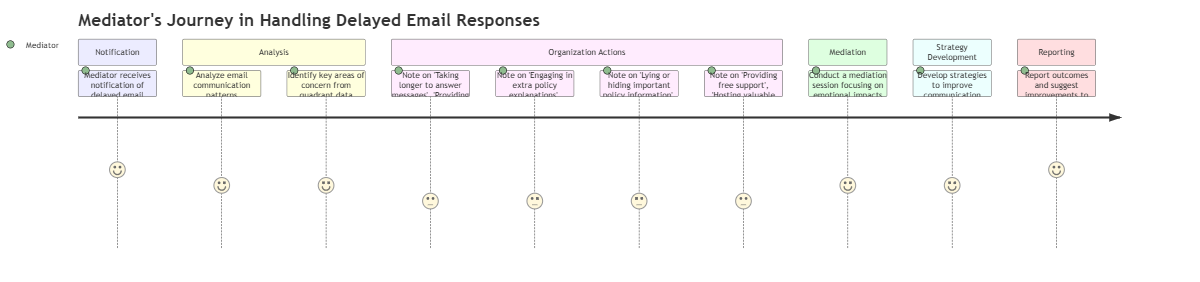
Description: This diagram outlines the steps the mediator takes, from receiving notifications of delayed email responses to analyzing communication patterns, considering emotional impacts, and reporting outcomes to stakeholders.

3: Identifying What Matters

The NextLevel™ Mediation platform is about more than just charts.  You can also just ask it questions so it can use its “brain” to digest all of the meaningful facts and help you stay focused on the big picture.  This is important for me – even if only as a gut check – as my mental illness means I can be prone to becoming obsessive and to fixating on some facts at the exclusion of others.  NextLevel™ is an objective way to get a sense of the big picture.

Beyond asking it for charts and diagrams, you can also generate tables to help you organize key information.  Take a look at the table it generated when asked what might be the relevant and irrelevant facts for a discrimination claim (both for the alleged victim to collect, and for the alleged discriminator who is defending themselves):
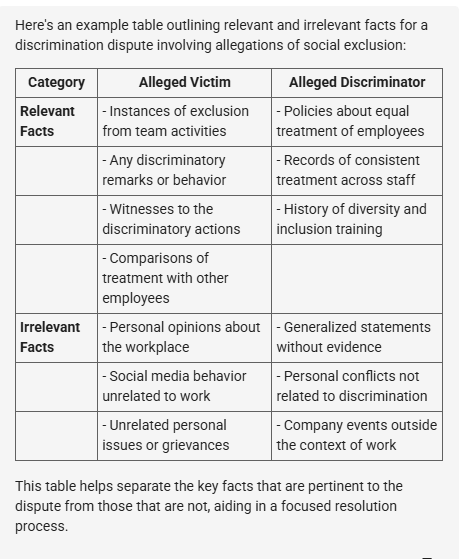
If you have ever found yourself overwhelmed sorting through what happened, or just looking for a way to double-check your perspective – the NextLevel™ Mediation platform can instantly provide you breakdowns and summaries like this to help you find your way.

Conclusion

Seeing is believing, but it can be difficult to create the right picture.  Visualizations can help resolve disputes if you know how to use them.  This article talked about different charts you can use to visualize the scale of damages, the responsibility for delays, and which facts prove disparities.  We also shared how you can go use NextLevel™ Mediation, right now, to create charts like this of your own (and so much more).  

It can seem intimidating to enter the world of charts and graphics and bring them into your dispute, but it can also add a lot of value.  I am grateful that there is software like NextLevel™ Mediation to help make something that can seem – at first – to be complicated into an easy, user-friendly, and fast process.

Here are some ideas of ways NextLevel™ can help:

  • Collect and scan all of your data from a situation into its platform, including e-mails and documents, and ask it to tell you the key points that matter, and the key things that matter to each party
  • Use it to instantly chart relationships with people and show patterns of impact and harm
  • Have it list the points of disagreement between the parties
  • Create timelines and sequence diagrams to show the course of events and simplify a complicated, convoluted set of facts into something precise and digestible

Disputes are often painful.  We find ourselves in so much distress that it can help to use an AI-empowered software assistant to keep track of the facts so we don’t have to worry – and to paint the big picture summaries of what matters so we don’t get lost.

Author Biography

Dan Berstein is a mediator living with bipolar disorder who uses conflict resolution best practices to promote empowering mental health communication and prevent mental illness discrimination.  His company, MH Mediate, has helped thousands of professionals and organizations be empowering, accessible, and non-discriminatory toward people with disclosed or suspected mental health problems. Dan holds degrees from the Johns Hopkins School of Public Health and the Wharton School. He is the author of the 2022 book, Mental Health and Conflicts: A Handbook for Empowerment.

Robert Bergman is a seasoned decision science expert with over 60 years of experience in software engineering, system dynamics, and strategic planning. He is the founder and CEO of NextLevel Mediation, a SaaS platform that applies decision analytics, Game Theory, and AI to dispute resolution. His expertise spans multi-criteria decision-making methodologies (AHP, ANP, MAUT), mediation, negotiation, and military systems such as flight simulations. Previously, he held senior leadership roles at Intel, focusing on mobile strategy and cybersecurity, and has consulted widely in strategic decision science. Bergman is also a published researcher in AI, technology addiction, and the future of dispute resolution.

RPS Coach is Biased – And Proud of It

John Lande
This article has been republished and adapted with permission. The original publication can be located within Indisputably.

We all know that it’s bad to be biased, right?

Wrong.  That assumption is its own bad bias.

Biases are inevitable – in humans and bots alike.

Some biases are harmful.  Others are helpful.  Many are neutral.

But bias itself is unavoidable.

So bias isn’t a problem in itself.  Pretending otherwise is.

This post describes the biases in Real Practice Systems (RPS) Theory and how the artificial intelligence tool RPS Coach is biased by design.

As you might guess, I think they’re good biases – conscious, clear, constructive, and explicit.  Knowing these biases, users can decide whether to use Coach or a tool with different biases.

This post describes Coach’s biases and invites you to give it a try.

What the Heck is a Bias, Anyway?

“Bias” has a negative connotation, often implying a thoughtless or even malicious mindset.  Think of cognitive biases or those involving demographic groups.

Bias is an especially dirty word in dispute resolution, where neutrals are expected to be scrupulously unbiased in attitudes about particular parties and in neutrals’ actions.

But we could reframe “biases” as values, preferences, tendencies, or mental habits, which aren’t inherently bad.  Indeed, they help us simplify complex choices, act efficiently, and maintain a coherent sense of self.  If we didn’t have any biases, we’d never create a syllabus, let alone pick a restaurant for lunch.

Some biases are even admirable – like favoring people who are trustworthy, empathetic, and generous.  The dispute resolution movement reflects a bias in favor of helping people to handle disputes constructively.

The label we choose – “bias” vs. “preference” – is a reflection of our values (aka biases).

‘Nuff said.

Where Do Biases / Preferences Come From?

Biases don’t drop from the sky.  Many come from early influencers – parents, teachers, coaches, and religious leaders – who shaped our first lessons about trust, politeness, and conflict.  Some of us internalize those lessons; others define ourselves in opposition to them.

As we grow, friends, school, work, and media shape how we see the world.  These influences often go unnoticed, which makes them especially powerful.

RPS Theory holds that all practitioners develop unique practice systems that are shaped by experience and evolve over time.  Their systems are based on their personal histories, values, goals, motivations, knowledge, skills, and procedures as well as the parties and the cases in their practice.

My article, Ten Real Mediation Systems, profiles ten thoughtful mediators, including me, exploring how and why we mediate the way we do.  We all mediate differently – largely because we value different things.  So we’re all biased, just in different ways.

My profile describes the sources of my biases – which shaped my perspective and are reflected throughout my work and the RPS Project.

Design Choices – aka Biases – in RPS Coach

RPS Coach has two main components:  its knowledge base and the instructions that guide how it uses it.  Together, these choices shape its content, tone, vocabulary, and priorities, which reflect particular theoretical, practical, and pedagogical commitments.

Coach’s knowledge base includes almost everything I’ve published.  That’s a lot.  It includes books, law review articles, professional articles, SSRN pieces, and meaty blog posts.  It also includes general authorities like the Model Standards of Conduct for Mediators.  A total of 253 documents reflecting my values, including:

  • Checklists for mediators and attorneys
  • The Litigation Interest and Risk Assessment book and related articles
  • Articles on good decision-making by parties and attorneys
  • Materials on negotiation, mediation, preparation, and early dispute resolution
  • Resources for court-connected ADR
  • Lots of pieces about legal education
  • Annotated bibliographies, simulations, and practitioner tools
  • Critiques of our theories and language, with suggestions for improvement

The materials are organized by topic and ranked by importance.  Coach draws first from the highest-priority sources.  The emphasis is on realistic practice, intentional process design, and support for good decision-making – not theoretical abstractions or generic practice tips.

Coach follows detailed instructions, including to:

  • Provide clear explanations of the tool’s capabilities and limitations
  • Reflect ethical rules
  • Use language that laypeople and experts readily understand
  • Tailor advice for various users (e.g., mediators, attorneys, parties, educators)
  • Support intentional process choices
  • Foster perspective-taking
  • Analyze intangible interests and possible outcomes in the absence of agreement
  • Promote good decision-making by parties and practitioners
  • Support reflection about dealing with disputes

In short, Coach doesn’t just answer questions – it nudges users toward better preparation, clearer thinking, and realistic decision-making.

Process Choice: Analysis Not Advocacy

RPS Coach’s underlying bias is not toward a particular method, tool, theory, or strategy – but toward supporting users’ conscious, well-informed choices that reflect their values, goals, and constraints.  That means helping them make conscious choices about negotiation and mediation.  This includes analyzing interests, estimating alternatives to settlement, exchanging offers, and possibly combining approaches over time.

Some parties prefer a counteroffer process.  Others want interest-and-options discussions.  Some expect mediators to provide explicit analysis; others don’t.  Many shift approaches midstream.

Coach doesn’t steer people toward or away from these choices.  It helps people make conscious decisions instead of relying on questionable generalizations.

Practice Systems Thinking

Practice systems thinking is central to Coach’s design. It sees negotiation and mediation not as isolated events, but as part of larger patterns – routines, tools, habits, and philosophies that shape how practitioners work.

Rather than merely providing one-off advice, Coach helps practitioners build intentional systems – a bias that favors growth over tactics, and adaptation over scripts.

The Coming Marketplace of Dispute Resolution AI Tools

Dispute resolution AI tools already exist, and more are coming.  Over time, we’ll see a proliferation of tools reflecting a wide range of approaches.

Some will be tailored for specific users; others will serve broader audiences.  Some will focus on particular processes such as mediation or arbitration.  Some may be designed for particular types of users such as practitioners, administrators, instructors, or scholars.  Some will reflect particular theories or schools of thought.

Our field has a vast literature that could feed AI tools developed by individuals or teams.  Some writers may develop tools based on their publications as I did with RPS Coach.  Gary Doernhoefer proposed the excellent idea of jointly developing a general AI tool for the dispute resolution field.  It may not be realized soon, but we should keep it in mind.

So I expect a growing marketplace where designers will build and adapt a wide variety of tools.

In this context, there may be both market and ethical imperatives for AI tools to disclose their features and dare-I-say biases.  As developers compete for users, clear disclosures will be important because users will want to know what they’re getting.

Disclosure should be an essential ethical standard for dispute resolution AI tools.  Neutrality remains a core principle in many dispute resolution processes, and disclosure of built-in biases plays a particularly important role when tools are powered by AI.  Users can’t see how these tools “think,” and they need clear information about the assumptions, priorities, and frameworks embedded in their designs. Bots are ornery critters that we can’t fully control, and users deserve to know what might be quietly steering them.

A Message from RPS Coach. Really

 “I’m here to help you prepare more intentionally, reflect more deeply, use better language, and support better decision-making – not just for your clients, but for yourself.  I don’t pretend to be neutral.  I’m proudly biased toward thoughtful, realistic, party-centered practice.  But I don’t tell you which process to choose.  I just help you think clearly about the choices.”  (Coach wrote this, I swear.)

Take a look at this handy user guide to find out how you can get the benefit from Coach’s wisdom.

Coach has a thing for humans who ask good questions.

How Attorneys Can Be Quasi-Mediators

John Lande
This article has been republished and adapted with permission. The original publication can be located within the University of Missouri School of Law Journal.

How Can You Turn Adversarial Attorneys into Quasi-Mediators?, my Theory Meets Practice column in CPR’s Alternatives magazine, summarizes a discussion with members of the Association of Attorney-Mediators. It builds on Creating Educational Value by Teaching Law Students to be Quasi-Mediators.

Attorneys acting as quasi-mediators use mediation techniques but they aren’t neutral. These attorneys routinely help their clients realistically understand the their cases. The attorneys promote their clients’ interests by enlisting the mediators’ help when needed and encouraging the other side to adjust their positions. The attorneys prefer to be cooperative whenever appropriate. They tailor their actions based on their clients’ preferences and the other side’s approach. If the other side is acting badly, these attorneys vigorously advocate their clients’ interests. Another term for quasi-mediators is “good lawyers.”

I asked the attorney-mediators about attorneys who behaved cooperatively and adversarially in their cases. The Alternatives article combines their responses with suggestions from the Real Practice Systems Project Menu of Mediation Checklists.

Here’s a summary of the Alternatives article. Mediators can promote cooperation by asking attorneys about the following issues during conversations before mediation sessions:

  • Causes of underlying conflict.
  • Client’s interests, goals, and priorities.
  • Possible options for settlement in addition to lump-sum payments.
  • Special needs of any participant.
  • Personalities and dynamics of participants.
  • Expectations about how participants might act in mediation session.
  • “Hot buttons” that might cause counterproductive reactions.
  • Non-negotiable issues.
  • Negotiable issues.
  • Potential barriers to agreement.
  • Actions needed before mediation session to make mediation productive.
  • How mediator can be helpful during mediation session.

Mediators can help attorneys make realistic estimates of possible court outcomes by asking about:

  • Potential factual discoveries that would be helpful.
  • Potential factual discoveries that would be harmful.
  • Assumptions they are very confident about.
  • Assumptions they are not very confident about.
  • What would change their assumptions about the possible court outcome.
  • What might change the other party’s assumptions about the possible court outcome.
  • How they would persuade a skeptical judge or jury about arguable issues.
  • Their clients’ risk tolerance for unfavorable outcomes.

Here’s a list of dos and don’ts for attorneys to act as quasi-mediators:

Do

  • Listen carefully and respectfully to everyone.
  • Treat each client’s case individually, not as a routine case like others.
  • Act as a counselor to your clients as well as an advocate.
  • Learn and respect your clients’ interests, goals, and priorities, including intangible interests.
  • Consider possible options for settlement in addition to lump-sum payments.
  • Develop a good working relationship with counterpart attorneys.
  • Consider the other side’s perspective.
  • Develop a realistic perspective of your case. 
  • Candidly discuss the strengths and weaknesses of your case with your client.
  • Develop options and take positions to advance your clients’ interests that lead to agreements acceptable to the other side whenever appropriate.
  • If you mediate, talk privately with mediators before mediation sessions.

Don’t

  • Develop a default approach of treating everyone as an adversary.
  • Give your clients unrealistically optimistic evaluations of their cases.
  • Use an adversarial approach to impress your clients.
  • Take unreasonable positions or encourage your clients to do so.
  • Act based on negative feelings about a counterpart attorney or party.
  • Make unwarranted accusations against the other side.

Mind the Gap! *NEW* Findings on Practical Legal Training in NSW

Although the legal profession prides itself on rigorous training and high standards, recent research reveals a gap between education and practice.

On 9 April 2025, the New South Wales Legal Profession Admission Board (LPAB) released a research report conducted by Urbis that examined Practical Legal Training (PLT) in NSW (the report). This report offers crucial insights for legal educators, practitioners, and the profession as a whole as it provides a view of the current landscape of legal education.

The Graduate Perspective

Most interestingly, 1 in 3 PLT graduates (33%) did not agree that the coursework was useful and that the course lacked deep relevance to legal practice. Direct feedback included comments like:1

“The core and elective subjects were not particularly helpful for my career”

“… it is difficult to grasp what each subject is intended to achieve”

Many characterised their PLT experience as merely a “box-ticking” exercise, which is gravely concerning considering the program is designed to bridge the gap between academic learning and professional practice. The purpose of PLT is to prepare future lawyers with the knowledge and skills required to practice competently and confidently, though feedback signifies otherwise.

Further, graduates reported that professional experience gained as paralegals or in other legal roles proved more valuable than the coursework itself. This practical exposure apparently delivered what formal PLT could not.

Though this was not a shared experience for all. Some respondents reported inadequate supervision, including being stationed to complete mundane administrative tasks or working under difficult supervisors.

In particular, one participant highlighted the challenges that would typially be faced by ‘first-generation’ lawyers–those who lack established connections within the legal profession–and described witnessing exploitative practices, power imbalances, absent quality control, and a lack of accountability.

The Supervisor Perspective

On the other hand, the supervisor perspective appears to be equally troubling. Over 2 in 5 PLT supervisors (42%) expressed dissatisfaction with the practical legal skills demonstrated by graduates. Even more concerning, 4 in 5 reported that graduates frequently required support to complete basic tasks and that they were not adequately prepared for workplace realities. Supervisors were particularly blunt in their feedback, with some commenting that graduates:2

“… [were] not up to the standards in private practice compared to [those] before the pandemic”

“… [were] unable to construct a sentence, have no idea what a title deed is, how to put together a brief, answer the phone, address an envelope, construct a cogent argument or conduct legal research”

Yikes… the latter response particularly raises some alarm bells to say the least. However, the quality of work will naturally vary from person to person, as one supervisor identified.

Furthermore, and somewhat optimistically, many supervisors explained that essential skills were ultimately better taught “on the job”, particularly in small or ’boutique’ firms. This suggests that graduates who receive proper guidance early on in their careers can develop the necessary practical skills effectively regardless of any deficiencies or challenges they might face in their formal studies or training.

An Extension of an Invitation

On 14 April 2025, the Honourable Andrew Bell, Chief Justice of New South Wales, issued a statement responding to the findings in this report. His honour highlighted these concerns and extended an invitation to members of the profession to make a submission in response.

The Honourable Andrew Bell
Eighteenth Chief Justice of New South Wales, 2022 –
via Supreme Court of New South Wales webpage

I encourage readers, particularly practising lawyers, to peruse that report and consider its relevance to your own legal practice. Perhaps even make a submission to the LPAB with your concerns, reflections, insights, and experience.

A Personal Reflection

As a recently admitted NSW practitioner myself, though not a participant in this research, I can share and appreciate others’ likely frustration post-PLT and the intimidating reality in beginning the journey as a young lawyer.

The major concern emerging from this research is that the current PLT program fails to adequately equip students with the knowledge, skills, and competencies required for professional excellence. And if this is true for PLT, what does it suggest about the overall law curriculum from which it extends?

This gap became immediately apparent to me upon entering the profession. As a ‘second-generation’ lawyer, I was fortunate to have benefited from opportunities that offered invaluable guidance. Having worked with both barristers and solicitors during my PLT and early career–those whom I am most grateful–I received mentorship that provided me with essential skills which were not covered in my formal legal education.

It is unacceptable that not all graduates are afforded the same basic level of guidance and respect by supervisors or colleagues within the profession. It is an absolute privilege to be part of this great legal profession, and it is shameful that some might not recognise that privilege in this same light.

When opportune and appropriate to do so, we all ought to guide future lawyers, colleagues, and even opponents. This is not merely a matter of goodwill but rather a professional duty toward maintaining a competent, credible, and reputable profession.

Addressing this Gap

This gap in education and practice requires our urgent attention and reform.

To address an aspect of this problem, I will be speaking alongside Philippe Doyle Gray, Barrister-At-Law at 8 Wentworth Chambers, at the 2025 Australasian Law Academics Association Conference this July in our address titled “Evidence in a ‘Paperless’ Practice: Bridging the gap between theory and practice in legal education”.

Our address will focus on just one gap, specifically, how the Evidence Law compulsory unit fails to translate theoretical knowledge into professional “real-world” skills. We will explain that theory alone is insufficient in today’s legal landscape, particularly in an increasingly digital practice environment, and that graduands desperately need practical skills development before they enter into the workforce.

What You Can Do

While I have highlighted certain aspects that were revealed within the report, it contains many additional findings worthy of your attention, including issues around the high cost of completing PLT and the shift from face-to-face to online learning.

I strongly encourage all members of the profession to review the report in its entirety and take a keen interest in these issues. The quality of legal education directly impacts the quality of our profession.


  1. See report, 19. ↩︎
  2. See report, 32. ↩︎

The Yoorrook Justice Commission Report: Has Truth-Telling Met Its Mark?

By Imogen Stephenson

This post is part of a series of the best blog posts written by undergraduate law students enrolled in 2024 in Non-Adversarial Justice at Monash Law.

The establishment of the Yoorrook Justice Commission in 2021 as Australia’s first formal truth-telling process into historical and ongoing injustices experienced by First Nations people marked a significant milestone in the nation’s journey towards reconciliation.  Before it publishes its final report later in 2025, it is time to reflect on the Commission’s contributions and whether it has fulfilled its ambitious mandate.

Chaired by Professor Aunty Eleanor Bourke, a Wergaia/Wamba Wamba Elder, the Yoorrook Justice Commission was established in May 2021 with a mandate to investigate systemic injustice through First Nations people’s stories, experiences and concerns.  A key goal in the mandate was to determine the causes and consequences of systemic injustice (including the role of State policies and laws), and to determine which entities bear responsibility for the harm suffered by First Nations people.  In practice, the Commission had a critical focus on child protection and criminal justice systems, both of which are long-standing sources of trauma for First Nations communities as a direct result of colonisation.  Now, with the hearing process complete, the Commission’s success can be qualified by its reception by the public, and most importantly, First Nations leaders and communities.

Significance of the Commission’s success

The deep-rooted trauma experienced by First Nations people is a backdrop to legal disputes in many jurisdictions, with a particularly pronounced effect in Australia.  In addressing this issue, the Yoorrook Justice Commission has garnered attention for its use of trauma-informed platforms to listen to people’s stories in a receptive and understanding way.

Importantly, the success of this approach is not limited to First Nations matters.  On a general scale, the Commission is a good demonstration of how processes aimed at bringing people together can help to address complex issues, including those involving significant trauma.

Emotionally informed approach to truth-telling

An overarching success regarding the Commission’s hearing process was the use of a social and emotional wellbeing support model, to avoid re-traumatisation of vulnerable communities.  This emotional sensitivity encouraged engagement by First Nations people, ensuring their voices were heard across each Traditional Owner country in Victoria.  By engaging with this broad range of communities, the Commission ensured its work was widespread and inclusive.

A significant outcome of this emotionally-driven hearing process was (then) Victoria Police Chief Commissioner Shane Patton’s apology in his witness testimony, acknowledging that police uniform was a ‘symbol of fear’ for First Nations people.  He renewed a commitment to eliminating bias and racism against First Nations people within police ranks, and bluntly admitted to having no First Nations-led services in the department.  This public admission brought the existence of inequalities to the forefront of public consciousness, where they may otherwise have been viewed as ‘consigned to the past’.  From this perspective, the Commission’s public engagement with responsible institutions has launched critical steps towards the genuine reconciliation aspired to by the mandate.

A middle aged many on a black or dark navy police uniform sits at a desk. There is a microphone in front of him and some leaves on the table visible in front of him. The chair behind his has some kind of animal skin on it. He is clearly high ranking as there are metal insignia on his shoulders. his badge reads Shane Patton Chief Commissioner.  His hands are folded and he is looking to his right.

Image: Yoorrook Justice Commission, Shane Patton speaking at Yoorrook Justice Commission, Accessed on 26 March 2025, used under CC BY 3.0

Focus on child protection and criminal justice systems

The Commission’s most prominent area of inquiry has been into child protection and criminal justice systems, through the Yoorrook for Justice Report.  This report exposed how Western conceptions of family continue to perpetuate racist systems of child removal – echoing the trauma associated with the ‘stolen generation’.  In the report, the Commission called for significant changes such as transferring decision-making power, control, and resources to First Nations people in these systems.  The report also recommended abolishing detention for children under 16 and urged Victoria Police to consider the unique backgrounds and systemic factors affecting First Nations people when making decisions.  By identifying and addressing how interactions with the police significantly contribute to perceived systemic injustice, these recommendations directly respond to the mandate.  However, despite the promising narrative propagated by the Commission, these recommendations have been met with substantial controversy – both by the public and by the government in response. 

Criticism of the Commission

Overall, the Commission has indeed been met with support from the public.  As stated by Uncle Bobby Nicholls, a Yorta Yorta, Dja Dja Wurrung and Wadjabalok man and previous Director of the Victorian Aboriginal Child Care Agency, ‘With Yoorrook, that gives me faith that we will get answers’.

However, criticism of the Commission’s work has appeared from both First Nations people and other Australian voices.  Chris Meritt from the Rule of Law Institute of Australia criticised how the Yoorrook recommendations to introduce a First Nations-led system ‘would entrench racial division’, and how a ‘narrative of victimhood was set in train from the very beginning’ through the mandate itself. 

While this opinion is rooted in the European-Australian ‘rule of law’, its criticism of ‘victimhood’ is shared by several First Nations perspectives.  For instance, Nyunggai Warren Mundine, a Yuin, Bunjalung and Gumbaynggirr man and Executive Chairman of Nyungga Black Group Pty Ltd, has condemned the recommendation that the state’s police commissioner should understand the ‘role of Victoria Police in the dispossession, murder, and assimilation of First Peoples,’ by accusing the Commission of adopting a ‘grievance and victim approach.’ Mundine argues that such recommendations do not contribute to constructive solutions, and should instead consider the actions by First Nations people that cause them to be incarcerated: ‘What we look at in this area is the wrong target.  People look at incarceration rates.  We should be looking at lowering crime.  The majority of those in prison are there for serious violent crimes.’ Similarly, Dr Anthony Dillon, who identifies as an Aboriginal Australian man and is a researcher, commentator and practicing psychologist at Australian Catholic University, has described some of the recommendations as ‘way over the top,’ suggesting that allegations of racism can sometimes distract from the harm First Nations people inflict on each other.  These perspectives suggest that the root cause of First Nations people’s aggravated experiences in Australian legal system may go beyond what is acknowledged by the Commission.

From yet another First Nations perspective, some agree with the Commission’s routes of inquiry, yet question the constrictive framework for such an ambitious mandate.  Marcus Stewart, Nira illim bulluk man of the Taungurung Nation and the inaugural Co-Chair of the First Peoples’ Assembly of Victoria, encompassed this in the hard-hitting question: ‘How in a three-year period do you unpack 200-plus years of the impacts of colonialisation?’ This rushed investigation period may have further limited the depth of inquiry available to the Commission.

Despite these concerns about the institutional motivations and implementation of the Commission, Yoorrook continues to demonstrate a promising sense of integrity as an independent body.  The Commission has already obtained a year extension for its inquiries, and requested law-making to facilitate its operation, such as preserving confidentiality of truth-telling for at least 99 years. 

However, while the Commission represents a first step to cultural change, true success will only be achieved if the government is willing to rectify systemic issues – something that appears to be in question.

Disappointment with government response

Although the Commission’s activities in isolation have been generally well-received, the public has expressed disappointment surrounding the dissonance between the Commission’s objectives and government action.  The Allan Government has responded to Yoorrook’s 2023 Report with full support of less than 10% of the recommendations, and ‘in principle’ support of only half.  The government fully rejected three recommendations, including modifications to bail laws and raising the minimum age of criminal responsibility.

This unwillingness to support Commission-led changes has been met with backlash.  The Victorian Aboriginal Legal Service stated the response was ‘unworthy of the heart wrenching truths that were told at the Yoorrook Justice Commission’.  According to Nerita Waight, Yorta Yorta and Narrandjeri woman with Taungurung connections and CEO of the Victorian Aboriginal Legal Service, ‘Promises have been delayed or shelved, and there’s no clear direction coming from the Government.’

The government’s reluctance to implement change poses a significant hurdle for the continuation, and ultimate success, of the Commission’s objectives – as well as First Nations confidence in the state government. 

Far from a failure

The above criticisms and reluctance to follow Commission recommendations clearly mark a dissonance between the aspirational approach of the Commission and the actual bandwidth for change within the existing system. 

However, even in these circumstances, it is important to recognise the Commission’s pioneering success in initiating dialogue about truth and reconciliation in Victoria.  Its underlying motivation is to distil issues as perceived by First Nations people, acting as a mouthpiece for First Nations interests.  If the resulting message speaks of trauma, rage and victimisation, even if not immediately actionable within the current framework, the Commission can nonetheless be seen as fulfilling its purpose by relaying it to the government. 

The Commission holds the confidence of many First Nations peoples. There is strong hope for the future of including First Nations perspectives in policy-making. 

All Victorians have been invited to join Kerrupmara Gunditjmara, Yoorrook Justice Commission Deputy Chair, Travis Lovett in the Walk for Truth to walk 370 kilometres from Gunditjmara Country in Portland to the Victorian Parliament on Wurundjeri Woi-Wurrung Country in May and June 2025. The walk will bring together people from all walks of life to build shared understanding. It will create a space for people to have meaningful conversations, share stories, experiences and knowledge, and learn and explore more about the importance of truth telling in the State of Victoria. You can register here.

About the Author

Imogen Stephenson is a final-year student at Monash University, studying a double degree in Law (Hons) and Physics (Hons). She currently works as a paralegal in Intellectual Property at Corrs Chambers Westgarth and performs clinical data analysis at Cyban. She has developed a keen interest in non-adversarial justice and therapeutic dispute resolution through her studies with Associate Professor Becky Batagol at Monash.


The Artificially Intelligent RPS Negotiation and Mediation Coach

John Lande
This article has been republished and adapted with permission. The original publication can be located within Indisputably.

Until January 27, I hadn’t planned to develop an AI tool for dispute resolution. That changed when I Zoomed into a program where Susan Guthrie showed how AI could be used in mediation. A brief conversation at the end shifted from mediating disputes to improving writing – and that’s when a light bulb lit up in my head.

I soon created the RPS Negotiation and Mediation Coach (“RPS Coach”) tool, which is an outgrowth of the Real Practice Systems (RPS) Project. Although I originally focused on developing a tool just for writing, I quickly realized that it had many other potential uses, especially to help people deal with disputes.

RPS theory is designed to help attorneys and mediators help their clients make good decisions in negotiation and mediation. The goal is for parties to be as knowledgeable, confident, and assertive as possible when making decisions.

RPS Coach was “trained” on almost all of my substantive writings. It absorbed the RPS checklists, key dispute resolution resources, and a generous helping of practical theory – giving it a distinctive perspective compared to generic AI tools.

It is designed to address users’ needs with clear, practical suggestions understandable to both experts and laypersons. It creates checklists and strategies tailored to specific situations. It asks clarifying questions and invites users to ask follow-up questions.

This document describes the elements of RPS Coach, how it differs from off-the-shelf AI tools, and why you might want to test it out.

What Can RPS Coach Do For You? A Lot, It Turns Out

RPS Coach is designed to help many different users perform numerous tasks including but not limited to:

  • Attorneys planning strategy, preparing clients, and anticipating tough spots
  • Mediators preparing for mediation sessions and generating creative options
  • Disputing parties looking for help to make better-informed decisions
  • ADR program administrators developing rules, policies, and materials
  • Educators and trainers crafting syllabi, exercises, and simulations
  • Students and trainees sharpening their thinking and skills

Educators can use RPS Coach during class discussions. They also can use it to design and apply rubrics analyzing students’ exams and papers. Students and trainees can use it to help prepare for and participate in simulations and to write course papers.

Want to See if You Can Benefit From RPS Coach?

Check it out.  Here’s a link to access RPS Coach. To use it, you must subscribe to ChatGPT, possibly using a free subscription. Be sure to read the description so you understand how it works.  It’s still a work in progress – and I’d love your feedback.

Live Field Test

Curious how it performs with real-world issues? Hiro Aragaki, the director of the Center for Negotiation and Dispute Resolution at UC Law San Francisco, kindly invited me to give a talk where I demonstrated the RPS Coach. After describing RPS theory and the RPS Coach, I invited people to pose questions to test the tool.

Hiro started by describing a case he mediated in which the parties reached agreement on the substance of their disagreement but deadlocked about a confidentiality provision to include in a mediated agreement.

A student asked about how one could apply experiences from the 9/11 Victim Compensation Fund to issues arising from the recent LA fires.

Another student asked if arbitration law allows companies to extend arbitration clauses to disputes unrelated to the original agreement.

Here’s the chat, the powerpoint of my presentation, and a 50-minute YouTube video of the session.

So What Did We Learn?

Mediation Coaching and De-Briefing. RPS Coach offered solid suggestions to handle the deadlock over the confidentiality clause. Hiro had tried some of these ideas but not others. That’s exactly the kind of “second brain” support the tool was designed to provide.

In this situation, RPS Coach essentially de-briefed the case. If Hiro used it during a mediation session, it might have suggested some options that he could have discussed with the parties.

Parties also can use the tool in mediated and unmediated negotiations. They might use it individually, in consultations with their attorneys, in private sessions with mediators (aka caucus), and/or in joint mediation sessions.

Here’s an intriguing recent study, When AI Joins the Table:  How Large Language Models Transform Negotiations, finding that when both parties used AI, it produced “84.4% higher joint gains compared to non-assisted negotiations. This improvement came with increased information sharing (+28.7%), creative solution development (+58.5%), and value creation (+45.3%).”

Assistance Analyzing Issues and Writing Papers. RPS Coach also did a great job developing insights about compensation related to the LA fires based on the experience of the September 11 Victim Compensation Fund. The first prompt was pretty general, and RPS Coach provided a list of practical resources for injured parties to seek benefits. I asked a follow-up question about dispute system design insights from the September 11 Victim Compensation Fund experience that would inform policy makers about how best to deal with the LA fires, and it produced a helpful outline suitable for writing a paper.

To get the best out of RPS Coach – or any AI tool – you may need to play a bit of conversational ping pong. AI tools may not “understand” what you are asking, and they often provide fairly short answers. Ask clarifying questions and test their assumptions.

I can attest that RPS Coach is a very good editor. I have fed it drafts and taken many of its good suggestions. Indeed, I have repeated the process with several successive drafts, and it provided incremental improvements each time.

Using the Right Tool. RPS Coach provided a plausible sounding response to the question about arbitration law, but there was some question whether it was accurate, particularly some of the citations.

RPS Coach is not the right tool to answer this question. It was designed to help with negotiation and mediation, not arbitration and not about legal rules. Despite its lack of training, it provided some plausible responses presumably based on material on the internet. I assume that AI tools in Westlaw and Lexis would provide much better responses about arbitration law.

AI tools can provide good responses – and people always should evaluate the responses and use their judgment in deciding what to do with them.

Build Your Own AI Tool. Many readers of this blog have written valuable publications that you can use to train your own tool. For example, some of you are arbitration experts and could develop your own tools that would have provided better responses to the arbitration law question. You’ve already done the hard part – writing useful, insightful material. Why not put it to work? You can create a tool solely for your own use or make it available to others.

Coming Attractions (Sorry, No Popcorn)

Developing RPS Coach has been quite an education for me. And it’s not over. I plan to write more blog posts about what I learn in the process and how you might benefit from RPS Coach in your work.

Stay tuned.

(Mis)Understanding the role and potential of mediation in resolving medical negligence disputes in Ireland

Presented by Dr Mary Tumelty, visiting scholar to the Australian Centre for Justice Innovation, Monash Law
with guest commentator, Mr Nick Mann, Polaris Lawyers

Date: Monday, 31 March 2025
Time: 12:00pm – 1:30pm
Lunch provided with seminar commencing at 12:30pm
Venue: Monash Law Staff Library Clayton Campus, or Zoom (link to be provided on the day)   Please register via this Google form.

Dr Mary Tumelty is a Senior Lecturer at the School of Law, University College Cork. Mary’s research interests include Medical Law, Patient Safety, Torts, Law and Emotion and ADR and she is experienced in empirical legal research.  Her work has been funded by the Royal Irish Academy, the Irish Research Council, and the National Forum for the Enhancement of Teaching and Learning in Higher Education. She has also collaborated on projects funded by the Economic and Social Research Council, and COST (European Cooperation in Science and Technology). In 2019, Dr Tumelty was appointed to the Health and Social Care Professionals Council (CORU) (Ireland’s multi-profession health regulator) by the Minister for Health. She is also a member of the Health Research Consent Declaration Committee (HRCDC) (appointed by the Minister for Health in January 2021). Dr Tumelty’s research focus is interdisciplinary, examining the interaction of law with the practice of medicine.

Informed, Involved, Inclusive: Why MIMI, why NOW, and why ME?

Rory Gowers & Milan Nitopi
This article is Part 3 of 3 in our series ‘Informed, Involved, Inclusive’.

Rory and Milan (left to right) presenting at the 12th Conference World Mediation Forum – Foro Mundial de Mediación in Brazil in November 2024.

The story of fisherman Mark and how mediators are not so different…

Mark Schenk recently shared a fishing story to illustrate when 90% isn’t enough.1 Mark tells us that he loves beach fishing, and beach worms make great bait–but at $9 each, he decided to catch his own. Turns out, it’s trickier than he expected.

Over several months, Mark learned to pick the right beaches, attract worms, spot them, and get them to latch onto bait. But despite all that effort, he would spend two hours catching just one or two worms. He kept missing the final step–grabbing them.

Frustrated, Mark studied everything there was to know about catching worms and learned insight from a highly experienced fisherman. That’s when he discovered the problem, that his instincts were wrong. Mark was using a pincer grip, like picking up a pencil. But the right way? He needed to press the flat his thumb into the first joint of his index finger.

Once Mark changed his grip, he started catching worms immediately–but only if he was focused. Whenever his attention lapsed, old habits crept back.

We share this story because intercultural mediation is not so different.

Although Mark spent months learning the skills and techniques to catch beach worms, it would be entirely futile as what he lacked was insight and experience. Once he learned the ways of experienced fishermen, his ability to catch worms increased exponentially.

Although mediators might be highly trained and skilled in their own right, they can lack the experience and insight required to mediate intercultural interactions effectively. Mediators can prepare meticulously, understand the key players, and enter negotiations with good intentions–but it is just not enough. Like Mark, they can often rely on ingrained instincts that don’t quite translate in another cultural context.

What is missing within intercultural mediation?

It is simply not enough to just understand different cultures, it is about recognising and appreciating how other people perceive fairness, respect, and the process within their own cultural lens. Ask yourself this:

  • Am I engaging with each parties’ culture on their own terms?
  • Am I identifying and discerning their expectations, needs, interests, or concerns accurately (including what they may require for the process to feel appropriate and fair)?
  • Am I adapting my approach to mediation so that each party can contribute their best in achieving mutually beneficial outcomes?

Without this level of intercultural predisposition, negotiations by and between parties may seem productive on the surface, but will fall apart in practice—just like Mark spending hours on the beach with only one or two worms to show for his efforts.

Why MIMI is the missing link–especially in 2025!

The world is shifting rapidly. Geopolitical tensions, economic realignments, and global challenges mean that current top-level negotiation skills are no longer enough.

Mediators need more than just knowledge of culture, they need an intercultural predisposition–a first-hand experience which complements their current knowledge and skills. The ability to move beyond rigid frameworks and adapt in real time to cultural expectations will produce fairness and respect from multiple perspectives.

Mediators must facilitate an environment where all parties can contribute their best, even when they feel like they are in foreign territory. Without this, agreements that are technically sound lack true buy-in, and those agreements will unravel under pressure or strain.

The cost of misalignment is growing. Whether in business, diplomacy, or public service, failure to navigate cultural expectations means failed projects, lost trust, and missed opportunities. MIMI helps mediators to develop that final 10% needed to excel within cultural interactions, and this cultural adaptability then turns competence into mastery. Like Mark’s fishing lesson, it’s a small shift that changes everything.

Who else can benefit from MIMI?

Mediators are not the only ones who can benefit from what MIMI has to offer. Leaders, coaches, negotiators, managers or executives in business, lawyers and legal professionals, doctors and nurses can all benefit immensely by mastering these intercultural skills.

Reflect on your own experiences… Has there ever been a time in your life, or the life of a person you might know, where there was a cultural disconnect? Where expectations within that interaction were not adequately met? Where needs, interests, or concerns were not accurately addressed? If you have, now imagine how others might feel where there is an even greater cultural disconnect–where the stakes, risks, and loss are substantial.

At MIMI, we have spent years refining our craft, and now we are guiding you to develop that same instinct—not by giving rigid rules, but by helping you see and feel the process differently. By completing our training program, you will begin your journey in becoming a master of intercultural mediation and you will be able to assist others in ways that are culturally relevant.

MIMI will teach you how intercultural mastery can become second nature, just like Mark adjusting his grip. MIMI is not just another training program–it is a transformational shift. This kind of shift, once made, cannot be unseen and will contribute to much beneficial change.

Join the MIMI Pilot Program—A Transformative Experience!

We invite you to express your interest in completing our pilot program and to contribute your thoughts on how we can make it better.

We are selecting only 8 accomplished professionals for the exclusive pilot cohort: the Mastering Intercultural Mediation Initiatives (MIMI) Program. If you would like to be a part of this transformative experience, express your interest here.

Expressions of interests close 31 May 2025.

Who should apply?

✔️ Experienced mediators who have navigated complex, high-stakes disputes.
✔️ Senior leaders and negotiators who operate across cultural boundaries.
✔️ Professionals with a proven ability to build rapport in challenging intercultural situations.

As a pilot participant, you will:

  • Be the first to experience MIMI
  • Expand on your intercultural toolkit
  • Join an elite mastermind, shaping the future of intercultural mediation

Don’t let that worm get away… Apply today!

  1. See Mark Schenk’s article at https://www.anecdote.com/ ↩︎

Attorneys, Mediators, and Self-Determination

John Lande
This article has been republished and adapted with permission. The original publication can be located within Indisputably.

Posting my short article, The Important Role of Attorneys in Promoting Parties’ Self-Determination in Mediation, on the NYC-DR listserv prompted several reactions. This post highlights and elaborates some points in my article.

Why Law School Faculty Should Increase Instruction in Mediation Representation

I’m a retired law professor who mediated and taught mediation for years. The main purpose of my article was to encourage law school faculty who teach mediation to increase their instruction about how attorneys can promote good decision-making by representing clients in mediation. About 90% of law school mediation instruction in the US focuses on the neutral role, with relatively little instruction in mediation representation.

Many faculty want to encourage their graduates to promote self-determination, and they focus on the mediators’ role in doing so. There are significant limits on mediators’ capabilities to do this.  Attorneys actually are in a much better position to help clients make good decisions in mediation sessions by carefully preparing them before mediation sessions.

Unfortunately, many attorneys don’t do a good job of preparing their clients for mediation sessions. That’s one reason why faculty should teach students how to do it well. This also would prepare them for the NextGen bar exam in the US (which will include questions about client management and dispute resolution skills) and to represent clients after graduation. New graduates are much more likely to represent clients in mediation than to serve as mediators.

How Preparation Promotes Self-Determination

For many parties, mediation sessions are very stressful. They are in the middle of an unresolved conflict, and they don’t know how the process or outcome will turn out. They may experience strong emotions, possibly aggravated by hostile reactions from the other side (who might be represented by a scary attorney). They may not be sure whether the mediator will help them. And they may be forced to respond to the mediator and other side under time pressure. So mediation sessions may be challenging environments for parties to make decisions.

Parties may have an especially hard time making decisions during mediation sessions if they have not prepared carefully before the sessions. Pre-session preparation is critically important as it can help parties empower themselves.

Some mediators can’t or don’t do much to help parties prepare before mediation sessions. My article, How Can Courts – Practically for Free – Help Parties Prepare for Mediation Sessions?, suggests things that courts and mediators can do, and it includes links to lots of resources. Parties represent themselves in many mediations, and that article includes suggestions to help self-represented parties.

Mediators should do whatever they appropriately can to help parties prepare. Even when they do encourage preparation, however, there are significant limits to the assistance they can provide because of their neutral role. Mediators typically do not provide advice that parties need before and during mediation sessions.

Attorneys are particularly well positioned to help their clients prepare for mediation sessions in legal cases. Attorneys can engage clients to make choices about dispute resolution processes (if they have a choice), obtain and exchange relevant information with their counterparts and the mediator, educate clients about the applicable law, provide legal advice, explain how the mediation process would work in their case, help them identify and prioritize their goals, anticipate the counterparts’ perspectives and tactics, consider the likely outcomes if the parties do not reach agreement, and plan possible mediation strategies.

When parties are well prepared before mediation sessions, they can participate as effectively as possible from the start of the sessions. Such parties are in a much better position than when the only efforts to promote self-determination occur when mediators do so during mediation sessions.

Realistically Promoting Self-Determination

Standard I.A of the Model Standards of Conduct for Mediators defines self-determination as follows: “Self-determination is the act of coming to a voluntary, uncoerced decision in which each party makes free and informed choices as to process and outcome.”

Making “free” choices is an admirable ideal.  What does it mean in practice?

My article noted that there are many factors that can limit parties’ decision-making freedom, including many they aren’t even aware of. Indeed, mediators generally have limited knowledge about what affects parties’ decisions.

So I suggested how we might practically operationalize this ideal. Mediators and attorneys can help parties become knowledgeable, confident, and assertive, with the goal of making the best possible decisions under their circumstances. I think that this is the best we realistically can do to fulfill the goal of self-determination.

Choosing Our Language

In our field, we use many vague terms that feel good, like self-determination. Unfortunately, many of these terms are opaque, so people can attach many different meanings to them and misunderstand each other.

In my article Oxymorons R Us, I suggested that we should communicate so that people actually do understand what we mean – especially people who are not in our field, like parties.

Some readers like our traditional concepts and want to continue using them. I hope to prompt people to reflect on the concepts they prefer and to consider whether other concepts would be more useful.

Author Biography

John Lande, JD, PhD is the Isidor Loeb Professor Emeritus at the University of Missouri School of Law and former director of its LLM Program in Dispute Resolution. He earned his JD from Hastings College of Law and his PhD in sociology from the University of Wisconsin-Madison. Since 1980, John has practiced law and mediation in California, and since the 1990’s, he has directed a child protection mediation clinic.

The American Bar Association has published John’s books, including ‘Lawyering with Planned Early Negotiation: How You Can Get Good Results for Clients and Make Money‘ and ‘Litigation Interest and Risk Assessment: Help Your Clients Make Good Litigation Decisions‘ (co-authored with Michaela Keet and Heather Heavin).

John frequently writes for the Indisputably blog and has received many awards for his scholarship, most recently the American Bar Association Section of Dispute Resolution’s award for outstanding scholarly work. You can download articles on a wide range of dispute resolution topics from his website.

New Law Reform Report: The role of Restorative Justice in responding to sexual violence. A focus on First Nations women

By Lavanya de Mel

This post is part of a series of the best blog posts written by undergraduate law students enrolled in 2024 in Non-Adversarial Justice at Monash Law.

The criminal justice system often leaves victim-survivors feeling that they themselves are on trial, paving the way for Restorative Justice (‘RJ’) to emerge as a compelling alternative. However, is RJ suitable for responding to sexual violence? More importantly, does it resonate with the experiences of First Nations women, who are significantly overrepresented in sexual violence statistics?

The Australian Law Reform Commission (ALRC) yesterday released its report, Safe, Informed, Supported: Reforming Justice Responses to Sexual Violence, recommending use of RJ in some sexual violence matters. In particular, the ALRC recommends funding for First Nations communities to design, build, and deliver accredited restorative justice programs for First Nations people (recommendation 63).

This blog post explores the extent to which RJ can effectively respond to sexual violence, and how it can be implemented to respect First Nations women’s experiences. We hope the ALRC’s proposals lead to prioritising First Nations voices in discussions around RJ as a response to sexual violence.

– “June Oscar signing” by AusHumanRights, used under CC BY 2.0

Due to the limited availability of direct testimonies, this post primarily draws on general perspectives of First Nations women gathered from reports by First Nations organisations and the Wiyi Yani U Thangani (‘Women’s Voices’) project.

The need for an alternative justice response

First Nations women experience sexual violence at a rate approximately three times higher than non-Indigenous women. This alarming statistic both stems from and perpetuates the ongoing negative impacts of colonisation, which have resulted in increased socioeconomic disadvantage and intergenerational trauma.

The criminal justice system often compounds this issue, by failing to provide an adequate response to First Nations women. A staggering 90% of violence goes unreported due to a fundamental fear of the police, compounded by police inaction and discriminatory decision-making. First Nations women describe their interactions with the justice system as having exacerbated the impacts of violence and worsened their trauma. Research shows that typical ‘Western’ responses to sexual violence, including the current criminal justice response, are often ineffective for First Nations communities.

The question then becomes whether alternative forms of justice, such as RJ, can provide a better response to sexual violence.

What is RJ and how can it respond to sexual violence?

RJ is multifaceted concept, sometimes perceived as confusing and incoherent. The Australian Law Reform Commission defines RJ is a ‘victim-centred, party-led process’ focused on identifying and addressing the harm caused by the offence and exploring options for repairing that harm’. Unlike the criminal justice system, which prioritises punishing the offender, RJ is designed to address the victim-survivor’s needs and experiences. It typically involves a voluntary and confidential dialogue between the victim-survivor and personal responsible.

The use of RJ in cases of sexual violence has sparked debate. Proponents argue that RJ can meet the complex needs of victim-survivors in ways the criminal justice system often cannot. For instance, victim-survivors often need to tell their story in their own words, have their story believed, and ask the person responsible any unresolved questions, and see them take accountability. RJ can provide a platform for these needs to be met.

However, critics are concerned that RJ risks re-privatising and decriminalising sexual violence. It may be seen as a ‘soft’ approach that diminishes the seriousness of sexual violence. Given that persons responsible often abuse the trust of victim-survivors, there are concerns that they might exploit their position of relative power in the RJ process and further harm victim-survivors. Additionally, RJ processes might not be culturally appropriate for some participants and might face challenges with linguistically diverse individuals.

Conclusively determining the effectiveness of RJ as a response to sexual violence is difficult due to the limited number of peer-reviewed studies. However, the risks of RJ are real and should be managed through a well-designed principle-based approach.

The Victorian Law Reform Commission has recommended the following principles to address some of these challenges:

  1. Voluntary participation: Participants join voluntarily and can leave at any point.
  2. Accountability: The person responsible must be truthful and admit to their actions. 
  3. Prioritising victim-survivors: RJ processes should prioritise the victim survivor’s needs and interests.
  4. Safety and respect: RJ processes should adapt to different needs, with power imbalances addressed and skilled experts in sexual violence involved.
  5. Confidentiality: What happens during RJ remains strictly confidential.
  6. Transparency: Anonymised data is used to continually improve RJ processes.
  7. Integrated justice response: RJ processes should work alongside the criminal justice system and therapeutic services.
  8. Clear governance: Legislation should empower and oversee RJ.

Adopting a RJ model based on these principles shows promising potential for dealing effectively with sexual violence. The question then, is how might it be successfully implemented for First Nations women?

RJ and First Nations women: a potential solution

Research in the context of family violence indicates that First Nations women tend to favour RJ more than non-First Nations women. This preference is linked to their perception of the criminal justice system as oppressive and contributing to the violence against them. First Nations women interviewed by Heather Nancarrow expressed optimism that RJ processes could empower them. They believed that involving their families and broader community in RJ would lead to successful outcomes. A practical model for this might involve Elders and respected members of First Nations communities on an expert panel that conveners in the RJ conference could consult with.

Implementing RJ in a way that allows victim-survivors to share their story in a culturally appropriate and safe setting, would likely facilitate more effective healing and validate their experiences. First Nations victim-survivors have long understood that they ‘have the answers to confront what is wrong and to create what is right’.

By offering opportunities for self-determination that respect cultural values, RJ might help First Nations women feel empowered, and lead to more meaningful resolutions to sexual violence.

RJ and First Nations women: challenges and concerns

Despite these potential benefits, the application of RJ must carefully navigate concerns raised by First Nations women. There are significant fears that RJ processes could inadvertently perpetuate harm rather than heal it. Some women fear that RJ, if not carefully managed, might become a vehicle for reinforcing power imbalances within their communities or become another ‘white justice model’ that doesn’t fully respect or address their needs.

There are also concerns about how RJ might be received within their communities. Concerns include the potential for male leaders or community members to misuse the RJ process to their advantage, or for cultural arguments to be employed in ways that undermine victim-survivors’ needs.

For RJ processes to be an effective response to sexual violence, it is crucial to design them with these risks in mind and establish strong safeguards.

What needs to be done?

To effectively implement RJ for First Nations women, a collaborative design process involving meaningful engagement with their lived experiences is vital. Many First Nations organisations, such as Djirra, stress that any RJ model must be co-designed with First Nations women to ensure it is sufficiently sensitive to their needs and does not become another mechanism of oppression. It is necessary to hear from First Nations women directly to identify the wellbeing, safety, procedural and privacy aspects they might need for an RJ model to work.

Ultimately, the potential benefits of RJ as a response to sexual violence appear to outweigh the challenges, provided a principle-based approach is implemented to address the risks. RJ offers a promising alternative to the criminal justice system for addressing sexual violence against First Nations women. Its success, however, depends on the active participation of families and communities as well as the establishment of a culturally safe environment. Through a collaborative design process, RJ has the potential to be a powerful response to sexual violence that aligns with the experiences of First Nations women.

ChatGPT (version 4.0) was used to check grammatical errors and suggest improvements in writing style in this blog post.

About Lavanya de Mel

Lavanya is a final-year law student at Monash University, minoring in Economics and Business Strategy. She is passionate about improving access to justice for culturally diverse and socioeconomically disadvantaged individuals. Later this year, she will begin her legal career as a graduate lawyer at a commercial law firm, where she hopes to explore the role of alternative dispute resolution in a commercial context.