REQUEST FOR PROPOSALS:  GLOBAL POUND CONFERENCE SERIES 

This post concerns a call for proposals to translate and/or analyse data that has been collected during the Global Pound Conference Series and/or produce a final report. Publication from any of the work performed under this request for proposals would be subject to pre-approval by the GPC Central Organising Group and the final report would also be subject to review by the GPC Series Academic Committee. If you are interested in expressing interest in undertaking some of this work, details of process and timelines are contained in the post.

This post has been contributed by network member Dalma Demeter. We have mentioned the Global Pound Conference Series before in Roscoe Pound would be proud – Reflections on the history of the Global Pound Conference, Global Pound Conference Sydney, and Researcher Profile: Meet the team from Resolution Resources. Some GPC Series data has been made available by IMI with guidelines for use by researchers on the GPC Series Website.

Dr. Dalma R Demeter LL.M., SJD, GCTE
Faculty of Business, Government & Law
School of Law & Justice
University of Canberra

imi logoIntroduction

Initiated by the International Mediation Institute (a not-for-profit organisation), the Global Pound Conference (GPC) Series 2016-17 will facilitate the development of 21st century commercial dispute resolution tools at domestic, regional and international levels.

Launched in Singapore and finishing in London in 2017, the GPC Series is a not-for-profit global project that convenes all stakeholders in dispute resolution – commercial parties, chambers of commerce, lawyers, academics, judges, arbitrators, mediators, policy makers, government officials, and others – at conferences around the world. Currently scheduled to take place in 40 cities across 31 countries, these conferences provoke debate on existing tools and techniques, stimulate new ideas and generate data on what corporate and individual dispute resolution users actually need and want, both locally and globally.

To date Approximately 1,700 people participated in Global Pound Conference (GPC) events between March 2016 – June 2017. The aggregated data from the first seven events that have taken place already show some interesting themes and trends and provide interesting food for thought and some ideas regarding how to possibly shape the future of commercial dispute resolution and improve access to justice in commercial disputes globally.

Stakeholder groups

Results are collected from 5 stakeholder groups:

Parties: Users (businesses) who are involved in disputes and use commercial dispute resolution services (e.g., business managers or in-house counsel involved in litigation, arbitration, mediation or mixed mode processes);

Advisors: External advisors who assist Parties in managing their disputes (e.g., external lawyers, experts, forensic accountants);

Adjudicative Providers: These comprise judges, arbitrators and organizations providing adjudication services;

Non-Adjudicative Providers: Conciliators, mediators, ombudsmen and organizations providing such services; and

Influencers: E.g., academics, government officials, educators, policy advisors, etc. who do not participate in commercial disputes but are influential in the dispute resolution market.

Data

Data collected consist of both ‘live’ data that are generated immediately during each GPC event (in response to 20 Core Questions, using the PowerVote electronic voting system) and qualitative data in the form of participant responses to a series of ‘open’ questions, delegate information, word clouds and written questions and answers, also collected during each event.

Scope of project and call for assistance

The final outcome of the GPC Series will be a final report based on a statistically robust analysis of the data collected that:

a. identifies key trends in commercial dispute resolution practice globally;
b. contains a cross-jurisdictional comparison of dispute resolution practices;
c. compares needs and perceptions across stakeholder groups;
d. makes recommendations about how access to justice in commercial disputes can be improved both globally and within jurisdictions.

The GPC Series requires assistance from interested parties to undertake one or more of the following aspects of the overall GPC research assignment:

1. Translation of qualitative responses from some events to English (Arabic, Spanish, Italian, French, Polish, German, Dutch, Russian, Thai, Portuguese).
2. Coding and analysing voting data.
3. Pattern analysis of qualitative data.
4. Producing a final report containing the elements referred to in a)-d) above.

The final report will be subject to review by the Academic Committee of the GPC Series.

The data collected from the various GPC Series events provide a rich source of qualitative and quantitative data for future research, which might focus on country, regional, jurisdictional or global trends identified in the course of the Series. It provides a unique opportunity to be involved in shaping the future of dispute resolution globally.

Researchers involved in the GPC research assignment may also have the opportunity to submit their authored work to a variety of publication outlets, subject to approval of the GPC Central Organising Group.

Timeframes

The following deadlines apply:

a. Expressing interest: 31 July 2017
b. Translation of qualitative data: 31 October 2017
c. Data analysis completion: 31 December 2017
d. Final report: 31 January 2018

Proposals

If you are interested in participating in the GPC research assignment, please send an email to the Academic Committee of the GPC Series (details below) indicating:

a. Details of your organisation, the individuals whom you propose to involve and their level of appropriate experience.
b. Which of the items 1 – 4 of the research assignment listed above you are interested in undertaking (preference will be given to tenders willing to handle all 4).
c. The extent of your or your institution’s ability to absorb costs involved in the aspect of research in which you are involved (at this stage the GPC does not have a budget available for these items).
d. Fee or cost estimates you may anticipate for completing this project by January 31, 2018.
e. A brief plan setting out how you intend to execute the items you have shown an interest in, including a time frame for each item.
f. Any other information you think would be helpful for the Academic Committee to know.

Please contact barney.jordaan@vlerick.com Barney Jordaan, Chair: Academic Committee of the GPC Series


What’s a Heat Exchanger got to do with it? – Mediation re-imagined

heat

Ground heat exchangers at One Angel Square, Manchester, England
By Rept0n1x – Daytrip to Manchester (44), CC BY-SA 2.0 – Wikimedia commons

Australian law schools have a broad range of Masters programs offering subjects in the ADR space. One of the most interesting qualities of the current Masters cohort is that it is no longer a group dominated by lawyers and would-be lawyers.

Amongst other influences, the commercial imperatives pushing higher enrolments have strengthened cross-institutional and cross-disciplinary promotion of programs. The result is that today, Masters students in our law schools now come from very diverse cultural, professional and educational backgrounds. Not only are classes culturally richer for the more diverse student profile, particularly the international cohort, but the professional backgrounds are spread over a far wider field.

This means that how and what we teach needs to be re-examined as we academics rise to the challenge of dealing well with differences.

The move from homogenous to heterogeneous has brought into the ADR postgraduate space doctors, social workers, engineers, architects, journalists, accountants and social scientists, to name a few. They all have their own language and narrative and draw on different thinking and reasoning tools.These different technical and professional approaches have brought great benefits including an appetite to challenge the legally influenced, conventional language about process and concepts. We are the richer for it.

Enter the Heat Exchanger.

Last semester I had the privilege of teaching Ahsan Ashraf (whose work I draw on with his permission) in the Mediation in Commerce program at Melbourne Law School. Ahsan is an international student currently studying in Australia and working here as a construction engineer on a major infrastructure project.

He is not a lawyer but is taking some subjects available in the law school Masters program. As we investigated the mediation matrix Ahsan worked hard to join the dots. He felt the concepts were familiar but he needed to find his own reference point for them. His thinking and reasoning tools were not linear and we all recognised that if he could find a connection, this would be useful in his engagement with mediation which is itself a flexible, non-linear process.

Turning to his own discipline he finally made a connection that spoke to him. He wrote:

‘Mediation involves a very similar process to a heat exchanger; a thermodynamic equipment used in refrigeration equipment. In a heat exchanger, a hot and a cold fluid are made to flow in tubes at a controlled rate to exchange heat.[1] The level of heat exchanged between the two fluids depends upon the surface area between them. Through this engagement, the two fluids exchange heat to minimize the difference in their temperatures.

Similarly, in mediation, the two parties undergo through a facilitated negotiation process, at a preferably slow pace, to exchange their views about a dispute.[2] The process essentially is a heat exchange where the parties express their emotions, anger and anxiety.[3] This exchange of heat minimizes the differences between the positions of the parties and opens channels of communications. The whole process remains uninfluenced and parties are only facilitated to share information in a natural manner very similar to a heat exchanger resulting in a win/win situation for both parties.’

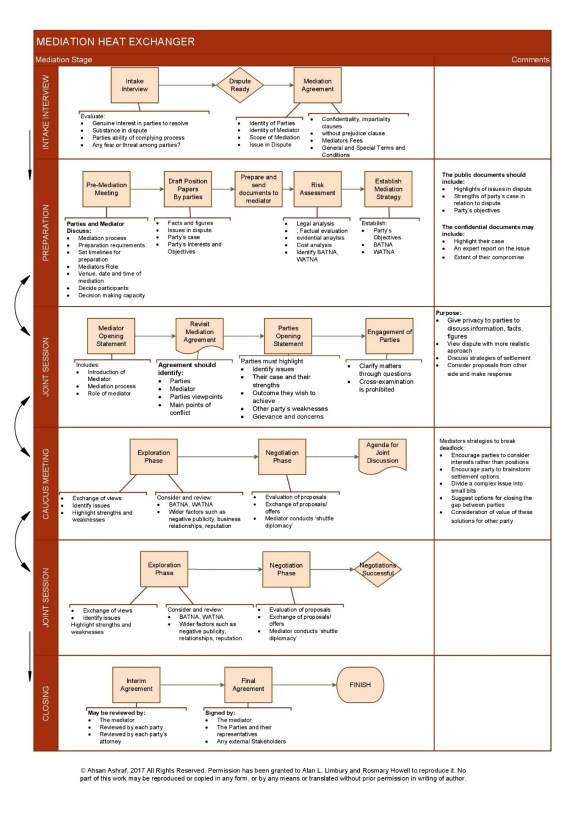
We continued to brainstorm his ideas in class and Ahsan was challenged to translate his ideas into his own version of a mediation matrix which would communicate mediation concepts to his constituency in a way that conventional mediation materials do not. And then – to add even more power to his analogy – he did what all good engineers do.

He constructed a flow chart of his mediation heat exchanger.

I reproduce it below with his permission.

flowchartIt is a great example of the kind of creativity that is valuable for teaching, practising and thinking about mediation.

Perhaps even more importantly, it is an example of cross-disciplinary thinking in the teaching and practice of ADR processes.

Ahsan’s gift to the class (and to me).

[1] Stephen Turns, Thermodynamics: Concepts and Applications (Cambridge University Press, 2006) 492.

[2] James Alfini et al, Mediation Theory and Practice (Lexis Nexis, Second Edition, 2006) 1.

[3] Ibid 33.

Asia Pacific Mediation Forum: Call for Papers

8th Asia Pacific Mediation Forum conference in Vietnam, November 2017

The 8th Asia Pacific Mediation Forum (APMF) three-day conference will be held in Da Nang, Vietnam from 11th to 13th November 2017.

8389794868_04d27b0ae7_b

Dragon or Budha? Photo credit Syromania, Creative Commons

The conference will be convened by Thomas G. Giglione and a Conference Organising Committee in cooperation with the Asia Pacific Mediation Forum, an international organization which aims to promote effective ways to bring peace and cross-cultural understanding to the Asia Pacific region by holding bi-annual conferences in different countries in the region.

The call for papers is now open.

Topics to be covered include the approaches to and management of conflicts and disputes in courts, families, communities, workplaces, education and human resource management, e-commerce and online dispute resolution, cross-cultural dispute resolution, environmental conflicts and land disputes.

To register for this conference or to submit a proposal to present a paper, poster or workshop, please visit the conference website: https://apmf2017.mediation.vn

Early bird registration of USD$286 is available until July 31st 2017 and will then increase to USD $386.


About the Asia Pacific Mediation Forum

The Asia-Pacific Mediation Forum (APMF) was formed in 2001. It is a not-for-profit regional association of individuals, organizations, and institutions interested in promoting peace through mediation and other dispute resolution processes wherever conflicts threaten the well-being of individuals, organizations, communities and local, state or national governments in the region. The main objective of the APMF is to facilitate the exchange and development of knowledge, values, and skills of mediation and other dispute resolution processes, in any form, including intercultural, interpersonal, inter-institutional and international, within and between the diverse countries and cultures in the Asia-Pacific region. To fulfill this objective, conferences are held in the region every two years, with a different country taking responsibility for hosting each conference. To date, successful conferences have been held in Australia, Singapore, Fiji, Malaysia, Thailand, The Philippines and Indonesia. For more information about the APMF go to http://www.asiapacificmediationforum.org


Contact

8th Asia Pacific Mediation Forum

Official Conference Website: https://apmf2017.mediation.vn

Email: support@mediation.vn / thomas@mediation.vn

Global Education Academy: +84 43267 3544

Conference Hotline: +84 12655 39748

Roscoe Pound would be proud – Reflections on the history of the Global Pound Conference

The Global Pound Conference (GPC) series 2016-17 is an ambitious, future-focussed project, established to create a contemporary conversation about improving the access to and quality of justice in commercial conflicts internationally.

pound

Roscoe Pound bust by Avard Fairbanks, Nebraska Hall of Fame – Creative Commons


When complete, the series will have included individual conference sessions involving 29 cities in 23 countries. Several blogs on this site have talked about the GPC series and how it has played out in a number of the host cities. The significant data analysis that has already emerged from the first session in the series (and has become known as The Singapore Report) has also received commentary in these pages.

The ultimate objective is the collection of data from all conference participants using a common set of 20 multiple choice questions (The Core Questions) and four sets of open text questions (The Discussion Questions) to stimulate robust discussion, research and innovation into dispute resolution

As we approach the last of the GPC series, to be held in London in July 2017, it seems timely to go back to where it all began. History informs the present and the future and, in our excitement about the significance of this ambitious project, it is important not to overlook the contribution of the memorable life of the man whose name it bears.

Roscoe Pound (1872-1964) was a remarkable man. Whilst some scholars brand him as ‘the most famous American jurisprudential thinker of the first half of the twentieth century’ and ‘the greatest twentieth century dean of the Harvard Law School’[1] his is hardly the name on every lawyer’s lips. Nor did he fit the mould of your average law school Dean.

Son of a well-known Nebraskan judge, law was not his first choice. Instead he pursued a career and doctorate in botany. Roscoepoundiana – a fungus – was named after him, ensuring his enduring botanical fame. I confess to feeling a twinge of envy!

However family pressure could not be resisted and he entered legal practice (possible in those days without a degree). Enrolling in the one year postgraduate law program at Harvard, family circumstances kept him from completing the exams but not from continuing as a practitioner.

His professional career saw him making memorable and enduring contributions wherever he went. At the Nebraska Bar he helped establish the Bar Association. He was appointed to the University of Nebraska and later became Dean of the Nebraska College of Law (1903-1907). Our students today benefit from his decision to introduce electives into the law degree.

In 1906 the American Bar Association (ABA) invited Dean Pound to deliver the keynote address at its annual meeting in St Paul, Minnesota. His speech, ‘The Causes of Popular Dissatisfaction with the Administration of Justice’, shocked many in his audience. Opening with the line ‘Dissatisfaction with the administration of justice is as old as the law….’- and continuing to chronicle the law’s deficiencies, it is not surprising that his address was not well received and the backlash from the profession provoked withdrawal of the initial decision to print and distribute 4000 copies.

However not everyone was a critic. In the audience was Dean Wigmore, Dean of Northwestern University, who soon persuaded Pound to accept a professorial post at Northwestern and later commented that Pound’s speech ‘struck the spark that kindled the white flame of high endeavour now spreading through the entire legal profession and radiating the spirit of resolute progress in the administration of justice.’[2] Discovering that Pound had not graduated in law, he gave him an honorary degree.

Pound continued his distinguished career teaching and writing, finally settling into the post of Dean of the Harvard Law School (1916-1964) – to this day he remains the only Harvard Law School Dean not to have graduated from law school.

An influential and widely published academic and administrator, by the time of his death in 1964, Pound had still not received the recognition he deserved from the practising profession to which he had contributed so greatly. Whilst not being prepared to issue an apology, the ABA did make a belated acknowledgement of Pound’s contribution to the profession and to legal thinking by awarding him the ABA medal (its highest award) in 1940.

Pound’s writing remained relevant and thought-provoking and he certainly influenced legal thinking. Those he influenced included Chief Justice Warren Burger, (another judge who managed to upset conservatives) defying his sponsor, the anti-progressive Richard Nixon, by upholding the Miranda decision and supporting the majority in Roe v. Wade.

In 1976, 70 years after Pound’s keynote address, the ABA conference returned to St Paul, Minnesota. It was here, at the appropriately named Pound Conference, that the profession finally provided Pound with what amounted to the apology and acknowledgement he so richly deserved.[3]  Joining the ABA as sponsors were the Conference of Chief Justices and the Judicial Conference of the United States. Burger clearly had considerable influence over the program as he is credited with issuing the invitation to Professor Frank E.A. Sander, a notable Harvard academic, to participate. Dealing broadly with various issues of dissatisfaction with the legal system, Dispute Resolution was one stream among a number and many papers were delivered. However it is Sander’s paper’ ‘Varieties of Dispute Processing’[4] that has provided the conference’s most memorable legacy and continued the work begun by Pound in his 1906 address.

This first Pound conference laid the groundwork for the significant world-wide event we are celebrating now. The name is an important link to history and an acknowledgement of the man who inspired it all.

Roscoe Pound would be proud.

[1] See for example Northwestern University’s Professor Stephen Presser ‘Foreword’ in Roscoe Pound, The Ideal Element in Law (Online Library of Liberty, 1958).

[2]  N.T.H Hull, Roscoe Pound and Karl Llewellyn, Searching for an American jurisprudence (The University of Chicago Press, Chicago, 1997) 65.

[3] See ‘Perspectives on Justice in the Future’ Proceedings of the National Conference on the Causes of Popular Dissatisfaction with the Administration of Justice, West Publishing Co., St. Paul Minnesota 1979

[4] Ibid at p.65

Reminder: 6th ADR Research Network Round Table

Monday 4 December to Tuesday 5 December 2017

Hosted by the Legal Issues Centre, University of Otago, Dunedin, New Zealand

ADR Network logo

**Call for Papers Extended until 3 July 2017**


Call for Paper Proposals

The Australasian Dispute Resolution Research Network is pleased to be hosting its sixth annual research round table on 4-5 December 2017. This year we are very excited to be expanding across the Tasman to New Zealand, to be hosted by the Legal Issues Centre, University of Otago, Dunedin. The round table will be held two days immediately prior to the Law and Society of Australia and New Zealand Conference at University of Otago, 6-9 December 2017.

The round tables are designed to encourage a collaborative and supportive research environment in which papers are workshopped and discussed in detail. Papers in draft form are distributed one month ahead of time to participants, to enable thoughtful and constructive quality feedback. In 2017 we will also be asking you to draft a short (1,000 words max) blog post about your paper prior to the roundtable. On the day, speakers are given up to 30 minutes for presentation, with 30 minutes for feedback and discussion. Two primary commentators will be appointed for each paper.

We welcome proposals that consider dispute resolution from a scholarly, critical and/or empirical perspective. We particularly encourage submissions from postgraduate students and early career researchers. All proposal will be considered. Papers must not have been published or submitted for publication, as the focus is work in progress.

There will be a limit to the number of papers able to be part of the round table discussions. A panel will select round table papers from abstracts submitted. The aim is to be as inclusive as time and numbers allow. The following selection criteria will be applied:

  • Papers take a scholarly, critical and/or empirical perspective on an area of dispute resolution;
  • The round table will include a spread of participants across stages of career; and
  • A well-balanced range of work will be presented at the round table to provide diversity, to develop the field and to enable cohesive discussion.

Participation is on a self-funded basis.

Attendance at the Round Table is only open to individuals who are contributing to the scholarly discussions by presenting a paper, or commentating and/or chairing a session.

Deadline for paper proposals:   Now 3 July 2017

(300 word maximum plus short bio, to adrresearchnetwork@gmail.com)

Date for notification: 31 July 2017

Draft (full) papers + blog post due: 30 October 2017 (to send to participants early Nov.)

For further information, please contact:

Conference Convenors and 2017 Network Presidents:

Sue Douglas and Becky Batagol via adrresearchnetwork@gmail.com (monitored twice weekly)


About the Australasian Dispute Resolution Research Network

The Australasian Dispute Resolution Research Network brings together leading dispute resolution scholars and provides a collaborative environment to foster, nurture and enrich high quality research and scholarship. The Network is inclusive and forward-looking and seeks to bring together emerging, mid-career and established scholars to build excellence in the field and provide peer support. Network activities are expressly designed to provide a supportive and collegial presentation environment in which meaningful discussion and constructive feedback is provided to the presenter.


Network activities include maintaining the ADR Research Network blog at www.adrresearch.net  on Twitter and conducting annual scholarly round tables of work in progress since 2012.


Guest blog post proposals are always welcome. Contact blog editor Dr Becky Batagol, at Becky.Batagol@monash.edu.


Membership of Australasian Dispute Resolution Research Network

We don’t like hierarchies or unnecessary administration, so we don’t have any membership list or legal organisational framework.

The way to become a member of the ADR Research Network is to subscribe to the blog. This is our primary means of communication.

Subscription will mean that every time a post is made on the blog you will receive a notification alert to your email address. Other ways to follow blog activity is through Facebook “ADR Research Network” and Twitter, but engagement on these platforms is not necessary to keep track of blog activity.

Working Group on International Arbitration and Conciliation/Dispute Settlement – an opportunity to observe

The UNCITRAL National Coordination Committee for Australia (UNCCA) is now able to send a few observers through the international organisation of lawyers’ association LAWASIA, to UNCITRAL Working Group Sessions.

This call is for expressions of interest to attend the upcoming 67th session of Working Group II on Arbitration and Conciliation / Dispute Settlement. The session, at this stage, is tentatively scheduled for 2-6 October 2017, and will be held in Vienna, Austria.

Blick_von_Stephansdom_Nordwesten

By UrLunkwill (Own work) [GFDL (http://www.gnu.org/copyleft/fdl.html), CC-BY-SA-3.0 (http://creativecommons.org/licenses/by-sa/3.0/) or CC BY 2.5 (http://creativecommons.org/licenses/by/2.5)%5D, via Wikimedia Commons

Work will focus on legislative development on the enforcement of conciliated settlements in two possible forms; as agreed at the end of the 66th session, “the Working Group would continue to prepare both a model legislative text complementing the Model Law on Conciliation, and a convention, on enforcement of international commercial settlement agreements resulting from conciliation.” (More information on the current work of WGII is available at http://www.uncitral.org/uncitral/en/commission/working_groups/2Arbitration.html)

Academics, researchers, and/or professionals whose current work is connected to that of the Working Group, and who could, accordingly, benefit from observing these sessions, are invited to register their interest in attending with:

Dr Dalma Demeter, Chair of the Expert Advisory Committee for Working Group II at UNCCA.

Please send a current CV and a short paragraph explaining why you would like to attend, and how attending the sessions would contribute to your work, to dalma.demeter@canberra.edu.au

by 15 June 2017.

Please note that there are only limited places available, and neither UNCCA, not LAWASIA are in the position of providing funding.

A big pair of shoes has been filled


Book launch

Rachael Field and Laurence Boulle celebrate the launch with Hilary Astor, Members of Resolution Institute and the ADR Research Network


In late May, Resolution Institute was the venue for the launch of a significant new text on Dispute Resolution – Australian Dispute Resolution – Law and Practice (LexisNexis, Sydney, 2017) authored by Resolution Institute members, Laurence Boulle and Rachael Field.

The launch was significant for academics and practitioners alike for several reasons.

The first was the acknowledgement of the pioneering work of Hilary Astor and Christine Chinkin whose original text, Dispute Resolution in Australia, was the ‘go-to’ resource for academics and practitioners alike. It was outstanding in its coverage and depth. Academics like me drew on it heavily and valued its breadth and the conversations it provoked.

This new text picks up the themes of its predecessor and updates them for todays’ dispute resolution challenges. It was a masterstroke to invite Hilary Astor to make the introductory comments and formally launch the publication. Her presence and script were great reminders of the remarkable scholarship that has been available to us since Dispute Resolution in Australia was first published in 1992.

Respecting where we have come from, as we explore future directions, is an appealing symbol of how we have developed as a dispute resolution community.

At the launch, Rachael and Laurence shared the secrets of their successful collaboration which gave us a sense of how challenging they found the responsibility of filling Astor and Chinkin’s ‘big pair of shoes’.

Laurence chose an unexpectedly poetic approach to describe to us the joys of collaborating with Rachael and I reproduce it below with his permission.


“Fieldsy and Bill

A DR Fairly Trail

Three score and seven months ago this Odyssey began

Intrepid Fieldsy taking charge, with vision and elan,

To turn established text into a third, more sage, edition

ADR, law, identity, much theory in addition.

Too onerous proved this arduous task for authors, young and free,

They forged a brand new first edition – with cover girt by sea.

The text prolapses ADR, and DR comes to fore,

One letter less, efficiency, the modern troubadour

DR is law’s true business, and the future task of lawyers

Though other disciplines bring great skills as DR purveyors.


Rachael creates matrices with fierce analysis

And practice has its rightful place – or better still praxis,

She critiques Priestly’s saintly core with missionary fervour

Though herself is, reverently, a god-fearing verger.

In every field young Fieldsy brings a rigour to the joust

Her style so mellifluous recalls the prose of Proust

Judges are too recalcitrant and theorists far too thin

She trumps them one by one with acerbic verve, and gin,

Bill looks on half-dazed as her libretto forms apace

Just minor emendations to claim his cover place


Disputes twixt Bill and Fieldsy? There were a somewhat few

The comma matter not resolved, it caused a constant blue.

For Rachael, every, word, must, have, its, punctuation, own,

ForBillajumbledflowofwordsnosyncopationzone


Now here’s a tale not told before, though every word is true,

Bill inveigled Fieldsy long to move to Bond uni

Abandon Brisbane’s creek and drudge and start again anew

Resistance was her sad retort, excuses thickly grew.

The strangest part: once Bill departs for Sydney waters twee

Then Rachael moves to Bondy’s place with stark alacrity

In truth she’s now resolved to move to Sydney Harbour Bridge

Once Bill has used his GPS to reclaim Bogun ridge.


One note of serious concern amidst the frippery

Concerning current happenings with lack of policy

How serious is the plight of those who flee from ravaged lands

Out-trumped by bigotry and fear, excuses weak and bland,

Asylum-seekers, refugees, minorities galore,

The flames are fanned by news corp hacks, the jocks and many more

Where is DR’s noble soul in contexts such as these?

That is a challenge we must face, so join a movement please.

To take on privilege and power, denial atmospheric,

Post-truth, untruth, and spin and sin, every sad heuristic.


But to end on sombre tones might seem a trifle crook

For cheerful lives and value add – you just should buy the book.

Thanks are due to Jocelyn Holmes and to Lexis Nex,

At RI Ellie, Brian and more provided superb flex

Hildegard of Bingham was a prophet most acute

Hilary of Astoralia from whom DR took root

Has graced us with her words and we extend our thanks

For legacy contributions and setting the early pace


I now must end abruptly too these rhymes sore terrible

Lest there be those who shout aloud ‘Enough, far too much bull.’


Congratulations Rachael and Laurence. I look forward to where this text will take our teaching and learning.

Trust and relationship building in native title negotiations

The following post is by a member of our Network – Lily O’Neill. Lily is a negotiation researcher looking primarily at native title negotiations.  She also teaches Dispute Resolution at Melbourne Law School, and presented her PhD research at the civil justice conference in Adelaide in February.

This blog post considers the importance of trust and relationship building in native title land access negotiations. It focuses on the negotiations that led to the Browse liquefied natural gas (LNG) agreements of 2011.[1] Like the literature on negotiation and mediation more broadly, building trust and good working relationships between governments, traditional owners and companies is often said to be a key potential benefit of these negotiations. Yet, as detailed here, there is a danger that negative impressions formed during negotiations can colour participants’ views of opposing parties’ motivations, even when they believe a reasonable deal has been struck.

The Browse LNG agreements, concluded by Goolarabooloo/Jabirr Jabirr traditional owners, Western Australia and Woodside Energy in mid 2011, were said to be worth $1.5 billion to traditional owners, and ‘much more positive’ than those typically achieved in negotiations between extractive industries and Aboriginal people.[2] These agreements were negotiated between 2007 and 2011.

Interviewees from all negotiation parties agreed that trust and relationship building should be important goals of native title negotiations, noting that they are particularly important attributes for implementing an agreement. Wayne Bergmann of the Kimberley Land Council, for example, said that where parties do not have a good relationship, agreements “don’t deliver half of what they should”.

However the parties viewed the negotiations in very different terms after the agreement was concluded. Negotiators from Western Australia and Woodside largely felt that while the negotiation had been “robust”, it had resulted in significant trust developing between all parties. One government negotiator described the feeling in the negotiation room as like:

“Stockholm syndrome – everyone became committed to each other in some sort of way or affected by the outcome and the desire to not see hurt, the desire to see everyone come out as a winner.”

Traditional owners and those working for them expressed a very different view. The negotiations were “long, protracted, quite bloody”, said one. Western Australia and Woodside had been “disingenuous” and had viewed traditional owners as “a thorn in their side … and they would do almost anything to get that thorn out”, said another. Of the company, a traditional owner said “you can’t take them at face value, they bullshit you.”

When interviewees were asked why parties had such different views of this aspect of the negotiations, two key reasons emerged.

The first was that traditional owners felt at a disadvantage in negotiations. A negotiator for traditional owners said:

“I think that we always had the David and Goliath, so we were very defensive.  Ready to take offense at anything, even sometimes when I don’t think they were actually intending to. If you think you are the underdog and you are fighting your way up, you have a certain attitude.”

The second was that both professional and non-professional negotiators conducted negotiations. Two senior government officials observed that traditional owners who had never experienced commercial negotiations were sometimes visibly upset by adversarial tactics because “they weren’t in on the gamesmanship of it all”. One reflected that Western Australia’s negotiation approach might have been different had they known from the outset that non-professional negotiators would be in the negotiation room.

These are lessons that are useful for all types of negotiations where trust and relationship building should be key negotiation outcomes.

[1] The information contained in this blog post is based on my PhD research: see Lily O’Neill, ‘A Tale of Two Agreements: Negotiating Aboriginal Land Access Agreements in Australia’s LNG Industry’ (PhD thesis, 2016). Available https://minerva-access.unimelb.edu.au/handle/11343/111978. This research used a comparative case study analysis to empirically examine the land access negotiations that led to agreements for Browse LNG in the Kimberley, Western Australia, and Curtis Island LNG in central Queensland. Among other data, it analysed 53 interviews conducted with negotiation participants from all negotiation parties.

[2] Ciaran O’Faircheallaigh, ‘Extractive Industries and Indigenous Peoples: A Changing Dynamic?’ (2013) 30 Journal of Rural Studies 20, 28. Note that in April 2013 Woodside announced that it was pulling out of the development option as detailed in the agreements, leaving large aspects of them likely unenforceable.

Global Pound Conference Sydney

I’m participating today in the Global Pound Conference (“GPC”) Series in Sydney. Taking its inspiration from the original Pound Conference, the purpose of this worldwide Series of conversations is to explore what can be done to improve access to justice and the quality of justice around the world in civil and commercial conflicts. The title of the GPC Series is: Shaping the Future of Dispute Resolution and Improving Access to Justice.

As you might expect, there is a lot of agreement in the room about the importance of DR and the role of DR practitioners in achieving access to justice through DR practice in commercial and civil matters. This is important because many people here are lawyers. It is encouraging to hear partners of top tier law firms affirming the place of DR approaches (and particularly non-litigation DR approaches) in legal practice. It is sobering but important to hear the perspective of these successful practitioners that law school is not equipping young graduates with the necessary knowledge, skills and attitudes that practising law in 2017 requires. That is, they’re saying that young law graduates don’t have the necessary knowledge about DR theory and practice, they don’t have the necessary DR communication and relational skills, and they don’t have the necessary self-management and reflection skills.

This brings me back to my soapbox point about the need to teach DR as a core compulsory subject in the law curriculum. If lawyers are to be able to adequately and ethically advise and guide their clients in order to manage and resolve their disputes effectively they certainly do need to be able to work with the substantive law, but they also need to be able to:

  1. Diagnose a relevant dispute resolution process that will enable the dispute to be resolved in a way that addresses the best interests of the client.
  2. Communicate effective, practical DR advice and generate creative solutions.
  3. Work in practice groups.
  4. Recognise, reflect upon, and respond to, ethical issues arising out of the legal dispute and its resolution.
  5. Reflect on and assess their own professional capabilities and performance.

DR subjects are very well-placed to equip students with this suite of knowledge, skills and attitudes.

​The Global Pound Conference series is an important innovation that will generate important data relevant to convincing the Law Admissions Consultative Committee about the appropriate place of DR in the Priestley 11 subjects required for admission to legal practice in Australia.

You can see here the core questions​ that are part of the GPC Series research element.

You can also explore the website to find out more about the Series: http://globalpoundconference.org/

I want to commend the organisers of the Sydney series – the organising committee, and the Resolution Institute (https://www.resolution.institute/), its CEO Fiona Hollier and her amazing team.

Congratulations also go to one of our ADR Research Network members – Emma-May Litchfield – who is leading the research component of the GPC. This is important work that will provide the DR community with a critical evidence base.

Justice in DR = Fairness?

This second blog in the series for May on the values and goals of DR is also adapted from Chapter 4 of: Laurence Boulle and Rachael Field, Australian Dispute Resolution – Law and Practice (LexisNexis, 2017).

Much of the DR literature about justice connects or conflates it with notions of fairness. NADRAC, for example, noted in its 1997 Discussion Paper on Issues of Fairness and Justice in Alternative Dispute Resolution, that the words justice and fairness ‘are essentially interchangeable’. [1] The word ‘fair’ is mentioned 179 times in volume 1 alone of the Productivity Commission’s 2014 Report on Access to Justice, often in conjunction with words such as ‘justice’, ’equity’, ‘transparency’ ‘openness’ ‘dignity’ and ‘reasonableness’. It has been said that ‘a just result must be a fair result’.[2]

Albin in her seminal article ‘The Role of Fairness in Negotiation’ identifies fairness as a ‘slippery concept’ but one which is an influential factor in DR across diverse cultures and disciplines.[3] Albin refers to justice as a macro concept which points to ‘what is right and wrong’.[4] Fairness on the other hand is seen as a concept in DR contexts that has a less definitive and a more practical, contextualised and individualised nature.[5]

It may not be possible to identify all the elements of fairness in DR with universal acceptance.[6] As Albin says: ‘fairness is an element of acceptability’,[7] and acceptability is something which is judged subjectively. In DR processes other than litigation this is often expressed as ‘what the parties can live with’.[8] The outcome may not be perfect but if the process is considered to be fair, it may thereby be seen as just and consequently acceptable to the parties. It is a challenging task, then, to develop a values framework of general application for DR that is relevant to processes across the matrix, especially if such a framework is to include a conception of justice as fairness which is responsive to the relevant individual and subjective perspectives of parties in dispute.

It would not be a satisfactory conception of fairness as a value for DR, however, if it were simply a postmodern blank canvass of individual perceptions. It is necessary to identify some core elements of fairness across DR systems.  Frey’s articulation of a ‘first class dispute resolution process, whether litigation or an alternative process’ refers to ‘impartiality, a just process and a just result’.[9]  These elements sit consistently with Albin’s identification of fairness as: structural fairness, process fairness, procedural fairness and outcome fairness.[10] They are also in accord with NADRAC’s focus on fairness and justice in procedure and outcome.[11]

What we know from brain research is that it is important for humans to perceive that they are being treated fairly. This is because being treated fairly is said to ignite the brain’s reward circuitry. UCLA scientists reported in 2008, for example, that ‘the human brain responds to being treated fairly the same way it responds to winning money and eating chocolate’.[12]

The significant body of scholarship and literature on the topic of fairness leads us then to suggest three process goals that contribute to the enactment of the macro value of justice in DR. These goals are: procedural justice (fair process), substantive justice (fair outcomes) and impartiality. The satisfaction of these goals is the safeguard that critics of processes other than litigation find lacking, and when these fairness-related goals are achieved, whatever the DR processes is, it can be regarded as true to the value of justice. In the blog posts that follow in the coming days of May I offer an analysis of the process goals of procedural and substantive justice and impartiality to further elucidate the nature of justice in DR systems.

Comments or responses to these thoughts are most welcome at any time!

[1] NADRAC, Discussion Paper on Issues of Fairness and Justice in Alternative Dispute Resolution (Commonwealth of Australia, 1997), 20. See also, Cecilia Albin, Justice and Fairness in International Negotiations (Cambridge University Press, 2001).

[2] Martin A Frey, ‘Does ADR Offer Second Class Justice?’ (2000) 36 Tulsa Law Journal 727, 727.

[3] Cecilia Albin, ‘The Role of Fairness in Negotiation’ (1993) 9(3) Negotiation Journal 223, 223.

[4] See Morton Deutsch, Distributive Justice: A Social Psychological Perspective (Yale University Press, 1985) and Michael L Moffitt and Robert C Bordone, The Handbook of Dispute Resolution (Jossey-Bass, 2005) 90.

[5] Albin, above n 3, 225.

[6] Ibid. Carrie Menkel-Meadow, ‘Whose Dispute Is It Anyway: A Philosophical and Democratic Defense of Settlement (In Some Cases) (1994) 83 Georgetown Law Journal 2663.

[7] Albin, above n 3, 225

[8] Menkel-Meadow, above n 6.

[9] Frey, above n 2, 727.

[10] Albin, above n 3, 225.

[11] NADRAC, above n 1, 20.

[12] Stuart Wolpert, ‘Brain Reacts to Fairness as it Does to Money and Chocolate, Study Shows’ UCLA Newsroom Science + Technology April 21, 2008, 6. See also, E Allan Lind, ‘Fairness Heuristic Theory: Justice Judgments as Pivotal Cognitions in Organizational Relations’ (2001) 56 Advances in Organizational Justice 88.