Could mediation transform democracy?

Mediation is commonly conceived as a mechanism for resolving disputes that would otherwise be settled through the courts. However, could mediation potentially be used for reaching agreement on other social issues—including those that would be decided by the executive or parliament? A recent interesting article by Richard Schmitt in the Journal of Social Philosophy explores this possibility.

Democratic decision-making is generally associated with the electoral process. Recent discussions have also explored the prospects of deliberative democracy, where elections are supplemented or even replaced by joint deliberation among citizens. Schmitt argues that mediation represents a third possible type of decision-making mechanism that has been neglected in the literature on democratic theory and practice.

Schmitt discusses some examples of groups that rely on mediation to make collective decisions. His main example is the Society of Friends (or Quakers). The Quakers, Schmitt notes, ‘have developed techniques over several centuries which allow groups to deliberate together without the conversation degenerating into bitterness and shouting, instead reaching agreements that meet no opposition’ (233).

At a Quaker business meeting, as Schmitt describes it, members sit quietly until moved to speak. They say their piece, but do not seek to defend their perspective against others. They merely offer it for consideration by the group. Members also do not criticise the viewpoints offered by others. ‘The focus’, Schmitt observes, ‘is not on “giving reasons”’ as is so often the case in deliberative democracy (234).

Members do not raise their voices, interrupt or try to win an argument. Instead, they silently consider what they have heard. At some point, an attempt is made to articulate the consensus of the meeting. Members may suggest amendments to this formulation. At the end, if nobody objects, the consensus will be adopted, not because everyone necessarily agrees, but because ‘no one is deeply troubled by it’ (234).

It is often assumed that unanimity is not possible in democratic decisions. Majority rule is always needed. However, Schmitt argues that the example of the Quakers shows this to be false. It is possible to achieve unanimity, even if not everyone agrees on everything, if the right kind of decision-making process is followed. This also requires, of course, that participants follow shared ground rules in good faith.

The process followed by the Quakers, as Schmitt observes, has much in common with mediation. It avoids rights-based discussions or positional bargaining. Instead, it allows participants to articulate their viewpoints without interruption, then encourages them to reach an outcome everybody can live with. The aim is not for someone to win, like in  court, but for everyone to walk away with something they can accept.

One shortcoming of Schmitt’s article is that his discussion of mediation is a bit out of date. For example, he describes the mediator as a ‘professional neutral’ without acknowledging the current lively debates about whether mediator neutrality is desirable or possible (237). Nonetheless, he captures some of the key features of mediation, such as the role of ground rules and the focus on exploration and option generation, showing their potential application to group decisions.

Mediation generally involves a relatively small number of parties. However, Schmitt argues that it can be applied to larger social groups. He discusses some examples of this, such as an effort by the Centers for Disease Control to reach consensus among 110 stakeholders from organisations with different views on HIV/AIDS. The mediators divided the stakeholders into teams and guided them through a facilitative process. This was successful in producing areas of consensus across the whole group.

Schmitt raises and responds to a possible objection to mediation as a democratic process. The worry is that mediation may be undemocratic, because it involves small groups making decisions on behalf of the whole community (243). Schmitt argues this is not necessarily a problem, provided that the small groups are representative, well informed and transparent. The general public can give feedback and views to the stakeholders directly involved in the mediation.

Schmitt’s response to this challenge, in my view, overlooks another, more radical possibility. What if we think of society not as one big group, but as a collection of many, overlapping smaller groups? If these smaller groups adopted mediation as a way of seeking consensus on specific issues, then one might expect areas of consensus to emerge organically in the community as a whole. (I explore this kind of possibility in my own current work on small justice.)

Could mediation transform democracy? Does it offer a genuine alternative to the electoral process and existing forms of political deliberation? The prospect of mediated outcomes taking over political discourse may seem far fetched in the current political environment with its partisanship, bargaining and rancour. However, mediators have always been innovators and risk-takers. It seems fitting that they could also be the ones to reshape democracy as we know it.

The Empty Idea of Mediator Impartiality

Jonathan Crowe and Rachael Field

RF and JC ImageMediation ethics has traditionally given a central role to the notion of mediator neutrality. The idea that mediators are ethically obliged to be neutral, however, has come under increasing attack in recent decades. Numerous scholars have argued that traditional views of mediator neutrality are unrealistic and unhelpful for mediation practice.[1] This is because they overlook the humanity of the mediator and ignore the reality of power imbalances in the mediation process. It is unrealistic for mediators to be wholly neutral, because they are human beings with their own perspectives and biases. Mediator neutrality is also unhelpful to the parties, because it robs the mediator of the ability to intervene actively in the process where needed and ensure that all parties achieve meaningful self-determination.

Some authors, such as Laurence Boulle,[2] have suggested that these criticisms can be avoided by shifting the focus from mediator neutrality to mediator impartiality. It may not be realistic, the argument goes, for mediators to be entirely neutral, but they can and should aspire to be impartial between the parties. This shift from neutrality to impartiality was taken up in the work of the National Alternative Dispute Resolution Advisory Council (NADRAC) and subsequently incorporated into the National Mediator Accreditation System (NMAS) of 2015.

We argue in a recent article, however, that this shift from neutrality to impartiality is unconvincing and lacks practical efficacy.[3] There are two main reasons, in our view, why focusing on mediator impartiality does not solve the problems confronting the traditional paradigm of mediator ethics. The first is that the distinction is too technical to make a real difference in how the mediation process is understood in practice. The distinction speaks perhaps to people who are steeped in the details of mediation terminology, but not to the ordinary party who comes to mediation for assistance with managing or resolving their dispute, seeking a transparent, fair and ethical process. Indeed, for most people, neutrality and impartiality mean the same thing, with the terms often used interchangeably.

The second problem with the distinction between neutrality and impartiality is that the notion of impartiality, as defined by authors such as Boulle, still encounters many (if not all) of the challenges that beset the traditional concept of neutrality. Boulle’s identification of impartiality with fairness, we would argue, is too simplistic. Treating parties with different and complex power dynamics between them in a way that prioritises ‘even-handedness [and] objectivity’,[4] as those terms are usually understood, will favour the more powerful party, in a way that would not be allowed by a genuinely fair process. This is because such an approach will generally entail giving the parties identical or similar treatment, even where they are differently situated or face distinct challenges. The notion of impartiality, in this respect, invites a similar critique to the more traditional idea of neutrality.

It would be possible to avoid this objection to mediator impartiality by interpreting the ideas of even-handedness and objectivity in a more creative and non-traditional way. This would involve saying that mediators can be even-handed and objective even if they treat the parties differently, provided that they do this in an ethically appropriate manner. However, this way of understanding mediator impartiality is of little assistance to mediators and parties in grasping the ethical framework, unless it is supplemented with a more detailed account of when mediator interventions are ethically appropriate. The basis for such an account, we suggest, has to come from some more fundamental ethical notion, rather than from impartiality itself. The idea of mediator impartiality is therefore empty: it either reproduces the traditional problems of mediator neutrality or offers little guidance on the mediator’s ethical role.

Merely shifting the emphasis to mediator impartiality fails to solve the dilemmas posed by the concept of neutrality. A more fundamental rethinking of mediation ethics is needed if we are to avoid the shortcomings of the traditional paradigm.  We suggest in our forthcoming book, Mediation Ethics: From Theory to Practice, that the better approach is to cease to treat mediator neutrality or impartiality as a guiding value of mediation practice, instead emphasising party self-determination. This framework recognises and legitimises the ethical choices mediators routinely make in response to information deficits or power imbalances, rather than seeking to shoehorn them into a modified version of the traditional paradigm.

[1] See, for example, Rachael Field, ‘Mediation and the Art of Power (Im)balancing’ (1996) 12 Queensland University of Technology Law Journal 26; Hilary Astor, ‘Rethinking Neutrality: A Theory to Inform Practice – Part I’ (2000) 11 Australian Dispute Resolution Journal 73; Rachael Field, ‘The Theory and Practice of Neutrality in Mediation’ (2003) 22(1) Arbitrator and Mediator 79; Bernard Mayer, Beyond Neutrality: Confronting the Crisis in Conflict Resolution (Jossey-Bass, 2004).

[2] Laurence Boulle, Mediation: Principles, Process, Practice (Butterworths, 1996) 19-21; Laurence Boulle, Mediation: Principles, Process, Practice (LexisNexis, 2nd ed, 2005) 30-36; Laurence Boulle, Mediation: Principles, Process, Practice (LexisNexis, 3rd ed, 2011) 71-80.

[3] Jonathan Crowe and Rachael Field, ‘The Empty Idea of Mediator Impartiality’ (2019) 29 Australasian Dispute Resolution Journal 273.

[4] Boulle, Mediation: Principles, Process, Practice (1st ed) 19.

Creating the leaders of the future – we need to broaden our focus on soft skill development in order to achieve organisational success

As we enter what is being referred to as the ‘Fourth Industrial Revolution’, characterised by its rapidly changing, technology focused and competitive environment, organisational leaders are faced with new challenges when striving to achieve organisational success. According to recent research undertaken by McKinsey & Co across the USA and Europe, we are facing a significant shift in the skills employees and leaders will need to achieve success. Not surprisingly, it is expected that between 2016 and 2030, the hours spent using technological skills (advanced IT skills, programming and basic digital skills) will increase by 55%. This is only part of the picture however as the research also indicates that the use of ‘social and emotional’ skills will increase by 25% in the same period. The types of skills classified as ‘social and emotional skills’ include advanced communication and negotiation skills, empathy, leadership skills, adaptability and coaching, skills that are often referred to as ‘soft skills’.

Whilst some organisations and educators at all levels (primary, secondary and tertiary), have invested a great deal of time and effort in preparing for the technological skill shift, there has been arguably much less focus on preparing for the increased need in ‘soft skills’.

Current research being undertaken at James Cook University (JCU) is focused on gaining a deeper understanding of the skills and behaviours required by organisational leaders to deliver organisational success now and into the future within the Australian context. Furthermore, the research is seeking to identify where there are perceived significant gaps between skills required in future leaders and those being observed in prospective organisational leaders (graduates and junior managers). Early results highlight the importance of ‘soft skills’ and recognise a significant gap in these skills within the current work environment.

Skills required by our future leaders

As part of the research project at JCU, organisational leaders in Australia operating across public, private and not-for-profit sectors were invited to participate in semi-structured interviews and complete a questionnaire. The research participants are working across a range of industries including health, human services, banking, mining, sustainability, higher education and insurance. When asked what skills and capabilities are required in order to lead an engaged and productive workforce, the research participants identified authentic engagement, connection and communication with staff as the most important skills. These were immediately followed by the ability to self-reflect, empathise, remove barriers and support autonomy across the workforce, motivate and stretch staff, create and clearly articulate a vision and purpose and to be able to connect staff contributions to the organisations vision and purpose.

Other important skills and abilities identified included the ability to engage in courageous conversations, deal with ambiguity and create clarity out of chaos, establish great networks to gain broader insights, be adaptable and transparent. Participants also highlighted the importance of creating a culture of ‘team’ where you felt safe, supported and felt your leader had ‘your back’ and believed in you.

Specifically, interviewees stated:

‘I think we know that where people feel safe, valued and empowered and asked to be their real genuine authentic self they come forward with new ideas’

[General Manager, one of Australia’s top four banks]

‘(a leaders) intelligence can be up and down …… I don’t think any of that matters because great leaders get the right people around them and that support enables them to deliver the best outcome.’

[Senior Manager, Organisational Development, State Government]

When asked to identify what skills and behaviours will be most important for the leaders of the future, the top 20 skills and behaviours identified were all ‘soft skills’ relating to either self-management or people management. Interestingly, these outcomes correlate with those identified through a research study conducted by Google that looked at the hiring, firing and promotion data accumulated since 1998, to identify the eight (8) most important qualities of their top employees. The project was titled ‘Project Oxygen’ and it found that out of the top eight skills, seven (7) were skills that would be considered ‘soft’ or ‘higher cognitive’ skills.  The top seven characteristics at Google, according to this research, are:

  • Being a good coach;
  • Communicating and listening well;
  • Possessing insights into others (including others different values and points of view);
  • Having empathy toward and being supportive of one’s colleagues;
  • Being a good critical thinker and problem solver;
  • Being able to make connections across complex ideas.

The eighth and final characteristic is subject matter expertise, namely STEM expertise.

Where is the gap?

A recent study by Deloitees involving 4000 Gen Z participants found that 37% experience concern that technology is weakening their ability to maintain strong interpersonal relationships and develop people skills. Deloittes insights paper on “Generation Z enters the workforce” states:

whilst these digital natives may bring an unprecedented level of technology skills to the workforce, there are some apprehensions about their ability to communicate and form strong interpersonal relationships.

Specific concerns include,

Technology has impacted the development of cognitive skills, including intellectual curiosity, amongst the next generation, creating the risk of skill gaps when they enter the workforce en masse. A shortfall in highly cognitive social skills such as problem solving, critical thinking, and communication, could be particularly evident.

The ability to skillfully interact and communicate with others not only contributes to successful relationships but also drives accumulation of tacit knowledge, which is usually passed down through decades of communication and collaboration in a work place. This may include specific information relating to processes, customers and other things, like culture. This type of knowledge is difficult to transfer through the digital realm as it is ‘rooted in context, observation and socialisation’. The Deloitte paper discusses how the communication skill gap in Gen Z may potentially hinder the transfer of tacit knowledge.

The JCU research results also highlight the critical gaps that are perceived to currently exist within Australian workplaces between critical skills required of a good leader and observed competency of emerging leaders in these skills. Research participants were asked to rank the ‘level of importance’, and then rank the ‘observed general competency’, of skills demonstrated by potential leaders within their organisations. The highest level of discrepancy between ranked level of importance and observed competence of prospective leaders was ‘the ability to manage conflict’. This was followed by six other people management skills, namely the ability to; influence others, delegate, motivate others, negotiate, inspire others, give positive and negative feedback, empower others and develop others.

Research participants observed that the areas where the skill gaps appear minimal include: setting specific goals and targets, self-confidence, passion, optimism, making analytical decisions, innovation and assertiveness.

Why is this relevant for Conflict Management and Resolution Practitioners

Through literature reviews, semi-structured interviews and questionnaires, the JCU research has found a significant overlap between the skills required to be a good leader and the skills required to be an effective CMR practitioner. These skills include:

  • Honesty
  • Self-awareness
  • Comfortable with uncertainty
  • Able to hold multiple perspectives
  • Identify options
  • Behavioural observation
  • Emotional intelligence
  • Understand broader views
  • Empathy
  • Active listening

As such CMR Practitioners will have the opportunity to play a critical role in addressing the gap in ‘soft skills’ and supporting organisations to build, develop and improve on their soft skills within their leadership (current and future) cohorts. This may be achieved in a number of ways including:

  • Practitioner – helping organisations to manage an increasingly high volume of workplace conflicts as a result of leaders not having the capability to manage or resolve conflict themselves.
  • Capability builders– educating and supporting organisations to build the capacity of their workforce, including bespoke training on important skills such as resilience communication, feedback, and other ‘social and emotional’ skills.
  • Taking on leadership positions – as many of the skills are transferable some CMR practitioners may choose to utilise their skills by taking on operational leadership roles.

All research participants were clear on the importance of investing in skill development for their workforce’s. One participant stated:

[Need to invest in the soft skills….] ‘without those skills you are not going to have a very good workplace, you are not going to have engaged staff, it leads to all sorts of issues, so it’s well worth investing in.’

[Senior Leader, Tertiary Education]

Therefore, as CMR practitioners, we may find increasing demand for our services and an expansion in the types of roles that exist for individuals who are competent practitioners and trainers in social and emotional skills.

Claire Holland and Amaya Mo presented on their research at the National Mediation Conference in April 2019, and a publication of the results is forthcoming.

Amaya is the Principal of Zing & Co, a management consultancy specialising in creating, developing and supporting high performing, engaged, happy and resilient workforces. Amaya is also a lecturer and researcher in the JCU Conflict Management and Resolution Program.


Can Mediation transform complaints between pet owners and veterinarians?

Jane Rose, a Veterinarian and JCU Master of Conflict Management and Resolution student shares her views on the opportunity to use facilitative mediation as part of a regulatory and complaints processes prescribed in the legislation governing veterinary practice in New South Wales (NSW). Jane’s blog post focuses on the NSW Veterinary Practice Act 2003 and has been co-authored with JCU Conflict Management and Resolution Lecturer, Rikki Mawad.

Conflict and Complaints in Veterinary Practice

It is not uncommon for mistakes to be made, costs to escalate and communications to break down between Veterinarians and Pet Owners. As with complaints in relation to human health care, disputes in relation to veterinary practice are invariably related to client dissatisfaction with a veterinary practitioner or the treatment outcome. Veterinarians practice in busy, emotionally charged small clinical businesses and have to make decisions in quick succession with little time for effective communication between team members and at times, impacted families. Each practice is a small business, standards can vary, and an external body does not audit the daily delivery of veterinary medicine.

A common example of conflict between veterinarians and pet owners is in relation to costs. While care costs are discussed at the beginning of treatment with pet owners, these can change unexpectantly. It is not uncommon that a patient may respond adversely to a procedure or for a new problem to be discovered and for the owner to not be contactable, leaving the care team to make critical decisions in the moment. The result of this is often a larger bill, and at times, unexpected euthanasia. The human impact can result in an angry and or grieving client, a stressed veterinarian and a possible hearing before the Veterinary Practitioner’s Board.

Prescribed Dispute Resolution Processes

 The Veterinary Practice Act (VPA) 2003 regulates the provision of veterinary services NSW.  The Act requires the establishment of a State Board as the regulatory authority, with one function of the authority being the investigation of complaints against veterinary practitioners. The Board recommends that concerns about veterinary practice are first raised with the veterinarian or clinic superintendent. If complaints are not able to be resolved directly between the veterinarian or the clinic superintendent and relate to animal healthcare, the complainant can raise their matter with the VPA State Board.

When the Board receives a complaint, the matter is investigated, experts may be called to give evidence and then a determination is made as to whether the practitioner has breached the Act and what sanctions may apply.

For matters that do not involve a breach or finding of misconduct, there are is no further recourse other than a separate legal action. Often however, the complaints process has further damaged both parties’. Not only does the complainant still feel aggrieved, the practitioner also still feels attacked and untrusted and there is a lingering fear of litigation.

(Un)Resolved Matters

For those involved in a dispute, the journey to resolution of a complaint is often long and arduous for all parties. For veterinarians, complaints can be mentally and emotionally demanding, and take them out of delivering clinical care and out of their businesses. Like medical practitioners, the fear of litigation has impacted the delivery of animal healthcare, with veterinarians increasingly forced to practice defensive medicine and with pet owners increasingly pursuing legal action beyond the regulatory body. Defensive medicine refers to departing from normal medical practice as a safeguard to litigation. It can involve unnecessary tests being performed, or treatments prescribed to be safe, and on the converse risky procedures, that could benefit patients, are avoided, serving the function to protect the physician.

Through the investigation and determination process, there is little to no scope for either party to present on and discuss their interests or needs, therefore preventing an opportunity for the conflict to be transformed. While serious misconduct must be addressed, the dispute resolution framework used by the Board doesn’t offer any opportunity to restore a complainant’s faith and trust in the veterinary profession or allow for any understanding of a practitioner’s perspective. The lack of communication (directly or facilitated by a third party) between the disputants thwarts any opportunity for understanding, forgiveness, apology and or reconciliation regardless of whether there has been a finding of a breach. When no breach has been found, the process has still further damaged both parties’ relationships and little has been done to address the fact the complainant is still aggrieved and the practitioner still attacked and untrusted.

In the author’s experience, the majority of complaints arise due to miscommunications between client and practitioner, accidental mishaps, communication breakdown with the practice team or sometimes acts of nature where an animal has a grave reaction that could not be foreseen. Given the root causes of these complaints tends to be miscommunication rather than misconduct, the author suggests there is much to be gained by introducing mediation into the VPA dispute resolution process.

 Better Resolution, Regulation and Relationships through Mediation

With mediation often used in human medicine to resolve clinical, bioethical and medical malpractice disputes to save time, money, emotional energy and lost opportunities, why not introduce facilitative mediation into animal medicine? Using a facilitative mediation process as a precursor to or part of a formal process under the Act arguably gives the parties the opportunity to better address the substance of a complaint, create shared understanding of the issues and potentially party-generated more effective options for resolution.

Other jurisdictions have already moved to include facilitative mediation as part of their regulatory regimes. The Royal College of Veterinary Surgeons (RCVS) in the UK for example found that facilitative mediation should be employed early in veterinary disputes. It was their recommendation that facilitative mediation form part of the dispute resolution framework as a way to improve client interactions, the delivery of care and to better support veterinarians overall in their work/as a profession.

The majority of complaints raised by pet owners in the United Kingdom, like in Australia, fall outside of the professional misconduct remit of the governing body. In these situations, the RCVS has embraced mediation as a way to resolve complaints and allows concerns, that fall outside of the professional standards remit, to be resolved to both parties’ satisfaction. The scheme has reported success with 78% of cases resolved after being sent to mediation (BVA 2017).  While the UK approach is only in the early stages, it is already showing huge promise as a better, less adversarial, confidential environment for constructive communication between disputing parties that can only add value to the profession (and the clients). In cases of gross professional misconduct, litigation is likely to remain the most appropriate remedy, however facilitative mediation can still assist to work through the parties’ emotional needs and interests.

Reducing the Impact of Complaints through Mediation

In 2016, thirty-three complaints were submitted to the Veterinary Practitioners Board of New South Wales (VPBNSW).  Eight were upheld and the veterinarians were found guilty of unsatisfactory professional conduct or professional misconduct.  The remaining 75% of complaints were dismissed. Moreover, since 2010, new complaints raised against veterinary surgeons has risen from 42 to 57 and since 2007 they have more than doubled ( 25 increased to 57) (VPBNSW Annual Report 2018) Though not all complaints resulted in arbitration, they would still have created anxiety to the veterinarian involved and distress to the pet owner. Whether these complaints were seen as legitimate or not by the board, they were to the complainant and remain real threats to practitioners.

As outlined in the previous section, engaging in facilitative mediation would enable each party to see the dispute from each other’s perspective, potentially reducing anxiety and dis-ease, re-establishment of client-doctor relationship and professional self-confidence and acknowledge the emotional impact of complaints.  The development of solutions to address why a complaint arose could also lead to improvement in clinical and customer standards.

Conclusion

With the suicide rate for veterinarians in Australia reported as four times higher than the general population and double that of other healthcare professionals, the industry is facing both a mental health crisis and skill shortages. With increased dissatisfaction with the current complaints processes and such serious stress on the profession, it is critical that the authorities review the dispute resolution and regulatory processes. Introducing facilitative mediation as part of the process is a clear and low risk opportunity to improve complaints handling, client satisfaction, practitioner wellbeing and the delivering of quality veterinary care in NSW and across Australia.

Mediators Beyond Borders International: Peacebuilders in a world of conflict

This post has been contributed by Rosie Carpenter, a student in the JCU Master of Conflict Management and Resolution, supervised by Claire Holland. Rosie is currently completing an internship as part of her studies with Mediators Beyond Borders International (MBBI) in the “Innovation and Impact” team. She is passionate about helping people to improve their lives, supporting others to accomplish personal goals, manage conflict effectively, and working towards achieving peaceful societies. Rosie has written this post as part of her role in supporting the organisation of the 2019 MBBI Peace Congress.

Are you a Disruptor?  Become a Peacebuilder in a World of Conflict.

Conflict exists worldwide. War-torn countries have communities in which they may not have access to any form of justice system. Within these communities there may be no, or limited access to police enforcement for protection, prison security system, legal representation, structured court system or judges to settle their case. How do these groups form peaceful resolutions to conflicts which arise within their lives?

Mediators Beyond Borders International (MBBI) are a not-for-profit organisation which over the past 10 years have successfully formed a network of conflict-transformation practitioners, mediators and community leaders. MBBI goes into the heart of these communities to educate local leaders with the knowledge and skills used to promote peacebuilding and conflict-transformation, which encourages sustainable positive change into the future.

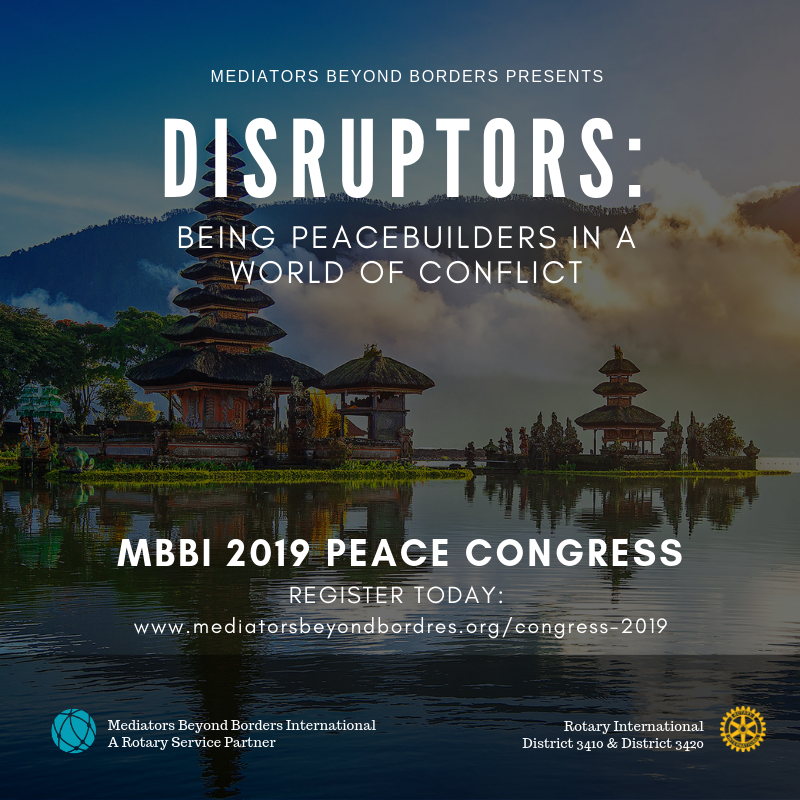
Disruptors: Being Peacebuilders in a World of conflict is the vision statement for the 2019 International Peace Congress to be held in Bail from 6th to 8th November 2019 at the Bali Intercontinental Hotel and Resort where accommodation packages are currently available.  Registrations for the congress are invited by MBBI for mediators, Rotary peacebuilders, conflict transformation practitioners, organisational leaders, government diplomats, public officials, advocates and academics to join them as trailblazers, changemakers and risk-takers. This year’s event will have a transformative emphasis on LeadershipVision, Innovation, and Implementation.  To become involved within this ground-breaking opportunity to share in the unique experiences and teachings from like-minded people who share the passion for empowering others to strive for peace through conflict resolution.

“We all have different inspirations, but one goal: a better world.” -Ernesto Arguello

The Global Vision for MBBI is “The 2020 Decade of Peace” development initiative which includes innovative projects such as:

  • Women’s Role in Building Peace
  • Innovating Social Change
  • The Asian Perspective on Mediation
  • Youth and Conflict Resolution
  • Equipping our Leaders

“The 2020 Decade of Peace” will be launched at the 2019 International Peace Congress in Bali to progressively introduce global peace through these projects backed by an increase in regional partnerships with worldwide community-minded groups such as Rotary International, the Bali International Arbitration & Mediation Centre and the United Nations. Congress will serve as a catalyst for the 2020 Decade of Peace Initiative, which invites individuals and organizations from around the world to advance mediation, dialogue, and conflict transformation practices as a mechanism for socio-economic change. You will be recognized as a Founding Member of the 2020 Decade of Peace Initiative, and you will have the ongoing opportunity to share your work and be showcased on our international platforms for years to come.

MBBI in partnership with The Bali International Arbitration & Mediation Centre (BIAMC) has fostered transnational relationships within this important region which has experienced surges in conflict as the region rapidly expands into becoming one of the fastest growing global economies. BIAMC is a non-profit service centre which provides elite alternative conflict management and resolution using arbitration and mediation internationally. Using its professional staff with creative and dynamic solutions, BIAMC succeeds with alternative dispute resolution where conventional forms are not effective.  The BIAMC’s core values are YOUFIRST, Young at heart innovation, Out performance through leadership, Unwavering accountability, First class and fast-track service, Integrity without fail, Reverence in diversity, Safeguard community and Transparency.

The MBBI Rotary Partnership Working Group (MBBI-RWG) is a collaborative partnership which combines resources from both organisations to strive towards the prevention and reduction of worldwide conflicts, encouraging peace while progressively healing communities. MBBI will lead this change to facilitate the exchange of innovative peacebuilding practices into the next decade and beyond by collaborating with leaders of communities and providing transformative education to those who are in desperate need of these alternative conflict resolution skills, to build peaceful resolutions.

“A genuine leader is not a searcher for consensus, but a moulder of consensus.” -Martin Luther King Jr.

Play an Active Role in Advancing the UN Development Goal 16:

The U.N. Sustainable Development Goal 16: Peace, Justice, and Inclusive Societies will be actioned at the 2019 Bali Congress.  We need your voice, vision, and experience to represented in this event, so that you can be a part of a collaborative effort to advance a global mission towards peace, prosperity, and positive social change. By attending the 2019 Congress you will develop a collective vision of what 2030 might look like, and what steps we will take to advance this goal of the United Nations.

Partnerships and sponsorships are available for individuals, corporations and governments to expand their business opportunities onto the global stage, building upon the growing economy within and enable this important peacebuilding to continue over future decades. For MBBI gaining future financial funding is imperative to achieve their significant global vision.

To find out more about MBBI and their many global initiatives, visit their website https://mediatorsbeyondborders.org/

Join us at the 2019 Peace Congress! To register visit, https://mediatorsbeyondborders.org/congress-2019/


A case for coaching: Influencing cultural change at the ATO *

Tina Hoyer** and Claire Holland***

*The views expressed in this payer are those of the authors and do not necessarily reflect those of the Australian Taxation Officer (ATO) or James Cook University (JCU).

** Tina Hoyer is currently on a 12 month secondment to the JCU Conflict Management and Resolution Program from the ATO. Tina leads the ATO In-House Mediation Service.

*** Claire Holland is the Course Coordinator of the JCU Conflict Management and Resolution Program. She is a lecturer and researcher in Alternative Dispute Resolution (ADR) and conflict resolution processes.

Dispute Resolution and the ATO

The Australian Taxation Office (the ATO) is one of the leading government agencies utilising Alternative Dispute Resolution (ADR) and has achieved a substantial reduction in disputes proceeding to litigation over the last five years. This is largely due to the ATO’s sophisticated Dispute System Design (DSD) and the ATO’s internal use of ADR methods, including the implementation of initiatives such as in-house facilitation (mediation), the dispute assist program, and independent review. Hoyer and Holland are proposing to trial a coaching model specifically designed for ATO operatives (auditors and objections officers) to build their dispute resolution capacity and improve the way in which they deal with tax disputes. It is envisaged this coaching model will complement the ATO’s toolkit for resolving tax disputes, and influence positive cultural change within the ATO.

Resolving tax disputes earlier saves time and costs for taxpayers and the ATO, and provides certainty for taxpayers. More importantly, if the taxpayers perception of the dispute resolution process is fair, then they are more likely to have a positive attitude toward the ATO and are more likely to meet their taxation obligations voluntarily.

Since 2013, the ATO has been undergoing a comprehensive program of reinvention a central theme of which has been fair, efficient and timely dispute resolution approaches in its interactions with taxpayers. The ATO disputes policy has comprehensive key principles of dispute management to promote a resolution culture based on effective communication, genuine engagement, collaboration, and strategies that are fair and proportionate to the matters in dispute, as well as leading to early resolution at minimal cost. The ATO has been recognised as having an effective DSD and possessing many best practice principles. However, some deficiencies have been identified; one such deficiency being inadequate staff training on conflict management. In addition, the ATO has been subjected to much adverse public attention in regard to its handling of disputes particularly in relation individual and small business taxpayers.

Conflict coaching has the potential to support ATO operatives to develop greater competency, confidence and understanding of choices that they can make that will meet the key principles of the ATO disputes policy.

Can conflict coaching assist?

Coaching is a term used to define a wide variety of activities. In the literature, coaching has been described as a conversation one person has with another to help them move forward or create change. Coaches work with individuals and groups to achieve their desired outcomes and it unlocks a person’s potential to maximize their own performance. Jones and Brinket define conflict coaching as a process for the purpose of developing the disputants (the clients) conflict-related understanding, intervention strategies and interaction skills.[1] Hardy and Alexander, principals of Conflict Coaching International, state that conflict coaching is provided by a conflict specialist whose role it is to assist the client to develop

1)         clarity about the conflict situation;

2)         greater understanding of their own and other people’s needs and goals;

3)         identify and evaluate their choices for moving forward;

4)         develop confidence about managing conflict and achieving their goals; and

5)         increase their conflict management skills so that they can constructively engage in conflict.[2]

The focus of the conflict coaching process is on assisting the individual to become clearer and more confident about their conflict situation. In the ATO context, this includes supporting ATO operatives to analyse their own behaviour and develop a greater understanding about what choices they can make in the situation that could result in a positive outcome for the taxpayer and the ATO in line with the key principles of the ATO disputes policy.

Freedman suggests that when working in complex adaptive systems, such as the healthcare sector, conflict coaching can be used to support conflict transformation or management, rather than focusing on resolution. Orientating the purpose of the coaching is important to ensure the coaching model, and style are best ‘fit for purpose’.  An adapted coaching model drawing on the REAL Conflict Coaching process and incorporating Ury’s 7 step negotiation preparation[3] will be developed and trialed with ATO operatives to determine if coaching is an effective process to support a conflict transformation mindset that results in greater positive tax dispute outcomes for the taxpayer and the ATO.

Orientating Conflict Coaching for the ATO context

To research the effectiveness of this coaching model, a research project will be conducted that employs a holistic approach to examine the model from all stakeholders’ perspectives. This research project seeks to understand whether:

  • the coaching model is effective in ensuring the ATO operative coachees are applying interest-based negotiation skills (considering the taxpayers interests, alternatives, all options for resolution, ATO policy and effectively communicating) when negotiating with a taxpayer;
  • the coaching model is effective in improving the ATO operative coachees’ dispute resolution capacity and if the they will self-assess any changes in attitudes, beliefs or values as a result of the coaching; and,
  • the coaching model can be implemented in other large government and non-government organisations.

This research will:

  • contribute to the growing body of knowledge on one-on-one dispute resolution methods;
  • evaluate the coaching model’s effectiveness in improving the coachees dispute resolution capacity and achieving genuine cultural change; and,
  • provide a basis for discussion for the implementation of this type of coaching model in other large government and non-government organisations.

Holland and Hoyer have recently presented at the National Mediation Conference in Canberra in April and will soon publish a paper outlining their research, Holland, C. & Hoyer, T (2019 – under review) A case for coaching: Influencing cultural change at the ATO. 

[1] Jones T.S. & Brinkert R. Conflict Coaching: Conflict Management Strategies and Skills for the Individual, (2008) Sage, Los Angeles, CA.

[2] Samantha Hardy and Nadja Alexander (2014) Beyond Mediation: How conflict coaching can enhance your practice, Journal on 3rd Asian Mediation Association Confernce.

[3] Roger Fisher and William Ury, (1991) Getting to Yes – Negotiation agreement without giving in, Second Edition, Penguin books.

A student journal – in parts (2)

Amazon smoke © A. Boyle

Days Three – Six 

The Amazon hangs over everything here, and today, literally so, with bleak, smoked air.  It smells quite different from Australian bushfires (all those eucalypts) and, at first this morning, I wondered if it was “merely” pollution in such an enormous city.  It truly is a “pall” of smoke.

Last week, one of the Brazilian delegates explained to me that Amazonia (its Portuguese name) has its own rainforest-generated climate typified by regular downpours.  Some call it “our river in the sky”.  So there are two rivers: on the ground is the Amazon itself and, in the sky, is the rain. It is said that, with all that has been happening over recent years, the river in the sky does not flow as much and, because it relies on the forest (which is so damaged), it may never flow again.

Although this School still has a couple of days to go, I am sending this today – it takes only a few minutes to arrive, but it actually isn’t delivered in Australia until thirteen hours from now.

Back to my homework.  Embarking on this journal was a purposeful exercise: I wanted to gain some insight into what students experience when they have to do a journal. In preparation, I have re-read Olivia’s articles, Tania’s guidelines, various references (including: P. Brown, H. Roediger, and M. McDaniel, Make It Stick: The Science of Successful Learning, [Belknap Press, Harvard University, USA, 2014],) and my own ‘Guide to Reflective Learning’ (2018-19).  This time I have read them from the viewpoint of a student rather than an assessor/marker. Needless to say, I have gained some insights that will inform my future teaching/instruction.  For example, it is a rigorous undertaking that requires constant concentration during the day, and the capacity for honest self-reflection in the evening.  It is far less for the faint-hearted than I had fully realised.  In terms of a contribution to ADRRN, I did hope that this task would contribute something to our collective knowledge, about what we teach, and how we teach it.  Though in the form of a much more self-conscious experiment than a controlled study.

This international “workshop” on Science and Innovation Diplomacy: there are three key ideas about journals that I have gained from my time here:

  • Having to write a journal forces me to concentrate much more throughout the day;
  • It also forces me to slow down and truly think about all that happened during the day; and
  • I have to sort between all that happened during the day, and what actually mattered to me.

I know that any amount of reading in the area tells me about the importance of journals as learning tools; however, now I have experienced how much keeping a journal has enhanced my own retention of information. 

Presidents of three universities © A. Boyle

What I understand from this whole Sao Paulo event is that Global South countries are seeking avenues to become equal players in the world despite their lack of competitive clout.  By concentrating on scientific and technology expertise, they aim to build transnational collaborations that are as strong as the Global North’s economic dominance.

There are three stand-out ideas for me:

  • The importance of a collaborative, respectful approach to building international relations;
  • Developing transnational relationships based on shared expertise rather than on the basis of politics; and
  • Recognising common purpose that needs no “ownership”.

As concepts, these are not entirely new to me, because they are similar to the concepts that underlie mediation.  As a member of this group here in Sap Paulo, I have witnessed and experienced the strength that comes from genuinely mutual recognition and acknowledgement.  This is not about the social desirability of doing the right thing in order to “look good”; “looking good” is out of place here.  Instead, it is about creating collaborative expertise.  For me, it echoes the sense of self-determination that is fundamental to (my own view of) mediation.

More importantly for me personally, I have discovered a sense of what it might be like for the majority of the world’s people most of the time: as a delegate here, I have experienced their frustration at not having a voice, not being heard, and not being understood by those (our) much richer countries.  People in my learning group have voiced their frustrations: “Can you explain to me why Africa gets so much more attention than Latin America?”  Though I do have to remember that Brazil has some racial problems, too (as a Nigerian delegate has explained to me).

Although any flow of funding is very important, I am now aware that of far greater value are the mutual recognition and respect inherent to the success of these collaborative relationships.  Although I have always been aware of these, I have not before seen it as starkly as here, perhaps because I have not before been in the situation of being so very out-of-place.  When I think of “culture”, I think of personal and social settings (and all that they entail).  Here, I am learning that global positioning is a key cultural identifier, regardless of personal or social setting (by global positioning, I am referring to the Global South and Global North).  

We have a major task to complete before Friday.  We have been allocated to small groups for devising the preliminary wording of guidelines for establishing the transnational collaborative relationships that are fundamental to the approach of science and innovation diplomacy (the focus of being here).  Typically, such relationships include at least government, universities, and private business.  The group I have been allocated to: “Private Sector of Developed Countries” (no stereotyping there …), and we will craft input for the document that reflects the views of private companies.  Other groups include: “Academia”, “Government”, “International Organisations” (e.g., UN agencies), and “Civil Society”.  On Thursday, all the groups will come together and, using their own ideas, jointly develop a document to be known as The Sao Paulo Framework for Science and Innovation Diplomacy.  A mass negotiation if you like, though perhaps not as well planned as it could be.

I have had a remarkable time here: formal learning, informal learning, meeting people I would never otherwise meet.  Today I tried to identify what, in particular, stands out for me from all that I have experienced; and what has been my personal learning?  What I found was not a surprise; I’ve been aware of it from the first day: it’s about being from the Global North, about not speaking Portuguese, about being the oldest delegate, about being white.  But I hadn’t realised what it means for me.

OMG.  It doesn’t matter what I do or say here, I have no choice but to STAND OUT.  My “discomfort zone” made so very unavoidable.Keeping a journal has been a valuable lesson for me, and it’s time I came home.

Futbol © A. Boyle

A Student Journal – in parts

© 2019, A. Boyle

Innovation and Science Diplomacy School, Sao Paulo School of Advanced Studies, University of Sao Paulo

Day One

When I read students’ submitted journals in mediation courses, or as part of university DR courses, Day 1 regularly has comments about being unfamiliar with the course subject (e.g., “I feel completely out of my depth in this course –  it is unlike anything I’ve ever done before”) and uncomfortable with having to do a daily journal (e.g., “The two things I dislike about this course are having to do this journal, and having to do group work and role plays”); “out of my comfort zone” is a common phrase.

Being selected for this event at the University of Sao Paulo presented an unbeatable opportunity for me to subject myself to the journal – to gain some experience in, and some empathy for, the situation that students describe.  I have never been to Sao Paulo before (nor do I speak Portuguese), I know almost nothing about the topic, and I did not know any of the other attendees, who seemed to have travelled from many countries.  Everything about the experience was way beyond my “comfort zone”.

I am here at the School to learn, and to see if I can get the beginnings of an international alliance of researchers who will help bring fresh ideas to how we conduct mediation research.

Today started 30 minutes late and we were encouraged to mill around the coffee, meeting each other.  Conversation starters were pretty straight forward: “Where are you from?”, closely followed by “How long did you have to travel?”  By the end of the day, writing this up, I realised that I had spoken to people from: Albania, Armenia, the Balkans, Benin, Colombia, El Salvador, India, Iran, Nigeria, South Africa, Sweden, UK, Uruguay, USA, and, of course, from all over Brazil.  And, of course, the other delegate from UoN.  There is a noticeably different atmosphere with so much true diversity and a complete absence of homogeneity.

Key information from today

(i) Being introduced to the key concepts of Science Diplomacy and Innovation Diplomacy:

  • The primacy of international relations that are based on equity, and on the value of human rights;
  • Using the common language of science to connect peoples and cultures; and
  • The importance of collaboration at all levels. 

(ii) Emphasis on cooperation and interpersonal influence; and 

(iii) Key repeated words throughout the day: trust, bridge-building, and peace.

This is not stereotypical science, I thought. Perhaps I will have to abandon stereotypes.  The sciences that delegates bring with them include: agriculture, oceanography, bio-chemistry, biodiversity, molecular science, chemistry, chemical engineering, mechanical engineering, genetics, and, of course, climate sciences.  And I did find a professor of Law who had travelled from Edinburgh.

What is Science Diplomacy and Innovation Diplomacy? 

What I learnt today is that no-one is quite sure what Science Diplomacy and Innovation Diplomacy are.  They all agree that it is about the use of science as a tool of diplomacy, the application of the unencumbered language and interests of scientists to create non-political alliances between countries; groups of scientists who work together to build bridges between their countries, especially where there are problematic political relations.  They create commonalities where none seemed to exist. These are things that I can understand. 

During the presentations, one example was mentioned more than once: over some years, scientists from Cuba and from the USA worked together on a range of projects, building trust with each other – in the full knowledge that Fidel Castro was very supportive of science and scientists. Apparently, it was this collaboration that led to President Obama relaxing travel to Cuba by US citizens. Each time this story was mentioned, it included mention of the current President and all that he has done to reverse that development – including banning the scientific collaborations.

What really stood out for me from today?

The constant emphasis on cooperation, trust, bridge-building.  The undoing of my stereotypes about scientists.  Here was a room full of highly idealistic people showing no sign of any kind of stereotype, even though they represent probably every branch of science.

And the group work.  Yes, of course, we had to do some group work.  We have been given a long-term task in which each group is to develop a strategy for bringing Science Diplomacy to assist with a major international crisis (each group gets to decide what sort of crisis to deal with – our group chose water).  We must complete the task – and report on it – before the end of this School.

Dr Marga Gual Soler, InnSCiD, University of Sao Paulo, 2019     © 2019, A. Boyle

Day Two

Today it was quite cool, and the sky monotone beige.  Many of the buildings here have that grey mouldiness typical of older tropical cities.  One important thing, though, Sao Paulo knows how to make coffee.  The hotel has beautiful coffee; even the university venue has beautiful coffee.

We all travel together in mini-buses from the hotel to the university and back again in the evening – a matter of safety here in Sao Paulo. This morning, riding in the bus and hearing all the languages, I was struck again by the diversity.  There is truly an air of excitement among people – everyone is openly very pleased that they were selected to attend this School. Last night, a small group of us went to a workmen’s street-side bar on a back lane behind the hotel, where we sat at three rickety tables and talked over the day amid bottles of local beer, supplied by the bar’s cheerful proprietress.  If this is how students wind down, I think we instructors have it very tough.  When I was back in my hotel room, I also realised just how isolated we instructors are.  Meanwhile, at the bar, in response to a question, I had mentioned briefly my own purpose in having applied to attend, and was surprised that people were genuinely interested in my, as yet unformed, plan.

The content of Day Two’s presentations was still focused on giving us an overview of Science Diplomacy.  Two presentations stood out for me: 

Dr Marga Gual Soler: she is a Science Diplomat, and something of a heroine here.  She advises the European Union on its Science Diplomacy strategy, and, in November, she leads the first all-women expedition to Antarctica to publicise Science Diplomacy and the climate emergency.  During her presentation, she said that, at its core, Science Diplomacy is flexible and creative, responsive to each situation and context.  Now what does that remind me of?  She also talked about the importance of capacity building to deal with future problems.

Professor Edouardo Viola: he gave a one hour presentation that tracked the political and economic contexts of climate change between the 1990s and now.  He showed the links between economic ups and downs, and countries’ responses to the various climate conferences.  He showed the links between political stability and countries’ responses to the various climate conferences.  And the links between the crisis in democracy and the rejection of scientists, the rejection of expertise.  Depressing in some ways, while, for me, so valuable to be given such a clear perspective on how we have arrived at this point.  And to see that, even in widely divergent fields, context has such strong influence over our collective decision-making.

During the day I have been thinking about the application of all these concepts in my own work.  There are so many commonalities between what is being said here and what happens around mediation, such as the importance of:

  • Trust and cooperation;
  • People to people contact;
  • Long-term capacity-building; and
  • People’s ability to overcome their differences.

This event continues until Friday next week.  I have so much more to learn, yet I am already discovering that mediators and scientists share such deep humanistic values. I wonder what else we have in common?

Part 2 will follow later this week…

Extended due date for Newcastle Law Review Special Edition: 30 September

The due date for submissions to the Newcastle Law Review Special Edition on Dispute Resolution has been extended to 30 September 2019.

If you missed the due date for submissions to the Newcastle Law Review and its Special Edition on the National Mediation Conference, a further opportunity for submissions on dispute resolution is available with a due date of 30 September 2019.

Get those papers in!

The Newcastle Law Journal

The Newcastle Law Review (the NLR), the journal of Newcastle Law School, was first launched in 1995. Since that time an impressive array of articles and notes has been published, representing traditional categories of legal scholarship as well as interdisciplinary contributions. Newcastle Law School has reinvigorated the journal and it is now published electronically and an open-access resource to the public.

Newcastle Law School  is organising a special edition of the NLR based on the dispute resolution theory and practice. This special issue will be published in 2019. We welcome the submission of original and high quality research work on dispute resolution for consideration as to publication in this special issue. Please note that the NLR is a refereed journal. The acceptance of a submission for publication is subject to the outcome of a double blind peer-review process with a final publication determination made by the editors after full consideration of the peer reviews.

In making a submission, the authors’ compliance with the following submission guidelines would be much appreciated:

1) Word limit: 6,000 – 9,000 words

2) Referencing style: Australian Guide to Legal Citation (Fourth Edition, 2018)

3) The deadline for submission is Monday 30 September at 5.00pm.

If you have any questions or enquiries in relation to this special edition, please contact: Dr. Bin Li, bin.li@newcastle.edu.au (Editor, The Newcastle Law Review)

Restorative Justice – Another Dimension

brass colored and black table decor

Photo by Anthony Acosta on Pexels.com

In his recent autobiographical work The Pursuit of Justice[1] former NSW District Court Judge, Michael Finnane QC gives a rather frank account of his experiences as a judge and provides a rare insight into the thought processes which go through the mind of a judge in sentencing offenders in NSW.  A recurring theme throughout the book is the constant frustration that he felt as a judge at the limited options available to him for dealing with problems which, although presented in the cloak of criminal conduct deserving of denunciation and punishment, were really much more about how our society deals with the inequities of health, education, poverty and social disadvantage.  One chapter of the book recounts numerous tragic stories of serious crime committed by people who lived in appalling circumstances, many of them clearly without any insight into the gravity of the conduct in which they had engaged or the effect that it had on others in the community around them.  The author concludes the chapter by saying:

“These stories highlight a problem in our society in New South Wales that there are no proper mental institutions which provide accommodation, care and treatment for people with severe mental disorders.  Many of these people, because of their disorders, cannot look after themselves, cannot manage money, run out of funds and then resort to crime just to stay alive.  Some are lucky enough to get support from generous people in the community, but many of them have no friends or family.”

Similar concerns have been expressed by other members of the judiciary and magistrates.  A recent interview with a Children’s Court Magistrate revealed similar concerns about the problem of charging children with criminal offences in relation to inappropriate sexual behaviour arising out of school yard romances or dysfunctional family relationships.

It seems that there is a large gap between the truly malevolent conduct of the determined criminal and the behaviour of normally functioning, well-balanced and productive members of society.  Into that broad gap fall a large number of people who are affected by poverty, illness, disability and maladjustment and find themselves before the courts charged with criminal offences because, for too long, they have struggled without assistance or without adequate assistance to combat these problems which are not of their own making and, in the end, have committed crimes that, in some cases might have been entirely preventable had they received appropriate assistance in a timely manner.  Too often the sentencing remarks of judges include a sad recital of tragic personal backgrounds and a litany of handicaps that would challenge the most robust citizens in society.

All too frequently media reports of serious and spectacular crime are met with calls for harsher penalties and there are politically opportunistic promises to crack down on crime and make “law and order” an issue at the next election.  Such rhetoric makes many false assumptions.  It assumes that all members of society have equal access to opportunity, resources, health, education, disability support and the support of a loving family network (the equity assumption).  It assumes that all offenders make rational, considered and pre-meditated decisions to commit crime (the criminal intent assumption) and, most of all, it assumes that there is a direct and proportionate relationship between the harshness of the penalty and recidivism (the penalty assumption).  None of these assumptions is correct.

As to the equity assumption, the Bureau of Crime Statistics and Research (BOCSAR) evidence discloses that, for the period from April 2018 to March 2019 the rate of non-domestic assaults within the Sydney city area and the inner western suburbs area to Beaconsfield were greater than 566 per 100,000 of population but reduced to less than 166 per 100,000 in the lower north shore and around Belleview Hill, Dover Heights and Vaucluse.  A map depicting the incidents of assaults per 100,000 of population is shown below.

Figure 1

2019-08-13 02.38.20 pm.png

Image source: NSW Bureau of Crime Statistics and Research (BOSCAR)

Of course the evidence is only as to one type of crime and there are other weaknesses with the use of this map including the assumptions about the affluence of Sydney’s inner west and the lower north shore.  However, the map does give some indication of the prevalence of that crime in a small though densely populated part of NSW.

As to the criminal intent assumption the statistical evidence is more difficult to establish.  It is interesting to note, however, that invariably the official reports of judgments handed down in the Criminal Law List of Common Law Division of the Supreme Court of NSW contain harrowing narratives of the kind described by Finnane in his book.

As to the penalty assumption the BOCSAR evidence is that the recidivism rate for non-custodial penalties is about 20% for adults and between 42% and 44% for juveniles as set out in the following table.

​2015 ​2016 2017
​Adults 20.3% 20.8% 20.6%
Juveniles 44.6% 42.0% 44.3%

Table 1

By contrast the recidivism rate for offenders who have been incarcerated is around 39% to 40% for adults and as high as 64% for juveniles as illustrated in the following table.


​2015 ​2016 2017
​Adults 39.8% 39.4% 40.7%
Juveniles 63.4% 63.4% 64.4%

Table 2

Two questions arise from this story.  Firstly, why does any of this matter to a community of ADR researchers and, secondly, if it does matter, what can be done to address these problems?

Dealing with the first question first, it seems entirely plausible that our attention to restorative justice and restorative practices in modern dispute resolution discourse may as well focus on addressing the root causes of criminal and anti-social behaviour in the broader context in addition to the immediately presenting problem of reconciling a victim to an offender in the form of victim-offender mediation or conferencing or circles or other restorative practices of the kind advocated by King, Freiberg, Batagol and Hyams in the book  Non-Adversarial Justice (Federation Press 2009).     Every victim-offender mediation which succeeds in making a victim feel even slightly better or does something to restore their lost dignity or restore them to their former position is a good thing.  How much better a place the world would be if we were able to extend restorative principles to encourage improvement in health, education and social welfare in order to remove the occasion for criminal delinquency and promote a healthier, better informed and better resourced society which reflected upon its failings and was more active in restoring equity to those who stumbled because they were unable to keep up.

The second question is how we deal with these problems.  Undoubtedly this is a much more complex and difficult question to answer and one which would occupy more space than be accommodated in this post.  In the first instant, we as academics and researchers can do much to educate the broader community both about the myths surrounding the causes of crime and anti-social behaviour and about the benefits to be gained by considering issues of crime and anti-social behaviour holistically and from an integrative perspective so that all of the causative influences are brought to account.  At some point the penny has to drop that increasing crime rates are not just about more socially unacceptable behaviour by more individual people.  They represented a systemic failure of society to provide more appropriate resources and funding to address these problems.

Secondly, we need to persuade governments that there should be a proper level of investment into the health, education, training and useful employment of people who are incarcerated.  In short, this means a proper level of investment into corrective services.  Those invested with the management of corrective services should understand that recidivism is a failure of the system – not a failure of the individual.  There is an abundance of evidence from abroad that a more enlightened approach to corrective services produces better results.    As an example, by comparison with the recidivism rates reported above, Norway, which boasts the most advanced corrective services system in the world, has a recidivism rate of 20%, about half that of NSW and less than one third of that reported in the USA which reports a recidivism rate of 68%.

Guided by a “Principle of Normality” under which imprisonment is regarded as deprivation of liberty but nothing more, life inside prison is designed to be as close as possible to life outside.  Prison officers are educated in a range of disciplines including social welfare and psychology.  Prisoners are taught a range of skills to assist them in their rehabilitation and receive vocational training to assist with employment prospects.

These principles bear some resemblance to those advocated by Justice Nagle in the NSW Royal Commission into Prisons when he said:   ”People are sent to prison as punishment, not for punishment.”  Norwegians cast their tactical approach to incarceration as a “good neighbour policy” – treat people like dirt and they will become dirt.  Treat them like human beings and they will act like human beings.

These principles are also consonant with the principles advocated by the Restorative Justice movement which is gaining strong momentum in the City of Newcastle NSW.  In a recent article by Professor John Anderson and Dr Nicola Ross of the University of Newcastle, the authors said:

“Restorative cities implement interdisciplinary restorative practices and restorative justice measures across a range of systems including education, justice, welfare, child protection and health to achieve positive results for residents, particularly the most vulnerable members of the community such as children and youth. Ultimately these cities are working towards and achieving a transformational change in culture and the social fabric of their cities using mediations, conferences and relationship-building exercises to encourage the resolution of disputes and disagreements through productive communication, to address inappropriate and harmful behaviours and to create community wellbeing in a caring and inclusive culture.”  (J Anderson and N Ross A Restorative City for NSW – Could Newcastle be a Model? (2018) 27 JJA 74)


If even some of these objectives could be achieved, there would be cause for great optimism that many of the matters of which Judge Finnane complained might be removed from the criminal law landscape in New South Wales.  It is to be hoped that this will be so.

[1] M Finnane The Pursuit of Justice (New Holland Publishers 2018)