The ADR Research Network is a group of Australian dispute resolution academics. Blogging & tweeting high quality, critical dispute resolution scholarship.
In the current climate there are many things we can’t control. It can feel a little overwhelming. However, there are many things that do still remain within our personal individual control. Included in that list are our approaches to communicating with others, and acting intentionally so as to positively prevent, manage or resolve disputes.
In order for us to develop a strong foundation for using dispute resolution skills purposefully in our daily lives, it’s important that we recognise that we have the ability to decide to act intentionally as agents of positive engagement with each other.
Things within my control:
My choices.
My words.
My attitude.
My effort.
My actions.
My beliefs.
My opinions.
My responses.
My thoughts.
My boundaries.
My own social distancing.
My engagement with the news and social media.
Agency involves taking individual control over a situation. People with agency feel that they are able to act independently and have the capacity to make their own free choices and decisions. When a person has agency, they are able to act on their own will and of their own accord.
Words associated with the notion of agency include: individual control; intentional action; empowerment; and free choice.
There are always external influences on us, and on our actions, as human beings. However, when we have a sense of agency, we feel as though we are able to manage those influences (as well as issues that arise in relation to, or as a result of, them). Having agency means we have a sense of control over our life: we have choices, a capacity to act and decision-making power for ourselves.
Our agency in relationships is enacted in our choices about how we behave and communicate. Relational agency concerns how we choose to interact with and impact on other people. We can choose to make those interactions positive and constructive even when faced with stresses, worries and challenges. But this requires effort, energy and intentionality. An investment in our dispute resolution agency is worth the effort, however, and can only have positive and empowering consequences.
Now is the time for all of us to harness a sense of agency in relation to how we choose to communicate with others, and in terms of how we navigate the stressors and challenges of living and working in lockdown. Effective communication – to be discussed in Blogs in the coming days – is one important key to the prevention, management and resolution of disputes. Some basic aspects of resilience building and self-management are another essential enabler of preventing, managing and resolving disputes. And of course, equipping ourselves with specific negotiation and dispute resolution skills is critical. We’ll be blogging about all these things across the Lockdown Dispute Resolution 101 series.
In accepting our own agency in relation to the quality of our relationships with others, we are accepting that we have the power to make positive choices about how we communicate and interact. It could even be said that in our current global situation we have a responsibility to do so.
Tomorrow’s Blog: Effective communication – the basics and the complexities.
Some scholarly resources on agency: Mustafa Emirbayer and Ann Mische, ‘What Is Agency?’ (1998) 103(4) American Journal of Sociology 962; Jack Martin, Jeff Sugarman and Janice Thompson, Psychology and the Question of Agency (SUNY Press, 2003); Albert Bandura, ‘Toward a Psychology of Human Agency’ (2006) 1(2) Perspectives on Psychological Science 164; Bryan W Sokol et al, ‘The Development of Agency’ in Richard M Lerner (ed), Handbook of Child Psychology and Developmental Science (Wiley, 7th ed, 2015) 284.
Acknowledgement: Some of the content of this Blog was adapted from Rachael Field, James Duffy and Anna Huggins, Lawyering and Positive Professional Identities (LexisNexis, 2nd ed, 2020)
This post is by Paul Lewis – an expert family lawyer and leading mediator who is a partner of Gadens in Sydney. Paul has been nominated for the Mediator of the Year category of the 2020 Australasian Law Awards.
The classical model of mediation is ”facilitative mediation” during which the mediator’s primary function is to encourage meaningful and constructive dialogue between the parties, without providing any comment or opinion on the substance of the dispute or providing suggestions or ”options” to assist the resolution of the dispute.
The requirement that a facilitative mediator refrain from ”entering the fray” springs from one of the underlying foundations of facilitative mediation, namely, the concept of ”self-determination” and the related concept of ”party autonomy”. It is worth noting that the advent of facilitative mediation arose through the germination and growth of ”community mediation” in the United States of America from the 1960s through to the 1970’s. Community mediation settled in Australia with the passage of the Community Justice Centres Act 1983 (NSW), the legislation explicitly adopting the principles of facilitative mediation.
References to evaluative mediation, sometimes called ”advisory mediation”, arose after the formal justice system began to co-opt mediation in to its prescriptive rules and case management procedures. This happened in Australia from the early 1990’s onwards and occurred earlier in North America. Under the model of evaluative mediation, the mediator is permitted to provide his or her views and professional observations about the content of the dispute on the basis that the mediator is a ”subject matter expert” in relation to the dispute.
”Evaluative mediation is a term used to describe processes where a mediator, as well as facilitating negotiation between the parties, also evaluates the merits of the dispute and provides suggestions as to its resolution. (See also combined processes.) Note: evaluative mediation may be seen as a contradiction in terms since it is inconsistent with the definition of mediation provided in this glossary.”
Standard objections to the evaluative model of mediation in civil cases include the following:
that the introduction of an evaluative component by the mediator may cruel, or at least stifle dialogue between the parties;
that the selection of an evaluative mediation model may see the parties, or one of them, adopt a passive stance in order to find out what an independent mediator thinks of the dispute, thereby defeating the intrinsic value of the mediation as an opportunity to reach a negotiated agreement; and
that a professional viewpoint or opinion expressed by a mediator will merely be one view among a range of possible views, and therefore not helpful in moving the parties towards agreement.
In the context of the evaluative mediation of financial cases under the Family Law Act 1975 (”the Act”), the above objections are, in practice, overstated. The law in relation to property settlements under the Act is described, in jurisprudential terms, as a ”discretionary property regime” in contrast to a ”community property regime” seen in overseas jurisdictions such as New Zealand, South Africa, California and other states of the United States of America. Similarly, the determination of spousal maintenance cases under the Act involves the exercise of discretion by the Court within the parameters of the legislative framework and statutory criteria, and the associated caselaw.
Systems of family law based on discretion, rather than fixed rules, are rationalised on the basis that they provide individualised justice and better justice in the vast majority of cases. The disadvantage of discretionary regimes is said to be unpredictability, and there is merit in that assessment. Community property regimes provide greater certainty or predictability but at the expense of just outcomes in many cases (being equivalent to a ”one size fits all” approach.)
In a discretionary family law system, mediation calls for an evaluative model, at least in financial cases. Many parties, even when they are legally represented, have firmly held views about ”fairness”, such views being highly subjective and often contrary to well-established legal principles in the vast majority of cases. It is advantageous to have a subject matter expert as the mediator in such financial cases, and for the mediator to be able to inject an evaluative component during the mediation if it might resolve an impasse, correct a misstatement of the law or bridge the gap between the parties’ respective bargaining positions by the identification of unexpressed needs and generation of additional options .
A good evaluative mediator is judicious with the expression of his or her evaluative opinion or input during the mediation. Indeed, the reason that evaluative mediation is often described as a ”blended process” in the mediation literature is because a good evaluative mediator will approach the mediation in the early stages as a facilitative mediation. An evaluative mediator hangs back and checks out whether the parties may be able to reach a negotiated agreement ”under their own steam.” The latter observations are critical in deflecting the criticisms inherent in the typical objections to the evaluative mediation process, as stated above.
It is important that the process of evaluative mediation is explained to parties during their preliminary conferences (separate preliminary conferences are the norm in family law cases, not just parenting cases). Further, the nature of the process must be clearly identified and described in the agreement to mediate.
At a micro level, the ways in which the mediator introduces an evaluative component must always strive to meet the other process requirements in mediation of impartiality and procedural fairness. Mediation clients readily understand the concept of the evaluative mediator having the liberty or discretion to inject his or her viewpoint during the mediation if the mediator believes ”that doing so may assist the parties reach a resolution of the matter.”
Welcome to the Australasian Dispute Resolution Research Network’s COVID-19 crisis inspired series on basic skills and strategies for effective communication, negotiation and dispute resolution practices. The series is written by dispute resolution experts who are members of the Network and is designed for this difficult and challenging time of worldwide lockdown.
It is clear that relationships are being tested as a result of the social isolation strategies currently in place in response to COVID-19. As we spend more time confined in our homes, and work remotely from our colleagues, it can be a struggle to maintain civil communications – it’s a perfect environment for nerves to become frayed and for disputes and conflict to develop. The reliable advice seems to be that we are really only at the beginning of trying to overcome the virus – so now is an absolutely critical time to equip ourselves with positive strategies to support relationships – personal relationships, work relationships and relationships with others we encounter when we get to go outside.
There are many stories of acts of kindness and generosity in families and the community. See for example. However, the significant stressors of living through this pandemic cannot be denied. A man in Woolworths the other day pushed rudely in front of me and then turned around and said abruptly ‘It’s all for one these days’. I think he actually meant ‘It’s every person for themselves’ (?!). In any event his actions demonstrated that he was losing his capacity to be civil and to cope.
The ADR Research Network is a network of leading dispute resolution scholars who collaborate to foster, nurture and enrich high quality dispute resolution research and scholarship. The Network is inclusive and forward-looking, highly collegial and supportive. In ‘these troubling times’ we want to share some of our expertise in support of individual, family, workplace and community harmony and peace in lockdown.
Starting today we will be positing a new Blog every day for the rest of April exploring ways in which we can all prevent disputes from arising, as well as manage and resolve disputes when they do arise. We’ll be covering topics such as effective communication strategies (for example, effective listening, appropriate ways to ask questions and the benefits of using tools such as summarising and reframing in communications), mental health strategies relevant to dispute resolution practice (such as reflective practice, resilience-building and self-management), conflict management approaches (conflict analysis and de-escalation) and dispute resolution practices with a focus on negotiation tips and tricks. We’ll be highlighting some of the great work of Network members and pointing you towards additional useful resources.
We always welcome your comments and feedback. Please be in touch with us via the comments function on the Blog.
Tomorrow’s Blog: Dispute resolution agency – it’s our responsibility at this time to take agency and build our communication, negotiation and dispute resolution skills.
The Australasian Dispute Resolution Research Network brings together leading dispute resolution scholars and provides a collaborative environment to foster, nurture and enrich high quality DR research and scholarship. The Network is inclusive and forward-looking.
In this time of crisis, the Network will use our April Blog to support societal, family and individual well-being during lockdown. Starting on Monday April 6th we will be offering daily Blogs entitled Lockdown Dispute Resolution 101. The Blogs will draw on the extensive scholarship and expertise of our Network members, offering DR tips and strategies for effective communication, negotiation and the resolution of disputes while in lockdown.
This post summarises a new study that has just been published in the University of New South Wales Law Journal that looks at the socio-demographic, crash, injury, and recovery factors that are linked to legal serviceuseamongpeoplewhoclaimcompensationforroadtrafficinjuries.The article is part of my PhDworkatMonashUniversity,whichlooksatclaimantlegalserviceuseininjurycompensationschemes.
This article has been published with my supervisors Drs Janneke Berecki-Gisolf, Becky Batagol, and Genevieve M Grant.
Background: Personal Injury Legal Problems
Personal injury is one of the most common types of legal problem that people experience. A legal problem is a problem that can be resolved using the law. A personal injury is a harm to a person for which compensation can be claimed; this harm can be the result of a road traffic crash, workplace injury, product fault, or other occurrence.
Research by the Law and Justice Foundation of New South Wales shows that seven per cent of Australians aged 15 and above experience a personal injury legal problem within a 12-month period. One fifth of these people sustain their injuries in road traffic crashes. Road traffic injuries are linked to a number of negative outcomes (beyond the injuries themselves) including loss of income and financial strain, stress-related illness, relationship breakdown, and moving house.
Compensation for Road Traffic Crash Injuries
In Australia, compensation for road traffic injuries can be accessed by lodging a claim through the relevant insurer. In Victoria, this insurer is the Transport Accident Commission (TAC).
People who claim compensation for road traffic injuries engage lawyers to help them to access benefits, including through navigating the claims process and resolving disputes with insurers. Because of this, lawyer use is linked to access to justice (or the extent to which claimants can enforce their rights through fair and open processes). But, surprisingly, little is known about the characteristics that are linked to lawyer use in compensation schemes. The role of injury severity and recovery outcomes is especially unclear.
New Empirical Research on Lawyer Use in Compensation Schemes
This study used TAC compensation claims and payments data to look at how much claimant lawyer use was explained by (a) injury severity, (b) individual-level socio-demographic, crash, and injury factors, and (c) short- and long-term recovery outcomes in the TAC scheme.
The study found that although injury severity and other socio-demographic, crash, and injury factors shape claimant decisions about engaging lawyers, the experience of negative recovery outcomes (such as time off work, mental health issues, and/or pain issues) plays by far the most important role.
Because information about injury severity was only available for claimants who had been hospitalised, those who had and had not been hospitalised had to be looked at separately. In the hospitalised group, claimants with more severe injuries were more likely to use lawyers. In both the hospitalised and non-hospitalised groups, the other factors that were linked to lawyer use are shown in the image below:
What Does This Mean for Access to Justice?
This study shows which claimants are likely to need and use lawyers in compensation schemes.
One interesting finding is that socio-economically disadvantaged claimants, who tend not to seek legal advice outside compensation schemes, tended to seek legal advice in the TAC scheme. That is, disadvantaged clients were more likely to seek and obtain legal advice. This finding differentiates access to justice in the compensation scheme context from the rest of the civil legal system. One possible explanation is that personal injury lawyers often provide their services on a ‘no win, no fee’ basis, which takes away cost barriers for disadvantaged claimants. Understanding what leads to better access to justice for this group in the TAC scheme could improve access to justice for this group in other settings.
The study also shows that there are opportunities to improve access to justice in the TAC scheme in some groups, for example among young claimants.
You can find the full advance copy of the article here (open access).
The full citation for the article is Clare E Scollay, Janneke Berecki-Gisolf, Becky Batagol and Genevieve M Grant, ‘Claimant Lawyer Use in Road Traffic Injury Compensation Claims (Advance)’ (2020) 43 University of NSW Law Journal.
This article was originally published in The Conversationon 6 March 2019.
The #MeToo movement has reminded us that sexual harassment has not gone away. The legal tools we’re using are not working and may even be hiding the true extent of the problem.
Sex Discrimination Commissioner Kate Jenkins, speaking at the CSW63 Side Event – Consigning sexual harassment to the dustbin of history – what it would take to achieve cultural change, March 2019. Photo Credit UN Women (CC BY-NC-ND 2.0)
Confidentiality is essential to get people to the negotiating table. Who can forget the media scrutiny actors Geoffrey Rush and Eryn Jean Norvill were subjected to?
Even for people who are not famous, the potential media interest in a sexual harassment claim is a strong reason to settle, as it is for employers who fear reputational damage. But it means the community isn’t aware that sexual harassment is still occurring or how it’s being addressed.
Employers usually insist on a confidentiality clause when they settle a claim. I recently interviewed 23 lawyers in Melbourne, asking them how common confidentiality clauses are in discrimination settlements.
A solicitor told me settlement agreements “almost always” include confidentiality. Another described the confidentiality clause as “not negotiable”. A barrister said: “No one I know has ever settled on non-confidential terms.”
The lawyers said employers use confidentiality clauses to avoid opening the “floodgates” to other victims. Employees seek confidentiality if they have left the workplace and worry about what their former employer might say about them.
At their most extreme, confidentiality clauses have a chilling effect on victims, who fear the repercussions of discussing any aspect of their claim. At the same time, they protect the perpetrator at their current workplace and anywhere they work in the future.
A complex, costly legal system
Making a legal claim is complex and costly. A woman who has been sexually harassed could use her local anti-discrimination law or the federal system. The federal system is costly because if she loses at court not only will she have to pay her own legal costs, she risks having to pay the other side’s costs too.
If she’s been discriminated against, unfairly dismissed or has a worker’s compensation claim, three more legal avenues are open to her. These vary in terms of costs, procedures, time restrictions and levels of formality, so they’re difficult to navigate without legal assistance.
It’s not surprising, then, that most people don’t use the formal legal system and those that do tend to settle.
Individual burden
There is no equivalent of the Australian Securities and Investments Commission (ASIC) or the Australian Competition and Consumer Commission (ACCC) that can prosecute employers or represent victims, so the person who has been sexually harassed bears a heavy burden. As one of the lawyers I interviewed put it, the victim has to do “all the heavy lifting”.
Respect@Work
This week, the AHRC released Respect@Work, a lengthy report on sexual harassment. It made 55 recommendations, many of which are designed to improve the legal framework. Will they resolve these weaknesses?
In terms of shedding light on the prevalence of sexual harassment, the recommendations include that the AHRC and its local equivalents should collect de-identified data about sexual harassment claims and settlement outcomes, share this data and prepare coordinated annual reports. This is significant because at the moment they only release numerical annual complaint data. They don’t publish anything about the nature of claims or settlements. Acknowledging that some parties want confidentiality, the AHRC will develop “best practice” principles, which might include preparing a model confidentiality clause and making some disclosures permissible.
Lawyers told me they negotiate damages payments in excess of what courts are likely to order. Because settlements are confidential, they have no impact on the courts’ understanding of the harm of sexual harassment, and victims and their lawyers don’t have a realistic starting point for negotiations. It is pleasing that the AHRC has recommended the government conduct research on damages awards and that this should inform judicial training.
Lawyers repeatedly told me the risk of costs is the main reason victims don’t use the federal system. The AHRC recommended a losing party should only have to pay the other side’s legal costs if their claim is vexatious, which is how the Fair Work system operates. The government should act to remove this barrier right away.
The recommendations to increase funding for community legal centres and bring consistency to federal and local sexual harassment legislation (including adding sexual harassment to the Fair Work Act) will reduce the cost and complexity of the system.
But a problem remains – the burden still rests on the victim. The AHRC has proposed establishing a Workplace Sexual Harassment Council comprised of federal and local equality and workplace safety agencies. But this is a leadership and advisory body, not an enforcement agency.
The AHRC president is conducting an inquiry into reforming discrimination law. Changing the enforcement model and alleviating the burden on the victim must be considered as part of this broader project.
We now know the date as well as the location of the next National Mediation Conference. Now’s the time to put it on your diary. NMC is a practitioner-focused conference with a strong academic edge, covering all areas of dispute resolution. You can see the details of the last NMC here.
The next NMC will be held in Alice Springs, Northern Territory from 1-4 September 2021. Importantly, the conference will be hosted on the grounds of Desert Knowledge Precinct, a beautiful 73 hectare property on the South Stuart Highway, 8km south of the Alice Springs CBD.
A copy of the press release from Prof Laurence Boulle, Chair of the NMC is posted below. Both Laurence and Alysoun Boyle are members of the ADRR Network and are planning the 2021 conference.
The directors of the National Mediation Conference Ltd acknowledge the Traditional Owners of country throughout Australia, and in the context of this announcement especially the Western Aranda and Central Arrernte peoples of the Alice Springs region. We recognise their connection to land, waters and culture, and we pay our deep respects to their Elders past, present and emerging.
In this regard the NMC is delighted to announce that the Desert Knowledge Precinct Partners (Centre for Appropriate Technology, Batchelor Institute of Indigenous Tertiary Education, Desert Knowledge Australia and the Desert Peoples Centre) have issued an invitation to us and the dispute resolution community to hold NMC 2021 at their facilities in Alice Springs (https://www.dka.com.au/activities/dk-precinct).
The NMC directors have accepted this invitation and would also like to acknowledge the valuable assistance from the Northern Territory Business Events Support fund for NMC 2021.
The Welcome Reception for the conference will be on the evening of Wednesday 1 September 2021 and the event will run over the following three days, namely 2, 3 and 4 September. In setting these dates the NMC Board has taken into account the timetable of The Ghan train from Adelaide to Alice Springs, and return.
Please save these dates and spread the word for an innovative, stimulating, and inspiring conference in the heart of the country.
The NMC Board is currently appointing a Design Committee to plan the conference and is commencing a formal process for selecting a Professional Conference Organiser. In due course, the Design Committee will start providing regular updates on all aspects of the conference.
Now it’s time to Save the Date and start preparing for a superb engagement in a wondrous setting.
Joanne Law is a registered Family Dispute Resolution Practitioner, NMAS Accredited Mediator, Certified Family Group Conference Facilitator and New Ways for Families Coach. She’s owner of Mediation Institute, established in 2013 to provide eLearning for the dispute resolution industry, with a human touch.
She is a professional trainer and co-founder of the not-for-profit Interact Support established to prevent family violence and abuse by providing accurate information and dispute resolution services for people who are slipping through the cracks in the family law system.
Joanne records a podcast called Mediator Musings which you can find on iTunes and other podcast distributors and is curator for TEDxCasey in South East Melbourne.
Our Earth planet and modern life. Elements of this image are furnished by NASA
The benefits of technology assisted training in dispute resolution
Using education technology is a rapidly growing approach to human learning. The dispute resolution education industry is not immune this trend and eLearning is now well established by pioneering organisations such as Mediation Institute.
The traditional approach to mediation training gathers people into a room for a workshop with lecture style instruction on new material and role plays in an intensive training environment.
Studies that compare classroom instruction, eLearning and blended learning indicate that eLearning and especially blended learning are at least as good as, and when well-designed, outperform classroom instruction alone. The major factors in eLearning that provide these benefits are realistic practice, spaced repetitions, contextualised meaningful scenarios and feedback.
There have been various studies and meta studies such as Means and Colleagues 2013—Meta-Analysis which conclude “eLearning-only situations produced an equal amount of learning compared with classroom-only situations. Blended learning (a combination of both classroom and online learning) produced better results than classroom-only instruction.”
It makes sense to use of technology to support learning in terms of cost, accessibility and flexibility. Mediation Institute delivers courses either fully online or via blended learning where there is no adequate way to simulate through video meeting. Our Family Group Conference Facilitation course is one where the skill to learn is facilitating a group meeting which takes place face to face.
It is important to design learning for eLearning and not just put offline material online.
What is online learning?
Online learning or eLearning is a form of education whereby the primary delivery mechanism is via the internet (Bates 2008) It is more than an evolution of the distance learning correspondence course and when well-designed makes use of technology in a unique way. The use of a website to deliver PDF content is still available and called online learning but that kind of approach gives eLearning a bad name, and promotes a bad student experiences and high drop out rates.
E-learning includes the use of a learning management system to provide course content, the opportunity to blend audio and video material, conduct quiz’s and assessments and to engage in on line recorded and live classes with other students.
Three of the biggest advantages we see for students in online learning are individualised learning, better feedback delivery and helping our learners to be better prepared for the future in the industry which we firmly believe will have a much greater presence of Online Dispute Resolution.
Individualised Learning
The accessibility and flexibility of elearning means that learning can be individualised . In the case of skills learning activities can be reduced down to the minimum number of participants to participate in a role play.
We are eagerly awaiting the time when Virtual Reality and Artificial Intelligence is sufficiently advance and affordable to allow us to provide individualised simulation opportunities for students. Till then with three students and a mentor and two hours to spare they can participate in a role play from wherever they are, providing they have access to the internet.
We favour asynchronous learning where possible, which means is that students can start their studies with Mediation Institute when they are ready to start, move through the course at their own pace and book in to do their role plays when they are ready.
There is real time learning in webinars and role plays but the rest of the course is self-paced with discussions via a forum where they can read other students’ entries and contribute in their own time. Semesters, course start dates and set assessment are for the convenience of educational institutions and provide no benefit for students, apart from a bit of extrinsic motivation. This flexibility means that we are tracking at 95 – 100% completion rate, depending on the course.
Individual support starts when a new student joins a course as we can use web meeting technology to offer individualised student orientations. In the session we hand over control of screen sharing to the student so they can navigate the course on their computer and the mentor can guide them remotely. Students book in for sessions like this using an online booking calendar tool that lets them schedule a session and insert it into the mentor’s calendar.
The other benefit of this individualised approach to learning is that the first role plays that they participate in are with students who have already participated in three role plays as a role player before their first role play as a mediator. In workshops the first role plays are often short and very messy due to everyone struggling to understand the new information they have just been presented with and a lack of good examples to work from. All of the role plays our students participate in are scheduled for two hours and provide the opportunity for tailored mentoring based on the needs of the student who is learning their new skills.
We use flipped learning which means that the theory learning takes place using online learning before interactive webinars, role play sessions or workshops. The students will have already completed some or all of the theory part of the course and ideally have had time to integrate what they have learnt as role players well before they attempt to use the skills as the facilitator.
This isn’t possible in a workshop as the time constraints of the schedule mean that the delivery pace is usually going to be too fast or too slow for the majority of the group. People get pushed through to role playing being a mediator with an incomplete understanding of the knowledge they need and sometimes struggle to even remember let alone understand the content and effectively translate it into competent role plays for their final assessment.
Our learning approach means that students are competent by the time they reach their assessment 95% of the time. For the small number who are not we offer further coaching and the opportunity to be re-assessed.
Better feedback delivery
Being a competent mediator is a unique skill building on interpersonal skills that most students already have. Learning how to mediate requires an adjustment in mindset and approach. Our experience is that students are often older learners who are very competent in roles where they give advice or advocate for clients. They may be used to working with a certain type of client, for example victims of family violence and have to learn how to work with other people in a non-judgemental way in order to facilitate a fair process while still using judgement in order to ensure that the process is physically and emotionally safe. It is complex work.
Approximately one third of our students are legally trained, another third are counsellors, psychologist or social workers and the rest from a business or other background.
They need to learn the mediation process, why the process developed and what each part of it does to help people to negotiate more effectively and how to be non-judgemental and empowering in their facilitation styles.
The benefit of doing our role plays using video mediation is that students can record their role plays and review them to help them to take in the feedback from their mentor.
Unconscious bias, poor questioning or failing to use active listening effectively and other problems can be pointed out and then they can review their role play to observe themselves.
I still remember the cognitive resistance that I and other learners had when I learned mediation in the traditional way, there was no action replay available to us! Sometimes we thought the mentor must have been mistaken in their feedback or struggled to understand it, impeding our learning.
Better prepared for the future
Online mediation is a growing trend that will continue to grow as more and more “digital natives” take up roles in business and become clients for mediators. Communicating electronically using video meeting technology is already becoming common.
I’ve already seen this trend in my own career as a dispute resolution professional and in the not-for-profit run, Interact Support.
Our policy is that if there is a family violence order in place, we don’t offer offline services. The options are video mediation, video shuttle mediation or mediator facilitated negotiation. The majority of our clients either seek out or accept video mediation even if family violence isn’t a factor in their relationship breakdown.
The use of legal tech is also going to be a major trend in our industry.
We train our CHC81115 – Graduate Diploma of Family Dispute Resolution students using Legal Tech software such as the Detection of Overall Risk Screening tool (DOORS) and FamilyProperty for their property FDR mediation simulations. We believe that it is important to ensure that new mediators are comfortable using technology with clients. Those who go on to do their fifty hours work placement with Interact Support are already prepared to work effectively with clients using video mediation and Family Property for their mediations and will be learning how to use MODRON for case management.
We’re currently developing a course on mediation case management which will be built around the MODRON online dispute resolution software.
The tool helps us to manage case management for our low income and community mediation programs.
We are firmly in the information revolution now that knowledge can be captured, digitally transported and used later. We are at an equivalent stage to the start of the industrial revolution when they were first able to capture energy and transport it for later use in the industrial revolution.
My concern is that many mediators are caught up in the same sort of thinking that the Luddites used when trying to hold back the tide of industrialisation in the 19th century. Resisting advances in technology due to the belief that it will threaten jobs is almost a self-fulfilling prophesy while embracing and using the technology to amplify our human capability ensures we remain relevant as dispute resolution professionals.
Failing to do that will see a continued advance of the use of Artificial Intelligence (AI) to replace human decision making and facilitation of dispute resolution processes.
Alternative Dispute Resolution is increasingly being required to be used before litigation and Online Dispute Resolution (ODR) is providing low-cost and independent dispute resolution in a much more accessible way that the traditional approach with its mediation rooms and waiting lists.
A Victorian Civil and Administrative (VCAT) ran a pilot in 2018 on ODR powered by MODRON to evaluate a hypothesis that “If VCAT introduces online dispute resolution then the Victorian community will experience improved access to justice.” You can watch a brief overview here https://youtu.be/LTkT9Z7cn9c on the pilot.
Mediation effectiveness doesn’t depend on the way it is delivered, what matters more is that it is available when it is needed rather than allowing disputes to continue to escalate.
When it comes to learning effectiveness, it is not whether the learning is delivered in eLearning or classroom instruction, it is the quality of the training that makes the difference.
Poor quality training in either context is going to be poor quality training.
Technology enables better quality training by making it easier to be more individualised, more flexible and provide better feedback and more realistic simulations. Anything that moves away from presenting information via a lecture and expecting a group of people to learn at the same pace is a positive improvement.
The research shows that it is essential to present to learners’ realistic scenarios for decision making, spaced repetitions over time to ensure retention, real world context through simulations and high quality feedback on their individual performance.
Online learning provides the opportunity to give learners these opportunities more effectively.
In his blogpost of December 2019, Alan Limbury gives us a thoughtful reminder of the history and background to the GPC.
I too was in the audience at London’s historic Guildhall on October 29, 2014, when IMI gathered together users of mediation, lawyers, mediators, academics and others involved in dispute resolution processes and began an exploration that led to the GPC Series conducted between March 2016 and July 2017 and travelling through 28 events in 22 countries.
Interior of the Great Hall, Guildhall, London
I have followed the Series carefully, attending the first in Singapore, the last when it returned to the Guildhall and the Sydney event somewhere in the middle.
Conceived and driven by IMI with the support of sponsors from around the globe, the Series was extraordinarily ambitious for a range of reasons – most remarkable being the ambition ‘to generate conversation and collect actionable data that could be used to shape the future of commercial dispute resolution (DR) and access to justice’.
The vision contemplated the collection of both quantitative and qualitative data – a bold ambition indeed. The qualitative and quantitative data were collected on the day via specially developed software accessed by participants. The results from the quantitative data, that is the 20 multiple choice questions, were displayed immediately in charts generated by the software, provoking significant discussion among participants.
The results of the qualitative data, that is the 13 open text questions, took significantly longer to analyse – for very good reason given the extraordinary rigour and precision required for analysis of this kind.
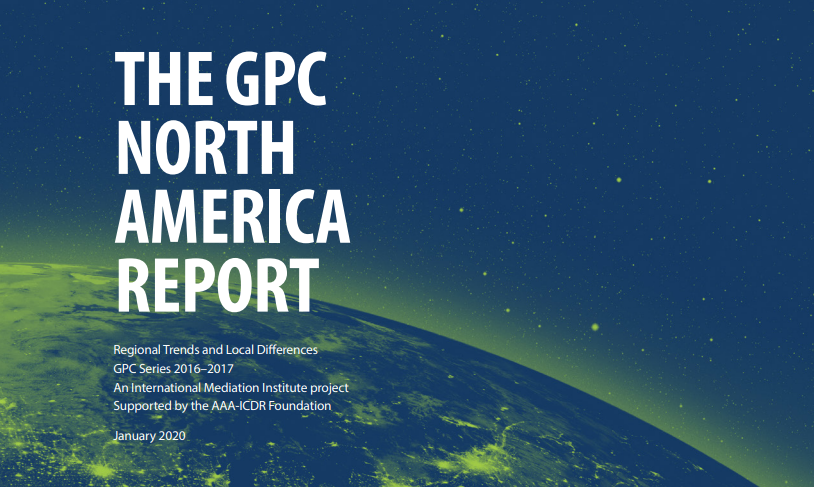
The significance of the report. The North America Report consolidates 7 individual reports of events in the series across North America. It is the result of rigorous and ground-breaking qualitative research on the data emerging from the open text questions. As the Report notes: ‘The GPC generated considerable data using methods not previously considered, in ways not previously possible, and at an unprecedented scale across the globe….and is the largest undertaking of its kind in the history of commercial dispute resolution’.
The call to action identified 6 top priorities. We will see a lot of attention paid to them as the Report gains the exposure it deserves. But there is a lot more.
My key take-outs: • Quantitative and qualitative research are very different.
Quantitative research matters. The results are relatively easy to consolidate and technology makes the process very efficient. Early release of results supports stakeholders seeking quick answers. However multiple choice questions reflect closed questions devised by their authors with a pre-determined choice of responses. There is always the risk that those answering the questions are choosing the best from a limited set of answers rather than making a ‘real’ choice. Open text questions offer some structure but allow what participants really think to emerge. This can produce the expected and the unexpected – telling the participants’ stories. It can also confuse us, producing richer information which apparently contradicts the quantitative data.
However the deep-dive into data required by qualitative research is extremely complex and time consuming. We had to wait a long time for this report to be produced so meticulously and now it is in our hands we can say it was worth it!
• We now have a new model of what qualitative research can do and how to go about it.
The methodology used to analyse the data and produce the report is not new but it is new to the DR arena. It is a result of the rich cross-disciplinary research experience of the authors of the report, Danielle Hutchinson and Emma-May Litchfield of Resolution Resources. It promises a new model of interdisciplinary thinking not constrained by academic backgrounds. It models how we can draw on psychometrics that have proven so robust and effective in the fields of education and psychology – a great addition to the DR research repertoire.
• It is time to lose the ‘A’ in ADR in the pursuit of a ‘party-centric approach to dispute resolution’
This was one of the top priorities identified in the call to action. It struck a particular chord with me as I have spent many sessions with my university students dealing with the challenge of answering the question ‘What is ADR and where does it fit?’ Many of us have struggled for a long time to take the ‘A’ out of ADR. We have tried using ‘appropriate’ and we have tried to replace ‘A’ with ‘C’ for consensual, but these attempts have not been successful. This report suggests that DR is the appropriate acronym for the suite of services covering adjudicative and non-adjudicative processes. Choosing the process or combination of processes that best meets what parties ‘need, want and expect’ is the element that provides the opportunity for a party-centric approach even if the process itself, such as litigation, is not seen as party-centric.
• We are not a unified DR community
The report consolidates findings from the 7 individual reports from
Austin, Baltimore, Los Angeles, Miami, New York, San Francisco and Toronto. Whilst the 6 elements of the call to action appear consistently, diving deeper into the individual reports I was struck by the significant differences in the details of practices and perceptions.
My take away is that we are a collection of individuals who have quite unexpected differences. The 7 individual reports demonstrate we are not united.
Our differences are likely to persist and it would be easy to see this as an impediment to collegiality. Our challenge is to build ‘an ability to deal well with differences’ – the definition of a good working relationship from Harvard’s Program on Negotiation.
What’s next?
I am still digesting the Report and I am sure I will continue to find more treasure.
I also expect more blogposts continuing to explore this very important research.
May the conversation continue and heartiest congratulations to IMI and Resolution Resources.
For more information about the GPC and its sponsors visit the IMI website.
I am thrilled to share this post by Dr Rosemary Howell which first appeared in the Kluwer Mediation Blogof February 22nd, 2020.
I would like to take the opportunity to thank Rosemary for her continued support and important contribution to the Global Pound Conversation.
By Dr Rosemary Howell
In his blogpost of December 2019, Alan Limbury gives us a thoughtful reminder of the history and background to the GPC.
I too was in the audience at London’s historic Guildhall on October 29, 2014, when IMI gathered together users of mediation, lawyers, mediators, academics and others involved in dispute resolution processes and began an exploration that led to the GPC Series conducted between March 2016 and July 2017 and travelling through 28 events in 22 countries.
Interior of the Great Hall, Guildhall, London
I have followed the Series carefully, attending the first in Singapore, the last when it returned to the Guildhall and the Sydney event somewhere in the middle.
Conceived and driven by IMI with the support of sponsors from around the globe, the Series was extraordinarily ambitious for a range of reasons – most remarkable being the ambition ‘to generate conversation and collect actionable data that could be used to shape the future of commercial dispute resolution (DR) and access to justice’.
The vision contemplated the collection of both quantitative and qualitative data – a bold ambition indeed. The qualitative and quantitative data were collected on the day via specially developed software accessed by participants. The results from the quantitative data, that is the 20 multiple choice questions, were displayed immediately in charts generated by the software, provoking significant discussion among participants.
The results of the qualitative data, that is the 13 open text questions, took significantly longer to analyse – for very good reason given the extraordinary rigour and precision required for analysis of this kind.
The significance of the report. The North America Report consolidates 7 individual reports of events in the series across North America. It is the result of rigorous and ground-breaking qualitative research on the data emerging from the open text questions. As the Report notes: ‘The GPC generated considerable data using methods not previously considered, in ways not previously possible, and at an unprecedented scale across the globe….and is the largest undertaking of its kind in the history of commercial dispute resolution’.
The call to action identified 6 top priorities. We will see a lot of attention paid to them as the Report gains the exposure it deserves. But there is a lot more.
My key take-outs: • Quantitative and qualitative research are very different.
Quantitative research matters. The results are relatively easy to consolidate and technology makes the process very efficient. Early release of results supports stakeholders seeking quick answers. However multiple choice questions reflect closed questions devised by their authors with a pre-determined choice of responses. There is always the risk that those answering the questions are choosing the best from a limited set of answers rather than making a ‘real’ choice. Open text questions offer some structure but allow what participants really think to emerge. This can produce the expected and the unexpected – telling the participants’ stories. It can also confuse us, producing richer information which apparently contradicts the quantitative data.
However the deep-dive into data required by qualitative research is extremely complex and time consuming. We had to wait a long time for this report to be produced so meticulously and now it is in our hands we can say it was worth it!
• We now have a new model of what qualitative research can do and how to go about it.
The methodology used to analyse the data and produce the report is not new but it is new to the DR arena. It is a result of the rich cross-disciplinary research experience of the authors of the report, Danielle Hutchinson and Emma-May Litchfield of Resolution Resources. It promises a new model of interdisciplinary thinking not constrained by academic backgrounds. It models how we can draw on psychometrics that have proven so robust and effective in the fields of education and psychology – a great addition to the DR research repertoire.
• It is time to lose the ‘A’ in ADR in the pursuit of a ‘party-centric approach to dispute resolution’
This was one of the top priorities identified in the call to action. It struck a particular chord with me as I have spent many sessions with my university students dealing with the challenge of answering the question ‘What is ADR and where does it fit?’ Many of us have struggled for a long time to take the ‘A’ out of ADR. We have tried using ‘appropriate’ and we have tried to replace ‘A’ with ‘C’ for consensual, but these attempts have not been successful. This report suggests that DR is the appropriate acronym for the suite of services covering adjudicative and non-adjudicative processes. Choosing the process or combination of processes that best meets what parties ‘need, want and expect’ is the element that provides the opportunity for a party-centric approach even if the process itself, such as litigation, is not seen as party-centric.
• We are not a unified DR community
The report consolidates findings from the 7 individual reports from
Austin, Baltimore, Los Angeles, Miami, New York, San Francisco and Toronto. Whilst the 6 elements of the call to action appear consistently, diving deeper into the individual reports I was struck by the significant differences in the details of practices and perceptions.
My take away is that we are a collection of individuals who have quite unexpected differences. The 7 individual reports demonstrate we are not united.
Our differences are likely to persist and it would be easy to see this as an impediment to collegiality. Our challenge is to build ‘an ability to deal well with differences’ – the definition of a good working relationship from Harvard’s Program on Negotiation.
What’s next?
I am still digesting the Report and I am sure I will continue to find more treasure.
I also expect more blogposts continuing to explore this very important research.
May the conversation continue and heartiest congratulations to IMI and Resolution Resources.
For more information about the GPC and its sponsors visit the IMI website.







 Interior of the Great Hall, Guildhall, London
 The Australian Dispute Resolution Research Network