Unknown's avatar

About Dr Samantha Hardy

Associate Professor Samantha Hardy PhD has been mediating and conflict coaching since 1997. She practices primarily in the workplace context, and in the university sector. Sam is a Nationally Accredited Mediator under the Australian Standards and a Certified Transformative Mediator by the US Institute of Conflict Transformation. She is an experienced conflict coach and the co-founder of the REAL Conflict Coaching System. Sam has a particular interest in education and has been recognized as a leader in this field, including receiving a University Teaching Excellence Award, a National Carrick Citation for an Outstanding Contribution to Student Learning and a Fellow of the Higher Education Research and Development Society of Australia. She is an adjunct and teaches at various universities including James Cook University, the University of New South Wales, the University of Tasmania, the Singapore International Dispute Resolution Academy, and is an Affiliate Scholar at the Center for the Study of Narrative and Conflict Resolution within the School for Conflict Analysis and Resolution at George Mason University. Sam has published widely in conflict resolution, including her books Dispute Resolution in Australia, 3rd Ed. (2014) co-authored with David Spencer, Mediation for Lawyers (2010) co-authored with Olivia Rundle, and Sex, Gender, Sexuality and the Law: Social and legal issues facing individuals, couples and families (2016) co-authored with Olivia Rundle and Damien Riggs.

When Apologies Don’t Come: Understanding and Managing Refusal to Apologise in Mediation

By Dr Samantha Hardy and Dr Judith Rafferty
This article has been republished (with minor amendments) with permission. The original publication can be found at The Conflict Management Academy.

Apologies can be transformative. A genuine “I’m sorry” has the potential to mend trust, restore dignity, and signal a willingness to move forward. Yet in practice, many mediators have sat through sessions where one party waits, sometimes desperately, for an apology that never arrives. The other party’s refusal to apologise can stall dialogue, harden positions, and frustrate attempts at resolution.

This post explores the dynamics at play when apologies are withheld. We will look at why people seek apologies, why others resist offering them, what options exist when an apology never comes, and how mediators can manage this fraught terrain.

1. Why someone might want to receive an apology

An apology might meet different needs for the receiver:

  • It might provide recognition of the impact of the other’s actions on the receiver. It might validate the receiver’s pain and suffering.
  • It might confirm that what happened was “wrong”, providing a sense of justice to the receiver.
  • It might restore a sense of power or control to the receiver. An apology can restore autonomy by giving them the power to accept, reject, or withhold forgiveness.
  • It might reaffirm shared values and expectations around behaviour. An apology communicates renewed consensus around those values, reinforcing the idea that both parties agree on what is acceptable behaviour in the future.
  • High-quality apologies can also reduce anger, increase empathy, and foster willingness to reconcile. This is particularly important in ongoing relationships such as workplaces, families, or communities.

2. Why someone might not want to apologise

If apologies are so powerful, why would someone refuse to offer one? The psychology is complex. Research has identified several barriers and motivations:

They don’t feel like they’ve done anything wrong

Many equate an apology with an admission of guilt. For those convinced they acted correctly, an apology can quickly feel exaggerated or unjustified.

Fear of consequences

Some worry that an apology will be interpreted as an admission of guilt, exposing them to criticism, sanctions, or even legal liability.

Protecting self-esteem

Apologising can feel like a loss of face, signalling that your standing is diminished in front of the other person. For those with fragile self-esteem, the psychological discomfort may be too great. Karina Schumann’s work highlights “perceived threat to self-image” as one of the strongest barriers to apologising.

Concerns about power and control

Okimoto, Wenzel, and Hedrick (2013) found that refusing to apologise can actually increase a person’s self-esteem by enhancing feelings of power and value integrity. By withholding an apology, people may feel they retain dominance and control.

Low concern for the relationship

Some simply do not value the relationship enough to invest in the discomfort of apologising. Low empathy, extreme self-interest, or avoidance of closeness can all reduce the likelihood of apology.

Perceived ineffectiveness of apology

Even when someone recognises that they caused harm, they may doubt whether apologising will help. They might expect rejection or believe the other person will not forgive them anyway.

Defensive fragility mistaken for strength

As psychologist Guy Winch notes, people who cannot apologise often appear tough, but their refusal usually reflects deep vulnerability and fragile self-worth.

They have already apologised

Sometimes people refuse to apologise in a mediation because they have already apologised (one or more times) and it hasn’t made any difference.

They don’t want it to be a trigger

Occasionally an apology can act as a trigger, reminding people of the circumstances and hurt of the past. Some people wish to avoid that and just “move on”, leaving the past behind.

3. What to do when someone refuses to apologise

In many mediations, a party may openly state that they want an apology. When it does not come, the process risks collapsing into impasse.

For mediators, it is important to see refusal not simply as obstinacy but as a defensive strategy rooted in self-protection, power, or relational disengagement.

Here are some strategies for mediators to help parties navigate this reality.

Manage expectations early

At the start of the mediation, clarify that apologies may or may not occur. This helps prevent disappointment later if one party was anticipating an apology as the main outcome. Mediators can also normalise the difficulty of apologising. Mediators can gently explain that apologising is psychologically hard for many people. This can reduce personalisation of the refusal.

Attend to power dynamics

Because apologies carry symbolic weight around power and control , mediators should be alert to how apology refusal may entrench dominance. They may need to balance this by giving the other party more voice or decision-making space.

Explore the interests underlying both the request for an apology and the refusal to give one

Ask the person who wants the apology to give an example of the kind of apology they would ideally like to receive, and explain the impact it would have on them.  Often, the need is for recognition, respect, or validation rather than the exact words “I’m sorry.” Mediators can help the party articulate what they hope to gain and explore other ways of meeting those needs.

Non-judgementally, ask the person who refuses to apologise to describe their reasoning. Listen for some of the reasons outlined above, and direct your interventions to exploring and responding to those needs.

These questions are probably best asked in private sessions so that parties have a safe space to be vulnerable.  From their answers, you may be able to identify what needs the apology (and not apologising) would meet and then work to brainstorm different ways to meet those needs.

Refocus the discussion to intent and impact

Supporting parties in mediation to clarify intent and impact can help address misunderstandings which may make the desire for apologies and the apology itself obsolete. Of course, clarifying intent and impact can also help people who weren’t aware of any wrongdoing gain awareness that their actions, even if meant/ intended otherwise, caused harm for the other and may thus increase the other’s desire and the actor’s awareness for a need for an apology. Apologising for something that had a different impact to what was intended could also be “easier” in the sense that it may be less threatening to self-image – after all, the actor had not had any intentions, but misunderstandings (external factors) may have led to the misperception of harm.

Support vulnerability and self-esteem

Support the person who does not want to apologise to explore ways of being vulnerable while still maintaining safety and self-esteem.

Mediators can help parties to identify substitute behaviours.

Sometimes, non-apologisers express contrition indirectly: by being extra kind, cooperative, or attentive after the fact. Mediators can help parties notice these gestures as alternative forms of repair.

Sometimes parties resist the word “apology” but are willing to express regret or acknowledge impact. Mediators can explore softer or alternative language that validates the other person without requiring full admission of fault.

Explore ways of meeting the requesting party’s needs by framing things in different ways that may or may not look exactly like an apology.

Importantly, mediators need not overemphasise hearing the words “I’m sorry.” Expressions of genuine remorse, awareness of impact, or acknowledgement of harm can often meet the deeper needs more effectively than the word itself.

Elicit reflection on meaning of apology

In private session, mediators can ask the person refusing to apologise: “What would it mean for the other party to hear you apologise?” This question does not pressure them to apologise, but it can prompt reflection on the potential value of an apology for the other person. At times, this reflection has opened space for an apology to emerge.

Use reframing techniques

If a party expresses their refusal bluntly (“I’m not going to apologise”), mediators can reframe this as an attempt to hold onto integrity or avoid insincerity. This can de-escalate defensiveness and allow conversation to continue.

Reality test

Ask the person who does not want to apologise what they potentially stand to lose and gain from apologising.

Ask the person who wants the apology what their choices are if they don’t receive it.

Invite reflection on choice

Mediators may also be able to encourage acceptance without agreement. Radical acceptance helps individuals acknowledge painful realities without condoning them. For example, someone may not receive an apology but can still choose to accept the situation and move forward with their values intact.

When a party faces the absence of apology, mediators can help them consider whether to persist in the relationship, renegotiate boundaries, or disengage altogether. As one writer put it: “Life becomes easier when you learn to accept an apology you never got”.

Invite mutual apologies

I also feel we should talk about situations where both parties are requesting an apology from each other and how that can create additional impasse or help the situation, since it balances the “power” a little.

Facilitate mutual checking for understanding

Invite each party to check that they have understood the other, including naming what was most difficult or hurtful in the conflict. Then ask the original speaker to confirm – “Did she/he get that right?” This creates a moment of empathy and can soften defensiveness. It also lays the groundwork for acknowledgement by ensuring that each person feels genuinely heard.

Shift the focus to future arrangements

If apology is not forthcoming, help parties reorient toward practical agreements. What changes in behaviour, communication, or boundaries could rebuild trust without requiring an explicit apology?

Support emotional closure without apology

Through reflective listening, summarising impacts, and validating emotions, mediators can help parties feel heard even in the absence of an apology. This may provide enough recognition to allow agreements to move forward. Research suggests there can be significant psychological benefits in choosing to let go of anger and resentment without an apology – including in situations where extreme harm has been suffered – showing how this approach can strengthen resilience. Recognising this possibility may open space for parties to consider new pathways to closure.

Conclusion

Refusal to apologise is one of the thorniest issues mediators can encounter. For the person harmed, it can feel like justice denied. For the person refusing, it can feel like self-preservation. And for the mediator, it can feel like an immovable barrier.

Yet by understanding the psychological underpinnings, mediators can reframe the impasse. People seek apologies for validation, dignity, and reaffirmation of values. People withhold apologies to protect self-image, preserve power, or because they doubt its effectiveness. When apologies do not come, parties can still find closure through acceptance, alternative forms of recognition, and practical agreements.

For mediators, the task is not to extract apologies but to help parties understand and meet underlying needs. With skill, patience, and creativity, even the absence of “I’m sorry” can become the starting point for resolution.

Navigating the Grey Zones: A Practical Guide to Ethical Decision-Making for Mediators

Samantha Hardy
This article has been republished with permission. The original publication can be found at The Conflict Management Academy.

The Conflict Management Academy has been running “The Mediator’s Dilemma Series” events this year, in which mediators explore a challenging hypothetical and discuss how they would deal with the dilemmas at various stages of the process. These events have been well attended and the discussions enlightening (and sometimes heated!) but what struck me after having reviewed the sessions so far is that the ethical decision making process used by participants was, well to be frank, rather ad hoc.

When mediators talk about ethics, the conversation often centres on principles we all know well:  impartiality, confidentiality, and self-determination. But knowing the principles is not the same as knowing what to do when those principles collide. Real-life mediation can place us in grey zones where personal values, professional obligations, and competing priorities pull us in different directions.

In those moments, gut instinct is rarely enough. It’s worth asking: how do we make ethical choices in a way that is both principled and defensible?

Ethics and ethical dilemmas

Ethics is the process of questioning, discovering, and defending our values, principles, and purpose (The Ethics Centre). In mediation, ethical questions arise when two or more principles we hold dearly seem to conflict creating an ethical dilemma. This might be as simple as a clash between our personal sense of fairness and our professional obligation to respect parties’ self-determination.

Ethical dilemmas are not just theoretical. They appear in intake interviews, joint sessions, private caucuses, and even after a mediation has concluded. They can be subtle, like sensing one party is being unduly influenced, or dramatic, like discovering information that could prevent harm to someone outside the mediation.

Personal and Professional Ethics

Many mediators underestimate the role of personal ethics in their professional life. Personal ethics are shaped by upbringing, culture, religion, and life experience, and they inevitably influence how we perceive conflicts and decisions.

For example, imagine being strongly pro-euthanasia, and being asked to mediate a dispute about whether someone should be able to access it. You might be able to set aside your views and remain impartial. Or you might find your values so engaged that you cannot mediate without bias or at least without the appearance of bias.

Professional ethics overlay our personal values. In Australia, mediators might refer to the AMDRAS Code of Ethics, the International Mediation Institute’s Code of Professional Conduct, or for lawyer-mediators the Law Council of Australia’s guidelines. These frameworks outline key principles, but they don’t tell us what to do in complex, context-specific dilemmas. They also don’t rank principles or explain how to decide when they are in tension.

Where Our Professional Ethics Come From

Professional ethics in mediation draw from multiple sources:

  • Codes of conduct issued by professional bodies (AMDRAS, IMI, etc.).
  • Legislation (e.g. family law provisions prioritising child welfare, or mandatory reporting laws).
  • Court cases that discuss ethical aspects of mediator conduct.
  • Academic scholarship that analyses ethical principles and categorises dilemmas.

Because no single document covers everything, mediators need a working knowledge of multiple sources and the ability to interpret them in light of the case at hand.

Ethics of mediation

Various academics and practitioners have tried to produce lists of ethical principles for mediators.  There are examples in the reading list below.

In my opinion, one of the most practical tools comes from Robert Baruch Bush, whose research in 1994 identified nine common categories (with numerous examples under each category) of ethical dilemmas mediators face:

  1. Keeping within competency – avoiding work beyond your skill or qualification.
  2. Preserving impartiality – managing bias or perceived bias.
  3. Maintaining confidentiality – between parties and with outsiders.
  4. Ensuring informed consent – avoiding coercion, ensuring understanding.
  5. Preserving self-determination / non-directiveness – resisting the urge to impose solutions.
  6. Separating mediation from counselling or legal advice – knowing the boundaries.
  7. Avoiding exposure to harm – preventing physical, emotional, or legal harm.
  8. Preventing misuse of the process – deterring fishing expeditions, stalling tactics, or intimidation.
  9. Handling conflicts of interest – both actual and perceived.

Here’s a handy infographic that summarises Bush’s categories for easy reference:

But what should we actually do?

While codes and guidelines identify principles, they rarely tell you how to make a decision when those principles conflict. For example:

  • Is self-determination more important than informed consent?
  • When does preventing harm justify breaching confidentiality?
  • How should context, cultural norms, relationships, situational risks influence our choices?

Without a process, mediators risk falling back on ad hoc decisions, which are likely to be less well informed and harder to justify if challenged.

An Eight-Step Process for Ethical Decision-Making

The following approach has been adapted from social work and refined for mediation (originally by my colleague Olivia Rundle and I in an early article). It gives mediators a clear structure for navigating ethical dilemmas, with 8 steps (set out with more detail in the infographic below):

  1. Clarify the dilemma
  2. Identify stakeholders
  3. Indentify applicable ethical principles
  4. Consider context
  5. Generate options
  6. Evaluate options
  7. Implement
  8. Reflect

Common Options in Response to a Dilemma

While the “right” choice depends on the situation, mediators often consider options such as:

  • Doing nothing (rarely ideal, but sometimes appropriate).
  • Reality-testing with the parties.
  • Taking a break to seek advice from a mentor or colleague.
  • Disclosing the dilemma to one or both parties.
  • Withdrawing from the mediation.
  • Reporting to relevant authorities or taking protective action.

There are many more possibilities depending on the dilemma, the stage of the mediation, and the particular circumstances. It’s important that, like we ask our mediation clients to do in mediation, we generate as many options as possible, evaluate them and then create a specific action plan. 

This is another thing I have noticed working with students in mediation training – they tend to come up with one option and work to justify it, rather than thinking about multiple and lateral options and then evaluating them. 

Also, they tend to come up with an action plan (e.g. report to the authorities) that is vague and incomplete.  For example, to whom will they report?  What will they say?  Will they identify themselves?  Will they share this decision with their parties?). In hypothetical activities we can be vague with no consequences, but in the real world we must act quickly and precisely. The more we practice precision in our hypothetical scenarios, the more we will be prepared in the event we face a dilemma in our practice.

Consequences of Acting Unethically

Potential outcomes include:

  • Legal liability – rare, but possible if conduct breaches laws.
  • Harm to parties or others – physical, emotional, financial.
  • Complaints and sanctions from professional bodies.
  • Damage to reputation – to the individual and the profession in general.
  • Missed opportunities for learning if we don’t reflect and share experiences.

In reality many unethical actions go unchallenged, but that doesn’t make them harmless. The absence of consequences is not the same as the presence of integrity.

Why Practice Matters

Trying to work through these eight steps in the heat of a mediation can be difficult. That’s why it’s valuable to rehearse using hypothetical scenarios (the mediation equivalent of a fire drill)! Practising with such scenarios in training, supervision, or reflective practice groups builds your repertoire of responses and your confidence in applying them.

Building an Ethical Culture in Mediation

Ethical competence isn’t just an individual skill. It’s a cultural norm we build together. By talking openly (within confidentiality limits) about ethical challenges, we normalise the idea that dilemmas are part of practice, not a sign of failure. We also expand our collective “library” of ways to handle them.

That might mean:

  • Incorporating ethical decision-making practice into professional development.
  • Participating in reflective practice groups or “mediator’s dilemma” forums.
  • Sharing anonymised case studies in articles, webinars, or conferences.
  • Encouraging a mindset of curiosity and humility, rather than certainty.

Ethics in mediation is rarely about black-and-white rules. It’s about learning to navigate the grey zones with care, courage, and a willingness to be accountable for our choices. With a clear process, a solid grounding in principles, and regular practice, mediators can face ethical challenges with confidence and model the integrity that gives our profession its credibility.

But it can be difficult to navigate this grey area. What happens when mediation meets mystery, debate, and high-stakes decision-making? Welcome to The Mediator’s Dilemma, an interactive event series that takes you to the heart of some of the toughest dilemmas mediators face.

The Mediator’s Dilemma is inspired by Geoffrey Robertson’s Hypotheticals, with each session you will be immersed in a fictional yet realistic mediation scenario that is filled with ethical quandaries, unexpected twists, and moments where the path forward isn’t clear. As the story unfolds, you’ll face the same challenges as the mediator in the story.

The facilitator will guide you through the unfolding drama, pausing at critical “dilemma moments” to ask for audience engagement. Discuss with fellow mediators from diverse backgrounds. Whether you’re stepping into your first session or reflecting on decades of experience, The Mediator’s Dilemma offers something for everyone.

RESOURCES:

  1. Boulle (2023) Mediation and Conciliation in Australia, Chapter 10. 
  2. Hardy and Rundle (2012) Applying the inclusive model of ethical decision making to mediation. James Cook University Law Review. 
  3. AMDRAS Practice Standards (2024) Code of Ethics
  4. IMI Code of Professional Conduct
  5. Law Council of Australia Ethical Guidelines for Mediators, 2011.
  6. Robert A. Baruch Bush (1994) A study of ethical dilemmas and policy implications. Journal of Dispute Resolution 1.
  7. Omer Shapira (2021) Mediation Ethics: A practitioner’s guide. American Bar Association. 

OTHER USEFUL RESOURCES ON ETHICS IN MEDIATION:

  1. Akin Ojelabi, L. (2023). The Challenges of Developing Global Ethical Standards for Mediation Practice In: Comparative and Transnational Dispute Resolution, Routledge, Oxford, United Kingdom
  2. Robert A. Baruch Bush (2019) A pluralistic approach to mediation ethics: Delivering on mediation’s different promises. Ohio State Journal on Dispute Resolution 34:459-536.
  3. Zachary R. Calo (2024) Artificial intelligence and mediation ethics. Cardozo Journal of Conflict Resolution 26:211-233.
  4. Cohen, “A Taxonomy of Dispute Resolution Ethics” in M Moffitt and R Bordone (eds), The Handbook of Dispute Resolution (Jossey Bass, San Francisco, 2005), Ch 16, p 244.
  5. Rachael Field (2012) Mediation ethics in Australia: A case for rethinking the paradigm. James Cook University Law Review 19:41-69.
  6. Rachael Field and Neal Wood (2006) “Confidentiality: An ethical dilemma for marketing mediation?” Australasian Dispute Resolution Journal 17(2): 79-87.
  7. Rachael Field and Jonathan Crowe (2020) Mediation ethics: From theory to practice.
  8. Carrie Menkel-Meadow, Ethics and Professionalism in Non-Adversarial Lawyering, 27 FLA. ST. U. L. REV. 153, 167-68 (1999).
  9. Mary Anne Noone and Lola Akin Ojelabi (2014) Ethical challenges for mediators around the globe: An Australian perspective. Journal of Law and Policy 45: 145-193.
  10. Mary Anne Noone, Lola Akin Ojelabi and Lynn Buchanan (2018). Ethics and justice in mediation.
  11. Joseph Stulberg (1995) Bush on mediator dilemmas. Journal of Dispute Resolution 57-71.
  12. Ellen Waldman (2011). Mediation Ethics: Cases and Commentaries. Jossey-Bass.

Boundaries in conflict

Samantha Hardy
This article has been republished with permission. The original publication can be found at The Conflict Management Academy.

In my work with clients in conflict, I constantly find that they have missed many opportunities to manage conflict more effectively. In particular, they often fail to set appropriate boundaries (or ANY boundaries) to allow themselves to be at their best in conflict situations.

Boundaries are a fundamental part of preventing unnecessary conflict, and managing conflict effectively when it does arise. Once you identify which kinds of boundaries work best for you, they are easy to set and maintain. You will start to become more courageous in conflict, bet better outcomes, and keep your integrity intact.

Caution

In any conflict situation, there are risks as well as opportunities. The information provided in this article includes general suggestions that are useful in many conflict situations. However, there are certain types of conflict, particularly when someone is using coercive or controlling behaviour over another person, in which boundaries are unlikely to work. Please think carefully before implementing any of the suggestions in this article, and ensure that you do not put yourself or others in danger. If in doubt, seek professional support, from a counsellor, a therapist or even the police if the risk of harm is imminent.

What are boundaries?

Boundaries are basically our own personal rules about what is, and what is not, okay. Effective boundaries support us to behave at our best in difficult situations. Brené Brown explains that boundaries help us to find ways to be generous to others, while still behaving in a way that is consistent with our personal values.

In conflict, boundaries allow us to engage in constructive conflict management, instead of simply avoiding the conflict or lashing out in order to protect ourselves. They provide a structure for communicating effectively in difficult situations.

If you don’t set good boundaries in conflict situations, you will end up feeling resentment, anger and frustration. You will act in ways that you later regret. You will damage relationships and your own reputation. You will not get what you need, you will not say what you need to say, and you will say things that you later wish you hadn’t said.

With good boundaries

  • You will prevent unnecessary conflict.
  • You will be able to stand up for yourself in conflict, while maintaining your integrity.
  • You will be able to communicate better in conflict situations.
  • You will be more understanding towards those with whom you are in conflict.
  • You will manage your emotions better in conflict interactions.

Types of boundaries

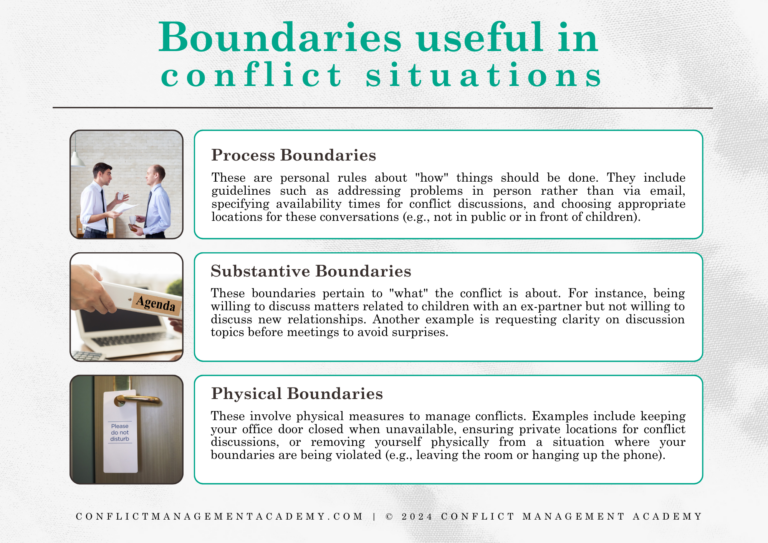
There are different kinds of boundaries that are useful for different situations. In conflict, there are three main types of boundaries: process boundaries, substantive boundaries and physical boundaries. These can all be used to prevent unnecessary conflict or to support you to manage conflict that does arrive courageously and with integrity.

A process boundary is a personal rule about “how” things should be done. For example, you may say to your employees that if they have a problem with something that you do at work, they should come and speak to you about it in person, rather than complaining behind your back or sending an email. Other process boundaries might relate to time – when you are and are not available to talk about a conflict, and for how long. Process boundaries may also relate to where conflict conversations take place (e.g. not in a public place, or not in front of children).

A substantive boundary relates to “what” the conflict is about. You may, for example, set a boundary that you are willing to talk to your ex-partner about what is best for the kids, but you are not willing to talk about your new relationship. A substantive boundary might be asking someone to be very clear about what they want to talk with you about before a meeting, so that you can be prepared to discuss those particular issues without being taken by surprise.

Physical boundaries are very useful in conflict situations. They may include things like keeping your office door closed when you are not available to have a conversation; ensuring that conflict discussions take place in a location where nobody can overhear what people are saying; or you physically removing yourself from a conversation in which someone is breaching your other boundaries (e.g. by walking out of the room, or hanging up the phone).

How to set boundaries

In order to set good boundaries, we need to know what is important to us. Our boundaries should support us to act in accordance with our values. We also need to know what kinds of behaviours from others make it difficult for us to maintain our integrity in conflict situations, and what kind of actions support us to communicate effectively. We need to distinguish between things that make us feel safe, but prevent us from managing conflict effectively (e.g. avoiding the other person) and things that enable us to interact in a constructive way.

Try to think about preventative boundaries, as well as boundaries that you might be able to use in the moment during a conflict conversation.

Things to think about when setting boundaries in conflict situations:

  • Which of our values are most important to us in conflict situations?
  • What kind of behaviour would be consistent with our values?
  • What would we like others to do in conflict situations to enable us to manage the conflict constructively?
  • What would help us to communicate effectively in conflict situations, so that we can listen respectfully but also say what we need to say?
  1. What makes you uncomfortable or stressed in conflict situations?
  2. What helps you communicate effectively in conflict situations?
  3. What process boundaries would support you in conflict situations?
  4. What substantive boundaries would support you in conflict situations?
  5. What physical boundaries would support you in conflict situations?

It can be difficult to get started and learn how to set effective boundaries in conflict situations, but fortunately The Conflict Management Academy provides an online module so you can develop the skills to interact with courage!

Are Mediators Ever Liable? Rethinking Accountability in Our Practice

Samantha Hardy
This article has been republished with permission. The original publication can be found at The Conflict Management Academy.

Inspired by Jennifer L. Schulz (2023). Mediator Liability 23 Years Later: The “Three C’s” of Case Law, Codes, & Custom. Ottawa Law Review / Revue de droit d’Ottawa, 55(1):151–186. Available at: https://doi.org/10.7202/1112508ar

A Quiet Assumption

For many of us working in the mediation field, there’s a quiet assumption we rarely question: that we’re not likely to be sued for what happens in a mediation room.

And, to date, that assumption has mostly held true. While a few attempts to sue mediators have occurred in different jurisdictions around the world, none have resulted in a mediator having to pay compensation to a party.

Canadian mediator and law professor Jennifer Schulz reviews 23 years of case law across six common law countries—including Australia—asking why mediators are not being held liable and arguing that they should be. The article is well worth reading in full, as the detailed summaries of the cases examined provide a vivid picture of the current gap between our aspirational standards of practice and the lack of accountability for those who do not meet them.

The Current Reality: A Legal Shield

Schulz’s research confirms what many of us might suspect: across Canada, the US, Australia, New Zealand, England, and South Africa, courts are still not holding mediators legally liable for negligent practice.

Even in cases involving mediator coercion, numerical errors in settlements, inappropriate behaviour, or poor handling of vulnerable parties, the most common judicial response is to set aside the agreement—not to hold the mediator accountable.

There are four main reasons for this legal shield:

  1. Causation hurdles – it’s hard to prove that a mediator’s actions caused a party’s loss.
  2. Mediator immunity – either through legislation (as in many US states and Australian courts) or through contractual terms.
  3. Mediation confidentiality – which often prevents complainants from even introducing evidence of wrongdoing.
  4. Lack of a defined standard of care – without it, there’s nothing to measure negligence against.

As Schulz puts it, we’re operating in a legal vacuum—where professional expectations are high, but legal consequences are rare.

The “Three C’s” Proposal: A Way Forward?

Schulz doesn’t advocate for a wave of mediator lawsuits. Instead, she proposes a more thoughtful framework for developing legal accountability: the Three C’s.

  • Case Law – court decisions that, even if inconsistent, begin to sketch the boundaries of acceptable practice.
  • Codes of Conduct – such as those issued by AMDRAS, state-based mediator panels, or court-connected schemes.
  • Custom – what a reasonable mediator would do in a given situation, based on community norms and practice standards.

I would personally add another C, perhaps attached to the Codes of Conduct item – and that is Complaints. More could be done to educate clients about what they should be able to expect from their mediator, and mediator complaints services could be more courageous and transparent about how they respond to client complaints. Complaints handling that is half-hearted or that aims to protect mediators rather than hold them publicly accountable only exacerbates the problem and pushes it underground.

These sources could help courts (and the profession) articulate what counts as competent mediation (the basis for a standard of care in negligence) and what crosses the line.

What the Cases Tell Us

The article walks through dozens of cases—some troubling, some absurd, many familiar. A few key themes emerge:

1. Coercive Behaviour Is Common—But Unpunished

Multiple cases involve mediators who pressured parties to settle, made legal predictions, lost their tempers, or belittled participants. Courts have rarely responded with consequences—unless the party was unrepresented and severely disadvantaged. The courts typically assume that if a party is legally represented, their lawyer will protect them from any harm.

Notably, some cases even include allegations of racist or discriminatory remarks by mediators—again, without findings of liability.

2. Vulnerability Is Often Overlooked

Incapacity cases—where a party was overwhelmed, unwell, or otherwise unable to engage effectively—are nearly always dismissed. Courts seem to assume that the voluntary nature of mediation allows a party to stop participating at any time, so choosing to continue negates their right to claim. This type of thinking shows a lack of understanding of how incapacity might show up, in that it might also make someone incapable of making a good choice to leave the mediation.

3. Mediators Who Make Mistakes Still Escape Consequence

From drafting errors to bad legal advice, mediators are largely shielded unless the consequences are glaring and the party can prove they were misled into harm. In such cases, courts tend to place responsibility on the parties’ lawyers—even where the mediator dictated the settlement. Even where there is no lawyer involved, the likely outcome is that the agreement will be set aside, rather than any consequences for the mediator.

Implications for Australian Practice

So what does this mean for those of us practising under the AMDRAS framework or in private, court-connected, or hybrid contexts?

  • Legal immunity doesn’t mean ethical impunity. Just because we’re unlikely to be sued doesn’t mean we shouldn’t hold ourselves—and each other—to higher standards.
  • Custom matters. If the law ever does change, it will likely rely on what we say is normal, ethical, and good practice in our mediation communities.
  • The codes we sign up to should guide us daily—not just when we’re audited or accredited. They may form the basis of future legal standards.
  • Training matters. When mediators pressure parties, overlook incapacity, or provide questionable advice, it’s often due to poor training, not bad intentions.
  • RABs need to have rigorous complaints processes.  Until the courts step up and impose consequences on mediators who behave badly, the mediator’s accreditation body must be able to manage complaints effectively to prevent harm to parties and the profession’s reputation. This means holding mediators accountable for improper behaviour and educating members about where the line will be drawn.
  • Industry/peak bodies could play an important role in educating clients about their rights/expectations of a mediator. It’s one thing for mediators to hold themselves accountable (and be required to do so through professional standards). It’s another for a client to be informed and educated about the treatment they are entitled to receive.

It is also important to acknowledge that there are many cases in which aggrieved clients lash out at mediators who have done nothing wrong. Vexatious complaints seem particularly common in the family sector, and it is important that the practitioners involved are treated with respect and allowed to defend themselves with dignity.

A Profession at the Crossroads

Mediation has come a long way—from fringe alternative to mainstream dispute resolution. With that growth comes a challenge: do we want the status of a profession without the accountability?

Schulz’s article offers a roadmap. The future of mediator liability may not lie in sudden lawsuits or rigid standards, but in a profession willing to evolve its own definitions of excellence, to recognise when harm has been done, and to hold people accountable.

As Australian mediators, particularly with the new AMDRAS standards about to come into effect, we’re well placed to lead this conversation. The question is: will we?

TIPS FOR NEW PRACTITIONERS: Getting your documents in order

Samantha Hardy
This article has been republished and adapted with permission. The original publication can be located within The Conflict Management Academy.

When setting up your practice, it’s important to have all your documents in order. Many people don’t prepare in advance and then are in a last-minute panic when the first client turns up and they need paperwork! 

It’s also important to remember that each client may need different types of paperwork, so you adapt and tailor your documents to each client and context.

What documents do you need?

During your training as a coach or mediator, you probably discussed things like agreements to mediate, or coaching contracts, but these are not all you need. You will also need things like:

  • Enquiry-related documents (e.g. information sheets and brochures for parties, lawyers, support people or employers)
  • Business-related documents (e.g. proposals, scope of work, invoices or client databases)
  • Service-related documents (e.g. questionnaires and intake forms agreements to participate, privacy and confidentiality agreements, record of mediation outcomes, spreadsheet for recording property items, value or distribution documents)
  • Correspondence templates
  • Feedback sheets, surveys, and evaluation documents

You may need a few versions of each kind of document for different clients and situations. For example, when an employer is involved as sponsor or when there are multiple parties involved in the conflict (whether a workplace or family conflict) or documents related for different services (e.g. mediation and coaching).

How do you make these documents available?

As well as the content of these documents, you should consider carefully when and how they are made available to prospective or current clients. For example:

  • Are the documents (in a generic version) made available publicly (e.g. on your website)?
  • Are the documents sent to prospective or current clients (as templates or with their details added)?
  • How important is it that the clients read and/or understand the documents? How do you ensure this is likely to happen? What happens if the client does not read the documents you provided?
  • Do you recommend and/or suggest clients obtain (legal or other) advice about the contents of any documents provided?
  • How accessible are your documents (e.g. for people who have visual or other impairments)?
  • What opportunities are there for clients to discuss the contents of the documents with you?
  • Do clients need to sign any documents? Do these need to be witnessed (by anyone, a lawyer or JP)? Can they be signed electronically?

You may have been provided with pro-forma examples of documents, like agreements to mediate or confidentiality agreements, from your trainers or your accreditation bodies, and these are a useful foundation to work from. However, using them “out of the box” is not ideal, as your brand, your clients, and your context are unique, and you need documents that are designed for your particular practice.

I highly recommend you go through any template very carefully and identify any contents or language that needs adjusting.  You should do this when creating your own branded template, but you should also do a quick check for each client, to ensure that each document is tailored appropriately for the specific client and their situation.

Check the content is applicable

Check that the content of the document suits your client and their situation. For example:

  • Is there is an employer or sponsor involved?
  • Is this a two-party or a multi-party situation?
  • Will you be working in person or online?
  • Is the process going to be confidential, or are there reporting requirements (e.g. to an employer)?
  • Does the template refer to laws (e.g. in relation to a mediator’s obligation to disclose information to authorities in certain circumstances) that might vary across jurisdictions?
  • Does the document use terminology that is not relevant to your client’s context. For example, does the document refer to litigation or going to court when this isn’t something your client is likely to be considering, or include statements like “settlement is legally binding” which may not apply to your client’s situation.

Check that the language is suitable

Formal or informal? The language used will differ greatly depending on your client-base. If you are working as a mediator in a legal context, many of your lawyer-clients may be repeat clients so will not need a great deal of information. However, referring lawyers may be providing information to their clients (e.g. a panel of three mediators for the client to choose between) and so you may also want to provide information suitable for lawyers to give to their clients to help inform the client’s choice.

How the people involved are referred to? If you are working with two employees involved in a personality clash at work, they may not find it comfortable to be referred to as “disputants” or “parties”. Try to accommodate language that is suitable for the dispute. For example, if it is a family dispute involving children, referring to the parties as “parents”.

How is the situation or conflict described? If your clients are currently involved in litigation, it might be perfectly acceptable to refer to the situation using language like “the dispute”. However, if you are mediating between family members in a personal conflict or employees who have a personality difference, this terminology might not sit well with them. You might be better using language like “your concerns” or “your working relationship”. Try to be sensitive to what would be comfortable for your clients.

Is it consistent with your brand? If your brand is down-to-earth, plain English, and informal, then providing clients with documents full of legal-ease or formal terminology and language may create a disconnect for your clients. This doesn’t mean you don’t include necessary information, but rather try to use language that is clear and also consistent with your brand ‘voice’.

Is it ambiguous, overstating, or misleading?  Be very careful not to use sweeping statements that may be misinterpreted. Terms to be careful about include “voluntary” and “confidential”. Depending on the client’s circumstances, these terms may not apply in a straightforward manner and can create confusion and distrust (and even sometimes lead to complaints).  For example, an employee who is required to attend mediation as a condition of their employment may not feel that their participation is voluntary. Similarly, if following a workplace mediation, one participant breaches an agreement to keep the discussions confidential by talking with a colleague about what happened, there is often very little anyone can do about this.  This can lead to the other person complaining that “the mediator said it was confidential and yet they couldn’t stop them from talking about what happened”.

Conclusion

Getting your documents in order and knowing how to adapt them when needed is important to build credibility and professionalism in your work.

In our Beyond the Table course accessible on the Conflict Management Academy, we have created an entire module on Your Documents which can help you review a broad variety of examples of different kinds of documents and be tailored to fit your practice and your brand.

We consider different categories of documents, including:

  • Enquiry-related documents (e.g. information sheets and brochures for parties, lawyers, support people or employers)
  • Business-related documents (e.g. proposals, scope of work, invoices or client databases)
  • Service-related documents (e.g. questionnaires and intake forms agreements to participate, privacy and confidentiality agreements, record of mediation outcomes, spreadsheet for recording property items, value or distribution documents)
  • Correspondence templates
  • Feedback sheets, surveys, and evaluation documents

Author Biography

Dr Samantha (Sam) Hardy is the Director and Lead Trainer of the Conflict Management Academy. Sam is an experienced mediator, conflict coach, and the founder of the REAL Conflict Coaching System™. She provides conflict support to managers and leaders across the world as well as professional development training, supervision and mentorship to mediators and coaches who work with clients in conflict. Sam is an accredited mediator under the Australian National Mediation Accreditation System (NMAS), a certified transformative mediator by the United States Institute of Conflict Transformation, and a certified narrative coach. She has been awarded Conflict Coach of the Year at the Australian Dispute Resolution Awards in 2022 as well as the Australian Resolution Institute Award for Service to Dispute Resolution in 2021 for her leadership and innovation in the field. Sam also publishes widely in dispute and conflict resolution, including Dispute Resolution in Australia, Mediation for Lawyers and Conflict Coaching Fundamentals: Working with Conflict Stories.

When “Sorry” seems to be the hardest word – but I don’t care!

This post is written by Judith Rafferty (nee Herrmann), lecturer in the Conflict Management and Resolution program at James Cook University, nationally accredited mediator, trained conflict coach, and facilitator. Judith has a degree in Business Administration and Conflict and Dispute Resolution, and is a PhD candidate assessing the experiences of female survivors of conflict-related sexual violence with transitional justice processes. This blog entry is based on Judith’s TEDxTalk “When “Sorry” seems to be the hardest word – but I don’t care!”, which can be viewed here.

Some background to the research discussed in this blog post can be found in Judith’s journal article “Experiences, challenges, and lessons learned: interviewing Rwandan survivors of sexual violence, which can be accessed here. Further publications discussing findings of the research are planned.

As a mediator and conflict coach I have observed many times how people in conflict feel wrongly treated by the other conflict party and request an apology. Only then, so they feel, is it possible to let go of the conflict and move on. Feeling the need for an apology makes people in conflict vulnerable and dependent on the other party, who might not be willing apologise. In this blog entry, I address the question of how people can become less vulnerable and more resilient when in conflict by forgiving those who they feel have wronged them, even if no apology is offered by the other side.

I was introduced to the concept of forgiveness while interviewing women who had survived sexual violence during the genocide in Rwanda in 1994 and who had experienced extraordinary wrongs by the hands of their perpetrators. Many of these women never received an apology from the people who had raped and tortured them, and yet, some of these women made the decision to forgive irrespective of any conciliatory actions of their perpetrators.

To give you a little bit of background, an estimated 250,000 – ½ Million women were raped during the genocide in Rwanda.  Many were raped and then killed, or died later from the consequences of the violence. The women who I interviewed as part of my PhD research on justice needs of survivors of sexual violence, had physically survived the violence and were able to share their stories with me. Many of the women had been raped by their own neighbours and have to live side by side with the perpetrators’ families today. At the same time, many of the women had lost their own families during the genocide. All the women who I spoke to had, following the genocide, participated in local justice processes in Rwanda (called “gacaca”). What women pointed out as particularly difficult during these justice processes was that most perpetrators denied everything of which they were accused. What would have helped, the women told me, was to hear a confession or even better, an apology. I wanted to know how the women coped with the fact that hardly anyone took responsibility and confessed and/or apologised to them. While discussing this question, a number of women raised the topic of forgiveness.

For example, a woman who had been raped and who had lost all her brothers and her father said:**

”There was a time when I was very angry. All the things that they had done to us were boiling inside us. But the anger is now gone and I can forgive them”.

She explained to me that she had actively made the decision to forgive, even though her perpetrators had neither confessed, nor apologised to her, and that this decision had helped her to find peace at heart and facilitate her recovery:

Once I decided to forgive, I was healed”.

I thought that these words “I decided to forgive” sounded empowering and suggested that forgiveness is a choice that can be made without receiving anything in return. After hearing the women’s stories, I was intrigued to learn more about forgiveness, a concept that I, like many other people, found initially rather abstract. In the literature, I found some definitions of forgiveness that seemed to align with what the Rwandan women had talked about, and that brought the concept closer to me, including the one provided by Dr Fukofuka:

“Forgiveness involves conscious choice. When we forgive we decide not to think or talk about what others have done to hurt us. Forgiveness is not forgetting and it is not excusing; it is in fact the opposite of excusing. The mere fact that forgiveness is needed and granted indicates that what someone else did was wrong and inexcusable”.

Similarly, psychologist and researcher Frederic Luskin views forgiveness as a discrete process of letting go of anger and resentment, which may occur regardless of whether the wrongdoer has apologised or not.[1] Luskin found in his research that learning to forgive has psychological and physical benefits for people, since it helps to ‘hurt less, experience less anger, feel less stress and suffer less depression’.[2] Some critiques argue that forgiveness implies condoning or excusing wrongs, which may ultimately result in an omission of punishment of a wrongdoer.[3] Others have questioned the impact of forgiveness on the dignity and self-respect of those who are requested to or who offer to forgive.[4] However, I believe that this criticism mainly refers to situations where forgiveness is expected in return for an apology, and not where forgiveness constitutes a deliberate choice of the person harmed to let go of anger and resentment as described by Luskin. In fact, the process of forgiveness as defined above does not require any future interaction with the other party who has caused harm. Having said that, forgiveness can be part of a broader reconciliation process where one party apologises and the other one forgives. A few women did talk about how some of their perpetrators eventually apologised and how the women forgave them. However, the majority of the women has never received an apology until today, and yet, some of them “decided to forgive”.

Lessons learned

In summary, what we can learn from the women in Rwanda and what is supported by professionals who have researched forgiveness, are the following points:

  • Forgiveness does not need to start with an apology, since you can decide to forgive unilaterally.
  • You don’t have to tell the other party that you have forgiven them, and in some instances it might be safer not to do so.
  • Even if you personally forgive someone who has harmed you, the person might still need to face consequences. One Rwandan woman explained: You forgive him but he still has to go to prison and pay for his crime.
  • Forgiving can help to find peace of mind and support individual healing.
  • Forgiveness doesn’t come naturally, but is difficult and takes time. It took the Rwandan women who “decided to forgive” many years. It seemed like the women went through a phase of intense anger first, and then reached a tipping point, where anger faded and having peace at heart by forgiving became more important than feeling anger.
  • Finally, I learned that even survivors of genocide who have experienced unspeakable harm have found the strengths to forgive their perpetrators. Maybe this means that we all have the potential to forgive and the power to become more resilient.

** The original interviews were conducted in Kinyarwanda and were later transcribed and translated by a Kinyarwanda-English speaker. Challenges associated with researching in another language and how they were addressed in this research are further discussed in Judith Herrmann, “Experiences, Challenges, and Lessons Learned – Interviewing Rwandan Survivors of Sexual Violence,” Griffith Journal of Law & Human Dignity 5, no. 1 (2017))

[1] Frederic Luskin, “Nine Steps to Forgiveness,” Aging Today 25, no. 4 (2004),, 13.

[2] Ibid., 13.

[3] Phil Clark, The Gacaca Courts, Post-Genocide Justice and Reconciliation in Rwanda (Cambridge;New York: Cambridge University Press, 2010), 42-3.

[4] Audrey R. Chapman, “Perspectives on the Role of Forgiveness in the Human Rights Violations Hearings,” in Truth and Reconciliation in South Africa, ed. Hugo Van der Merwe and Audrey R. Chapman (Philadephia, Pennsylvania: University of Pennsylvania Press, 2008), 67.

REFERENCES

Chapman, Audrey R. “Perspectives on the Role of Forgiveness in the Human Rights Violations Hearings.” In Truth and Reconciliation in South Africa, edited by Hugo Van der Merwe and Audrey R. Chapman. Philadephia, Pennsylvania: University of Pennsylvania Press, 2008.

Clark, Phil. The Gacaca Courts, Post-Genocide Justice and Reconciliation in Rwanda. Cambridge;New York: Cambridge University Press, 2010.

Herrmann, Judith. “Experiences, Challenges, and Lessons Learned – Interviewing Rwandan Survivors of Sexual Violence.” Griffith Journal of Law & Human Dignity 5, no. 1 (2017): 165-88

Luskin, Frederic. “Nine Steps to Forgiveness.” Aging Today 25, no. 4 (2004): 13.


Avatars as third party neutral? Opportunities and challenges for technology in Mediation.

This post is written by Kirsty Cadusch, a Human Resources professional with a focus on workplace conflict and resolution.  Kirsty is passionate about supporting parties to address conflict in the workplace, and building leadership capability to effectively manage workplace conflict, to enable the development of high performing teams.  Kirsty’s twitter handle is @kirstycadusch.  Kirsty is currently undertaking the Masters of Conflict Management and Resolution at James Cook University.  This blog entry was originally submitted as part of the assessment for the subject Foundations of Mediation in the JCU Masters program.  

The commercialisation of the internet and development of e-commerce in the 1990s called for a dispute resolution system to address complaints into online transactions (Fernandes and Masson, 2014). In response, online dispute resolution (ODR) evolved as the fields of alternative dispute resolution and information technology intersected (Ebner and Zeleznikow, 2016). ODR refers to any method of dispute resolution in which an open or closed network is used, either wholly or partially, as a virtual location to solve a dispute (Carneiro et al, 2012).

Artificial intelligence advances have taken mediation for the resolution of business-to-consumer e-commerce disputes to wholly online dispute resolution systems, using computerised mediators to facilitate party interactions via text and messaging (Liyanage, 2012; Ebner and Zeleznikow, 2016). So, what does this mean for the future of mediation practitioners? As artificial intelligence continues to advance, and systems are increasingly able to act as agents, assessing and responding to human interactions and emotions in mediation (Carneiro et al, 2012), are mediators to be replaced by avatars and holograms?

The development of AI for conflict resolution

In the mid 1990’s, the field of artificial intelligence was thought to offer exciting opportunities for alternative dispute resolution (ADR).   Developments such as artificial neural networks, intelligent software agents, case-based reasoning mechanisms, methods for knowledge representation and reasoning, argumentation, learning and negotiation would move ADR to a virtual environment in which ODR services proactively assisted disputant parties (Carneiro et al, 2012). It was considered using such technologies may contribute to develop ODR processes that could mimic the cognitive processes of human experts to deal with complex multiparty, multi-issue, and multi-contract issues, leading to more efficient ODR tools (Carneiro et al, 2012).

In practice, two decades later the field of ODR has yet to reach the technological utopia anticipated. While the development of ODR as a field of ADR is growing, with many mediators offering ODR as part of their service, this is typically an add on to their traditional face-to-face practice (Ebner and Zeleznikow, 2016). Mediators typically rely on first generation technology such as instant messaging, forums, video and phone calls, video conferencing, mailing lists and file sharing to deliver their ODR service (Carneiro et al, 2012).

Online Dispute Resolution in practice

At present, ODR in this context is used in family, employment and commercial dispute resolution, and in the traditional court setting in the form of government-sponsored electronic courts (Liyanage, 2012). Relationships Australia Queensland (RAQ) provide an example in the Family Dispute Resolution (FDR) context.

From 2009 to 2011, RAQ developed a web-based online FDR (OFDR) system to provide a safe, secure online environment in which a family dispute resolution practitioner (FDRP) may actively facilitate registration, intake, family dispute resolution and Pre-FDR education of a mediation session. The system operates across most platforms, including Windows and Mac, and provides flexibility to deliver online sessions with or without video conferencing and for sessions to be conducted individually, jointly, by co-facilitation, shuttle or with interpreters (including sign languages) and/or support people (RAQ, 2011).

Currently, the Resolution Institute is working with MODRON, a ODR service provider, to develop a mediation platform that will enable parties, representatives and mediators to resolve disputes ‘from any device, anywhere in the world’. This web-based technology will enable participants to instant message, host private and group video and audio calls and securely share files and manage cases (Resolution Institute, 2017).

Governance and ethical considerations

As mediators and ODR service providers identify opportunities to increase the use of technology in mediation practice, it raises issues regarding governance and ethics, confidentiality, security of information, mediator impartiality and education and training requirements. These issues relate to the disputing parties and mediators utilising the technology, as well as what Katsh and Rifkin call “The fourth party”, i.e., the technological elements involved (Carneiro et al, 2012). Additionally, these issues relate to what may be considered the “fifth party”, i.e., the service providers who provide and deliver the technological elements (Carneiro et al, 2012).

Governance of ODR may be considered from the two perspectives that influence the field, Alternative Dispute Resolution (ADR) and Information Technology (IT). Mediation in Australia is governed by the National Mediator Accreditation System (NMAS) and focuses on accreditation of practitioners and practice standards. Court and legal systems, with their existing structures, procedures, and oversight also impact mediation governance as it is increasingly embedded in those systems (Ebner and Zeleznikow, 2016).

The Australian Computer Society is the professional body that certifies computing professionals’ qualifications, and has a code of ethics and a code of professional conduct, and codes of testability and of quality control to ensure software engineering standards (Ebner and Zeleznikow, 2016). However, in both Mediation and IT, practitioners are not required to be members of these bodies or hold a licence to practice, making industry regulation of standards and quality of service challenging (Ebner and Zeleznikow, 2016).

Ebner and Zeleznikow (2016) note that ODR generally knows little or no regulation, authority, standards, or monitoring and as it has not yet been embedded in court or government systems, it has developed largely unregulated from a public policy standpoint. The Mediator Standards Board and the NMAS (2015) do not currently reference ODR in relation to mediation services or processes.

This lack of governance may reduce participants trust, sense of security, and confidence that the online mediation process is fair (Ebner and Zeleznikow, 2016). Significantly, misuse of online mediation may cause harm for the participants (Ebner and Zeleznikow, 2016)   Examples might include where a digital record of the mediation is shared unsuitably due to poor system security, or where inefficiency, errors or bias are hidden behind the interface of a poorly designed system (Fernandez and Masson, 2014).

However, the NMAS Practice Standards (2015) do consider ethical practice and provide, among other ethical consideration, that a mediator may liaise with other relevant professionals with permission from the relevant parties. The Standards also require a mediator to take care to preserve confidentiality in the storage and disposal of notes and records and take reasonable steps to ensure that administrative staff preserve such confidentiality. In the absence of specific ODR guidelines or inclusion in the NMAS Practice Standards, these broad and general requirements should be considered when engaging ODR service providers to provide online mediation services.

Consideration should also be given to the impact of online mediation and use of technology on the perception of mediator impartiality. A mediator’s impartiality may come into question where there is a lack of information about the systems being used, the mediator’s affiliation with the ODR service provider and whether there is a conflict of interest, and the governing structures of that provider with regard to the parties’ personal information (Fernandez and Masson, 2014).

As mediators increasingly utilise technology to deliver online mediation services, they will need to identify what training they may require to develop the skills to manage a virtual mediation room (Sole, 2016). The NMAS Approval Standards specify the training and assessment required of NMAS accredited mediators, and currently require an applicant to complete a training course of 38 hours duration. There may be an opportunity for Recognised Mediator Accreditation Bodies that provide mediator training to incorporate information about online mediation systems and skills into their programmes.

Mediators also need to be mindful of the parties’ willingness to engage with technology and their technical capability in considering whether the dispute is suitable for mediation. When utilising technology or an online mediation system, mediators should consider reliability and ease of use of the device or system to ensure a robust process.

The future of AI in ADR

The development of AI technologies has influenced the field of mediation predominantly in the legal field, using rule based legal decision-making systems (Carneiro et al, 2012). However, the concept of replacing human mediators with computerised third party agents such as avatars, capable of mimicking the full range of human emotions and interactions to support disputing parties to reach fair and reasonable solutions is a daunting prospect.

It seems more probable that we may see the increased use of automated systems to supplement the traditional mediation process whereby second generation systems are used to facilitate some aspects of the mediation process. For example, mediator practitioners may utilise a ‘fourth party’ to facilitate case assessment and intake; option generation and evaluation; negotiation and documentation in the mediation.

To ensure party self-determination and procedural justice, a mediation practitioner may facilitate the initial stages of the mediation joint session; mediation opening, party statements, agenda setting and issue exploration and discussion; as well as the private sessions and the agreement/outcome. Key findings from the RAQ online mediation pilot included that participants rated the online service as convenient, however face-to-face FDR remained the preference for most parties (RAQ, 2011).

While the use of technology will no doubt increasingly impact mediation interactions, there appears to be a long way to go in terms of developing governance and ethical standards for all parties involved before this becomes commonplace. Incorporating these standards into the existing NMAS Approval and Practice Standards will likely positively influence the trust and confidence participants have in engaging in online mediation that may see this aspect of mediation practice gain momentum into the future.

References:

Boulle, L. (2012). Mediation: Principles, Process, Practice. Australia: LexisNexis Butterworths

Carneiro, D., Novais, P., Andrade, F., Zeleznikow, J., Neves, J. (2014). Online dispute resolution: an artificial intelligence perspective. Artificial Intelligence Review, 41(2), 211-240. doi: 10.1007/s10462-011-9305-z

Casey, T., & Wilson-Evered, E. (2012). Predicting uptake of technology innovations in online family dispute resolution services: An application and extension of the UTAUT. Computers in human behaviour, 28(6). 2035-2045. DOI: 10.1016/j.chb.2012.05.022

Ebner, N. & Zeleznikow, J. (2016). No Sheriff in Town: Governance for Online Dispute Resolution. Negotiation Journal, 32(4), 297-323. doi:10.1111/nejo.12161

Fernandez, A.J., & Masson,M.A. (2014). Online mediations: advantages and pitfalls of new and evolving technologies and why we should embrace them. Defense Counsel Journal, 84(1). p. 395+. Academic OneFile. Accessed 22 May 2017

Liyanage, K. C. (2012). The Regulation of Online Dispute Resolution: Effectiveness of Online Consumer Protection Guidelines. Deakin Law Review, 17(2), 251-282. http://www.austlii.edu.au/cgi-bin/sinodisp/au/journals/DeakinLawRw/2012/11.html?stem=0&synonyms=0&query=Online%20Dispute%20Resolution

Sole, M.E. (2015). e-Mediation: A New Stage of Ethics. Retrieved from http://www.mediate.com/articles/SoleME4.cfm

Mediation in a media nation

Margarets image

This post is written by Margaret Marton, a Humanities and Legal Studies teacher with many years experience. Margaret is currently completing a Masters in Conflict Management and Resolution at James Cook University with the view to be a mediator within juvenile justice and/or schools. She is particularly interested in introducing conflict resolution skills training in schools, possibly via competitions. She is also interested in how new technology is influencing the dispute resolution processes. This blog post was originally submitted as part of the assessment for the Masters subject Foundations of Mediation.

Where is mediation heading? How much influence has new social media had and potentially will have on mediation? The clash between social media and traditional litigation is tectonic so can mediation as we know it survive?

Does mediation’s lack of formality when gathering and presenting information need special rules regarding social media? What guidance should parties in mediation be offered regarding use of social media? Will there be a “Mediation App” in the future? All immensely interesting and challenging questions in a nation where social media is so ubiquitous Waleed Aly has wailed you cannot escape it!

The wildfire pace at which technological apps have developed has people demanding new forms of dispute resolution more in tune to the power of the individual, their ease with technological communication and their access to immense amounts of information and advice at the touch of a screen? What do mediators need to focus upon to be reflective mediators in a media nation?

One of the most problematic elements for mediation is confidentiality. Even though there is profound debate over mediation’s definition there is general consensus on what occurs in its practice. Most agree mediation involves a private impartial mediator-facilitated meeting, conducted on a confidential basis, between disputing parties to assist reaching a mutually agreed outcome. Confidentiality is a hall mark of mediation. It is the access to or exposure about what transpired in a mediation. Section 9 of the Australian National Mediation Accreditation System Practice Standards, state that subject to the requirement of the law a mediator must maintain the confidentiality required by parties. Without doubt confidentiality of the process was the driving force behind the popularity of mediation as an alternate to the public disclosure central to court litigation.

Even though working in the “shadow of the courthouse”  has already placed significant limits on confidentiality in mediation, it can be argued social media is a far greater threat. Due to peoples’ increasing lack of intimacy and privacy in interpersonal relationships, as practiced on social media sites, confidentiality has lost much of its credence.  Mediators must be attuned to this. As an aside, in a recent survey on counselling 80% of practitioners indicated they had clients who expressed concerns about the impact of social and mobile media on their relationships.

The ethical issues surrounding this loss of confidentiality become clear when the motives for “sharing” on social media platforms are not positive. In a recent divisive family law case, Lackey v Mae the judge ruled a father immediately remove from Facebook all references to the proceedings, the children, the mother’s name, the father’s name, and so on. As the  Deputy Chief Justice of the Family Court of Australia, John Faulks, explained, what would it  be like if you were a kid at school and all your mates said, ‘Oh, we’ve been looking at Facebook and we’ve seen what your father says about your mother,’ or whatever it may be, it’s a pretty horrible situation.” Certainly it is against the paramount rights of the child and section 121 of the Family Law Act (which is rarely applied). On the Law Report Faulks DCJ went on to say “people will use the social media to abuse the other party, to bully the other party, to be critical of the proceedings,… which of course is relatively easy to do in the middle of the night, sit down, open up your account, put the information on there. You don’t have to look at anyone when you’re doing it, you don’t have to feel any empathy for the person who is being affected by it, you can just spray.” How would an impartial mediator, who would most likely actively avoid access to this Facebook site, know about and then deal with the ramifications to cyberbullying such as this?

Another ethical issue for mediators involving social media is secret taping of private conversations. This could occur during mediation or be tapes of situations concerning the issue being mediated. Secretly taping a private conversation is legal in Queensland, is promoted as a way of dealing with conflict and is only breached if broadcast without reason. For example it may be used for protection or as evidence to record what happens in particular situations like child handovers or fidelity issues.

As there is little discussion re this concerning mediation a look to the courts can be illuminating. Until recently courts had not seen this as useful evidence, but increasingly courts are accepting smart phone-taped evidence as it is timed, dated and can be GPS referenced for location. A family court lawyer claimed there was discussion about the use of social media derived evidence in at least 30% of cases they dealt with.  Interestingly, the Domestic Violence Resource Centre in Victoria has just won the Victorian Premier’s Award for public sector innovation for the SmartSafe+App. This App was designed with police to help women collect and store evidence concerning breaches or the need for intervention orders. Mediators must be able to deal with this form of information if brought to the table in discussions.

Broadcasting information or images has enormous implications for mediation and its potential to escalate a dispute. A Home Economics teacher recently had an incident where two 12 year old boys instead of fashioning bachelor buttons with their dough fashioned an appendage they were far more interested in. Just as the teacher realised what they were doing a fellow student quickly photographed the biscuit and loaded the image on to Instagram.

The resulting discipline, after conversations with parents, was as severe for the upload of the image as for the creation of a limp biscuit. Recently, new apps allow a person to broadcast or share an image to complete strangers.  New tracking functions on the latest smart phones have again raised online privacy fears. Mediators must definitely negotiate with both parties at the beginning of mediation about confidentiality and how mobile phones or similar devices are to be handled in the meeting. It is possible that special rules need to be applied concerning smart phones usage such that if breached it could terminate the mediation.

A final ethical dilemma concerns the personal use of social media of mediators. Impartiality is critical to the neutral position of mediators so use of social media which compromises this impartiality is a potential problem. Mediators personally must have the right to use social media but must navigate it with awareness. At present social networking “affiliations” are sufficiently loose that impartiality has not been questioned but there is very little guidance on these issues.

Not all impacts of social media are negative and many see the new technologies as a positive force in mediation. Technology is transforming the work of lawyers and the delivery of legal services to the consumer. Already legal advice and dispute resolution can be accessed online. Jacques Joubert argues that social media is a “game-changer” and that mediation between large companies and the general public will be  will be controlled by mass outrage, one of the most powerful of human emotions. The reason people post on social media is also affected by our culture and way of life. A UK study has shown that British people post to maintain personal distance while Chinese do it to maintain privacy. Even attention spans are blamed on it. Social media is a game-changer for mediators!

Central to managing all these impacts of social media on the mediation process is the professionalism of the mediator. In the absence of binding formal rules, ADR participants and practitioners grappling with social media issues should be guided by two foundational concepts:

  1. balancing the respective interests of the partieswhich may require the mediator to develop an agreement that outlines exactly what type of information the parties and their counsel can disclose, including via law firm websites, blogs, and the various social media platforms. As public disclosure via social media has the potential to reach thousands of people who may know the parties or be interested in the dispute, just relying on the normal rules of confidentiality would not protect the interests of one or both parties; and
  2. adhering to professional ethics must be complied with by the mediator. This will require using their own judgement based on their personal ethical standards and reflections supported by reviews of issues with trusted colleagues. This includes personal use of social media to find out more information about parties, counsel or witnesses and impartiality in dealing with parties who the mediator may have social media contact with.

Interestingly, Diane Levine, a long standing ADR blogger holds that blogging is the best way to stay current [and possibly reflective?], as blogging is a conversation between fellow practitioners “who make it their business to keep abreast of essential news and trends.”

Using these two principles will not deal with all issues impacting on mediation by social media platforms. However, they should provide a useful framework for thinking through the ramifications of a “media-nation on mediation.” The heart of any profession is clear standards of ethics and practice.

Amanda Boardman a mediator from the Centre for Integrative Law (CIL) in Cape Town reminds us that “a legal system is a fluid and dynamic system, inextricably woven into the fabric of the society it is expected to contain.” Mediation must, can and will adapt to social media platforms to serve its media – nation.

When persuasion is coercion

This post is written by Benjamin Freedman, an accredited mediator, social worker, and healthcare manager who will finish a Masters in Conflict Management at James Cook University in November 2017. His interests include interprofessional collaboration in healthcare and conflict engagement in complex organisations.  This blog entry was originally written as part of the assessment for the Masters subject Foundations of Mediation.

Mediation goes on trial

Given how often mediation and litigation occupy different spaces within the same dispute resolution landscape it is perhaps surprising how rarely the processes or outcomes of mediation have been challenged in court. While there are some plausible reasons for this, it does mean that the Australian cases which do exist afford a valuable opportunity for ADR practitioners to learn about their potential legal liability.

There is thought to be three areas of legal liability relevant to mediators:

  • Liability in contract– where a party suffers harm or loss caused by a failure of the mediator to perform in accordance with an Agreement to Mediate
  • Liability in tort– where the mediator fails to adequately exercise their specialist skills, causing an actual loss to one or more parties
  • Liability in fiduciary duties– where a mediator is in a relationship of trust with a party and acts in a way that is not in that party’s interests.

Tapoohi v Lewenberg

Tapoohi v Lewenberg is widely regarded as the most compelling test of mediator liability in Australia (see also conversations about immunity in family law and admissibility in farm debt contexts). Tapoohi v Lewenberg involved two sisters in a complex dispute about their mother’s deceased estate. The dispute had gone to court, but the parties agreed to attend mediation.

Seven facts you need to know

  • Due to the value of the estate, each sister was represented at the mediation by a team of barristers and solicitors.
  • The mediator, a QC who specialised in commercial litigation, was not mediating under a court order and there was no formal agreement to mediate (therefore no statutory immunity).
  • In position statements, pre-mediation conferences and during the mediation Ms Tapoohi repeatedly stated that any agreement should not be final until professional taxation advice had been sought.
  • The mediation took place over a single day and lasted late into the night
  • At the end of the evening, the mediator persuaded the parties that an agreement should be drafted and signed that night.
  • The mediator dictated the terms of the agreement, which was scribed by a solicitor in the legal party, and this was signed by each sister.
  • This included a provision, suggested by the mediator, that shares in the family company would be transferred for a nominal sum of $1, but no provision for taxation advice was included in the agreement.

Subsequent to this mediation, Ms Tapoohi discovered that the value of her position was substantially reduced after capital gains tax. Ms Tapoohi sued her legal team, who spread liability by including the mediator as third party to the claim.

The mediator applied for a summary judgement, hoping that the litigation would be found not to have a reasonable chance of success and therefore he would be excused as a third party. After the summary judgement was in favour of the plaintiff, the matter was settled out of court.

Seven critical learnings for the reflective practitioner

The precedence value of this case is limited as the matter was settled out of court before the full evidence was presented and tested. However, the allegations and arguments during the interlocutory proceedings provide some insight into the legal elements of many ethical dilemmas faced by many contemporary facilitative mediators.

Persuasion versus Coercion

Ms Tapoohi argued that the mediator ‘coerced’ parties to continue the mediation late into the evening, despite the misgivings of the legal representatives, two of whom had already left for the day. It is alleged the mediator recommended extending the session in such a way that Ms Tapoohi’s team felt it was a direction.

ADR practitioners often rely on their mastery of persuasion. While persuasion and coercion are both strategies that aim to influence the actions of another party, ‘coercion’ is to do so by using threats and sanctions where ‘persuasion’ seeks a voluntary and willing change by exploring interests or encouraging parties to evaluate options. The judge did not rule on whether the mediator used coercion, but this case challenges the reflective practitioner to be aware how the use of language, context, non-verbal communication and relationship can ‘frame’ whether a message is received as persuasion or coercion, even when intentions are good.

Influence the process, not the outcome

Ms Tapoohi argued that the mediator unilaterally dictated some of the critical details in the mediated agreement, including the ill-fated provision to transfer shares in the family company for $1.00. Facilitative mediators are process experts, upholding the principle of self-determination, where parties make their own decisions and the mediator does not evaluate or advise on the merits of, or determine the outcome of, disputes.  Often when mediation is on the precipice of breaking down because it is perceived by parties as too uncomfortable, risky, or difficult, the mediator has an important role in persuading parties to keep communicating and moving through the stages of process. Yet there is a difference between exerting influence on the process, versus influencing the substantive outcome.

Where the mediator may have reasonably believed it was appropriate to extend the mediation into the evening to maintain the momentum of the process, it was his influence on the substantive outcome which became problematic. This is a dilemma in many mediation contexts; where a ‘small suggestion’ from the mediator may be the difference between an impasse and a mediated agreement.

Fiduciary responsibilities

Ms Tapoohi alleged that the engagement between her and the mediator had characteristics of a fiduciary relationship, and the mediator was in breach of his responsibilities by acting in a way which was contrary to her interests. The mediator unsuccessfully argued that there were no characteristics of a fiduciary relationship with Ms Tapoohi as he was retained to provide a facilitative process, and fiduciary responsibilities towards Ms Tapoohi rested with her legal team.

While the matter of whether mediation has the characteristics of a fiduciary relationship remains, it is worthwhile to consider the imperative of a mediator to act with diligence, even-handedness and trustworthiness. While this is fairly ingrained in practice, there are also potential dilemmas, or tensions, which shape mediator self-interest and pressure to settle when not in the best interests of parties.

Facilitative mediator expertise

In this instance the mediator was a Queens Counsel with a background in commercial litigation. This became important when the judge considered the standard of practice that should have been exercised by the mediator- whether it was that of an expert mediator or an expert commercial litigation barrister. It is common that an accredited mediator will also have a professional background that is relevant to the content of the mediation. While the mediator may delineate in their own mind that they are being retained for mediation and not the skills of their background profession, this should be made explicit to parties who may be less familiar with the process-orientation of a mediator. Regardless, the National Mediation Accreditation Standards advise that ‘mediators should adhere to, and be familiar with, the code of conduct or ethical standards prescribed by the organisation or association with which they have membership’.

Legal exposure in agreement drafting

Ms Tapoohi argued that she had repeatedly asked that any agreement not be made final until professional taxation advice had been sought, and this expert knowledge was not present in the legal team. However, this condition was not included in the signed final agreement which was dictated by the mediator and scribed by one of the solicitors. This raises a question of the standard of care that is required by the mediator when drafting an agreement, and how much of the responsibility for checking its accuracy and completeness sits with the parties as signatories.

Mediation in high-stakes commercial disputes

Facilitative mediation has many advantages over other more formal processes. It can far less costly than litigation, integrative rather than adversarial, there is less of a focus on ‘facts’ or ‘evidence’ and more a focus on interests and agreements, and resolution can occur far quicker. While there is no ‘upper limit’ on the stakes that can be part of a mediated agreement, parties should be made aware that the process and outcomes are often less robust than settlement through courts. It is a challenge for facilitative mediators to identify when the dispute may require a more rigorous enquiry than what is provided by a facilitative process. Even more so, to ensure that parties understand the benefits and limitations of facilitative mediation to optimise informed consent.

Given the likelihood that these and other areas of mediator legal exposure, and questions about immunity will be tested in court in the future, it is important that facilitative mediators consider their obligations of contract, tort and fiduciary relationship during the complexity and dilemmas of everyday practice.

Further reading

Melinda Shirley and Tina Cockburn discuss whether mediators operating outside statutory immunity will be liable for negligence in the aftermath of Tapoohi v Lewenberg

Conflict coaching: Panacea or placebo?

Aside

My dispute resolution ‘journey’ began with life as a litigation lawyer.  While completing my Master of Laws I studied a subject on ‘alternative dispute resolution’ and we had the option of doing an extra two days of training to become certified under what was then a Certificate 3 in Mediation.  This training was enough to change my path from lawyer to mediator and I began a PhD which looked at how different approaches to dispute resolution (litigation and mediation) impacted on psychological outcomes for participants.  Some years later I completed conflict management coach training in the CINERGY model, and subsequently developed the REAL Conflict Coaching System, which I now practice and teach through Conflict Coaching International.  For a link to a talk I gave a few years ago in the US about the REAL Conflict Coaching System and the philosophy that it is based on, see this youtube link.

Conflict coaching is a one-on-one process during which a conflict specialists ‘coaches’ someone in conflict to assist them to manage their conflict more effectively and perhaps even resolve it.  The conflict coaching does not provide advice or advocacy-type support, rather the coach facilitates a kind of reflective process through which the client gains insight into the situation they are facing and ideas for moving forward.

Conflict coaching:

  • Provides the client with undivided attention
  • Is founded on deep listening
  • Gives the client non-judgmental support
  • Uses curious questioning
  • Promotes self-reflection
  • Promotes empowerment

A quick note on terminology:  The process I am discussing here was originally called “conflict coaching” but the name has fairly recently developed into “conflict management coaching”, I assume for a number of reasons:  Firstly, to emphasize the connection between conflict coaching and management/executive coaching; but secondly and perhaps more importantly, to highlight that the coaching process is about supporting people to develop strategies to manage their conflict, not to teach them how to have conflict (emphasizing that it’s nothing like being a boxing coach!).  It’s also interesting to note here that the process has not been called conflict resolution coaching and this is an important point – the aim of conflict coaching is not necessarily to resolve the conflict.  In one sense, including the word “management” is an attempt to include a positive term alongside the word “conflict” which is often seen as negative (so one would not want to provide coaching for someone to engage in “conflict”; whereas coaching someone to engage in “management” sounds more constructive).  However, this tends to perpetuate the idea that conflict is something negative, when in fact in can be something very positive if it is engaged with appropriately.  For this reason (and for pragmatic reasons of brevity) I continue to use the simple term “conflict coaching”.

When considering the place of conflict coaching in today’s suite of conflict support services, it’s useful to consider the changing nature of societal responses to new conflict resolution processes. Laurence Boulle, in his book Mediation: Principles, Process, Practice identifies the following ‘waves’ of responses to mediation in Australia, which be equally applied to the development of conflict coaching as a service:

  • First wave: Optimism and idealism
  • Second wave: Skeptism, hostility, call for exacting standards
  • Third wave: Balanced understanding, recognition and organization, mainstreaming
  • Fourth wave: Cross-fertilisation
  • Fifth wave: Integration and interconnectedness (which can lead to an identity paradox, as the process becomes blurred with others). [1]

Where is conflict coaching currently on this spectrum?  Well, there is certainly some optimism and idealism (at least from those offering conflict coaching services).  There is also some skeptism, particularly about the potential for a one-on-one process to achieve conflict resolution.  There have also been moves towards accreditation of conflict coaches, and some models provide their own practice standards, but these are not widespread or nationally recognized in the same way as the Australian National Mediator Practice Standards.  In some sectors (e.g. the Australian Defence Force) there is evidence of a strong understanding and mainstreaming of conflict coaching, but this is not universal.  There is perhaps the beginning of cross-fertilisation, with referrals to and from mediation and other conflict resolution processes, and there is also some blurring of the process with others (e.g. counseling or advocacy) but this is probably more based in a general ignorance of the process rather than widespread integration and interconnectedness.

The process of conflict coaching began as a back-up plan when mediation was not possible (usually because one party was not able or willing to participate).  It is first recorded as being offered at Macquarie University in Australia and was known as “Problem solving for one” (developed as a one-on-one process based on Fisher and Ury’s interest-based negotiation model) and then at Temple University in the USA (based on the Thomas-Kilman Conflict Mode Instrument). For a brief overview of the development of conflict coaching see chapter one of this thesis about mindfulness in conflict coaching.

Recently, however, conflict coaching has been used as more than just a back up plan when mediation is not possible.  Rather, it is frequently the first process choice, before and often instead of mediation.  It can be used as a preventative measure.  Conflict coaching can also be used as a kind of ‘triage’ process into other services.  It can also be used post-mediation.

There are a range of different models and approaches.  The most well known model in the Americas and Australia is the CINERGY model, however other models have developed including the narrative-based Comprehensive Conflict Coaching model and the Australian-developed REAL Conflict Coaching System.

In my opinion, the increase in popularity of conflict coaching as a process can be explained by a number of factors: Firstly, there is a shift towards individualized services.  Secondly, and somewhat contradictory to its original purpose, mediation is now often seen as “too formal” a process.  Another impacting factor is arguably that people are losing the capacity and motivation to communicate directly with those with whom they are in conflict and so are more comfortable with a process that does not require them to do so.  People in conflict also want someone “on their side” but not necessarily a lawyer/advocate.  There is also a growing social focus on self-development.  When conflict coaching is sold as a kind of professional development exercise, it is also easier to motivate staff to participate.

The growing popularity of conflict coaching is consistent with the shift in emphasis towards self-determination in dispute resolution rhetoric.  It is popular with those seeking to “do it yourself” and empowerment, and also provides an individualized and just-in-time support for those experiencing conflict.  Conflict coaching is broadening in scope, and is being used in contexts including:

  • Managers dealing with staff conflict;
  • Preparation for mediation, negotiation, litigation;
  • Divorce coaching;
  • Negotiation coaching;
  • Self-represented litigant coaching;
  • Change management coaching;
  • Conflict coaching for students in school;
  • Conflict coaching to support people to implement parenting plans agreed upon during family dispute resolution;
  • Conflict prevention as well as resolution.

Some boundaries are being blurred, for example: conflict coaching is being provided by individuals who are not independent (e.g. managers) and it is sometimes being used as an educational tool and an ongoing, rather than a short-term, intervention.

So is conflict coaching the panacea we have been waiting for to support individuals to manage their conflict more constructively?  In its favour, it promotes self-determination and empowerment, integrates well with other processes, and is flexible and individualized.  However, it is not suitable in all individual conflict situations (e.g. family violence and bullying are typically not appropriate for conflict coaching, unless used very carefully by practitioners who understand the dynamics of power-based violence – supporting a client to be more assertive in engaging with a perpetrator of violence can result in the violence escalating).

It is difficult to evaluate the benefits of conflict coaching apart from based on an individual’s perceptions of how it made them feel.  It is hard to prove that people who access conflict coaching services move on to actual improvements in their conflict management / conflict resolution.  It is also important to consider whether conflict coaching is replacing more helpful interventions such as early conflict education, communication skills development, and in a workplace – effective performance management.

It seems that the answer lies somewhere in between the two poles of placebo and panacea.  Conflict coaching can make a client feel better, by giving them a forum to vent and to be listened to attentively and without judgement.  It can also make managers feel better when they refer an employee to conflict coaching as they feel they have done something productive in response to a conflict situation in the workplace.  However, conflict coaching used unmindfully can act simply as a placebo, and an expensive exercise without any objective improvement in the client’s conflict situation.  On the other hand, conflict coaching, even when used appropriately, is not the answer to all conflict situations.  It also may need to be used in conjunction with other conflict services in order to provide a holistic response that maximizes the chances of a lasting positive outcome.

[1] L. Boulle, Mediation: Principles, Process, Practice, 3rd Ed. (Lexis Nexis Butterworths, Chatswood, 2011), pp 349-351.