
Unknown's avatar

About Dr Claire Holland

Dr Claire Holland is mediator, conflict coach, and trainer with the Conflict Management Academy, an Adjunct Senior Researcher with the Cairns Institute, James Cook University, and international consultant, currently working in Papua New Guinea.

Mediators Beyond Borders International: Peacebuilders in a world of conflict

This post has been contributed by Rosie Carpenter, a student in the JCU Master of Conflict Management and Resolution, supervised by Claire Holland. Rosie is currently completing an internship as part of her studies with Mediators Beyond Borders International (MBBI) in the “Innovation and Impact” team. She is passionate about helping people to improve their lives, supporting others to accomplish personal goals, manage conflict effectively, and working towards achieving peaceful societies. Rosie has written this post as part of her role in supporting the organisation of the 2019 MBBI Peace Congress.

Are you a Disruptor?  Become a Peacebuilder in a World of Conflict.

Conflict exists worldwide. War-torn countries have communities in which they may not have access to any form of justice system. Within these communities there may be no, or limited access to police enforcement for protection, prison security system, legal representation, structured court system or judges to settle their case. How do these groups form peaceful resolutions to conflicts which arise within their lives?

Mediators Beyond Borders International (MBBI) are a not-for-profit organisation which over the past 10 years have successfully formed a network of conflict-transformation practitioners, mediators and community leaders. MBBI goes into the heart of these communities to educate local leaders with the knowledge and skills used to promote peacebuilding and conflict-transformation, which encourages sustainable positive change into the future.

Disruptors: Being Peacebuilders in a World of conflict is the vision statement for the 2019 International Peace Congress to be held in Bail from 6th to 8th November 2019 at the Bali Intercontinental Hotel and Resort where accommodation packages are currently available.  Registrations for the congress are invited by MBBI for mediators, Rotary peacebuilders, conflict transformation practitioners, organisational leaders, government diplomats, public officials, advocates and academics to join them as trailblazers, changemakers and risk-takers. This year’s event will have a transformative emphasis on LeadershipVision, Innovation, and Implementation.  To become involved within this ground-breaking opportunity to share in the unique experiences and teachings from like-minded people who share the passion for empowering others to strive for peace through conflict resolution.

“We all have different inspirations, but one goal: a better world.” -Ernesto Arguello
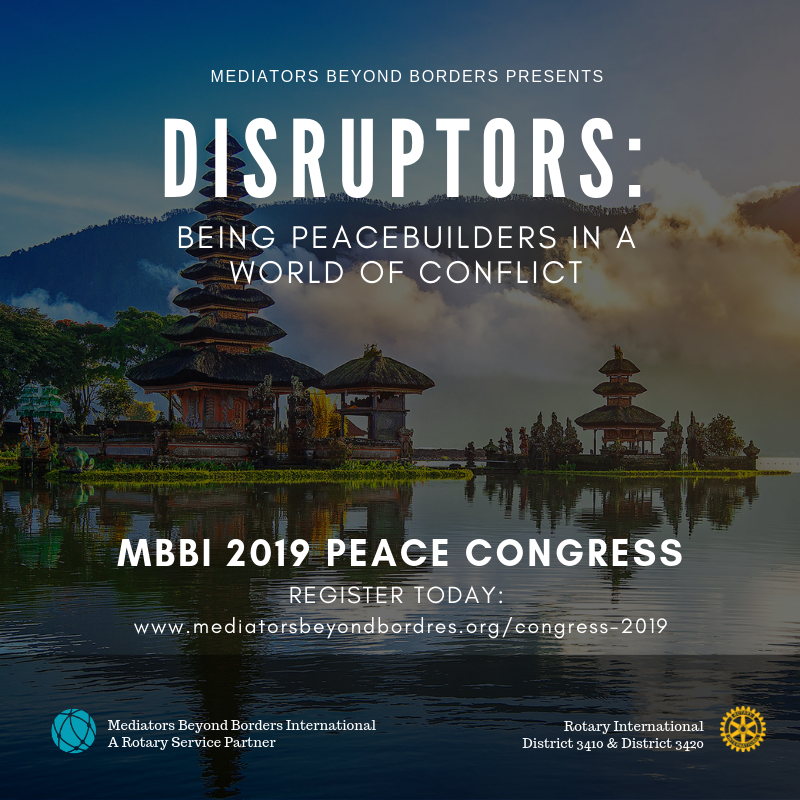
The Global Vision for MBBI is “The 2020 Decade of Peace” development initiative which includes innovative projects such as:

  • Women’s Role in Building Peace
  • Innovating Social Change
  • The Asian Perspective on Mediation
  • Youth and Conflict Resolution
  • Equipping our Leaders

“The 2020 Decade of Peace” will be launched at the 2019 International Peace Congress in Bali to progressively introduce global peace through these projects backed by an increase in regional partnerships with worldwide community-minded groups such as Rotary International, the Bali International Arbitration & Mediation Centre and the United Nations. Congress will serve as a catalyst for the 2020 Decade of Peace Initiative, which invites individuals and organizations from around the world to advance mediation, dialogue, and conflict transformation practices as a mechanism for socio-economic change. You will be recognized as a Founding Member of the 2020 Decade of Peace Initiative, and you will have the ongoing opportunity to share your work and be showcased on our international platforms for years to come.

MBBI in partnership with The Bali International Arbitration & Mediation Centre (BIAMC) has fostered transnational relationships within this important region which has experienced surges in conflict as the region rapidly expands into becoming one of the fastest growing global economies. BIAMC is a non-profit service centre which provides elite alternative conflict management and resolution using arbitration and mediation internationally. Using its professional staff with creative and dynamic solutions, BIAMC succeeds with alternative dispute resolution where conventional forms are not effective.  The BIAMC’s core values are YOUFIRST, Young at heart innovation, Out performance through leadership, Unwavering accountability, First class and fast-track service, Integrity without fail, Reverence in diversity, Safeguard community and Transparency.

The MBBI Rotary Partnership Working Group (MBBI-RWG) is a collaborative partnership which combines resources from both organisations to strive towards the prevention and reduction of worldwide conflicts, encouraging peace while progressively healing communities. MBBI will lead this change to facilitate the exchange of innovative peacebuilding practices into the next decade and beyond by collaborating with leaders of communities and providing transformative education to those who are in desperate need of these alternative conflict resolution skills, to build peaceful resolutions.

“A genuine leader is not a searcher for consensus, but a moulder of consensus.” -Martin Luther King Jr.

Play an Active Role in Advancing the UN Development Goal 16:

The U.N. Sustainable Development Goal 16: Peace, Justice, and Inclusive Societies will be actioned at the 2019 Bali Congress.  We need your voice, vision, and experience to represented in this event, so that you can be a part of a collaborative effort to advance a global mission towards peace, prosperity, and positive social change. By attending the 2019 Congress you will develop a collective vision of what 2030 might look like, and what steps we will take to advance this goal of the United Nations.

Partnerships and sponsorships are available for individuals, corporations and governments to expand their business opportunities onto the global stage, building upon the growing economy within and enable this important peacebuilding to continue over future decades. For MBBI gaining future financial funding is imperative to achieve their significant global vision.

To find out more about MBBI and their many global initiatives, visit their website https://mediatorsbeyondborders.org/

Join us at the 2019 Peace Congress! To register visit, https://mediatorsbeyondborders.org/congress-2019/




A case for coaching: Influencing cultural change at the ATO *

Tina Hoyer** and Claire Holland***

*The views expressed in this payer are those of the authors and do not necessarily reflect those of the Australian Taxation Officer (ATO) or James Cook University (JCU).

** Tina Hoyer is currently on a 12 month secondment to the JCU Conflict Management and Resolution Program from the ATO. Tina leads the ATO In-House Mediation Service.

*** Claire Holland is the Course Coordinator of the JCU Conflict Management and Resolution Program. She is a lecturer and researcher in Alternative Dispute Resolution (ADR) and conflict resolution processes.

Dispute Resolution and the ATO

The Australian Taxation Office (the ATO) is one of the leading government agencies utilising Alternative Dispute Resolution (ADR) and has achieved a substantial reduction in disputes proceeding to litigation over the last five years. This is largely due to the ATO’s sophisticated Dispute System Design (DSD) and the ATO’s internal use of ADR methods, including the implementation of initiatives such as in-house facilitation (mediation), the dispute assist program, and independent review. Hoyer and Holland are proposing to trial a coaching model specifically designed for ATO operatives (auditors and objections officers) to build their dispute resolution capacity and improve the way in which they deal with tax disputes. It is envisaged this coaching model will complement the ATO’s toolkit for resolving tax disputes, and influence positive cultural change within the ATO.

Resolving tax disputes earlier saves time and costs for taxpayers and the ATO, and provides certainty for taxpayers. More importantly, if the taxpayers perception of the dispute resolution process is fair, then they are more likely to have a positive attitude toward the ATO and are more likely to meet their taxation obligations voluntarily.

Since 2013, the ATO has been undergoing a comprehensive program of reinvention a central theme of which has been fair, efficient and timely dispute resolution approaches in its interactions with taxpayers. The ATO disputes policy has comprehensive key principles of dispute management to promote a resolution culture based on effective communication, genuine engagement, collaboration, and strategies that are fair and proportionate to the matters in dispute, as well as leading to early resolution at minimal cost. The ATO has been recognised as having an effective DSD and possessing many best practice principles. However, some deficiencies have been identified; one such deficiency being inadequate staff training on conflict management. In addition, the ATO has been subjected to much adverse public attention in regard to its handling of disputes particularly in relation individual and small business taxpayers.

Conflict coaching has the potential to support ATO operatives to develop greater competency, confidence and understanding of choices that they can make that will meet the key principles of the ATO disputes policy.

Can conflict coaching assist?

Coaching is a term used to define a wide variety of activities. In the literature, coaching has been described as a conversation one person has with another to help them move forward or create change. Coaches work with individuals and groups to achieve their desired outcomes and it unlocks a person’s potential to maximize their own performance. Jones and Brinket define conflict coaching as a process for the purpose of developing the disputants (the clients) conflict-related understanding, intervention strategies and interaction skills.[1] Hardy and Alexander, principals of Conflict Coaching International, state that conflict coaching is provided by a conflict specialist whose role it is to assist the client to develop

1)         clarity about the conflict situation;

2)         greater understanding of their own and other people’s needs and goals;

3)         identify and evaluate their choices for moving forward;

4)         develop confidence about managing conflict and achieving their goals; and

5)         increase their conflict management skills so that they can constructively engage in conflict.[2]

The focus of the conflict coaching process is on assisting the individual to become clearer and more confident about their conflict situation. In the ATO context, this includes supporting ATO operatives to analyse their own behaviour and develop a greater understanding about what choices they can make in the situation that could result in a positive outcome for the taxpayer and the ATO in line with the key principles of the ATO disputes policy.

Freedman suggests that when working in complex adaptive systems, such as the healthcare sector, conflict coaching can be used to support conflict transformation or management, rather than focusing on resolution. Orientating the purpose of the coaching is important to ensure the coaching model, and style are best ‘fit for purpose’.  An adapted coaching model drawing on the REAL Conflict Coaching process and incorporating Ury’s 7 step negotiation preparation[3] will be developed and trialed with ATO operatives to determine if coaching is an effective process to support a conflict transformation mindset that results in greater positive tax dispute outcomes for the taxpayer and the ATO.

Orientating Conflict Coaching for the ATO context

To research the effectiveness of this coaching model, a research project will be conducted that employs a holistic approach to examine the model from all stakeholders’ perspectives. This research project seeks to understand whether:

  • the coaching model is effective in ensuring the ATO operative coachees are applying interest-based negotiation skills (considering the taxpayers interests, alternatives, all options for resolution, ATO policy and effectively communicating) when negotiating with a taxpayer;
  • the coaching model is effective in improving the ATO operative coachees’ dispute resolution capacity and if the they will self-assess any changes in attitudes, beliefs or values as a result of the coaching; and,
  • the coaching model can be implemented in other large government and non-government organisations.

This research will:

  • contribute to the growing body of knowledge on one-on-one dispute resolution methods;
  • evaluate the coaching model’s effectiveness in improving the coachees dispute resolution capacity and achieving genuine cultural change; and,
  • provide a basis for discussion for the implementation of this type of coaching model in other large government and non-government organisations.

Holland and Hoyer have recently presented at the National Mediation Conference in Canberra in April and will soon publish a paper outlining their research, Holland, C. & Hoyer, T (2019 – under review) A case for coaching: Influencing cultural change at the ATO. 

[1] Jones T.S. & Brinkert R. Conflict Coaching: Conflict Management Strategies and Skills for the Individual, (2008) Sage, Los Angeles, CA.

[2] Samantha Hardy and Nadja Alexander (2014) Beyond Mediation: How conflict coaching can enhance your practice, Journal on 3rd Asian Mediation Association Confernce.

[3] Roger Fisher and William Ury, (1991) Getting to Yes – Negotiation agreement without giving in, Second Edition, Penguin books.