Unknown's avatar

About Associate Professor Becky Batagol

Dr Becky Batagol is an Associate Professor of law at the Faculty of Law, Monash University. She is a researcher and teacher with a focus on gender, family law, family violence, non-adversarial justice, dispute resolution, gender, child protection and constitutional law. Becky is the co-author of Non-Adversarial Justice (2nd ed, 2014), Bargaining in the Shadow of the Law? The Case of Family Mediation (2011) and the author of many academic articles. Becky, alongside Dr Jessica Mant, is the President of the Australian Dispute Resolution Research Network in 2024-25.

Should mediation be regarded as a separate profession?

By Spencer Csapo-Grege

This post is the second in a series of posts on this blog written by students studying Non-Adversarial Justice at the Faculty of Law at Monash University. Students were invited to write blog posts explaining various complex areas of law relating to dispute resolution to ordinary readers. The very best post on each topic is published here.


I INTRODUCTION

For effective dispute intervention, mediation may be a necessity. Issues may arise as intervention through mediation requires a particular skill set that is not taught to all mediators. Because mediation requires independence of knowledge it could thus benefit from existing as a unique profession.

The central issue is whether the lack of legal, or other specialised expertise in independent mediation outweighs the positive benefits of independents being solely trained in mediation skills. I propose that it would – mediation should not be a distinct profession, based on three peripheral issues.

The first is that of qualification, it is already evident that Mediators can be sufficiently qualified to demonstrate an appropriate standard in their mediation ability.

The second issue addresses the need for professionalism, over the potential loss of individual comfort.

And, the third is the issue of Content – independent mediators may not understand, and hence be able to implement, necessary content into their mediation, such as a mediator not being able to recommend legal options due to a lack of formal training in the law.

separate

Mediation should remain a separate profession. Photo: creative commons source

II ISSUES OF QUALIFICATION

Dispute resolution practitioners currently rely on their status as professionals in other fields such as law, psychology or social work to demonstrate their expertise into the area of mediation. Due to this diversity there are mediation laws which both regulate the requisite standard of mediation, as well as mediator accreditation.

In the National Mediator Accreditation System mediators do not require a formal qualification to satisfy mediation standards. A requisite of experience in mediation, or good personal attributes can satisfy the qualification criteria – demonstrating the potential of being insufficient.

Hence it can be erroneously said that mediation would benefit from formal qualification as its independent identity as a profession will be established, rectifying this potential of insufficiency. However, mediation involves dealing with the individual’s specialised issue, and the accumulation of content relevant experiences aids in its resolution. Thus the identity of mediation is based on the content mediated upon, not on the process.

The current system is effective in recognising this through interconnecting mediation, as dispute resolution, into its relevant field, such as law.

If mediation was a separate profession, there may be two possible financial benefits. Firstly, having to pay someone who has been educated in another profession to mediate, such as law, can be more costly than if mediation was distinct, because the education requirements would likely be less. Secondly, because of this educational difference, Mediation is subject to possible monetary exploitation – lawyers’ fees can be standardised as expensive due to their legal expertise, and not because of their ability to mediate.

This is problematic because monetary gain should not be the driving force behind mediation. If a mediator only cares about making a profit, and not the parties’ situation, then they may stall time to earn a higher profit, even though it is not in the best interests of those involved. Thus a distinct profession of mediation, that is capable of attracting individuals desiring mediation for reasons other than financial gain remains beneficial.

Even though there is possible financial detriment and shortage of formal qualification, the established method of mediator qualification remains sufficient because it binds and aligns dispute intervention to its relevant field. However, the current system of qualification may not be adequate. This is because the National Mediation Accreditation System primarily focuses on facilitative mediation and fails to cover the full range of mediation practices.

However, this flaw also represent the adverse effect that separate mediation can bring – an inapplicability of appropriate mediation principles to specific subject matter and a possibility of exploitation due to mediator exclusivity. Thus, current mediation regulation should not be revolutionised so that mediation is an independent profession.

III ADDRESSING INDIVIDUAL WELL-BEING THROUGH PROFESSIONALISM

A Assistance of Therapeutic Mediation?

A contentious issue with the integration of mediation with other fields is the impact of the people involved on an individual level. If mediators were trained independently, there would be stronger emphasis on the individual and the relationship of the parties – thus therapeutic mediation could benefit. However, a professional able to help with the specific dispute at hand is likely to aid individual well-being because the parties will appreciate the mediator’s assistance on the basis of their professionalism – finding comfort in the mediator having relevant expertise to deal with the content matter of issue. For example, although a psychologist has better educated understanding of, and thus will take into account, the individuals emotional and mental well-being – as opposed to a lawyer. It is probable an individual will be more distressed in a psychologist trying to mediate for them in a matter of law, then a lawyer, because the psychologist is not trained in legal procedure.

B Advancement of Facilitative mediation?

Facilitative mediation is proven to be the most common form of mediation in Australia and is thus the recognized standard. If the integration of mediation advances facilitative mediation, then it indicates that mediation should not be a distinct profession. Integrating mediation provides for a more accurate basis of assessing an individual’s needs, which is important to facilitation, because it’s concerned with addressing both the personal and commercial needs of the parties. And, complete understanding of the individual’s options and abilities, in the case of law, are only prevalent because of the mediator’s legal background. Because mediators cannot usually give legal advice, parties are encouraged to have a lawyer attend with them as the need for legal understanding arises. Thus there is an issue in that a lawyer may want the most profitable outcome for themselves, and not necessarily the best situation for their client, and can, as an advisor to a party in mediation, cause disruption. This issue would be increased if mediators were separate and did not have legal training, because people would be further required to bring lawyers with them, for greater comprehension in choosing the best course of option between mediation and legal. Due to this dependent variable, the parties’ needs may not be prioritized and therefore a separate profession of mediation should not be established.

IV DIFFERENCE IN CONTENT

If mediation was a distinct profession would need to overcome the issue of how to achieve specialization in the subject matter of each mediation. We know that mediators intervene in the content of disputes, even in facilitative mediation. For effective intervention they must be familiar with the subject matter so that they can adequately provide information – based on all available knowledge. Content differentiation varies depending on the type of mediation, however, as outlined below, in general it is likely to indicate that mediation should not be a separate profession, but instead exist as a form of specialisation within its relevant profession. For example – as a lawyer, psychologist or social worker specialising in mediation, with requisite qualifications that demonstrate both their ability to work in the relevant field, as well as their ability to mediate.

The most appropriate option for parties to take may not be that of pure mediation but, for mediation to be a specialisation in a range of professions, such as law. Lawyers are trained in law and can rely on that experience to resolve the issue in a way that may be practical in the circumstances. This is because the legal avenue, may be more feasible then pure mediation. Thus, for a dispute to be resolved in a balanced manner the recommendation of legal options can also play a vital role in mediation – such as through settlement mediation to determine if the matter can be practically resolved in the legal sense, not just through negotiation. Hence, if mediation was independent, it would be difficult to intervene in disputes because the intervener, the mediator, may not fully comprehend the matters of discourse.

Mediation as a separate profession causes another issue in that if a mediator was mediating on a legal matter, but was not trained in the law, they would not be able to predict court decisions, and pressure parties into accepting on the basis of their predictions. Essentially evaluative mediation would be non-existent, or at best, less accurate. Thus, as evident, it is not feasible to blend all the content on which mediation can be applied, into one distinct profession.

V CONCLUSION

Mediation incorporates differing aspects and thus its independence can create broadness which undermines the field itself. The first two issues discussed, that of qualification and professionalism are contentious, and indicate possible support for independence – financial benefit towards the public and emotional health of the parties. Support for the third issue is highlighted as many mediation services focus on the resolution of relationship issues, and not just legal problems. However because relationship issues can be largely influenced by the law, a requisite of comprehension which remains vital to mediation. The third concern discussed demonstrates that this requisite of comprehension only exists with the knowledge gained through formal training in a relevant profession – supporting the current system. Mediation is hence mutually intertwined with its relevant subject matter, whilst benefit is also provided in its separation. As a result, the most suitable conclusion is that there should be organisations within the relevant professions, such as law, to manage mediation – it should be an area of specialised expertise, and not an area of independence.


Mr Spencer Csapo-Grege is a third year law student at Monash University with a primary interest in international law, banking and investments. He wishes to focus specifically on international investments, with a particular orientation towards banking. Furthermore, Spencer aims to be involved with international politics through the United Nations – he believes that state sovereignty has no place in a globalised world. For the practice of domestic law, Spencer’s interests are in alternative dispute resolution as he believes that most issues should be resolved outside of the court system. Currently Spencer runs a licensed investigations business and aims to finish his undergraduate studies at the end of 2017.

Blogging Basics for Beginners: Or, how to write a really good academic blog post

In this post, I set out what I have learned about writing a really good academic or research blog post. It is increasingly important to present academic research to the broader public. That requires a special way of writing about research.

 I am a legal academic at Monash University and I am a regular blogger and author for academic commentary site The Conversation. For the past three years I have been editor of this Australian Dispute Resolution Network blog and I encourage and require my undergraduate law students to write for the public in the blog format.

This post has been written in conjunction with the Australian Dispute Resolution Network’s 5th annual workshop in Hobart from 9-11 December 2016 at the University of Tasmania. This piece has been posted during my session about academic blogging, to demonstrate how easy it is.


artist-barbara-horsley-involves-chloe-stout-in-adding-a-few-brush-strokes-to-the-old-post-office-at-the-australianitalian-festival-in-ingham-queensland-2013

Artist Barbara Horsley involves Chloe Stout in adding a few brush strokes to ‘The Old Post Office’ at the Australian-Italian Festival in Ingham, Queensland, 2013, Scragg, Sarah, Courtesy John Oxley Library, State Library of Queensland


Why Blog Research?

All academics need to be able to write about their research in simple and non-technical language for the broader public. Blogging is also a great way for students and practitioners to present their work to a broader audience.

In this blog we have already set out the Top 6 ways that Twitter can help your research.

Blogging is a great way of sharing your research with a more wide-ranging audience than a typical peer-reviewed academic journal allows. The ubiquity of neo-liberalism has meant that those working at higher education institutions today need to demonstrate how they have contributed to the knowledge economy.

As impact and engagement are increasingly becoming important measures of research productivity at Australian universities, blogging allows academics to increase the exposure of their research and to develop their profile as a public commentator.

But the real reason that I blog as a scholar whose salary is paid by Australian taxpayers, is that it feels like the right way to give back.

Through my legal research I have learned wondrous things about the impact of law upon everyday lives. Explaining what I have learned and why it is important to the people directly affected by law and legal process can help to give people understanding and choice and it can help towards them achieving that elusive goal, access to justice.

Start by Looking at Other Academic Blogs

Research blogging is a unique genre. Lots of students and academics I know find it hard to know where to start.

I think the best way to learn about how to write a blog post is to read lots of high quality research blogs. The gold standard is academic commentary site, The Conversation, which started in Australia in 2011 and which has presence now in the US, South Africa, the UK and France. The Conversation was developed with the aim of helping academics to present their research to improve the quality of public discourse. In my experience of publishing with that site, although they can be tricky to get published in, the advice of the editors on how to present my research has informed how I write outside the blog genre too.

If you are interested in looking at Australian law blogs, here’s one great aggregate and another from my Monash colleague Melissa Castan. Specifically on the non-adversarial theme is this ADR Research Network blog and the Mainstreaming Therapeutic Jurisprudence blog. For research-specific blogs I like the Thesis Whisperer for postgraduate researchers and their supervisors, as well as its more grown -up sibling, the Research Whisperer.

There are other places where people have written well about academic/research based blogging. Here’s a great introduction to academic blogs by Professor Patrick Dunleavy at London School of Economics.

There are some other interesting links on writing research/academic blogs and the blog genre: from the Thesis Whisperer about the value of blogging for PhD students, the Research Whisperer (ostensibly about science blogging but really relevant to any discipline) and this one about how to start writing a research blog post.

What Should I Write About?

In working out what to write about, you can take Dunleavy’s approach in this post and write a summary of a paper, article, chapter or essay you have already (mostly) completed. Dunleavy argues that after you publish an academic journal article, you should write a post summarising it.

Academically a blogpost boosts citations for the core article itself. It advertises your journal article in ways that can get it far more widely read than just pushing the article out into the ether to sink or swim on its own.

Dunleavy’s argument could apply to a thesis chapter, a conference paper or to a research essay completed for academic coursework.

I prefer to start with a blog and then turn the post into something that counts more readily as academic productivity.  Writing a blog post is often a great way to capture an idea quickly. Many of us in the ADR Research Network have found that our posts on this blog have become the basis for a later academic project, whether that be a conference paper, an empirical research project, a collaboration between researchers or an academic journal article. In a busy academic life, it is good to make one piece of work count twice, and blogging allows for that.

Another trick is to ask someone else to write a post as a guest blogger. That adds variety to the range of posts on a particular blog and helps ensure that posts are regular.

Tone and Form

A blog post should be written differently to an academic journal article. It needs to be understood by a non-expert audience, it needs to keep people engaged when they could easily switch to social media entertainments, it needs a different way of referencing sources and needs to look good on a screen (rather than on a page).

A good length for an academic blog post is 800-1500 words. It can definitely be shorter but any longer than that will lose readers part way through and will be too long on the page.

Don’t use technical language, or if you must, you need to explain it simply. I try to think that I am blogging for an interested, intelligent but non-specialist audience.

Paragraphs should be short, just a few sentences at most. Otherwise, your paragraphs will look too long on the page.

Rather than footnotes you should use hyperlinks. Blogging raises the moral problem of so much publicly -funded academic writing being hidden behind publisher’s paywalls. Assume your readers aren’t connected to universities and can’t afford to pay journal subscription fees. Hyperlinks should be to open source material that is not behind a paywall.

Grab their Attention with a Photo

A post should start with a hook that grabs readers’ attention. You can do this with a cracker opening line or you can use a picture.

I find that a great photo enlivens a post, and encourages readers to look at the piece. Especially with blogging services such as WordPress which send an email out to blog subscribers, a photo looks really good on the email that gets sent out.

28537784326_498e1cdb40

Creative commons. Source 


When using photos online, it is important not to breach copyright restrictions. You could use a photo that you have taken yourself or you could use photos that are open access/licensed under Creative Commons or which are out of copyright.

All of the State Libraries in Australia have picture libraries that are searchable and which have photos with minimal copyright restrictions. (Always check the terms of use of the photo in the library record when you search and attribute as required). I love using old photos with some kind of tangential relevance only to the post. Or you can check out compfight.

Happy blogging!

Collaborative Practice – unique skillset or traditional lawyering?


Student Guest Post by Ben Zocco


This post is the first in a series of posts on this blog written by students studying Non-Adversarial Justice at the Faculty of Law at Monash University. Students were invited to write blog posts explaining various complex areas of law relating to dispute resolution to ordinary readers. The very best posts are published here.


The advent of collaborative practice as a means of resolving family law disputes has provided couples with a means of completing a divorce or separation in a conciliatory and cost effective manner. With more than 200 practitioners currently registered with the Law Institute of Victoria’s Collaborative Law Section, a significant number of lawyers have undergone training that allows them to practice collaboratively.


The Law Council of Australia’s Basic Training Requirements

In response to its increasing popularity of collaborative practice, the Law Council of Australia has published the Australian Collaborative Practice Guidelines for Lawyers. This document encompasses a series of “Basic Training” requirements in order to be recognised as being collaboratively trained. This set of overarching training requirements forms a best practice guide for ensuring practitioners engaging in collaborative law are appropriately prepared for acting in this unique practice area.

army-recruit-is-in-training-at-the-army-physical-training-school-brisbane-1942Image: Courtesy State Library of Queensland
 

The Basic Training requirements provide for the teaching of a range of skills that are unique to the practice of collaborative law. This is particularly so with the requirement that practitioners are provided with relevant training of the “collaborative model”.


What is Collaborative Practice?

Collaborative practice, as the name suggests, is a non-adversarial process used to resolve disputes. It requires the parties and their legal representatives to enter into a formal contract that puts the focus of the process settling a matter rather than resorting to litigation. Terms in the agreement generally refer to a commitment for each party to engage in the collaborative process in good faith and to share all available relevant information pertaining to the dispute with the other party. If the dispute is not resolved and parties seek to formally commence legal proceedings, the lawyers engaged in the collaborative process are contractually required to cease representing their clients. This requires the parties to engage new lawyers, generally at a significant cost, and serves as a major incentive to the parties to find common ground and work collaboratively to resolve their dispute.

Collaborative practice is conducted in the presence of each party and their legal adviser in what is described as a “four way meeting”. Several four way meetings take place over the course of a number of months, with each run according to agenda devised by the parties in consultation with their lawyers prior to the meeting. The conclusion of the four way meetings seeks to culminate in the drafting and execution of an agreement that resolves the dispute in a manner that is mutually acceptable to both parties.


The Unique Nature of Collaborative Practice

The collaborative model, as describe above, is an entirely unique approach to the resolution of disputes. While traditional mediation is also seen as an alternative to litigating matters, it differs from collaborative practice in many respects. The absence of a mediator in collaborative practice requires the legal representatives to facilitate the discussion rather than simply representing their client. Additionally, the capabilities necessary to operate collaboratively in the absence of a court-mandated framework for discovery and good faith negotiation is at odds with that of conventional alternative dispute resolution approaches. Accordingly, this skillset is unique to collaborative law practitioners.

The skills required of collaborative practitioners are also unique insofar as the model makes use of independent experts to facilitate the settlement of disputes. It is standard practice in a matter being resolved collaboratively to utilise the expertise of third party professionals, especially those who are trained as child specialists or financial advisors. These experts assist the parties and the lawyers in exploring interests (rather than positions) and potential options to satisfy the needs of the parties. Additionally, their experience assists the couple in being able to understand the impact of their separation on their children, as well as its effect on the financial position of each person once the dispute has finalised.

While the interaction of legal practitioners and independent experts is extremely common, the manner in which they work together in a collaborative setting compared with that of general legal practice is significantly different. In many jurisdictions, the relationship between independent expert is governed by a formal practice note, issued by the court. Lawyers typically engage independent experts by way of a formal retainer, setting out the advice necessary for the purposes of the matter. The expert will then write a formal report, setting out their findings. In many cases, an expert will be required to “hot tub” with an expert appointed by the opposing party in order to reach consensus conclusions and to narrow the issues in dispute. Additionally, experts retained in a litigation matter are subject to rigorous cross examination from other parties, adding an adversarial flavour to their contribution made for the purposes of resolving the matter.

In contrast, a collaborative approach requires each party to jointly appoint an expert, often by way of a shared recommendation by the practitioners representing them. The expert will work with each party in the room together and will rarely engage in separate discussions with parties individually. Rather than the lawyers approaching the assistance of an expert’s contribution as potentially suspect or misconstrued as may be the case in litigated disputes, they are able to respect and value their support in a truly collaborative fashion. Accordingly, the interdisciplinary approach to collaborative practice means a collaborative practitioner is required to have a unique skillset when involving experts in a matter being managed collaboratively.


Negotiation for All, Not Just the Collaborative

While there are many aspects of the “Basic Training” requirements that are unique to collaborative practitioners, it is clear that are not all exclusively within the domain of collaborative law.

A crucial example of this is the necessity that collaborative practitioners must be aware of and trained in negotiation theory; specifically, that of the differences between interest and positional-based bargaining.

A key tool in the arsenal of a collaborative practitioner is assisting the parties to consider the distinction between positions and interests. Unlike traditional positional bargaining, focusing on interests allows the parties to concentrate on the key issues that require resolution, rather than the parties becoming distracted on minor matters, falling into positional impasses or creating acrimony in the process. This prioritisation of interests, rather than positions, also assists the parties in being able to develop creative solutions that are mutually amenable, rather than being focused on finding a middle ground between two respective positions, neither of which may be the best holistic outcome.

But similar strategies are used in some forms of mediation generally, rather than solely within a collaborative setting. Facilitative mediation, for instance, also focuses on steering the parties toward concentrating on positions rather than interests. This occurs in a traditional mediation setting, involving the parties, their legal representatives and a trained mediator. Additionally, several popular negotiation courses offered by institutions such as MIT and Harvard University train legal practitioners and business executives to be aware of the distinction when being involved in a negotiation.

Accordingly, negotiation theory should not be considered solely a skill that is relevant to collaborative practitioners, but to the legal profession generally. Despite the differences in approach to alternative dispute resolution, ensuring that the legal profession is adequately trained to delineate between a client’s needs and wants should be recognised in considering the skills that are desirable for all practitioners to hold.

It is clear that collaborative practitioners are required to be appropriately trained in their interaction with fellow lawyers in a collaborative setting, the collaborative model in general and the manner in which the interdisciplinary focus of the practice differs from the general use of experts in a dispute. These are skillsets that, currently, are largely unique and confined to the practice of collaborative law. It is essential for the continued success of collaborative practice within Australia for the distinction between these attributes to other forms of alternative dispute resolution to be clear.

However, it can also be said that collaborative law requires skills that are not solely used within its discipline. A knowledge of negotiation theory is highly desirable for legal practitioners to possess for everyday dispute resolution, not just that involving collaborative practice. To that extent, it is clear that the collaborative practice “Basic Training” requirements of the Law Council of Australia encompass training that is both unique to collaborative practitioners and also relevant to the legal profession generally.


Mr Ben Zocco has recently completed Bachelor of Arts and Bachelor of Laws degrees from Monash University and will be commencing as a graduate lawyer with a national law firm in 2017. He has spent the later years of his legal education studying various forms of alternative dispute resolution and looks forward to the opportunity to put this knowledge into practice as a lawyer.


Reviewing of recent books on mediation and ethics

By Dr Bobette Wolski, Faculty of Law, Bond University


In this post, Dr Wolski provides a quick summary and compares two recent texts on mediation and ethics.


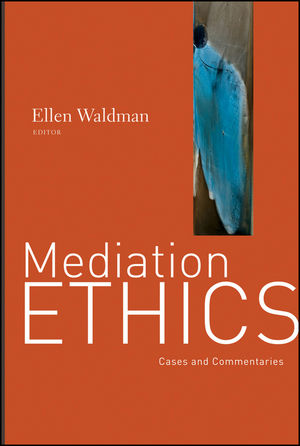
Ellen Waldman, Mediation Ethics: Cases and Commentaries 2011

Many of our readers will be familiar with Professor Waldman’s book titledMediation Ethics: Cases and Commentaries published in 2011 by Jossey-Bass. This is only the second text of which I am aware to deal exclusively with the ethical complexities of mediation practice. Waldman’s text is ground-breaking in that it adopts a case-specific problem-solving approach to the subject. (The first text was a collection of essays edited by Phyllis Bernard and Bryant Garth, titled ‘Dispute Resolution Ethics: A Comprehensive Guide’ published by the American Bar Association Section of Dispute Resolution in 2002.) According to Professor Waldman, one of the primary aims of her text is to showcase the diverse thinking in the field of mediation and to offer guidance to mediators on how to navigate the ‘murky ethical terrain’ that they are likely to encounter in practice.

waldman-ethics

There are thirteen chapters in Waldman’s text. The first, written by Professor Waldman, discusses the ‘underlying values of mediation, its regulatory codes, and emerging models of practice’. The values identified by Waldman are: disputant autonomy, procedural fairness, and substantive fairness. Each of the remaining 12 chapters deals with a particular ethical topic by using two or more case scenarios to illustrate the tension that may exist between these core values. Of continuing interest is the tension between the promotion of disputant autonomy (eg by helping disputants make informed decisions) and concern that basic norms of fairness and equity are not violated.

The case scenarios in each chapter are followed by commentaries from two (and sometimes more) leading dispute resolution scholars who explain what they would do in the circumstances presented and why. Contributors to the book are well known to us. They include:  Forrest (Woody) Mosten, Lela Love, Jacqueline Nolan-Hayley, Julie Macfarlane, Dwight Golann, Art Hinshaw, Carrie Menkel-Meadow and Harold Abramson. These commentators do not always agree on what to do. The diversity of mediation approaches is evident: facilitative, evaluative, narrative, transformative. Here Waldman is able to highlight the very different conclusions that experienced practitioners and scholars reach when analyzing what constitutes ‘right action’ in any particular mediated case. However despite these different end-points, there is a commonality in the way commentators approach problems presented in the case studies ie the authors identify the values that are important to them, the priority that they give to these values, and the action plan that they would adopt.

Mediator Responsibility and Justice

The issue of mediator responsibility for outcome fairness is a central theme tying the chapters together. In the end, Waldman’s own opinion shines through: mediators ‘ought to bear some responsibility for ensuring that mediated outcomes meet minimal standards of fairness’ though she acknowledges that the idea ‘remains controversial and has yet to gain traction’ (email with Professor Waldman dated 10 November 2016).

Professor Waldman is also very interested in the concept of justice in mediation, a topic she explores in greater depth with Dr Lola Akin Ojelabi (see Ellen Waldman and Lola Akin Ojelabi, ‘Mediators and Substantive Justice: A View from Rawls’ Original Position’ (2016) 30 Ohio State Journal on Dispute Resolution 391).

Waldman’s book is written is an accessible easy-to-read style, with mediation and conflict resolution professionals in mind. While the book will be useful for a range of people – students of dispute resolution, academics seeking inspiration for their classes, researchers and policy makers, and anyone else seeking thoughtful analysis of mediation’s many unresolved issues, the real strength of the book is in its practice orientation.


Omer Shapira, A Theory of Mediators’ Ethics: Foundations, Rationale, and Application 2016

More recently another excellent text on mediation ethics has become available that being Omer Shapira’s text entitled ‘A Theory of Mediators’ Ethics: Foundations, Rationale, and Application’ published this year by Cambridge University Press.

shapira

Many readers will be familiar with Dr Shapira’s earlier work in articles such as ‘Exploring the Concept of Power in Mediation: Mediators’ Sources of Power and Influence Tactics’ (2008-2009) 24 Ohio State Journal on Dispute Resolution 535; and ‘Joining Forces in Search for Answers: The Use of Therapeutic Jurisprudence in the Realm of Mediation Ethics’ (2008) 8 Pepperdine Dispute Resolution Law Journal 243.

A Professional Ethics Perspective

As its title suggests, in this new publication, Shapira attempts to construct a theory of mediators’ ethics – a theory he describes as ‘a professional ethics perspective’ based on role-morality and applied to a core definition of the mediator’s role. This is used as the theoretical basis for discussing and evaluating the ethical norms that govern mediators conduct, including existing codes of conduct for mediators.

Shapira argues that all mediators are placed in ethical relationships with mediation parties, the mediation profession, the public and their employers or principals and that these relationships produce certain ethical obligations. He goes on to explore the legitimate expectations of these groups and ultimately to propose a model code of conduct for mediators described as ‘a detailed set of norms of mediators’ ethics that can be rationally justified and defended with regard to mediators at large’.

This book will also be of value to ADR researchers, teachers and students, mediators and mediation participants, mediation organizations and programs, policymakers and ethical bodies.

Comparing the Books: Which is Best?

While there are practical guidelines in Shapira’s work, this is a heavy-weight text, more theory oriented than Waldman’s book, and in the end, more prescriptive in its approach. It is more about what mediators ‘ought’ to do.

Both books in their own way strive to provide guidance for mediators on how they might exercise discretion in making decisions on the many aspects of mediator conduct where there is a choice between competing values and contradictory courses of action. This is an exciting new direction for mediation professionals.

Conversations that Change the World one Glass of Wine at a Time

I’ve just spent the past 4 days in a whirlwind of ideas and conversations at the American Law and Society Association annual meeting in New Orleans. (You can follow the fascinating Twitter feed for the conference Here.) Three ADR Research Network members presented papers at the conference: Professor Rachael Field from Bond University, Professor Tania Sourdin, Dean of Newcastle Law School and me. Both Tania and I tweeted prolifically at the conference.

There were lots of wonderful papers about dispute resolution, judging, case management and therapeutic and procedural justice. The conference often had 12 parallel sessions running, with papers each plus discussants, from 8.15am-5pm for 4 days straight. I have a strong case of ideas-overload right now.

I think what I love the most about huge conferences like this one are the conversations that take place outside and around the formal paper sessions. It is there we are able to make real connections with researchers in other jurisdictions and think about how developments in other legal systems might reveal truths about our own legal system.

Over a very nice glass of vinho verde, I was having such a conversation with Dr Bridgette Toy-Cronin, Director of the Legal Issues Centre at the University of Otago in New Zealand and Dr Karni Perlman of Bar Ilan University on Israel. We were comparing civil justice reforms in our countries and methods used by governments  to streamline litigation and increase settlements before trial. Sometimes parliaments and courts attempt to de-legalise disputes by banning lawyers or forcing parties to appear unrepresented in litigation or other dispute resolution procedures. In Israel, and New Zealand recent legislation has required family law disputants to attend informal dispute resolution processes or litigation without their lawyers.

Both of these developments remind me of how, in Australia between 2006 and 2009, just after implementation of the major family law reforms making family dispute resolution (FDR) compulsory in many family law childrens’ disputes, guidelines banned lawyers from attending FDR seasons at Family Relationship Centres. Those guidelines very revised in 2009 and lawyers are now involved productively and cooperatively in FDR in a number of cases, including in special FDR process set up to support victims of family violence.

To my way of thinking, ousting lawyers from legal processes and discouraging legal representation is a very crude way of attempting to streamline dispute resolution procedures. Such measures are based upon the false assumption that the source of adversarialism is lawyers. Therefore, it is reasoned, having clients go ‘naked’ without their legal counsel, will facilitate a collaborative settlement. 

This assumption ignores several truths that are well-established by research. One ignored truth is that a key role that lawyers play in civil disputes is to manage the expectations of their clients. Lawyers often assist with reaching a settlement by encouraging their clients to accept an outcome that is closer to what the other side may see as reasonable, thus bringing the parties closer together. A second ignored truth is that legal advice plays an important protective role in ensuring that clients, in the absence of their lawyers, don’t bargain away rights that they will need. Legal advice helps prevent unjust settlements, especially where there is an imbalance of negotiating power. Forcing clients to negotiate or litigate without their lawyers may unreasonably disadvantage vulnerable parties.Edit

We’ll continue our conversation about the implications of cross-national civil justice reform that ejects lawyers from dispute resolution processes.  

  We hope to use the experiences of other jurisdictions to inform development of civil justice policy. Without the chance to meet and chat about our own work at the conference, we would never have made the connection between justice reforms in these three diverse jurisdictions. 

Can you help? Are there any examples of similar reforms in your jurisdiction or area of practice that reject the involvement of lawyers? Please post a comment here or email me.

The Challenges of Drafting Mediator Standards

By Professor Laurence Boulle, Thomas More Law School, Australian Catholic University
  

This piece complements the post by Associate Professor Bobette Wolski introducing the Australian National Mediator Accreditation System (NMAS) published on this blog earlier this month. 

Background

Version 2.0 of the NMAS became effective on 1 July 2015. It is designed to enhance the quality of mediation practice by up-dating and simplifying the previous standards and provide some structure to RMABs and the MSB.

This version had a painful and protracted parturition. Drafting should be easy but having been involved in these standards, and in a similar system abroad, I know this is not the case.

The political context

It is challenging to keep all interest groups within the tent, particularly lawyers who approach the practice standards from a risk perspective and are concerned that any specificity in regard to the mediation procedures could leave them exposed. Indeed, the legal profession might yet elect to set up its own standards.

The indeterminacy of words

As HLA Hart told us decades ago, all words have a core of certainty and a penumbra of uncertainty. As soon as one starts drafting the core seems to shrink and the penumbra to expand. Drafters spend hours pondering over the meanings of words. Fortunately the NMAS is not a bilingual document.

Definitional challenges

We all thought, post-NADRAC, that definitional conundrums were behind us. Sadly they are not. Drafters, at the risk of their health, endlessly revisit definitions of ‘mediation’, ‘conciliation’, ‘blended process’, ‘impartiality’, and the like. Thanks to the work of a few radical revolutionaries ‘neutrality’ was not defined but banned from the discourse.

Organisational challenges

Volunteers work in bursts of frenetic activity, followed by weeks and months during which the momentum is lost. In the eventual pursuant meeting they start again: definitions, words, politics and the rest. Not to mention the ego challenges which surface in the interstitial crevices of drafting projects.

The evidence question

Has the NMAS improved quality in the provision of mediation? As usual the evidence is meagre. Will version 2.0 enhance knowledge, skills and knowledge in the area? Time might tell. But it might not. Social science surveys tell us that social science can only survey 20% of the variables in human variables. Mediation is a social science.

The result

For the above reasons all Standards, and all drafting, involve many compromises and many are reflected in the NMAS version 2.0. Now it’s over to the research scholars to analyse the contribution they make to dispute resolution practice. However please mind your definitions.


The National Mediator Accreditation System (NMAS) – An Introduction

By Bobette Wolski, Bond University

By now, most mediators in Australia are familiar with the National Mediator Accreditation System which facilitates accreditation of mediators (and the creation and maintenance of a national list) and regulation of their conduct.


The National Mediator Accreditation System (‘NMAS’) commenced operation in Australia on 1 January 2008. The NMAS is an industry-based system which relies on voluntary compliance by mediator organisations (known as Recognised Mediator Accreditation Bodies or RMABs) that agree to accredit mediators in accordance with stipulated NMAS Standards. Two sets of Standards were promulgated in 2007-2008: Approval Standards which define minimum qualifications and training for accreditation and Practice Standards which specify the minimum practice and competency requirements of a NMAS accredited mediator. The NMAS and the Standards were recently revised, with the revisions becoming effective on 1 July 2015. As a result of the revisions, the Approval and Practice Standards are set within the context of a ‘broader document covering ancillary aspects of the NMAS’ including an Introductory section (Part I), more formal provision with respect to RMABs including the imposition of an obligation on them to upload to the National Register the list of mediators accredited by them (Part IV), provision with respect to the Register of Nationally Accredited Mediators (Part V) and a section dealing with membership and responsibilities of the Mediator Standards Board (MSB) (Part VI). (See letter from Anna Lee Cribb, Chair of MSB to members, dated 8 March 2015, together with a history of the development of the standards, available from the NMAS website).


Behind the scene, the process of drafting of standards of conduct is itself fraught with difficulties. Most standards end up representing a compromise between various possibilities eg between being specific and prescriptive on the one hand and general and aspirational on the other; and reflecting the tension between the need for certainty, predictability and enforceability on the one hand and flexibility and scope for the exercise of discretion on the other.


Laurence Boulle AM, Professor of Law at the Australian Catholic University, author of many popular mediation texts including Mediation: Principles, Process, Practice and former chair of the Mediator Standards Board was asked to share his experience of the process of drafting the NMAS Standards.

PUTTING THE SPOTLIGHT ON ETHICS & VALUES IN MEDIATION


Four young ladies watching a game of cricket, Brisbane

Jackman, George ; Queensland Newspapers Pty Ltd

Collection reference: GL-12 George Jackman Photograph Albums

John Oxley Library, State Library of Queensland | Undated


This post is by Associate Professor Bobette Wolski from Bond Univesity in Queensland. In it, Bobette asks some questions which we’d love your views on. You can comment by replying the this email (if you are a subscriber to our blog) or by responding in the comments box below this post in our blog. We’d love to hear your thoughts.


This month, I would like to get a conversation started about ethics and values in mediation. What are your thoughts on any or all of the following questions? 


What are the critical ethical issues for mediators? Does the answer differ according to the context of the mediation (eg whether it is a commercial matter or a family matter; and whether it is court-annexed or private)? Are there special concerns attached to mandatory mediation?


What responsibility, if any, does a mediator have for outcome fairness? Assuming the procedure used is fair and that the proposed outcome does not involve the commission of an offence or fraud, should a mediator intervene to protect a party against a manifestly unfair agreement and if so, what intervention is permitted?


Should a mediator intervene to protect the interests of parties who are not involved in the mediation but nonetheless affected by its outcome? Assuming again the procedure used is fair and that the proposed outcome does not involve the commission of an offence or fraud, should a mediator intervene to protect third parties. Does the answer depend on the subject matter of the dispute? For example, in family law disputes an obligation to consider the interests of children is imposed on mediators (and legal representatives) by relevant legislation. What about in other contexts?


What can a mediator do to balance the scales when confronted with a power imbalance?

Assume that the mediator has tried everything listed in s 6.2 of the new NMAS Practice Standards. Assume further that one party is well off financially and has retained a QC. The other party is unrepresented and has no access to funds. The mediator believes that the unrepresented party is agreeing to particular terms because they are exhausted and want to end the matter. The unrepresented party appears to understand the consequences of the proposed agreement. Can and should the mediator intervene and if so, what can he or she do.


If there is a conflict of values in mediation, how should they be prioritised? There is a conflict of values involved in most of the questions set out above eg mediators might have to make a choice between self-determination, impartiality and process fairness. Is self-determination the central value of mediation?


Can you find the answer to any of these questions in the new NMAS Practice Standards? Should the answers be in the Standards?


Do the new NMAS practice standards cater for the diversity of mediation practice or are they unduly weighed towards a facilitative approach? How can the diversity of mediation practice be captured and catered for in a single set of Practice Standards? 


Dr Bobette Wolski 12 November 2015


Workplace Culture and Mediation: Creating a Workplace Mediation Model That Works


 Photo: The Circulation Desk, 1946 by Bob Kent, State Library Victoria, (www.slv.vic.gov.au)


This is the third of a series of posts on papers we are sharing from the 2015 ADR Network Roundtable #ADRRoundtable held last month in Sydney. 


In this post, Pauline Roach describes her work  into developing a healthy workplace dispute resolution culture. Pauline began her career as nurse and midwife, working in several different hospitals in Australia, England and Scotland. Following her return from a 4 year trip overseas, she began a career with the NSW Public Service. Pauline has worked in the dispute resolution field for 20 years and has managed the Community Justice Centres (CJCs) Sydney and Bankstown, where she provided ongoing training and supervision to mediators and staff.

In 2003, Pauline was appointed to the position of Grievance Network Coordinator at the Roads and Traffic Authority (RTA) where she completed a major review of the RTA’s Grievance Resolution Policy. In this role she established the grievance resolution network and the RTA Workplace Mediation Panel. In 2013 she was appointed to the position of Consultant at Transport for NSW.

Pauline completed the Master in Dispute Resolution at University of Technology, Sydney.


Workplace disputes are disruptive, expensive and often linger in one form or another for long periods of time. This post looks at anew workplace mediation model developed and implemented at (an anonymous for this post) large public sector organisation in New South Wales. The post is in two parts: The first part discusses strategies and structures implemented to respond to workplace disputes. The second part provides details the new hybrid mediation process developed and analyses the outcomes from this mediation process.


Strategies and Structures

The organisation implemented a strategic framework to help develop a corporate culture and context where the principles of ADR could succeed and are accepted by staff. This has involved staffing, policy development and the education of staff. It also includes engagement with the union to encourage and support their members to participate in the process. The organisation, employee and union representative have a shared benefit in the successful resolution of a dispute, the employer has a functioning workplace and the employee has a job. Both groups acknowledge this understanding of the shared benefits and this removes many barriers to the ADR process succeeding.

Policies such as the Code of Conduct outline an ethical framework for the standards of work, conduct and responsibilities for all staff, managers and contractors. The use of ADR processes to resolve workplace disputes are integrated into its culture and policies such as the Code of Conduct. The Code of Conduct highlighted that staff must be actively involved in resolving their disputes. Through on going education staffwere aware of the ADR procedures available to them, which assist in the resolution of workplace disputes at the local level. The organisation established a grievance resolution network which provided staff and managers with the tools to resolve workplace issues locally, in a timely manner and as close as possible to the origin of the dispute. The aim is principally to assist in the early identification and management of a dispute before it had a negative impact to the workplace. This included the development of an individual dispute resolution strategy (DRS) for each dispute. A broad range of ADR processes are available to assist in the resolution of disputes:

➢ Mediation
➢ Facilitated discussion
➢ Team Development Days
➢ Conflict coaching
➢ Group facilitation.

For a great description of many of these terms, see this NADRAC document.

Grievance Contact Officers (GCOs) were appointed from across the state for a three year term on a voluntary basis. GCOs assisted staff with workplace communication difficulties and/or interpersonal disputes or other workplace concerns. Where possible they encouraged staff to:

➢ Speak directly with the person concerned
➢ Ask their manager for assistance
➢ Referred the matter to Human Resources for assistance.

To support this policy direction, the organisation has also established a Workplace Mediation Panel. This panel consists of independent consultants who are skilled in the provision of a range of ADR processes.


The Hybrid Mediation Model

The hybrid mediation model implemented at the organisationhas three distinguishing features:

1. Before any ADR intervention is undertaken a thorough intake and /or pre-mediation process is conducted. The aim is to ensure that the most appropriate dispute resolution strategy is developed (i.e. conflict coaching scheduled prior to and after mediation). Before a dispute resolution strategy is developed all parties to the dispute must be identified, interviewed and the facts analysed. It also includes discussions with local managers to gain an understanding of previous action taken to resolve the dispute. Why wasn’t the action successful? What outcome does the manager want and how do they see it being resolved? It may also include discussions with the union organisor.
2. When the agreement is being developed the party’s manager is present. This means that the relevant manager becomes a party to the mediated outcomes so that responsibility for agreed changes to conduct cannot be ignored. In cases where a manager is involved, that manager’s manager is involved. All parties including the manager sign the mediated agreement and are also given a copy of the agreement.
3. Where possible the mediators mirror the parties (e.g. gender, age, language and cultural background).

Bearing in mind the importance of retaining or rebuilding a working relationship following resolution of less complex bullying complaints, the organisation also refers these cases for ADR intervention. In these cases a thorough intake interview is also undertaken to access the power imbalance between the disputants and to ensure the disputants and the manager understand the process and reality check outcome options.

Resolution of workplace disputes requires a strategic and explicit cultural change rather than a piece meal application of ADR processes in isolation. The organisation has implemented a strategic framework and consistent approach, which developed a culture and context where dispute resolution can succeed and be accepted by staff. Through a review of policies and staff education programs, staffs are aware of their responsibilities under the Code of Conduct and various policies. In a climate that supports dispute resolution, the organisation has successfully developed a dispute resolution process which accommodates its unique culture and business.

Bringing mediation skills into the workplace: can we call this ‘conflict literacy’?

This is the second paper from those presented at the 4th ADR Research Network Roundtable (#ADRRoundtable) at the University of NSW, Sydney last month. We are keen to share the wonderful and challenging ideas discussed. At our roundtables and in this blog we aim to advance the dispute resolution field by presenting high quality, critical dispute resolution scholarship. Next year we’ll be meeting in Hobart, Tasmania and if you’d like to join us (and perhaps visit the equally challenging MONA) , we will be posting information about how to be part of the next meeting here on our blog.


Please feel free to comment here on or over on Twitter @ADRResearch.


This post and the next one feature discussion of the important area of workplace dispute resolution. Today’s post is by Olivia Davis. Olivia has worked in ADR since 2001 and is currently Quality Manager for the Financial Ombudsman Service. She is completing a Master of Dispute Resolution at UTS and is interested in bringing ADR skills into the broader workplace context.


We can measure an individual’s literacy level, but can we measure their ability to deal with conflict productively? This post discusses the concepts that need to be considered before developing a methodology for measuring ‘conflict literacy’.


Bringing mediation skills into the broader workplace context enhances workers’ ability not only to deal productively with conflict, but to cultivate positive relationships, negotiate more persuasively and include multiple perspectives when problem-solving. Key skills from the mediation skill set are listening, questioning, reflecting, reframing, and summarizing, as well as the ability to manage emotions and power imbalances, and reality-test proposed outcomes. The literature around ‘conflict competence’ adds to this list the skills of multivalent thinking, emotional intelligence and impulse control.


The contribution of this post is to combine current thinking about definitions of literacy with current thinking about conflict, to develop a new concept that is more nuanced and complex than ‘conflict competence’, as it is outlined above. To arrive at an understanding of what is meant by the term ‘conflict literacy’ as proposed by the author, the phrase is broken down and each word looked at separately.


The word literacy is commonly attached as a suffix (eg; media literacy, financial literacy, scientific literacy, computer literacy etc) to a particular field as a shorthand way of indicating an individual’s level of knowledge about, and ability to navigate, that particular subject area effectively. As technology and social media have pervaded our daily lives in ever-increasing ways, our understanding of what it means to ‘be literate’ has been forced to expand beyond the simple ability to read and write, to include such skills as the ability to critically evaluate sources of information, filter for relevance, understand which signifiers are valued, as well as produce relevant content. Literacy has always been about the ability to participate effectively in a social environment, but it now has a ‘meta’ aspect which demands that we be able to interrogate the frame the environment sits within, and critique our role as co-creaters of that environment.


Looking at ‘conflict’ it is notable that current thinking sees conflict not as something to be avoided or suppressed – or even resolved – but rather as an energy force that is part of the human experience, and is ever-present, whether latent or manifest. Conflict theorists have applied the principles of complexity science to better understand the dynamics of conflict, how to harness its energies and how to intervene effectively. Complexity science sees all elements in a system as having mutual causality; everything happens in a context, and there are no clear-cut ‘victims’ and ‘perpetrators’. More complex perspectives allow participants to evade the tyranny of binary oppositions and create more satisfying agreements.


The term ‘conflict literacy’ combines all these concepts; it is more than ‘conflict competence’, and goes further than the parameters of the mediation skill set. Is conflict literacy achieved by bringing mediation skills into the workplace? The answer would have to be: not on their own, no.​