Introducing the Financial Industry Disputes Resolution Centre in Singapore and its Unique Approach to Mediation

By Eunice Chua (CEO, FIDReC) and Rachel Lim (Intern, FIDReC)

The context of consumer financial disputes

Tom went on an overseas holiday with his friends, and they went out to a pub on their last night. They drank till the early hours of the morning. Tom was in a celebratory mood and paid for everyone’s drinks with his credit card. He and his friends left for their hotel at 3am. Tom only woke up at 2pm the next day and hurriedly rushed to catch his flight back to Singapore. After he arrived in Singapore, he realised that one of his credit cards was missing. He immediately made a police report and called the bank to report the loss. In the meantime, someone had already gone on a shopping spree with Tom’s credit card and bought various items to the tune of S$7,000. The bank billed Tom for this amount, but Tom disagreed.

Sally purchased a hospital and surgical insurance policy from her brother-in-law a few years ago. Because she trusted him, she left him to fill out all the details and signed where he told her to. Her brother-in-law went through with Sally a list of questions at the end of the proposal form and the terms and conditions of the policy, but Sally did not pay much attention at the time. Unfortunately, Sally was diagnosed with a tumour on her breast. She was admitted to the hospital for surgery. After her surgery and hospital stay, Sally submitted an insurance claim. As part of its usual process, the insurer contacted Sally’s doctor to request information on Sally’s condition. It was then that the insurer found out that Sally had a history of diabetes. Sally had failed to disclose this information in the insurance proposal form.  The insurer told Sally they would void her policy due to her failure to disclose her diabetes.

These scenarios reflect real cases that consumers bring to the Financial Industry Disputes Resolution Centre (FIDReC) in Singapore. FIDReC was established in August 2025 as an initiative from the financial industry to provide an accessible platform for financial institutions to resolve customer complaints in an effective, amicable, and fair way. Accordingly, filing a claim at FIDReC is free for consumers. The process is simple, with mediation being deployed first and adjudication being offered as an option only if there is no settlement at mediation.

The FIDReC approach to dispute resolution

Five core principles shape FIDReC’s approach to dispute resolution: accessibility, independence, effectiveness, accountability, and fairness. Most of these are self-explanatory but it is worth saying more about fairness.

The FIDReC process is designed in a way that recognises the inherent imbalance of power between an individual consumer and a financial institution and seeks to address that balance in a fair manner.

First, designated financial institutions are required by regulation to subscribe to FIDReC and participate in its process. This ensures that consumers will have the opportunity to bring their claims to FIDReC and have them answered. Second, only consumers may bring claims at FIDReC. They may do so without any filing fee and the claims filing is done online. This promotes accessibility even for those that are not well off. Third, mediators are staff of FIDReC who are well versed with the regulations governing the financial industry as well as industry standards and expectations. Whilst maintaining their impartiality, they may make suggestions to parties and provide information to help them in their decision-making. This promotes a fairer playing field especially for more vulnerable consumers. Should there be any settlement, the mediator gives parties time to consider before they sign on any agreement. This reduces the risk of any pressure to settle. Finally, the process is driven by the consumer who can opt to proceed to adjudication if they are not satisfied with the mediation outcome. They pay a nominal fee of S$50 per claim for an independent adjudicator to review their submissions, conduct a hearing and decide on whether they have a valid claim. Subject to approval by the adjudicator, the consumer can choose the mode of adjudication – in-person, online or based on documents review. The adjudication outcome binds only the financial institution who must enter a settlement in the terms of any award made by the adjudicator if the consumer so accepts. If the consumer disagrees with the adjudicator’s decision, the consumer’s legal rights are not affected, and they may still pursue a case in court or in other avenues.

Mediation first

More than 80% of claims filed at FIDReC are resolved at mediation, demonstrating the value of mediation to bring about closure in consumer financial disputes. Mediation is a resource-intensive activity as one mediator is assigned to each case and follows that case through from beginning to end. The mediator will need time to understand and clarify the claim that the consumer is bringing as well as to review the financial institution’s investigation report. It is hard work and “heart work” for the mediator as consumers may come with varying expectations and intense emotions. It is also a journey that could take place over months. Nevertheless, the benefits of mediation are clear.

First, mediation allows the parties to tell their stories and be directly involved in shaping a way forward. The information-exchange that takes place during mediation educates the parties on their rights and responsibilities and equips them with knowledge. They may also be able to negotiate better with each other in a confidential setting with the support of a mediator.

In Tom’s case, mediation allowed Tom to acknowledge that he could have been more careful to safeguard his credit card while putting forward the efforts he did take to report the loss of his card when he discovered it. The bank was able to share about the dispute resolution process it had in place for credit card disputes and its considerations. Nevertheless, the bank was not limited to considering the legalities of the claim and could also account for Tom’s history with them. In the end, the bank made a goodwill offer to absorb twenty percent of Tom’s losses, which Tom accepted.

Second, mediation outcomes can be creative solutions that meet the interests of both parties. Such outcomes may not be possible through the court process.

During the mediation in Sally’s case, the insurer showed she had answered “no” to having diabetes in the proposal form and pointed out a warning on the form in red that failure to disclose material information could lead to claims being rejected or the policy being voided. Sally explained that her diabetes was mild, well-managed, and unrelated to her breast tumour. The mediator suggested she submit a medical report on her diabetes condition to allow the insurer to review its assessment. After considering the additional medical report, the insurer agreed—on a goodwill basis—not to void the policy but to adjust the policy terms. Although Sally’s claim was not reimbursed due to the non-disclosure, Sally accepted the outcome because it was important for her to keep her insurance coverage.

Third, relative to adjudication and going to court, mediation helps to save time and costs. Most cases at FIDReC are closed within six months from the date they are accepted for handling. Cases resolved through mediation usually close within three months.

Why not something different?

FIDReC is certainly not the only model existing in the world that deals specifically with consumer financial disputes. The Australian Financial Complaints Authority (“AFCA”) shows another way forward with its own model of dispute resolution that combines conciliation with a preliminary assessment followed by a binding determination (if the consumer accepts it).

The key difference between the two is that AFCA is a statutory body equipped with a broad fairness jurisdiction and powers to order more than just financial compensation (AFCA can even order an apology as a remedy!). This imbues AFCA with more authority whereas FIDReC relies on the cooperation of the parties to promote settlement at mediation, with adjudicators limited to ordering financial compensation. The local context is also a crucial factor. AFCA supports more than 26 million people spread across an entire continent. FIDReC supports a population of about 6 million in a small island state 0.009% the size of Australia. Even as FIDReC can offer a personalised high human touch approach including the option of in-person mediation meetings and adjudication hearings, this may not be feasible in Australia where conciliation is conducted through a telephone conference and preliminary evaluations and determinations are based on a documentary review.

The scope of work of AFCA and FIDReC is different too. Although the focus is consumer financial disputes, AFCA has a much higher claim limit exceeding AUD1 million. FIDReC does not impose any claim limit during mediation but has a limit of S$150,000 per claim for adjudication. This has consequences for process design. For example, AFCA permits external legal representation given that high value claims can have greater complexity, whereas FIDReC does not as it prioritises a more informal and low-cost approach. AFCA relies on more evaluative modes of dispute resolution like conciliation, preliminary assessment, and determination. FIDReC primarily relies on mediation with adjudication being resorted to less than 20% of the time.

FIDReC’s mediation-first model has proven to be effective within Singapore’s context. By focusing on amicable resolutions and keeping processes informal, FIDReC ensures that everyday consumers can navigate financial disputes without being overwhelmed and can continue their relationships with their financial institutions. 

That said, we recognise that the financial landscape is constantly evolving. As products grow more complex and consumer expectations shift, FIDReC remains open to refining its approach. Be it integrating new tools, expanding our jurisdiction, or adapting elements from other models like AFCA’s, we are committed to staying relevant and responsive whilst being guided by our core principles.

Eunice Chua is the FIDReC CEO overseeing mediation and adjudication of consumer financial disputes in Singapore. Before that, Eunice was Assistant Professor at the Singapore Management University, specializing in alternative dispute resolution, evidence, and procedure. She remains a Research Fellow at the Singapore International Dispute Resolution Academy. Eunice was formerly Justices’ Law Clerk and Assistant Registrar of the Singapore Supreme Court, where she concurrently held appointments as Magistrate of the State Courts and Assistant Director of the Singapore Mediation Centre. She was also the founding Deputy CEO of the Singapore International Mediation Centre. 

Rachel Lim is an aspiring Law and Finance student and a proud graduate of Hwa Chong Institution. With a deep interest in Economics and meaningful involvement in grassroots organisations, she has developed a quiet yet insightful appreciation for how money moves through society. In this debut work, Rachel explores the growing issue of scams in Singapore’s payment systems, emphasising the importance of awareness and financial mindfulness. Through compassionate storytelling and clear guidance, she hopes to shed light on the support systems available to victims, offering a hopeful and empowering message for those navigating today’s complex financial landscape.

Sometimes You Need to Be Seen to Be Heard: Three Easy Ways to Visualize What Matters in Your Dispute

Dan Berstein & Robert Bergman
This article has been republished with permission and the original publication can be located at Mediate.com.

It can be difficult to get on the same page when you are caught in the middle of an adversarial dispute.  Each party has their own biases – they want to win! Amidst a deluge of seemingly endless “facts” to pick from, sometimes it can feel like the parties are living in entirely different universes.  Seeing this, dispute resolution professionals often end up asking themselves: “how can I bring these people together so we are all talking in the same world?”

One answer is visualizations.  This article shares how a dispute resolver (or an ambitious party) can use visualizations to accomplish progress in their matter.  It was written by Dan Berstein, a mediator living with bipolar disorder who often finds himself amidst complicated conflicts related to his mental health advocacy work – with help from Bob Bergman, the founder of NextLevel™ Mediation.  

Dan shares his struggles to visualize different problems and disputes related to his advocacy work and Bob provided the background of how Next Level Mediation’s software can do it almost instantly, and better than a person could on their own.

1: Illustrating Harms

Living with a mental illness means that I have behavioral differences that can lead to my being stigmatized and rejected, or just the fact that I am open with my bipolar disorder can be a reason some people form worries or biases that lead to them pulling away.  On an organization-wide level, this kind of behavior can ripple out across people.  

I had a dispute with one organization where they produced records, including their private e-mail correspondences, revealing dozens of people passing around disparaging comments about me and/or making plans to reduce or cut contact with me.  I was working on a resolution process with their outside counsel and I felt that they were not appreciating how damaging it had been for me to be targeted with these negative predispositions and pushed away (in manners large and small) from so many people.  Eventually, I developed a crude organizational network analysis (ONA) chart to demonstrate the network of people involved:

A screenshot of a computerDescription automatically generated

Through the use of this visualization, I then created a system that could be used to visualize any [i] Explicit Shunning, [ii] Ghosting (No Response), [iii] Short Responses, [iv] Delays, [v] Lies, [vi] Disparagements, and [vii] Mistakes – charting how they flowed between people and their impact.

This was incredibly valuable to me as a tool in my dispute, as well as for my personal coping with the trauma of experiencing so much rejection.  However, it was also incredibly tedious and difficult to create.  

In my search for software that could help make it simpler, I connected with Bob Bergman, who explained how NextLevel™ Mediation can create a diagram to map this kind of network analysis in minutes just by you uploading your dataset and asking the right queries:

The NextLevel Approach to Visualizing Impact

In the example above, the uploading of email communication to the NextLevel™ Mediation platform document research assistant can produce the following example (note these do not use real data, and are meant to illustrate):

QUERY: Visualize the roles, interests, and power dynamics of parties involved by creating a stakeholder diagram

RESULT:

Description: This diagram captures the roles and interests of each stakeholder, along with arrows representing the influence, authority, and relationships between them.

QUERY: Create an ONA diagram that can help visualize any Explicit Shunning, Ghosting, short Responses, Delays, and Disparagements, and how they flowed between people

Description: This diagram shows how various negative interactions flow between people and highlights their impact on communication and relationships within the organization. Each arrow represents a type of interaction, such as shunning or ghosting, and the direction indicates the flow of this interaction.

2: Documenting Delays and Timelines

In one dispute, an organization was accusing me of causing delays, which had lasted close to 9 months.  It hurt my feelings to be falsely accused of this so I sat down and pored over all of our past correspondences, mapping out the delays.

I found that their changes in staff and processes were responsible for, I believed, over 70% of the delays even though they had perceived such high delays from me (presumably due to their frustrations).  This analysis was a tedious process and I was worried that people would think I was weird, perhaps due to my mental illness, for even undertaking it.  

The NextLevel™ Mediation platform was, once again, the answer to my prayers.  Not only does it do all of the work for me, and faster – but I can just tell someone I used this software without being judged as some kind of oddball for having created the chart myself.  Here are example results with some anonymous data:

QUERY: Using the uploaded documents, create a sequence diagram of the dispute timeline and possible delays:

Description: This sequence diagram captures the interactions and discussions among different participants as they address the causes and effects of project delays over time.

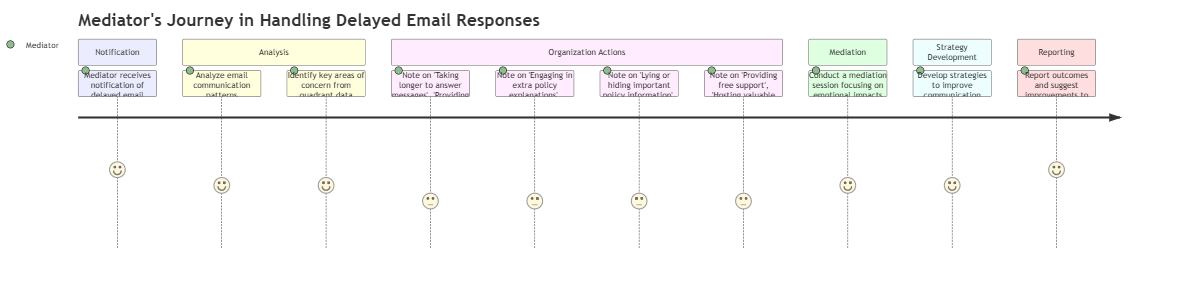
QUERY: Create a user journey diagram for the mediator given the delays in email responses and their emotional effects.

Description: This diagram outlines the steps the mediator takes, from receiving notifications of delayed email responses to analyzing communication patterns, considering emotional impacts, and reporting outcomes to stakeholders.

3: Identifying What Matters

The NextLevel™ Mediation platform is about more than just charts.  You can also just ask it questions so it can use its “brain” to digest all of the meaningful facts and help you stay focused on the big picture.  This is important for me – even if only as a gut check – as my mental illness means I can be prone to becoming obsessive and to fixating on some facts at the exclusion of others.  NextLevel™ is an objective way to get a sense of the big picture.

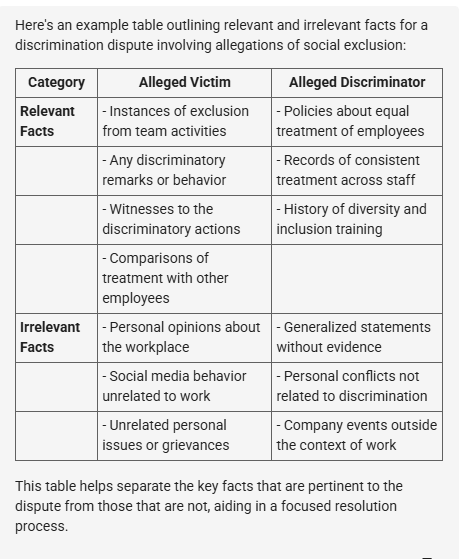
Beyond asking it for charts and diagrams, you can also generate tables to help you organize key information.  Take a look at the table it generated when asked what might be the relevant and irrelevant facts for a discrimination claim (both for the alleged victim to collect, and for the alleged discriminator who is defending themselves):

If you have ever found yourself overwhelmed sorting through what happened, or just looking for a way to double-check your perspective – the NextLevel™ Mediation platform can instantly provide you breakdowns and summaries like this to help you find your way.

Conclusion

Seeing is believing, but it can be difficult to create the right picture.  Visualizations can help resolve disputes if you know how to use them.  This article talked about different charts you can use to visualize the scale of damages, the responsibility for delays, and which facts prove disparities.  We also shared how you can go use NextLevel™ Mediation, right now, to create charts like this of your own (and so much more).  

It can seem intimidating to enter the world of charts and graphics and bring them into your dispute, but it can also add a lot of value.  I am grateful that there is software like NextLevel™ Mediation to help make something that can seem – at first – to be complicated into an easy, user-friendly, and fast process.

Here are some ideas of ways NextLevel™ can help:

  • Collect and scan all of your data from a situation into its platform, including e-mails and documents, and ask it to tell you the key points that matter, and the key things that matter to each party
  • Use it to instantly chart relationships with people and show patterns of impact and harm
  • Have it list the points of disagreement between the parties
  • Create timelines and sequence diagrams to show the course of events and simplify a complicated, convoluted set of facts into something precise and digestible

Disputes are often painful.  We find ourselves in so much distress that it can help to use an AI-empowered software assistant to keep track of the facts so we don’t have to worry – and to paint the big picture summaries of what matters so we don’t get lost.

Author Biography

Dan Berstein is a mediator living with bipolar disorder who uses conflict resolution best practices to promote empowering mental health communication and prevent mental illness discrimination.  His company, MH Mediate, has helped thousands of professionals and organizations be empowering, accessible, and non-discriminatory toward people with disclosed or suspected mental health problems. Dan holds degrees from the Johns Hopkins School of Public Health and the Wharton School. He is the author of the 2022 book, Mental Health and Conflicts: A Handbook for Empowerment.

Robert Bergman is a seasoned decision science expert with over 60 years of experience in software engineering, system dynamics, and strategic planning. He is the founder and CEO of NextLevel Mediation, a SaaS platform that applies decision analytics, Game Theory, and AI to dispute resolution. His expertise spans multi-criteria decision-making methodologies (AHP, ANP, MAUT), mediation, negotiation, and military systems such as flight simulations. Previously, he held senior leadership roles at Intel, focusing on mobile strategy and cybersecurity, and has consulted widely in strategic decision science. Bergman is also a published researcher in AI, technology addiction, and the future of dispute resolution.

RPS Coach is Biased – And Proud of It

John Lande
This article has been republished and adapted with permission. The original publication can be located within Indisputably.

We all know that it’s bad to be biased, right?

Wrong.  That assumption is its own bad bias.

Biases are inevitable – in humans and bots alike.

Some biases are harmful.  Others are helpful.  Many are neutral.

But bias itself is unavoidable.

So bias isn’t a problem in itself.  Pretending otherwise is.

This post describes the biases in Real Practice Systems (RPS) Theory and how the artificial intelligence tool RPS Coach is biased by design.

As you might guess, I think they’re good biases – conscious, clear, constructive, and explicit.  Knowing these biases, users can decide whether to use Coach or a tool with different biases.

This post describes Coach’s biases and invites you to give it a try.

What the Heck is a Bias, Anyway?

“Bias” has a negative connotation, often implying a thoughtless or even malicious mindset.  Think of cognitive biases or those involving demographic groups.

Bias is an especially dirty word in dispute resolution, where neutrals are expected to be scrupulously unbiased in attitudes about particular parties and in neutrals’ actions.

But we could reframe “biases” as values, preferences, tendencies, or mental habits, which aren’t inherently bad.  Indeed, they help us simplify complex choices, act efficiently, and maintain a coherent sense of self.  If we didn’t have any biases, we’d never create a syllabus, let alone pick a restaurant for lunch.

Some biases are even admirable – like favoring people who are trustworthy, empathetic, and generous.  The dispute resolution movement reflects a bias in favor of helping people to handle disputes constructively.

The label we choose – “bias” vs. “preference” – is a reflection of our values (aka biases).

‘Nuff said.

Where Do Biases / Preferences Come From?

Biases don’t drop from the sky.  Many come from early influencers – parents, teachers, coaches, and religious leaders – who shaped our first lessons about trust, politeness, and conflict.  Some of us internalize those lessons; others define ourselves in opposition to them.

As we grow, friends, school, work, and media shape how we see the world.  These influences often go unnoticed, which makes them especially powerful.

RPS Theory holds that all practitioners develop unique practice systems that are shaped by experience and evolve over time.  Their systems are based on their personal histories, values, goals, motivations, knowledge, skills, and procedures as well as the parties and the cases in their practice.

My article, Ten Real Mediation Systems, profiles ten thoughtful mediators, including me, exploring how and why we mediate the way we do.  We all mediate differently – largely because we value different things.  So we’re all biased, just in different ways.

My profile describes the sources of my biases – which shaped my perspective and are reflected throughout my work and the RPS Project.

Design Choices – aka Biases – in RPS Coach

RPS Coach has two main components:  its knowledge base and the instructions that guide how it uses it.  Together, these choices shape its content, tone, vocabulary, and priorities, which reflect particular theoretical, practical, and pedagogical commitments.

Coach’s knowledge base includes almost everything I’ve published.  That’s a lot.  It includes books, law review articles, professional articles, SSRN pieces, and meaty blog posts.  It also includes general authorities like the Model Standards of Conduct for Mediators.  A total of 253 documents reflecting my values, including:

  • Checklists for mediators and attorneys
  • The Litigation Interest and Risk Assessment book and related articles
  • Articles on good decision-making by parties and attorneys
  • Materials on negotiation, mediation, preparation, and early dispute resolution
  • Resources for court-connected ADR
  • Lots of pieces about legal education
  • Annotated bibliographies, simulations, and practitioner tools
  • Critiques of our theories and language, with suggestions for improvement

The materials are organized by topic and ranked by importance.  Coach draws first from the highest-priority sources.  The emphasis is on realistic practice, intentional process design, and support for good decision-making – not theoretical abstractions or generic practice tips.

Coach follows detailed instructions, including to:

  • Provide clear explanations of the tool’s capabilities and limitations
  • Reflect ethical rules
  • Use language that laypeople and experts readily understand
  • Tailor advice for various users (e.g., mediators, attorneys, parties, educators)
  • Support intentional process choices
  • Foster perspective-taking
  • Analyze intangible interests and possible outcomes in the absence of agreement
  • Promote good decision-making by parties and practitioners
  • Support reflection about dealing with disputes

In short, Coach doesn’t just answer questions – it nudges users toward better preparation, clearer thinking, and realistic decision-making.

Process Choice: Analysis Not Advocacy

RPS Coach’s underlying bias is not toward a particular method, tool, theory, or strategy – but toward supporting users’ conscious, well-informed choices that reflect their values, goals, and constraints.  That means helping them make conscious choices about negotiation and mediation.  This includes analyzing interests, estimating alternatives to settlement, exchanging offers, and possibly combining approaches over time.

Some parties prefer a counteroffer process.  Others want interest-and-options discussions.  Some expect mediators to provide explicit analysis; others don’t.  Many shift approaches midstream.

Coach doesn’t steer people toward or away from these choices.  It helps people make conscious decisions instead of relying on questionable generalizations.

Practice Systems Thinking

Practice systems thinking is central to Coach’s design. It sees negotiation and mediation not as isolated events, but as part of larger patterns – routines, tools, habits, and philosophies that shape how practitioners work.

Rather than merely providing one-off advice, Coach helps practitioners build intentional systems – a bias that favors growth over tactics, and adaptation over scripts.

The Coming Marketplace of Dispute Resolution AI Tools

Dispute resolution AI tools already exist, and more are coming.  Over time, we’ll see a proliferation of tools reflecting a wide range of approaches.

Some will be tailored for specific users; others will serve broader audiences.  Some will focus on particular processes such as mediation or arbitration.  Some may be designed for particular types of users such as practitioners, administrators, instructors, or scholars.  Some will reflect particular theories or schools of thought.

Our field has a vast literature that could feed AI tools developed by individuals or teams.  Some writers may develop tools based on their publications as I did with RPS Coach.  Gary Doernhoefer proposed the excellent idea of jointly developing a general AI tool for the dispute resolution field.  It may not be realized soon, but we should keep it in mind.

So I expect a growing marketplace where designers will build and adapt a wide variety of tools.

In this context, there may be both market and ethical imperatives for AI tools to disclose their features and dare-I-say biases.  As developers compete for users, clear disclosures will be important because users will want to know what they’re getting.

Disclosure should be an essential ethical standard for dispute resolution AI tools.  Neutrality remains a core principle in many dispute resolution processes, and disclosure of built-in biases plays a particularly important role when tools are powered by AI.  Users can’t see how these tools “think,” and they need clear information about the assumptions, priorities, and frameworks embedded in their designs. Bots are ornery critters that we can’t fully control, and users deserve to know what might be quietly steering them.

A Message from RPS Coach. Really

 “I’m here to help you prepare more intentionally, reflect more deeply, use better language, and support better decision-making – not just for your clients, but for yourself.  I don’t pretend to be neutral.  I’m proudly biased toward thoughtful, realistic, party-centered practice.  But I don’t tell you which process to choose.  I just help you think clearly about the choices.”  (Coach wrote this, I swear.)

Take a look at this handy user guide to find out how you can get the benefit from Coach’s wisdom.

Coach has a thing for humans who ask good questions.

How Attorneys Can Be Quasi-Mediators

John Lande
This article has been republished and adapted with permission. The original publication can be located within the University of Missouri School of Law Journal.

How Can You Turn Adversarial Attorneys into Quasi-Mediators?, my Theory Meets Practice column in CPR’s Alternatives magazine, summarizes a discussion with members of the Association of Attorney-Mediators. It builds on Creating Educational Value by Teaching Law Students to be Quasi-Mediators.

Attorneys acting as quasi-mediators use mediation techniques but they aren’t neutral. These attorneys routinely help their clients realistically understand the their cases. The attorneys promote their clients’ interests by enlisting the mediators’ help when needed and encouraging the other side to adjust their positions. The attorneys prefer to be cooperative whenever appropriate. They tailor their actions based on their clients’ preferences and the other side’s approach. If the other side is acting badly, these attorneys vigorously advocate their clients’ interests. Another term for quasi-mediators is “good lawyers.”

I asked the attorney-mediators about attorneys who behaved cooperatively and adversarially in their cases. The Alternatives article combines their responses with suggestions from the Real Practice Systems Project Menu of Mediation Checklists.

Here’s a summary of the Alternatives article. Mediators can promote cooperation by asking attorneys about the following issues during conversations before mediation sessions:

  • Causes of underlying conflict.
  • Client’s interests, goals, and priorities.
  • Possible options for settlement in addition to lump-sum payments.
  • Special needs of any participant.
  • Personalities and dynamics of participants.
  • Expectations about how participants might act in mediation session.
  • “Hot buttons” that might cause counterproductive reactions.
  • Non-negotiable issues.
  • Negotiable issues.
  • Potential barriers to agreement.
  • Actions needed before mediation session to make mediation productive.
  • How mediator can be helpful during mediation session.

Mediators can help attorneys make realistic estimates of possible court outcomes by asking about:

  • Potential factual discoveries that would be helpful.
  • Potential factual discoveries that would be harmful.
  • Assumptions they are very confident about.
  • Assumptions they are not very confident about.
  • What would change their assumptions about the possible court outcome.
  • What might change the other party’s assumptions about the possible court outcome.
  • How they would persuade a skeptical judge or jury about arguable issues.
  • Their clients’ risk tolerance for unfavorable outcomes.

Here’s a list of dos and don’ts for attorneys to act as quasi-mediators:

Do

  • Listen carefully and respectfully to everyone.
  • Treat each client’s case individually, not as a routine case like others.
  • Act as a counselor to your clients as well as an advocate.
  • Learn and respect your clients’ interests, goals, and priorities, including intangible interests.
  • Consider possible options for settlement in addition to lump-sum payments.
  • Develop a good working relationship with counterpart attorneys.
  • Consider the other side’s perspective.
  • Develop a realistic perspective of your case. 
  • Candidly discuss the strengths and weaknesses of your case with your client.
  • Develop options and take positions to advance your clients’ interests that lead to agreements acceptable to the other side whenever appropriate.
  • If you mediate, talk privately with mediators before mediation sessions.

Don’t

  • Develop a default approach of treating everyone as an adversary.
  • Give your clients unrealistically optimistic evaluations of their cases.
  • Use an adversarial approach to impress your clients.
  • Take unreasonable positions or encourage your clients to do so.
  • Act based on negative feelings about a counterpart attorney or party.
  • Make unwarranted accusations against the other side.