Top Ten Ways to Improve Your Mediation Skills

John Lande, JD, PhD
This post is adapted from the Association of Family and Conciliation Courts article published by the University of Missouri School of Law in the Legal Studies Research Paper Series.

Traditional mediation theories are incomplete at best and misleading at worst, providing mystifying descriptions of what mediators actually do. Those theories focus on only a few behaviours during mediation sessions and don’t recognise the many variations of mediators, parties, and cases. This leaves many mediators to ignore these models because they are either confusing or unhelpful.

John Lande uses Real Practice Systems (RPS) theory in his article to identify 10 things that mediators can do to include within their skillset and improve their own practice. This article is adapted from his previous article ‘Helping You Do the Best Mediation You Can‘ published by the University of Missouri School of Law.

Although Lande’s article is directed to practicing mediators, he refers to additional resources in this Indisputably blog which can be used by teachers and trainer in their work, including to prepare and further develop student’s skills in negotiation, mediation, and advocacy.

These 10 things are summarised below, but it is highly encouraged that you to read John Lande’s published article for a complete and comprehensive explanation.

1. Recognise That You Have a Complex Practice System

If you mediate regularly, you have a complex mediation practice system. Mediation is not “just” what you do during mediation sessions when all the participants have convened, you also have unconscious routine procedures and conscious strategies for dealing with recurring challenges that you use before, during, and after mediation sessions.

It is important that you recognise the basis for your system and that have you developed categories of cases, parties, and behaviour patterns that led you to develop your system.

2. Understand Real Practice System Theory

In this 20-minute video, John Lande explains Real Practice Theory (‘RPS’) and how can improve your mediation practice system. It is applicable in every type of case and at every stage of practice, from novice to mid-career to senior mediator.

3. See Illustrations of Practice Systems in Experienced Mediators

Read John Lande’s article ‘Ten Real Mediation Systems‘ which illustrates the account of ten experienced mediators who identify factors affecting their mediation practice systems and includes links to a detailed account of their systems.

4. Complete a Self-Assessment Questionnaire to Get an Overall Understanding of Your Practice System

This 18-question self-assessment worksheet is designed to help you recognise basic elements of your practice system, prompting you to reflect on your background, motivations, mediation practice, common patterns in your cases, and your procedures.

5. Understand and Use Real Practice System Menu of Mediation Checklists

Read John Lande’s article ‘Real Practice Systems Project Menu of Mediation Checklists‘ which is a detailed menu of checklists for mediators. It includes mediators’ actions before, during, and after mediation sessions as well as items about information to provide on websites, compliance with ethical requirements, and reflection and improvement of mediation techniques.

In another article, ‘Practitioners Tell Why Real Practice System Checklists Are So Useful‘, Lande uses the descriptions of fourteen current and former practitioners to explain how these checklists can help you to carefully design your unique practice system.

6. Develop Your Own General Mediation Checklist

By using the above Real Practice Systems (RPS) checklists, you can consciously develop your own general checklist based on the typical cases and parties in your practice, the procedures you find useful. This checklist is quite versatile, enabling you to choose items which can be modified to suit your needs. But the RPS checklists cannot be exhaustive, so you should add any other items that are relevant to your practice and remove any which are not.

A mediators’ checklists necessarily vary based on many factors including the subject matter, complexity, typical legal issues, participation of attorneys, and amount of time before mediation sessions, among others. As a result, some mediators’ general checklists are longer and more complex than others.

7. Customise Your General Mediation Checklist for Each Case

Before each mediation session, review your general mediation checklist and consider any modifications you might make based on what you know about that particular case you are about to mediate. This can ensure that you are better prepared and equipped with a checklist that will be most useful to you during that mediation.

8. Read Articles in the Real Practice System Annotated Bibliography

To develop a deeper understanding of practice systems generally as well as your own practice system, you should read Lande’s ‘Real Practice Systems Project Annotated Bibliography‘ which organises several publications concerning various topics, including:

  • Overview of Real Practice System theory
  • Critiques of traditional dispute resolution theories
  • Promotion of party decision-making
  • Litigation interest and risk assessment
  • Preparation for mediation sessions
  • Technology systems

9. Participate in an Ongoing Educational Practice Group

It is important to learn from each other as well as give and receive feedback to and from other mediators. This can be done by participating in practice groups.

Although practice groups vary in size, Lande suggests that between 5 and 8 people is optimal. A fixed membership with a commitment to participate for an extended period of time (such as at least 6 to 12 months) is beneficial to allow members to feel comfortable sharing sensitive experiences with each other.

Lande also provides numerous considerations before commencing or joining a practice group, including similarities or differences between members, the type of activities completed, and the use of reflective practice techniques.

10. Share Your Experiences

Sharing your experiences with others is a valuable way to learn. This might include giving talks, participating in trainings, teaching courses, or writing articles. These activities require reflection, which can produce new insights, and interactions with people can stimulate thinking and further reflection on those experiences.

Author Biography

John Lande, JD, PhD is the Isidor Loeb Professor Emeritus at the University of Missouri School of Law and former director of its LLM Program in Dispute Resolution. He earned his JD from Hastings College of Law and his PhD in sociology from the University of Wisconsin-Madison. Since 1980, John has practiced law and mediation in California, and since the 1990’s, he has directed a child protection mediation clinic.

The American Bar Association has published John’s books, including ‘Lawyering with Planned Early Negotiation: How You Can Get Good Results for Clients and Make Money‘ and ‘Litigation Interest and Risk Assessment: Help Your Clients Make Good Litigation Decisions‘ (co-authored with Michaela Keet and Heather Heavin).

John frequently writes for the Indisputably blog and has received many awards for his scholarship, most recently the American Bar Association Section of Dispute Resolution’s award for outstanding scholarly work. You can download articles on a wide range of dispute resolution topics from his website.
Are frameworks useful to help understand complex conflict contexts?

This post is republished with permission from the Conflict Management Academy.

Claire Holland and Judith Rafferty, conflict management specialists, academics, researchers and trainers with the Conflict Management Academy (CMA), say YES! According to Judith and Claire, frameworks are a useful way to break down and look at complicated conflict situations in a way that can bring greater awareness, understanding, and clarity to the situation. It’s not suggested that frameworks simplify the conflict, but that they are useful to make the conflict appear more manageable.

Practically, a framework can help to better understand a complex conflict by allowing the user to view the conflict through different lenses. Frameworks can also suggest multiple ways of thinking about the issues at hand, help the user to develop a more detailed and holistic picture of the conflict, and then consider multiple opportunities to work with the conflict. Claire and Judith suggest that using frameworks in conflict management contexts have multiple benefits, including:

  1. Assisting conflict management specialists, like mediators, conflict management coaches, and HR professionals, to work with clients to gather necessary information about the conflict and its context, and decide on next steps.
  2. Supporting clients to take a step back or ‘go to the balcony’ and perhaps not react out of habit and prior learned behaviour, but to suspend judgement on the situation until a more holistic analysis of the situation has been conducted.
  3. Thinking about future options that might be quite different from a conflict parties’ initial reaction to the situation once the conflict has been considered through different lenses.
  4. Focusing on long term strategies to manage the conflict by considering how the conflict may play out overtime. Looking at a conflict through an analytical lens and framework helps the user to determine if the issues in the conflict are suited to resolution or require alternative approaches to manage the conflict.

Conflict Analysis Framework

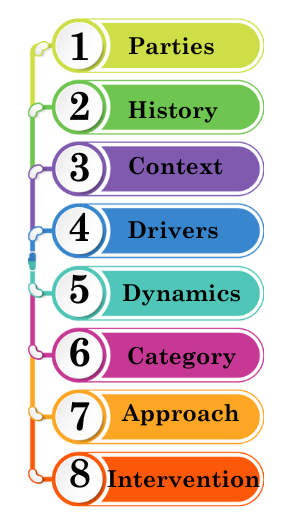
Drawing on years of teaching, research, and conflict management practice, Judith and Claire, have developed a framework to support conflict management specialists and conflict parties better understand ‘what is going on’ in a conflict situation. Drawing on multidisciplinary scholarship, including conflict studies, psychology, management, history, political science, etc. the Conflict Analysis Framework guides users through a step-by-step process to compartmentalise a complex conflict into more manageable segments for analysis.

Spencer, Barry, and Ojelabi in their text Dispute Resolution in Australia provide only a short commentary on conflict analysis. While they note that it’s not easy to analyse complex conflicts, they suggest that conflict specialists would ideally have knowledge of multiple analytical tools and models to help them collect information about the conflict, understand the conflict dynamics and to support the conflict parties to constructively manage or resolve the conflict. Condliffe, in his text Conflict Management: A practical guide, leads the reader through a process of ‘understanding conflict’ and presents several considerations in ‘responding to conflict’. Condliffe outlines several models of conflict but does not provide a clear overarching framework for analysis.

Several scholars and practitioners have introduced frameworks or tools to support conflict analysis. For example, Furlong, in his book The Conflict Resolution Toolbox, introduces 8 different models that help analyse and intervene in conflict, all considering different aspects of the conflict. This resource is particularly useful for interpersonal, less complex conflict situations. Bright’s Conflict Mapping Chart, lists specific elements for consideration in a conflict analysis process, aimed at analysing complex conflicts. Referring to Wehr’s Conflict Mapping Guide and Sandole’s Three Pillar Approach, Bright’s mapping chart describes five key steps to consider for analysis, informing a sixth step of conflict intervention. Judith and Claire have previously used this Chart in their teaching, as well as to develop engaging resources to be used for teaching conflict analysis.

Drawing on the work of colleagues and contemporary scholars, Claire and Judith have developed an 8-step framework for conflict analysis that will be introduced in their webinar Beyond Resolution: A planned approach to conflict engagement, available to view on demand on the CMA website.

Planned Approach to Conflict Engagement

Many conflicts have resolvable elements, but may also have ongoing aspects. For example, a divorcing couple may be able to negotiate and decide on selling the family home. However, decisions about their children’s future education, extracurricular activities, health, nutrition, etc., can’t really be negotiated as a one off, but will need to be managed for as long as both parents are involved in their children’s upbringing. So in the conflict analysis process that we described above, it is important to recognise the different aspects of a conflict, e.g. as resolvable or ongoing elements, and address them appropriately. Judith and Claire have developed a framework to support parties consider their options for “conflict engagement” as an alternative approach to dealing with conflict when elements of the conflict may be ongoing, and where resolution is not possible, or may be ill-advised.

The Planned Approach to Conflict Engagement, or PACE for short, draws on multidisciplinary scholarship, such as Bernard Mayer’s book Staying with Conflict: A strategic approach to ongoing conflict, Sam Hardy’s book Conflict Coaching Fundamentals: Working with conflict stories, as well as contemporary literature on neuroscience, psychology and emotions, including Judith’s recently published open access educational resources. PACE has also been informed by Judith’s and Claire’s own research and practice as conflict management specialists, including in Australia and in culturally diverse settings like the Central African Republic, Rwanda, the Philippines and refugee camps on the Thailand-Myanmar border. They have published a blog post and a journal article about their work as mediation specialists in some of these settings, discussing the adaptation of mediation models to different cultural settings.

Claire and Judith suggest that the development of a constructive and sustainable conflict engagement plan is ideally based on an exploration of several key areas, which they describe in detail in PACE. With the assistance of a suite of prompt questions and models for categorization for each of these key areas, the PACE framework assists conflict parties in deepening and expanding their understanding of the conflict itself as well as their options to engage constructively in the conflict over time. Some key recommendations for a sustainable approach to engagement in ongoing conflict include that parties:

  1. Have understood the ongoing nature of at least some aspects of their conflict, and
  2. Develop a plan to manage their emotions, energy, and access to resources and support long-term. This point is important so that parties don’t burn out and can continue to stay productive and engaged in the conflict over time.

In the webinar Beyond Resolution: A planned approach to conflict engagement, available to view on demand on the CMA website, Judith and Claire are introducing their PACE framework in addition to the Conflict Analysis Framework. They will also offer training on the Planned Approach to Conflict Engagement (PACE) Framework on the CMA platform.