The United States: unbarring the way forward

(This article is posted by Cameron McPhedran)

The future of United States democracy can be found in a prison. But not in the way that we might anticipate.

San Quentin Prison, January 2016:

A murderer and the wife of a murdered police officer speak. They deliver a united message on building change ten months shy of the US general election.

Phillip Melendez advocated that change “means cultivating emotional intelligence, cultivating empathy and compassion. And all of that teaches us to look outwards to our communities.”  

 Dionne Wilson forecast, “the goal of public safety can be achieved without tearing each other apart but it’s going to take all of us working together… we can do better, and we must.”

In 2021 with Joe Biden as President, these comments strike as clarion calls of the need for both a more effective US justice system, and a more nuanced public debate. San Quentin has endured a mass outbreak of COVID-19, in 2020 the US bore witness to yet more racialised violence, and white nationalists began 2021 by storming the Capitol building. What is striking about the comments, however, is who delivered them and the circumstance of their relationship.

Restorative justice:

Melendez and Wilson were not transformed into allies by luck. They participated in a diverse range of rehabilitation strategies utilised at San Quentin. Restorative justice is at the heart of them.

Restorative justice is an intervention where affected parties come together to discuss how a criminal act impacts upon them, and how they can move forward collectively constructively. It views engagement as more effective than retribution, and may be used to replace or to augment criminal justice sanctions.

Dionne Wilson- healing through leadership:

Wilson’s husband Nels Neimi- a Californian policeman- was murdered in July 2005. After successfully campaigning that his killer Irving Ramirez be executed, Wilson remained broken. She reflected that “when the joy of ‘winning’ that verdict evaporated, the real misery set in.”

Wilson began caucusing with women in the Californian prison system as part of victim/offender education groups organised by the Insight Prison Project. This work included discussing how offenders could be accountable for their actions, express empathy for victims, and repair their own traumas.  

Dionne Wilson, restorative justice and criminal law reform advocate.

Whilst complex and challenging work for all involved, victim offender education groups often empower all parties: Wilson reflected that instead of “seeking my healing in the misery and death of another human being… [the] key to my healing was connecting with people who were learning to find their own humanity.” Since this time, she has since served as a co-facilitator for victim offender education groups at San Quentin and has advocated for criminal justice law reform, especially around repealing the death penalty.

Philip Melendez- renewing his purpose:

In 1998, Philip Melendez was nineteen when he killed two people, in response to his father being stabbed. His brother had previously been murdered and violence was commonplace in his community.

Restorative justice at San Quentin helped Melendez fully acknowledge and take responsibility for his wrongdoing. After he began his engagement with restorative justice, he mediated in intra-prison gang disputes and committed to victim awareness programs. Changes in Californian law saw Melendez released in 2017. Since that time, he has served as the Director of Organizing for the organisation Re:Store Justice, which works to empower prisoners and communities through restorative justice and policy advocacy.

The United States, a democracy in tatters?

It is easy to write off the relevance of restorative justice to wider society. It is a mechanism that relies on the voluntary commitment of people who have experienced hardship or trauma, revisiting these experiences. It requires listening, carefully and openly, to those who often have very different life backgrounds from one’s own. It is precisely these qualities that make restorative engagement, albeit challenging, exactly what the United States needs right now.

The polarities between Democrat and Republican, Southern and Northern, white and people of colour, undocumented and passport carrying, and other such divisions are seen as representing irreconcilable differences among Americans. These divisions, are, from the outside, ravaging the country.

Legislators and policy makers need to be able to reach consensus about evidence, to be responsive to the social good in their governance. The bipartisanship that aided Australia in the early stages of its Covid policy response has not been seen at any stage in the United States.

Covid- and racial injustice- has shown that delivering public safety is a community responsibility. This becomes impossible when social trust is broken.  An analysis of the decline befalling the United States over recent years found that nations high on the World Values Survey measure of interpersonal trust- China, Australia, most Nordic countries- delivered both better policy responses and public compliance with them than the United States.

Biden Era Washington DC:

The events of 2020 and the initial stages of 2021 suggest that it would be easy to resort to despair for the United States this year. However, a new president has been elected and statements of condemnation about the Capitol attack and its aftermath resounded among both Democrats and Republicans. Linking the United States to the Europe he emigrated from, Arnold Schwartznegger’s compared the Capitol riot with the 1938 Kristallnacht killings in Germany.

The impact of Covid and racial injustice show that the United States must fight for a renewed civil sphere, for accountability with compassion. Events at the US Capitol show that fighting for justice is both necessary, and a daily, task.

Marcus Henderson, chief editor of San Quentin News

The only way out of COVID-19 and civic breakdown for the United States is together, through the sustained and committed dialogue among groups who are different to each other.

Restorative justice proves that this changes lives. When empathy, forgiveness and hope endure, a brighter political culture is possible.

Cameron McPhedran participated in the Restorative Justice Roundtable at San Quentin Prison whilst on university exchange in 2013. He works in community mediation for the NSW Government. These views are his own.

Cameron aspires to specialise in DR for the LGBTIQA+ community.

CREATING A WORLD IN BALANCE: REFLECTIONS ON THE 9th ADRRN ROUND TABLE AND CIVIL JUSTICE RESEARCH CONFERENCE

On 1st and 2nd February 2021, the University of Newcastle hosted the 9th ADRRN Round Table and Civil Justice Research Conference. The proceedings brought together online twenty six leading world scholars from around Australia, New Zealand, Bangladesh and the United Kingdom to present papers and discuss themes of topical interest to dispute resolution.

A theme which emerged from conference papers, and which is taken up in this post, is the reconciliation of competing interests which are valued by the traditional justice institutions and dispute resolution theory respectively. In her paper “Is Civil Dispute Resolution all about how best to balance competing objectives?” Sonya Willis observed that the most efficient solutions lack procedural protections and the fairest solutions come at a cost which makes them unjust or just plain unavailable. Juxtaposing four conflicting imperatives of civil dispute resolution, (efficiency and due consideration; certainty and flexibility; privacy and openness and autonomy and control) the author argues that acknowledging those imperatives involves acceptance that they are irreconcileable and that achieving optimal outcomes through ADR means striking a balance in which some measure of each value is sacrificed in the interests of achieving an overall better outcome than would otherwise be available under the competing imperatives.

This is a conundrum that has long troubled both civil justice and dispute resolution theorists. In 1997 it prompted former High Court Chief Justice Brennan to express concern that the diversionary procedures offered by dispute resolution processes would deliver “…a cheaper but a less satisfying form of justice.” (G Brennan Key Issues in Judicial Administration (1997) 6 Journal of Judicial Administration 138 at 141). It troubled Justice Ronald Sackville when he wrote that the functions performed by the courts cannot always be discharged in a manner that is compatible with heightened expectations of cheap and swift justice. (R Sackville: Reforming the Civil Justice System: the Case for a considered approach in Stacy and Lavarch (eds) Beyond the Adversarial System (Federation Press 1999 p35). Perhaps it also troubled Professors Jonathan Crowe and Rachael Field when, in their paper “Intuition and Artestry in Mediation: Implication for Mediator Ethics, they observed that mediators should not only meet minimum standards of competence but should attain higher levels of expertise. Drawing upon social scientific research on intuitive decision making, the authors argue that such research has important implications for how mediators respond to ethical dilemmas. They propose a guided framework for mediation practice that “leaves room for mediators to exercise and enhance their capacity for ethical judgment.” If mediators are to engage in the exercise of addressing a balancing of competing interests between efficiency and due consideration, between certainty and flexibility, between privacy and openness and between autonomy and control, it makes sense that they should be properly equipped to exercise that judgment in a sophisticated manner with emotional maturity and from a sound ethical framework.

The balancing of competing civil dispute resolution imperatives in practice and the methodology employed by mediators to resolve ethical dilemmas, like so much of mediation practice, are largely unknown quantities. This is largely because of the confidentiality provisions surrounding mediation and the private nature of the process. In her paper “Evaluating Mediators – stepping off the beaten track” Dr Alysoun Boyle reported on the key outcomes of a major analysis of empirical studies into mediation using a metaresearch framework. She reported that: “…in the absence of significant changes in research approach and design, there is unlikely to be any increase in what is known – including about what mediators do in mediation, how they might influence what happens during mediation and how they might influence the achievement of mediated outcomes and their content.” The author proposes a significant review of the research methodology to be employed in approaches to research into dispute resolution practices and observes that there may well be opportunities for leadership roles for bodies such as the ADRRN Network.

Though held online for the first time in 2021, the ADRRN Round Table and Civil Justice Research Conference was again successful in delivering an impressive suite of research documents which will no doubt inform civil justice and dispute resolution research into the future. This brief post has drawn attention to one of many themes which were explored during the conference. We hope to feature others in coming weeks.

State of the Art: Program from the 9th Australasian Dispute Resolution Research Network Roundtable and advance notice of the 10th Roundtable

Photo by CQF-Avocat on Pexels.com

One of the greatest joys of academic work is the opportunity to discuss big ideas with colleagues. To really get into the details of another person’s work, think through the issues together, and receive critique on our own work – all in a supportive, engaged group.

For nine years, the ADR Research Network has offered precisely that opportunity to established academics and early career researchers from around Australia. Since that first meeting, our membership and scope has expanded, and this year we welcomed participants from Australia, New Zealand and the United Kingdom. And for the first time, the Roundtable was combined with another established research and teaching conference, the Civil Justice Research and Teaching conference, which has been the main meeting of academics who teach and research in what is sometimes known as ‘civ pro’ (civil procedure) – or more commonly these days ‘civil justice’ or ‘civil dispute resolution’.

We look forward to the 10th Research Network meeting, which is scheduled for February 2022 at Bond University on the Gold Coast. As always, we invite early career researchers and especially PhD students to take part, and encourage any readers who are also supervisors to extend that invitation to their students. A call for papers will be made on this site towards the end of 2021.

In the meantime, here’s the conference program from the 9th meeting, which provides an insight into the range of topics covered this year, together with the abstracts of the papers and the bios of the presenters. Keep an eye out for much of this excellent work coming out in journal articles and other formats throughout 2021.

Pandemic Possibilities: Current Research on Technology and Dispute Resolution

Photo of the conference program showing an aerial view of Newcastle Australia

The 9th Australasian Dispute Resolution Research Network Roundtable, held this year in conjunction with the Civil Justice Research and Teaching Conference, was held on 1-2 February and hosted by the University of Newcastle Law School.

Every year the Roundtable provides a unique perspective on the ‘state of the art’ in dispute resolution research – and this year was no exception. For the benefit of those who could not attend, this post draws insights from one section of the many conference papers – those focussed on the technological change that has been hastened by COVID-19.

The Covid19 pandemic required courts, tribunals and dispute resolution providers to rapidly ‘pivot’ to keep providing services during the pandemic. As Dr Joe McIntyre observed in his paper,

The last five years have seen significant developments in the use of digital justice technology globally. Australia has, in contrast, been relatively slow moving in embracing the use of such technologies to improve the efficiency and accessibility of its courts. The sudden shutdown required to respond to the 2020 global pandemic forced jurisdictions around the country to rapidly cobble together technological solutions to allow emergency access to the courts to continue…

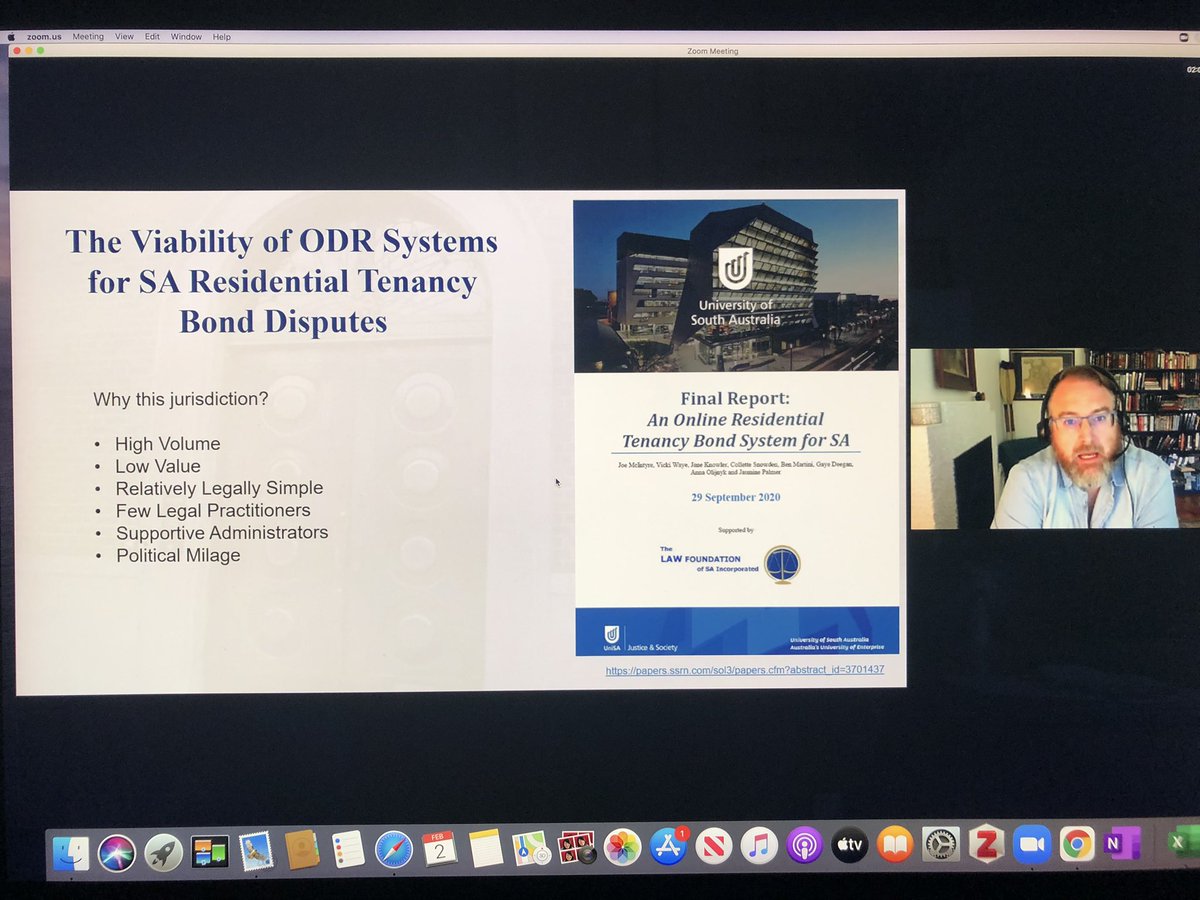
Joe’s paper highlighted what he sees as a potential upside of the pandemic-driven technology shift – that we might be might be willing to shift our mindset to embrace a broader conception of the role of a court. His paper also highlighted some of the practical work he’s been doing on an online mechanism for resolution of tenancy bond disputes.

The Roundtable provided early insights into some of the excellent empirical work undertaken during 2020 on the disruption and innovation seen internationally in the civil justice sphere.

The Roundtable provided early insights into some of the excellent empirical work undertaken during 2020 on the disruption and innovation seen internationally in the civil justice sphere.

Associate Professor Genevieve Grant undertook a study of 37 lawyers about their experiences of hearings undertaken both online and by phone. Her findings reflected a wide range of experiences and both the advantages and disadvantages of hearings at a distance.

In New Zealand, Dr Bridgette Toy-Cronin has been looking – both pre- and post- pandemic at the telephone mediation of rental disputes. While this research was already important in 2019, it has acquired new urgency during 2020 as telephone mediation has become more widespread. While the ‘low tech’ solution of telephone can make it accessible for those not able to engage with video technology like zoom, the medium presents its own unique challenges.

Tayne Redman, is a lawyer at the Accessible Justice Project, which is an organisation established bythe University of Adelaide and law firm Lipman Karas – and which operates as a not-for-profit law firm. Tayne’s presentation highlighted the intense community demand for innovative and cost-effective delivery of legal services – now more than ever for the ‘missing middle’ who can neither afford legal advice nor are eligible to receive legal aid.

My own research, currently still at the stage of data analysis, unintentionally examines the impact of covid on innovation in law firms and legal education. Like many researchers, my team collected data during 2020, which meant that participants’ thoughts were naturally attuned to the impact of the pandemic. That study, designed to understand how legal actors conceptualise and respond to ‘innovation’ has highlighted the beneficial effect that a rapidly emergent situation can have on innovation. Not only is the speed of innovation, by necessity, sped up, the need for rapid change can dampen the impact of path dependency and lessen resistance to change.

What, then, is the way forward for the legal profession, legal institutions, lawyers and academic in this new environment? I think it’s summed up beautifully by one of my interviewees, the Dean of a large law school:

It’s important to consider the relationship between research and its contribution and its community – it’s at its best when there’s mutual understanding. We have brought a sense of mutual understanding much more clearly back into the frame as a result of COVID-19.

We need to focus on what communities and businesses need, and to design solutions that meet those needs. We need to keep building new and innovative partnerships between the academic sector, the public sector and the private sector, and bring lots of voices into the conversation. We also need to carefully evaluate solutions that have been implemented quickly, before allowing temporary fixes to become more permanent. It is reassuring that there is so much important research from the Network continuing in 2021.