Court Managed Expert Evidence – Using ADR techniques to enhance the integrity and utility of expert evidence in the Land Court

Fleur Kingham

Fleur Kingham – President Land Court of Queensland

The National Mediation Conference 2019 continues to provide rich material for learning and reflection some weeks after the it concluded. This blogpost from Fleur Kingham, President, Land Court of Queensland provides a great taste of the challenging and thought-provoking session she delivered.

What has ADR got to do with expert evidence?

In the Land Court of Queensland, ADR objectives, skills and techniques are at the heart of its procedure for managing the pre-trial preparation of expert evidence.
With the aspiration of enhancing the integrity and utility of expert evidence, the President of the Land Court adopted Practice Direction 3 of 2018, supplemented by the Guidelines for Expert Evidence.
The procedure for Court Managed Expert Evidence, or CMEE for short, brings together two very familiar processes in civil litigation – active case management and meetings and joint reports by the experts. The innovation lies in how those processes are connected, located within a without prejudice framework and supervised by a convenor, who is either a member or the Judicial Registrar of the Court.
The impetus for this procedure is twofold – the importance of expert evidence to its cases and enduring concerns about the quality of expert evidence led before the Court.
Expert evidence is central to the resolution of most matters that come before the Land Court. It is a specialist court with jurisdiction to hear disputes about the terms of access to and compensation for use of land for mining and other resource developments, compensation for the compulsory acquisition of land, cultural heritage disputes and appeals about land valuations. Expert evidence is involved in nearly all cases and, in some, the only issues in dispute involve expert evidence.
The Court has the same concerns that have motivated courts and tribunals to become increasingly interventionist in the management of expert evidence. Those concerns include bias (conscious or unconscious), the complexity of the information, the incomprehensibility of technical reports, and the risk of competing expert reports passing like ships in the night.
The CMEE Convenor’s role is procedural, facilitative, neutral, and expert. The CMEE Convenor cannot decide any substantive matter and cannot make directions without the parties’ consent. They facilitate communications about pre-trial preparation of expert evidence and seek to build consensus between the parties and their lawyers about the necessary steps. It is expert in the sense that the CMEE Convenor is an expert in the Land Court’s procedure and has content expertise in the Court’s jurisdiction. It is not evaluative, except to the extent that suggestions about process might involve the Convenor applying their expertise to help the parties move through process stalemates.
The objectives of the CMEE process are familiar to an ADR practitioner:
• To resolve, reduce and manage disagreements to a minimum; and
• To prepare for either mediation or more focussed preparation for the trial with reduced issues.
The Convenor uses the ADR skills of convening, facilitating, and managing disputes. The CMEE Convenor assists the experts during their meeting process to understand their role and the Court’s expectations. They facilitate the experts’ discussions and preparation of their joint expert report. In Queensland, once the experts start their meeting, they must proceed without further instruction from the lawyer/party who engaged them. This can create a dilemma if the experts need further instruction or information or need more time to complete their work. The CMEE Convenor can facilitate communications with the lawyers as a group. This ensures the confidentiality of the expert evidence process is not a barrier to meaningful communication and further instruction (without inappropriate influence) where required.
The CMEE Convenor also facilitates communications between the experts and the lawyers/parties and the Court. The CMEE Convenor will identify when something needs to be taken from the expert meeting to the lawyers for direction. The CMEE Convenor will also ensure that any matter that needs to be resolved on the record can be brought back to the member managing the case.
ADR techniques are central to the work of the CMEE Convenor: to clarify, find common ground and to explore solutions. The CMEE Convenor does not mediate a resolution between the experts. They use constructive controversy to encourage deliberative discussions aimed at creative problem solving. The CMEE Convenor ensures the experts address the same issue, with reference to the same material and that, if they differ, it is clear why they differ and to what extent. Many differences between experts, at the end of the day, prove to be immaterial to their ultimate opinion. The CMEE Convenor encourages the experts to identify what differences between them are material to the outcome of their opinion.
The CMEE process is relatively new. An international team of ADR academics will evaluate it in due course. To date, CMEE appears to be well received by the parties/lawyers and their experts. The President considers it has resulted in more focussed preparation of better quality expert evidence.

Can Poetry teach us about Mediation?

NMC2019One of the best features of the national Mediation Conference 2019, with 7 separate streams jam-packed with sessions, was the extraordinary variety of themes and presenters.
Days after the conference has ended I am still revisiting the ideas that were shared and the challenges to my view of what ADR is and might be.

BrysonIt is probably unsurprising that David Bryson, a colleague with qualifications in Politics, History, Psychology, Social Anthropology and Organisational Change signaled his intention to present us with a decidedly different conference session.
He described his surprise when the NMC organising committee accepted the idea he had proposed (somewhat provocatively) for this session – and his subsequent challenge to deliver something that until then had been just a playful idea.
Session participants, were surprised also – but certainly not disappointed.

Bryson bookA published poet himself, David delivered a session on ‘ADR Lessons from the Art of Poetry’ (subtitled (Poetry Lessons from the art of ADR).
His idea was that in some ways ADR and poetry share the same space although they have different frames.
He used the example of how poetry and ADR both rely heavily on words and on navigating meaning through the use of metaphor, with poetry adding the influence of imagination.
He used the language of ‘encode’ (from the deliverer) and ‘decode’ (from the receiver) to explore the intention/reception dynamic which is often a significant element in a mediation process. He engaged us further by sharing some lines of poetry which invited the audience to explore the intricacies of language.
Bryson used the unexpected concept of ‘sweet and correct formality’ to continue his exploration of concepts linking poetry and mediation.

New language for mediators
He developed this idea through his notion of ‘the ‘thoughtful machinery’ of poetry, giving us:
• Structure of lines
• Rhythmic energy and
• Repetitive sounds
He demonstrated how we can also find the ‘sweet and correct formalities of mediation’ where:
• Words are channeled in form and purpose in process
• Language is directed into negotiation elements
• Interpretations [need to be] filtered for heuristics and mind tricks and
• Social dynamics of conflict [can be explored]
We were certainly being engaged in a very different but compelling frame in which (using unexpected analyses) Bryson described mediation and poetry as sharing the common elements of:
• Multi-level meanings
• Emotional drop, below the surface
• Images of truth about humans enlivened to take greater weight; especially by the use of metaphors.

Learning from poetry
Using extracts from a series of poems, Bryson encouraged us to explore these elements – an analytical framework quite different from more conventional analytical frameworks that we are accustomed to bring into mediations with us.
Continuing his theme of comparisons he gave 3 further examples:
Multi- level meanings (using poetry to encourage our exploration of a range of possible meanings)
The emotional drop (through naming and listening)
The use of metaphors
This example was the most powerful – exploring, through the language of poetry, how mediators change the frame by changing the metaphor. A memorable example was changing the metaphors of conflict from war or entrapment (such as armed with the facts; between a rock and a hard place) to journeying and collaboration (such as first steps towards an agreement; where do we go from here?).
Bryson finished by encouraging us to think about becoming poet mediators. A big challenge and one that seemed to be taken up very energetically at the Poetry Slam – a very unexpected highlight and hotly contested highlight of the Conference Dinner.

ADR Research discussed at the NMC 2019 PhD Session

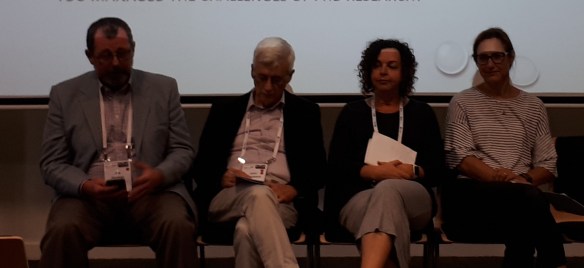
The PhD Session at the just concluded National Mediation Conference featured John Woodward, Joe Harman, Joanne Clarke and Jackie Weinberg discussing their PhD research topics. The discussion was interesting and stimulating and each research topic makes a positive contribution to Alternative Dispute Resolution (ADR) theory and/or practice.

phd-session-pic.jpg

Judge Joe Harman discussed his research which explores the nature of mediation confidentiality and the interaction of mediation confidentiality with family violence. So far, two papers have been published on the origins of mediation confidentiality and attitudes of mediators and others towards mediation confidentiality. The first, titled ‘Mediation Confidentiality: Origins, Application and Exceptions & Practical Implications’ is published in the Australian Dispute Resolution Journal, and the second titled, ‘An Imperfect Protection: The Attitudes of FDRPs to Mediation Confidentiality’ is published in the Bond Law Review. Forthcoming papers include on whether mediation should be the first step in all family law proceedings, and on the intersection of family dispute resolution and family violence.

Dr John Woodward’s PhD, now concluded, adopted a qualitative methodology to explore the relationship between confidentiality and disputant participation in facilitative mediation occurring in the shadow of the law where disputants are represented by lawyers. A prominent theme which emerged from the research was lawyer perceptions that disputant participation risks compromising the legal case or “giving away” confidential information which may be misused in the hands of an opponent. This perception is based on the uncertainty around the nature of mediation confidentiality and the extent of its protection. As such, disputant participation is limited. The research concludes that there is a need to do more to clarify the meaning of confidentiality so that disputants may reap the full benefits of the mediation process.

Jackie Weinberg’s PhD is studying ADR in Clinical Legal Education (CLE). The research explores whether ADR should be taught in various legal clinics across Australia; what aspects of ADR should be taught to students; why it might be valuable to teach ADR to clinical students; and in what ways teaching of ADR in the clinical context can be enhanced. Data has been collected using semi-structured interviews and observation of interaction between clinic supervisors and students. The research outcomes include theoretical insights into ADR teaching in CLE, new knowledge on ADR skills acquisition in CLE, empirical insights into how the role and impact of ADR in clinical legal education settings can be measured and recommendations pertaining to the teaching of ADR in Australian clinical legal education.

Finally, Joanne Clarke’s research explores the discourse of conflict resolution in western liberal tradition which positions ‘competing interests’ or ‘communication difficulties’ between individuals as the origins of family conflict notwithstanding that conflict is complex and contextual. Western liberal tradition’s dominant response to conflict is to apply a rational problem-solving model of conflict resolution and this has tended to ignore the complexities of people’s lives and promoted simplistic ways of viewing conflict and related concepts such as power and identity. In contrast, post-structural ideas offer a more complex understanding of conflict in the proposing of multiple realities that are culturally and historically created and challenge the idea of a universal truth. Most importantly, these theories identify the links between knowledge, language and power, highlighting how dominant discourses create conflict through privileging reality and meaning. This makes it essential for FDR practitioners to be aware of the broader social/structural origins of conflict and more importantly because many FDR matters involve family violence.

The Australian Dispute Resolution Research Network’s (ADRRN) Roundtable coming up 9-10 December 2019 provides another opportunity for ADR researchers including PhD students to discuss their research. The Call for Papers may be viewed here.

NMC 2019 Rosalind Croucher, AM, President, Human Rights Commission

We had the privilege and pleasure of an address from Emeritus Professor Rosalind Croucher, AM, President of the Human Rights Commission on day 2 of the National Mediation Conference.

Professor Croucher’s address included the following themes:

  • The history of Human Rights legislation in Australia and recent outcomes
  • The architecture of Human Rights complaint handling through the HRC and the central place of conciliation.

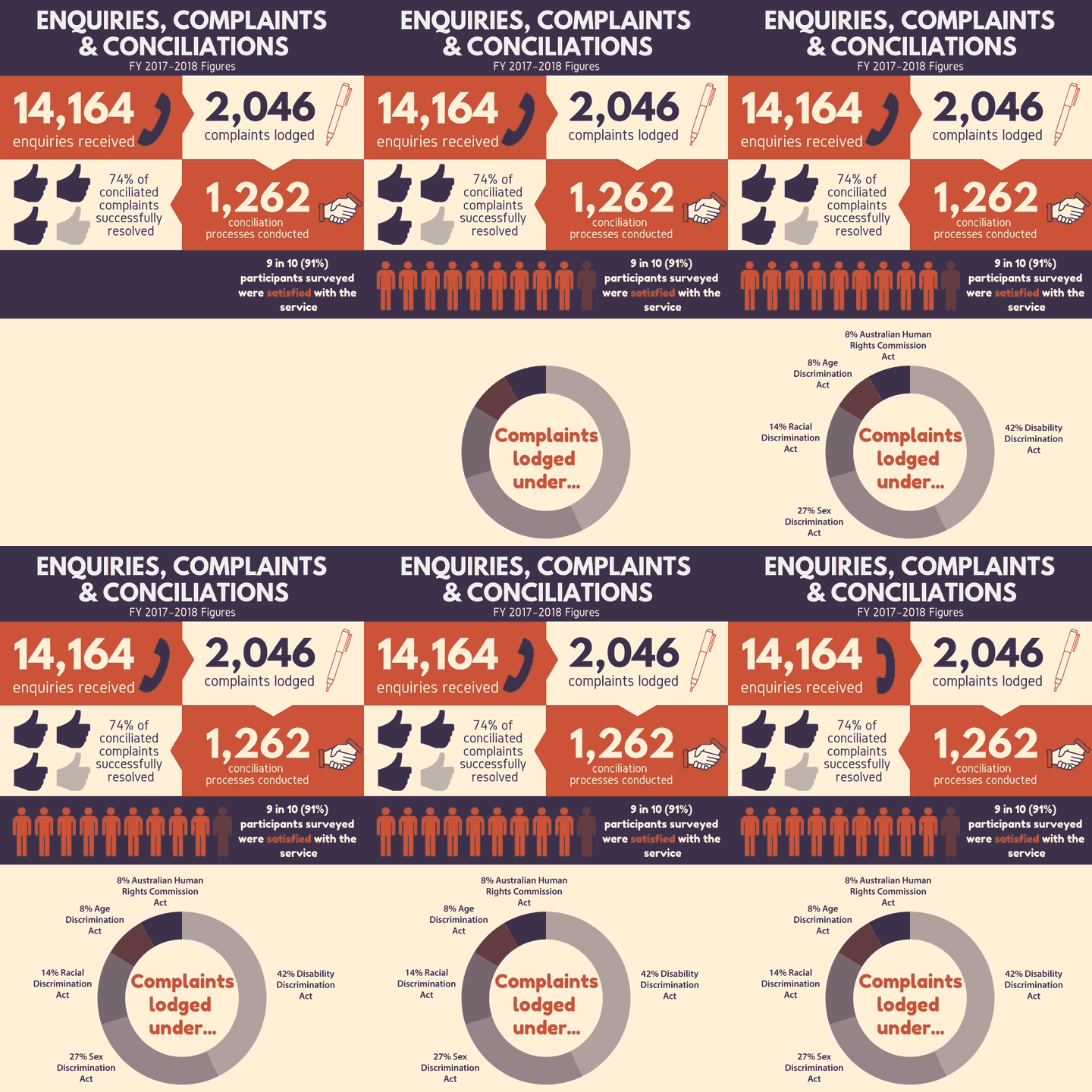
Professor Croucher traced the development of Human Rights legislation in Australia in its political context and provided an overview of the work of the Commission, summarised in the diagram below.

  • Animated infographic illustrating statistics from the article.

(Reproduced from the HRC website at: https://www.humanrights.gov.au/ )

Professor Croucher noted that well over 1,000 conciliations had been conducted at the HRC in the last year and reflected on the significance of conciliation for the resolution of complaints her comments echo her address to the Supreme and Federal Court Judges’ Conference 2019 in Hobart, 22 January 2019.

“So much of this work of conciliation continues unnoticed and observed over the years. The reports, required in a few instances, and only in cases of human rights complaints or ILO 111 discrimination, may attract attention—at times—because they do become public of necessity, even though the names may be protected through pseudonyms. Publicity may also happen if the individuals involved in any of the otherwise confidential processes decide not to keep them confidential.

But the Commission’s record over the years speaks for itself. For example, if we look at the number of complaints the Commission has received and conciliated over the past 20 years, the numbers represent successful alternative dispute resolution through conciliation for more than 30,000 people and organisations.  And these are not just numbers: for every matter there is an individual who has taken the initiative, sometimes the courageous decision, of coming to the Commission.”

(Reproduced from: https://www.humanrights.gov.au/news/speeches/ahrc-roles-responsibilities-and-challenges )

More gems from NMC 2019

NMC2019

The National Mediation Conference continues to offer us opportunities to share and learn. The pace has been remarkable and the overarching experience has been of inclusion and learning from each other.

The profoundly challenging moments of reflection have also been interspersed with lighter moments. Dinner at the winery was a relaxing event enlivened by the unexpected and, at times hilarious, poetry slam. I had not expected to be a participant but the audience was generous about my ‘Ode to Short People’.

Today was a particularly important day for me.

Attending the conference with my husband and two of my children who are mediators has been a gift. I never anticipated a family of mediators and it never occurred to me that one day we could all have a learning experience as colleagues.

NMC2019family

My family of dispute resolvers- Alan Limbury, me, Emma-May Litchfield and Ashley Limbury

This morning I had the joy of being in the audience as my daughter Emma-May Litchfield presented on her current research – ‘Should emotions be considered in the design and delivery of mediation training’ – under the watchful eye of her Masters’ supervisor Dr Kathy Douglas.

We are all tired by day three so we were enlivened when Emma-May engaged the room – polling our experiences as mediators, trainers of accrediting programs and as parties is mediation processes.

She challenged us to identify our own perception of whether emotion enters the room as part of the mediation process.

A starting point of her research was the requirement contained in the NMAS standards, requiring that those seeking accreditation under the standards demonstrate an ‘ability to manage high emotion’.

The Research Process

We were introduced to Emma-May’s qualitative process of interviews with 12 accredited mediators who were also trainers in accrediting programs.

Her semi-structured approach provided consistency whilst also allowing the opportunity to explore unexpected dimensions as they arose.

This led us to an overarching question she pursued as part of her work – Is the skill of dealing with emotions part of the design of accreditation training programs?

A particularly interesting outcome of the research was that the factor that determined whether training in emotions were included in the training depended on whether the trainers thought that it was important. I found this remarkable.

We were given an explanation of what might this mean via the hierarchy developed as part of Krathwohl’s Affective Domain of Objectives.

Krathwohl's Affective Domain of Objectives

Krathwohl’s Affective Domain of Objectives

Exploring the values hierarchy Emma-May used the great analogy of the path to adoption of a plastic bag free life to demonstrate the development of values – from the most basic acknowledgement of a value to the top of the hierarchy where there is active living of values.

It’s a great sensation when your children become your teachers. I am really enjoying the learning emerging from this research.

The National Mediation Conference 2019 opens

NMC2019

The National Mediation Conference opened in Canberra yesterday and it has already given us memorable experiences.
From the opening plenary sessions the tone was set for us to experience the ‘Over the Horizon’ conference theme.

Honeyman Christopher Honeyman gave us some language that was repeated throughout the day – ‘no tools and no rules’. His humour encouraged us to engage with his message that part of mediation’s value lies in the difficulty we experience with definitions and rules – offering us the opportunity of being infinitely flexible (within ethical boundaries) whilst also delivering a process that is situation specific. His parting encouragement for ‘keeping a sense of doubt about the right thing to do’ is something I am still reflecting on.

Oscar Honeyman was followed by Aboriginal and Torres Strait islander Social Justice Commissioner June Oscar AO of the Australian Human Rights Commission who introduced herself to us as a proud Bunuba woman.
Commissioner Oscar gave us a warm Bunuba welcome and then explained (in what she described as her second language) that her welcome to us was in support of her intention to support our understanding of indigenous ways of being and governing. The ceremonial welcome is part of keeping us connected and supports the cultural imperative of actively keeping peace and avoiding disputes.
She spoke of a ‘web of being’ which reflected a whole of life approach to mediation where everyone and everything in the community is accountable – providing lessons to sustain ‘societal health and wellbeing.’
Connection was a continuing theme and Oscar talked about ‘song lines and stories that keep us connected’. She shared her own important stories of mediating in her community at Fitzroy Crossing. She used her stories to introduce us to what she views as the basis of indigenous mediation – ‘deep listening’.
This phrase has struck a chord with the mediation community gathered for the conference and it continues to be a reference point of presentation after presentation.
Naming is powerful and now that we mediators have been given this powerful naming, we can be sure that when we use it we recall Oscar’s words:
‘Deep listening stops us from imposing our own ideas and imposing the outcome we want – it creates an important space so we have the opportunity to be exposed to the thoughts and feelings expressed by others.’

(PDF version of Oscar’s paper will be available on the NMC2019 website)

Invitation to Participate – Study to understand the use of international commercial arbitration

The Commonwealth Secretariat is conducting a Study on challenges to accessing international commercial arbitration across the Commonwealth, and potential solutions (http://thecommonwealth.org/arbitration-study). The Secretariat was requested to conduct the study by Senior Officials of Commonwealth Law Ministries at their meeting in London in October 2018.

The aim of the study is to understand the use of international commercial arbitration in addressing commercial disputes across the Commonwealth, as well as ways in which member countries may strengthen the accessibility and effectiveness of international commercial arbitration. The study will be authored by a group of distinguished arbitration experts, advised by a task force representing arbitration expertise from every region of the Commonwealth.
As part of the study stakeholders are asked to fill out relevant questionnaires:
arbitrator, counsel, business, academic (closed).

The Study is expected to be completed for consideration at the meeting of Commonwealth Law Ministers in late 2019 and will be publicly available on the Commonwealth Secretariat website.

Teaching Mediation through Video and Peer Discussion

Legal education in Australia increasingly acknowledges the need to teach about technology and law schools have included elective and core curriculum dealing with such issues (Judy Gutman and M Riddle, ‘ADR in Legal Education: Learning by Doing’ (2012) 23 Australasian Dispute Resolution Journal194; Kathy Douglas, Josephine Lang and Meg Colasante, ‘The Challenges of Blended Learning Using a Media Annotation Tool’ (2014) 11(2) Journal of University Teaching and Learning Practice 1, 3-4). There are now subjects that provide the opportunity to build computer apps (applications) to solve legal problems and core courses include information on issues such as smart contracts and blockchain. For example, FineFixer, an application devised to help the public implement strategies to deal with fines, was initially developed by RMIT University students in an elective course and was later made available through the Moonee Valley Legal Service, funded by a grant from the Victoria Law Foundation.  Higher education is evolving with faculty increasingly engaged ‘with options and technologies, including collaboration tools, video and media’ where video, as a visualisation media, taps into ‘the brain’s inherent ability to rapidly process visual information, identify patterns, and sense order in complex situations.’ (New Media Consortium and EDUCAUSE, NMC Horizon Report: 2018 Higher Education Edition (2018) 11 March 2019, 35)  ADR teaching also needs to adopt the latest technology in teaching about areas such as negotiation, mediation, arbitration and collaborative law.

Teachers of mediation have often relied on videos to demonstrate mediation skills to prepare for role-plays. However, merely watching a video may not be as effective as also engaging with peers. The watching of video, combined with a subsequent online discussion of mediation skills, can enhance student learning as students become active rather than passive learners. After watching videos and discussing the legal skills online, students can later be asked to demonstrate these skills in role plays. Our article in the latest edition of the Australasian Dispute Resolution Journal discusses an example of the use of video and online discussion to scaffold learning about mediation (Kathy Douglas, Tina Popa and Christina Platz, ‘Teaching Mediation Using Video and Peer Discussion: An Engaged Video Learning Model’ (2019) 29(3) Australasian Dispute Resolution Journal 182). Students watch a video of a mediation, discuss the mediator interventions online and then undertake role plays at an intensive weekend seminar. The scaffolding of student learning through watching the video and subsequent online discussion prepares students to demonstrate the mediation skills. The article concludes with a model of ADR learning with video that serves as a useful guide to implementing active video learning activities. This model can be used to make further videos such as specific contexts of mediation that is family, workplace or community mediations. The model could be used to develop videos on other ADR options such as conciliation, arbitration and collaborative law. We hope this model might assist the ADR community to use technology effectively in their teaching of ADR skills and theory.

webinar-3199164_1920

[pixabay, free image, mohamed_hassan]

NMC2019

NMC2019-banner

OMG       YOU’RE NOT REGISTERED YET???

This will be a remarkable event.  Not only 11 national and international Plenary Speakers.  Not only more than 130 national and international presentations.  Not only more than 500 delegates to catch up with, or to lose yourself among.

But also a Welcome Function with views to die for.  A cocktail party with the Australian Government Solicitor.  An informal dinner at a smokehouse that just happens to be a winery, too.  A (competitive) poetry slam.  And a farewell function to wrap it all up.

Pre-conference workshops to refresh your practical skills.  Not only traditional presentations, but opportunities to contribute and to take part: mini-workshops, collaborative conversations, interactive panels.  Child-inclusive FDR; ethical complexities in Elder Mediation; perspectives on leadership; unexpected applications for restorative practice; what’s happening in conciliation; research and you; younger people, older people, and everyone else.  And illuminations from other countries, other cultures, other societies.

And three journals calling for papers from the conference: the ADRJ, The University of Newcastle Law Review, and the Bond Law Review.

And the ADRRN NMC2019 Blogfest.

Phew!  Thank goodness the Easter break is so close – you’ll have earned a rest.

Pickle_Puppy_cropped

[© A. Boyle 2018]

Get on to it, before it’s too late:

http://nmc2019.com.au/

Please do contribute to our Indigenous Delegate Support Fund while you’re registering.

Understanding the Brexit dilemma – How negotiation games provide analytical tools

Brexit

Picture Credit – Wikimedia Commons

When Professor Roger Fisher of Harvard Law School’s Program on Negotiation published ‘Getting to Yes’  in 1981, Game Theory was well developed.

It was firmly in the grasp of mathematicians and economists – not lawyers.

First advanced by mathematicians  in1944, more mathematicians followed, developing a game model of co-operation and conflict. This was later enhanced–  given a prison-sentence scenario and named The Prisoners Dilemma.

Nobel Prize – winning John Nash made further enhancements, giving us the Nash equilibrium – a model of problem solving to analyse and resolve the prisoner’s dilemma game.

By the time ‘Getting to Yes’ was published, game theory was a strong part of economic theory and analysis. Business schools had wrested it from the mathematicians and installed it in mainstream business programs.

Researcher followed researcher – developing and enhancing what has become known as the field of distributive negotiation.

Fisher’s ideas about interest-based negotiation (called integrative negotiation) were influenced by but separate from the distributive work of the business schools.

Fisher embraced The Prisoners Dilemma and other games in his teaching.

He often used the famous Negotiation Auction game, demonstrating how emotion and ego can override rational behaviour in negotiation. In this game, players bid for, say, a $10 note. Bids start low and then move surprisingly close to $10 as the competitive emotions kick in. The rules require that the top two bidders must pay their final bid although only the highest wins. Consistently the last two bidders pay more than the face value of the note, trapped in an ego-driven battle in which emotion overrides reason.

Edward’s Game

Using case studies, Fisher refined this game into something he named ‘Edward’s Game’ – although sadly he did not explain who Edward was nor publish his analysis.  Playing it in class with Fisher, we experienced an addictive game where the proponent has something desired increasingly fiercely by other competing negotiators. The proponent’s pitch is ‘I won’t tell you what I want – you just keep putting offers on the table and I will tell you when it is enough’.

The seductive quality of the game increases with the negotiator’s desire for what is at stake. In the domestic setting we often observe Edward’s Game when one party anxiously seeks forgiveness from another who refuses to indicate what forgiveness will require.

Edward’s Game is the gift that goes on giving.

It provides a terrific frame to test and analyse international dilemmas that appear completely irrational.

Brexit through the lens of Edward’s Game.

Brexit is playing out in the House of Commons, while the world watches in dismay. It is evident that no-one, except the economists who are commenting, the EU and the horrified public, is behaving in a way that can be explained  by the rational, analytical tools of game theory.

Edward’s game has been playing for quite a while.

May clearly has a powerful interest in being seen to honour her promise of being the Prime Minister who implements the public vote to leave. To complicate matters, there is more than one Edward’s game being played out. This makes her negotiation task so much more difficult because the different interests she has to satisfy in order to ‘win’ are in conflict. Some interests use Brexit blocking as a tool to pursue a more devious agenda of self-promotion and derailing of May’s leadership. Some interests relate to overturning the ‘leave’ decision and some interests relate to being unwilling to do anything which might be seen to be ‘giving in’ to the Europe that Brexiteers had vowed never to be seen to agree with again.

May keeps putting more on the table.

She went back to the EU to negotiate an extension. The warring parties would not agree and more of her own party defected to a new independent group with different interests again.

Receiving intelligence that a uniting interest of key decision-makers was her demise, she offered a new solution. She would resign if the proposal negotiated with the EU were approved. No luck.

She is now talking of a further extension which shows no signs of meeting sufficient approval yet for a motion to be passed in the house – but watch this space.

Negotiating Edward’s game successfully

Fisher constantly demonstrated to us willing participants in his game how difficult it was to ‘win’ without giving away more than the value on offer. This is what is happening with Brexit also.

Fisher proposed 3 tools for ‘winning’ Edward’s game. How might they work in this scenario?

  1. Go to yourBATNA– but, leaving it so late, what could have been May’s BATNA has deteriorated into a WATNAand would end in lose/lose – a very bad outcome.
  2. Change the players– May has signalled willingness to resign as the price for approval of her deal but it is too late. Divisions are so entrenched it would be near impossible to find an acceptable leader with the numbers to get May’s deal through. She has been experimenting with another version this week – collaborating with Labour leader Jeremy Corbyn. A good outcome seems very unlikely.
  3. Change the game– May has already been cycling through Fisher’s seven elements. She has tried ‘relationships’ but her antagonists are prepared to risk all key relationships in their bid to block her. She has tried to brainstorm ‘options’ but masterful Edward’s Game players won’t play. She has tried ‘standards’ but apparently the regulatory pain of a hard Brexit is bearable if it will block her deal. Seems hard to see where to go from here.

Edward’s Game provides a great opportunity for using negotiation tools to explain the apparently irrational. As world leaders in many places showcase their Edward-like skills, commentators and analysts need to name the game early so that constituencies can be encouraged to find common interests quickly and avoid discovering that both the battle and the war have been lost.