
Collaborative Practice – unique skillset or traditional lawyering?


Student Guest Post by Ben Zocco


This post is the first in a series of posts on this blog written by students studying Non-Adversarial Justice at the Faculty of Law at Monash University. Students were invited to write blog posts explaining various complex areas of law relating to dispute resolution to ordinary readers. The very best posts are published here.


The advent of collaborative practice as a means of resolving family law disputes has provided couples with a means of completing a divorce or separation in a conciliatory and cost effective manner. With more than 200 practitioners currently registered with the Law Institute of Victoria’s Collaborative Law Section, a significant number of lawyers have undergone training that allows them to practice collaboratively.


The Law Council of Australia’s Basic Training Requirements

In response to its increasing popularity of collaborative practice, the Law Council of Australia has published the Australian Collaborative Practice Guidelines for Lawyers. This document encompasses a series of “Basic Training” requirements in order to be recognised as being collaboratively trained. This set of overarching training requirements forms a best practice guide for ensuring practitioners engaging in collaborative law are appropriately prepared for acting in this unique practice area.
army-recruit-is-in-training-at-the-army-physical-training-school-brisbane-1942Image: Courtesy State Library of Queensland


The Basic Training requirements provide for the teaching of a range of skills that are unique to the practice of collaborative law. This is particularly so with the requirement that practitioners are provided with relevant training of the “collaborative model”.


What is Collaborative Practice?

Collaborative practice, as the name suggests, is a non-adversarial process used to resolve disputes. It requires the parties and their legal representatives to enter into a formal contract that puts the focus of the process settling a matter rather than resorting to litigation. Terms in the agreement generally refer to a commitment for each party to engage in the collaborative process in good faith and to share all available relevant information pertaining to the dispute with the other party. If the dispute is not resolved and parties seek to formally commence legal proceedings, the lawyers engaged in the collaborative process are contractually required to cease representing their clients. This requires the parties to engage new lawyers, generally at a significant cost, and serves as a major incentive to the parties to find common ground and work collaboratively to resolve their dispute.

Collaborative practice is conducted in the presence of each party and their legal adviser in what is described as a “four way meeting”. Several four way meetings take place over the course of a number of months, with each run according to agenda devised by the parties in consultation with their lawyers prior to the meeting. The conclusion of the four way meetings seeks to culminate in the drafting and execution of an agreement that resolves the dispute in a manner that is mutually acceptable to both parties.


The Unique Nature of Collaborative Practice

The collaborative model, as describe above, is an entirely unique approach to the resolution of disputes. While traditional mediation is also seen as an alternative to litigating matters, it differs from collaborative practice in many respects. The absence of a mediator in collaborative practice requires the legal representatives to facilitate the discussion rather than simply representing their client. Additionally, the capabilities necessary to operate collaboratively in the absence of a court-mandated framework for discovery and good faith negotiation is at odds with that of conventional alternative dispute resolution approaches. Accordingly, this skillset is unique to collaborative law practitioners.

The skills required of collaborative practitioners are also unique insofar as the model makes use of independent experts to facilitate the settlement of disputes. It is standard practice in a matter being resolved collaboratively to utilise the expertise of third party professionals, especially those who are trained as child specialists or financial advisors. These experts assist the parties and the lawyers in exploring interests (rather than positions) and potential options to satisfy the needs of the parties. Additionally, their experience assists the couple in being able to understand the impact of their separation on their children, as well as its effect on the financial position of each person once the dispute has finalised.

While the interaction of legal practitioners and independent experts is extremely common, the manner in which they work together in a collaborative setting compared with that of general legal practice is significantly different. In many jurisdictions, the relationship between independent expert is governed by a formal practice note, issued by the court. Lawyers typically engage independent experts by way of a formal retainer, setting out the advice necessary for the purposes of the matter. The expert will then write a formal report, setting out their findings. In many cases, an expert will be required to “hot tub” with an expert appointed by the opposing party in order to reach consensus conclusions and to narrow the issues in dispute. Additionally, experts retained in a litigation matter are subject to rigorous cross examination from other parties, adding an adversarial flavour to their contribution made for the purposes of resolving the matter.

In contrast, a collaborative approach requires each party to jointly appoint an expert, often by way of a shared recommendation by the practitioners representing them. The expert will work with each party in the room together and will rarely engage in separate discussions with parties individually. Rather than the lawyers approaching the assistance of an expert’s contribution as potentially suspect or misconstrued as may be the case in litigated disputes, they are able to respect and value their support in a truly collaborative fashion. Accordingly, the interdisciplinary approach to collaborative practice means a collaborative practitioner is required to have a unique skillset when involving experts in a matter being managed collaboratively.


Negotiation for All, Not Just the Collaborative

While there are many aspects of the “Basic Training” requirements that are unique to collaborative practitioners, it is clear that are not all exclusively within the domain of collaborative law.

A crucial example of this is the necessity that collaborative practitioners must be aware of and trained in negotiation theory; specifically, that of the differences between interest and positional-based bargaining.

A key tool in the arsenal of a collaborative practitioner is assisting the parties to consider the distinction between positions and interests. Unlike traditional positional bargaining, focusing on interests allows the parties to concentrate on the key issues that require resolution, rather than the parties becoming distracted on minor matters, falling into positional impasses or creating acrimony in the process. This prioritisation of interests, rather than positions, also assists the parties in being able to develop creative solutions that are mutually amenable, rather than being focused on finding a middle ground between two respective positions, neither of which may be the best holistic outcome.

But similar strategies are used in some forms of mediation generally, rather than solely within a collaborative setting. Facilitative mediation, for instance, also focuses on steering the parties toward concentrating on positions rather than interests. This occurs in a traditional mediation setting, involving the parties, their legal representatives and a trained mediator. Additionally, several popular negotiation courses offered by institutions such as MIT and Harvard University train legal practitioners and business executives to be aware of the distinction when being involved in a negotiation.

Accordingly, negotiation theory should not be considered solely a skill that is relevant to collaborative practitioners, but to the legal profession generally. Despite the differences in approach to alternative dispute resolution, ensuring that the legal profession is adequately trained to delineate between a client’s needs and wants should be recognised in considering the skills that are desirable for all practitioners to hold.

It is clear that collaborative practitioners are required to be appropriately trained in their interaction with fellow lawyers in a collaborative setting, the collaborative model in general and the manner in which the interdisciplinary focus of the practice differs from the general use of experts in a dispute. These are skillsets that, currently, are largely unique and confined to the practice of collaborative law. It is essential for the continued success of collaborative practice within Australia for the distinction between these attributes to other forms of alternative dispute resolution to be clear.

However, it can also be said that collaborative law requires skills that are not solely used within its discipline. A knowledge of negotiation theory is highly desirable for legal practitioners to possess for everyday dispute resolution, not just that involving collaborative practice. To that extent, it is clear that the collaborative practice “Basic Training” requirements of the Law Council of Australia encompass training that is both unique to collaborative practitioners and also relevant to the legal profession generally.


Mr Ben Zocco has recently completed Bachelor of Arts and Bachelor of Laws degrees from Monash University and will be commencing as a graduate lawyer with a national law firm in 2017. He has spent the later years of his legal education studying various forms of alternative dispute resolution and looks forward to the opportunity to put this knowledge into practice as a lawyer.



Invitation: Civil Justice Research and Teaching Symposium

adelaide-fringeProfessor David Bamford of Flinders Law School invites interested dispute resolution researchers to attend the 2017 Civil Justice Research and Teaching Symposium. Keynote speaker is Carrie Menkel-Meadow, internationally renown dispute resolution scholar. An additional bonus is that the Adelaide Fringe Festival is on at the same time. You will see from the invitation that the Call for Papers is open.

The Civil Justice Research and Teaching forum is an established gathering of legal academics who teach civil procedure and conduct research into civil justice issues. Typically these gatherings have been informal and supportive opportunities to exchange ideas. There are many excellent reasons for dispute resolution focused academics to engage with this group. Obviously, formal civil justice processes are simply one narrow part of the broader dispute management and resolution system that deals with private disputes. As David Bamford said when I asked him whether I could make this post:

I would encourage the  dispute resolution scholars to attend. I really see what we do as a subset of the DR field – DR using courts.

To properly understand the civil justice system, it is essential to know about dispute resolution mechanisms that are part of that system. This is reflected in reports such as the Productivity Commission’s 2014 Access to Justice Arrangements, the focus on dispute resolution in civil justice research (see for example the Australian Centre for Justice Innovation’s Civil Justice Online Clearinghouse), and the teaching of dispute resolution within civil litigation/procedure units in Australian law schools (see for example: NADRAC, Teaching ADR in Australian Law Schools (2012); Pauline Collins, ‘Resistance to the Teaching of ADR in the Legal Academy’ (2015) 26 Australasian Dispute Resolution Journal 64, 68;  James Duffy & Rachel Field, ‘Why ADR Must be a Mandatory Subject in the Law Degree: A Cheat Sheet for the Willing and a Primer for the Non-believer’ (2014) 25 Australasian Dispute Resolution Journal 9, 17; Kathy Douglas, ‘The Teaching of ADR in Australian Law Schools: Promoting Non-Adversarial Practice in Law’ (2011) 22 Australasian Dispute Resolution Journal 1).

Many dispute resolution researchers who teach in law schools will be aware that consultation is in progress regarding a proposed amendment to the LACC/Priestley 11/Admission Requirement subject area of “Civil Procedure.” Essentially, the amendment would redefine the subject area as “Civil Dispute Resolution” and add “Dispute Resolution” to the list of sub-topics that must have been studied by applicants for admission to legal practice. This change reflects the reality that pre-trial civil procedure cannot be taught in isolation from dispute resolution mechanisms other than trial. The change has the potential to build better links between academics focused upon formal justice system processes and those focused mainly on non-judicial decision making. The Civil Justice Research and Teaching Symposium is an excellent opportunity to strengthen those bonds.

Some of our network members are already part of the civil justice research and teaching group, and we look forward to some new faces in Adelaide.

Learning from our Italian colleagues – and a ‘Room with a View’

A holiday in Italy is always a wonderful experience, especially when it includes the beautiful city of Florence. My recent Italian holiday was made even more pleasurable by the opportunity to visit with the Chiara Tondini and Nadia Sportolaro, the Managing Team of The Florence International Mediation Chamber (FIMC).

A branch of the Florence Chamber of Commerce, FIMC was established in 2015 with the goal of offering an international mediation service to Italian companies involved in international commercial relationships and to foreign companies who very wisely choose to resolve their disputes in Florence.

FIMC has a lot to offer its commercial clients. It has a growing panel of experienced mediators from around the world (including Australia) accredited to rigorous international standards and a mediation room with a marvellous view over the city – a drawcard in itself!

FIMC is continuing to build its profile and will host the Florence session of the Global Pound Conference series, an international program involving over 36 events in more than 26 countries and which has been featured in several of these blog posts.

FIMC is active internationally – for example, it is working with the Permanent Court of Arbitration in The Hague to secure the right to become the Italian host for its arbitrations and mediations. It is also an official observer of the UNCITRAL Working Group II which is investigating developing an enforceability vehicle for international mediated settlement agreements along the lines of the New York Convention which applies in the arbitration environment.

The Chamber of Commerce of Florence (CCF) of which FIMC is a branch, was founded in 1770 – via a statute enacted by Grand-Duke Pietro Leopoldo of Tuscany.  Since 1998 it has been handling domestic mediation services and 6,000 cases later it has an enviable track record.

The CCF domestic mediation service operates under Legislative Decree no. 28/2010, the single legislative instrument controlling both mandatory and voluntary mediation in Italy. It ensures that parties cannot litigate most (but not all) matters without a trial of mediation.

With typical Italian creativity, the constitutional challenge to 28/2010, spearheaded by the legal profession (which succeeded on a technicality) has been overcome by an amendment which has proved wise and durable – parties are still required to attend the commencement of a mediation prior to issuing legal proceedings, however they are given the opportunity to opt out of the process before the formal mediation commences.  Once the parties agree to commence a mediation and settle the dispute, the operation of the Legislative Decree creates an immediately enforceable agreement – this provision extends to both mandatory and voluntary mediation.

The operation of this regime has been surprising successful – an interesting lesson for us in Australia. The chart below, provided by FIMC, provides insight into the success of the process.  

TOTAL MANDATORY MEDIATIONS VOLUNTARY MEDIATIONS
Procedures handled (and closed) from 1st January 2014 to 30th September 2016 1.154(100%) 742 (100%) 403 (100%)
% of cases where invited party accepted invitation to the first meeting 625 (54,16%) 505 (69,75%) 160 (39,70%)
%of cases in which parties accepted to start the mediation after the first meeting (opt-out mechanism) (based on # of cases in which invited party accepted invitation to the first meeting) 314 (50,24%) 203(40,20%) 108 (67,50%)
Settlement rate in % (based on # of cases in which parties accepted to start the mediation after the first meeting (opt-out mechanism) 190 (60,51%) 120 (59,11%) 66 (61,11%)
Number of cases in  % settled after having filed the mediation request but before that the mediation meeting took place(based on # of total cases filed) 61(5,29%) 25 (3,37%) 17 (4,22%)

As Chiara and Nadia explain, requiring all parties to come to the mediation table, even in a preliminary way, provides the opportunity for parties, who might otherwise not be willing to initiate a mediation, to consider what mediation has to offer and choose to stay. The process is also efficient, low cost and not punitive for those parties who do opt out – removing the argument lawyers often use here about the unnecessary expense imposed by a mandatory regime.

As the chart demonstrates, more than 50% of parties who attend the introductory session choose to stay and of those matters, more than 60% settle.

Yet another reason to visit Florence![1]


[1] Discover more at: www.fimcmediation.com


Reviewing of recent books on mediation and ethics

By Dr Bobette Wolski, Faculty of Law, Bond University


In this post, Dr Wolski provides a quick summary and compares two recent texts on mediation and ethics.


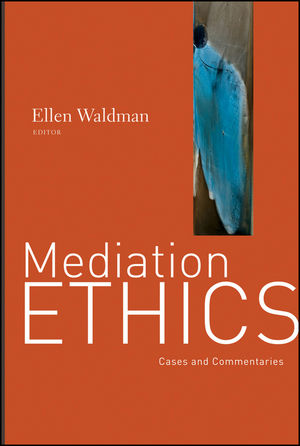
Ellen Waldman, Mediation Ethics: Cases and Commentaries 2011

Many of our readers will be familiar with Professor Waldman’s book titledMediation Ethics: Cases and Commentaries published in 2011 by Jossey-Bass. This is only the second text of which I am aware to deal exclusively with the ethical complexities of mediation practice. Waldman’s text is ground-breaking in that it adopts a case-specific problem-solving approach to the subject. (The first text was a collection of essays edited by Phyllis Bernard and Bryant Garth, titled ‘Dispute Resolution Ethics: A Comprehensive Guide’ published by the American Bar Association Section of Dispute Resolution in 2002.) According to Professor Waldman, one of the primary aims of her text is to showcase the diverse thinking in the field of mediation and to offer guidance to mediators on how to navigate the ‘murky ethical terrain’ that they are likely to encounter in practice.

waldman-ethics

There are thirteen chapters in Waldman’s text. The first, written by Professor Waldman, discusses the ‘underlying values of mediation, its regulatory codes, and emerging models of practice’. The values identified by Waldman are: disputant autonomy, procedural fairness, and substantive fairness. Each of the remaining 12 chapters deals with a particular ethical topic by using two or more case scenarios to illustrate the tension that may exist between these core values. Of continuing interest is the tension between the promotion of disputant autonomy (eg by helping disputants make informed decisions) and concern that basic norms of fairness and equity are not violated.

The case scenarios in each chapter are followed by commentaries from two (and sometimes more) leading dispute resolution scholars who explain what they would do in the circumstances presented and why. Contributors to the book are well known to us. They include:  Forrest (Woody) Mosten, Lela Love, Jacqueline Nolan-Hayley, Julie Macfarlane, Dwight Golann, Art Hinshaw, Carrie Menkel-Meadow and Harold Abramson. These commentators do not always agree on what to do. The diversity of mediation approaches is evident: facilitative, evaluative, narrative, transformative. Here Waldman is able to highlight the very different conclusions that experienced practitioners and scholars reach when analyzing what constitutes ‘right action’ in any particular mediated case. However despite these different end-points, there is a commonality in the way commentators approach problems presented in the case studies ie the authors identify the values that are important to them, the priority that they give to these values, and the action plan that they would adopt.

Mediator Responsibility and Justice

The issue of mediator responsibility for outcome fairness is a central theme tying the chapters together. In the end, Waldman’s own opinion shines through: mediators ‘ought to bear some responsibility for ensuring that mediated outcomes meet minimal standards of fairness’ though she acknowledges that the idea ‘remains controversial and has yet to gain traction’ (email with Professor Waldman dated 10 November 2016).

Professor Waldman is also very interested in the concept of justice in mediation, a topic she explores in greater depth with Dr Lola Akin Ojelabi (see Ellen Waldman and Lola Akin Ojelabi, ‘Mediators and Substantive Justice: A View from Rawls’ Original Position’ (2016) 30 Ohio State Journal on Dispute Resolution 391).

Waldman’s book is written is an accessible easy-to-read style, with mediation and conflict resolution professionals in mind. While the book will be useful for a range of people – students of dispute resolution, academics seeking inspiration for their classes, researchers and policy makers, and anyone else seeking thoughtful analysis of mediation’s many unresolved issues, the real strength of the book is in its practice orientation.


Omer Shapira, A Theory of Mediators’ Ethics: Foundations, Rationale, and Application 2016

More recently another excellent text on mediation ethics has become available that being Omer Shapira’s text entitled ‘A Theory of Mediators’ Ethics: Foundations, Rationale, and Application’ published this year by Cambridge University Press.

shapira

Many readers will be familiar with Dr Shapira’s earlier work in articles such as ‘Exploring the Concept of Power in Mediation: Mediators’ Sources of Power and Influence Tactics’ (2008-2009) 24 Ohio State Journal on Dispute Resolution 535; and ‘Joining Forces in Search for Answers: The Use of Therapeutic Jurisprudence in the Realm of Mediation Ethics’ (2008) 8 Pepperdine Dispute Resolution Law Journal 243.

A Professional Ethics Perspective

As its title suggests, in this new publication, Shapira attempts to construct a theory of mediators’ ethics – a theory he describes as ‘a professional ethics perspective’ based on role-morality and applied to a core definition of the mediator’s role. This is used as the theoretical basis for discussing and evaluating the ethical norms that govern mediators conduct, including existing codes of conduct for mediators.

Shapira argues that all mediators are placed in ethical relationships with mediation parties, the mediation profession, the public and their employers or principals and that these relationships produce certain ethical obligations. He goes on to explore the legitimate expectations of these groups and ultimately to propose a model code of conduct for mediators described as ‘a detailed set of norms of mediators’ ethics that can be rationally justified and defended with regard to mediators at large’.

This book will also be of value to ADR researchers, teachers and students, mediators and mediation participants, mediation organizations and programs, policymakers and ethical bodies.

Comparing the Books: Which is Best?

While there are practical guidelines in Shapira’s work, this is a heavy-weight text, more theory oriented than Waldman’s book, and in the end, more prescriptive in its approach. It is more about what mediators ‘ought’ to do.

Both books in their own way strive to provide guidance for mediators on how they might exercise discretion in making decisions on the many aspects of mediator conduct where there is a choice between competing values and contradictory courses of action. This is an exciting new direction for mediation professionals.

Reflective Practice in Dispute Resolution

Dr Sue Douglas‘ presentation at the Australasian Law Teacher’s Association Conference in Wellington, New Zealand in July was titled “Constructions of Reflective Practice in Dispute Resolution”. This builds upon a paper that Sue presented at the 2014 National Mediation Conference.

sue-douglas-in-nz

The research project

Sue’s project is motivated by a curiosity about what FDRPs understand to be reflective practice. This focus on practitioner views is consistent with Sue’s preference for a ground up approach to her research. Sue is interviewing FDRPs on the Sunshine Coast about their understanding of reflection and the place that reflection has in their practice.

So far, Sue has found that the practitioners have diverse perspectives and practices. Practitioners do not appear to be familiar with literature about reflection or models of reflection.When asked whether it is important that they be supported to engage with literature about reflection, Sue noted the realities of practice and her belief that the practitioner experience should be a touchstone in the development of recommendations.

The planned outcome of the research is the development of a model for reflection that practitioners will be able to use within their practice context, and which supports high quality critical reflection. The model will be informed by the literature about critical reflection as well as the practitioners’ insights gained through Sue’s empirical work.

What is already known about reflection

Critical reflection is an important activity in dispute resolution practitioner practice, as it moderates and informs decisions regarding:

  • neutrality and independence;
  • unconcious bias;
  • lack of neutrality;
  • dealing with prejudices;
  • cultural sensitivity;
  • other ethical dilemmas;
  • looking back on self; and
  • taking a broad focus upon social structures and processes.

Reflection is a well established professional activity in many professions, who have developed standards and models to guide practitioners to be reflective. It is the activity that assists professionals to perform the artistry of practice.

Reflection is not mentioned in the National Mediator Accreditation Standards, but could be viewed as a “meta-competence.” A mediator specific model of reflection that builds upon what is already known from existing models and approaches in other professions, as well as the vast literature about reflection, will be a valuable contribution to the field.